




Hindu American Foundation Calls for Unity Without Admitting Culpability in Polarizing Indian American Community

- After the Great MAGA Betrayal, HAF says that it’s open to a dialogue “grounded in mutual respect.” Seriously? There can be no meaningful engagement without mutually subscribing to a few basic values, such as commitment to civility and eschewing personal attacks.

President Trump’s recent post on truthsocial.com sharing podcaster Michael Savage’s racist remarks on India and Indian Americans has shocked and angered Indians around the world. In a rare moment of unanimity, Indian Americans of all political shades have condemned the President’s ill-considered and hurtful repost, underscoring that our shared bonds with India can transcend our political differences.
In India, there was some criticism that the Modi government hadn’t adequately defended the country’s ‘honor,’ but that conversation passed quickly. The screaming headlines in recent days have been about the electoral victory of Modi’s BJP in the state of West Bengal, which many commentators feel was made possible by the disenfranchisement of millions of legitimate voters. If this process continues, the minorities worry, it’s only a matter of time before secular India’s transformation to a majoritarian/authoritarian “Hindu Rashtra” will be complete, with one political party effectively in control.
In the U.S., the unprecedented campaign of anti-Indian hate driven by the MAGA Right continues apace, often re-triggered by a news item involving Indian Americans or an unpleasant visual coming from India.
As the Indian American community grapples with all these issues simultaneously, the Hindu American Foundation (HAF) has thrown us all a ‘curve ball’ with this long and uncharacteristically modest appeal for unity, in response to Trump’s abusive post.
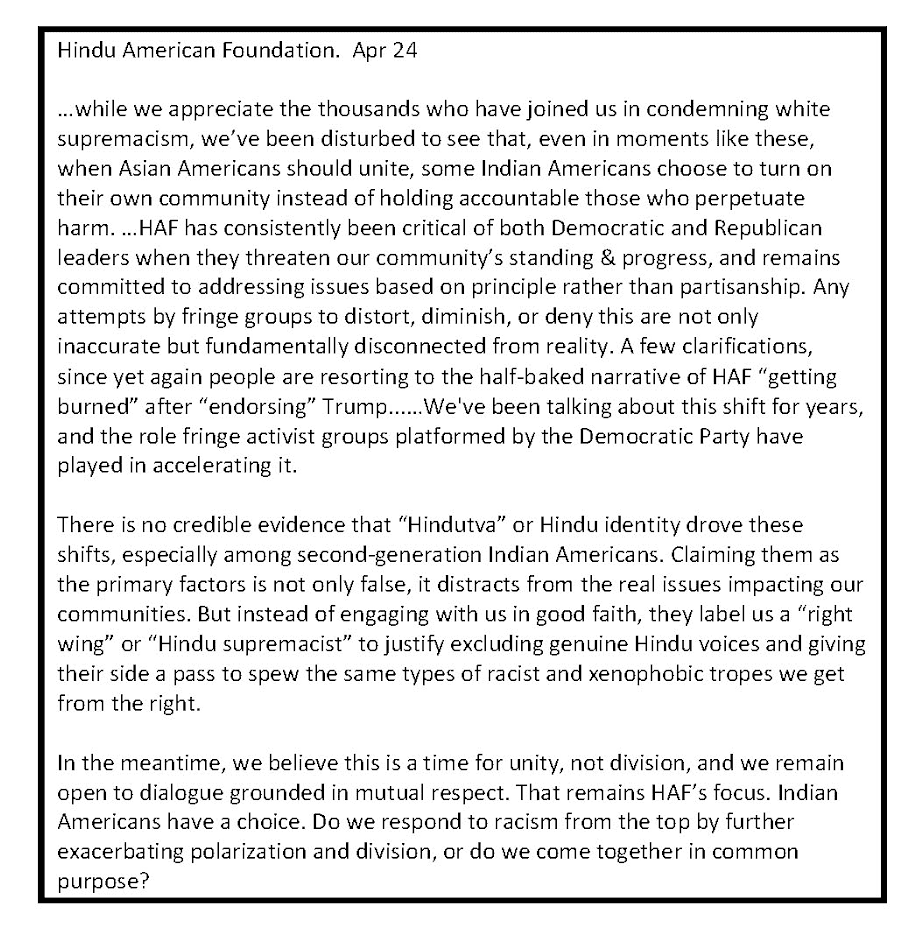
HAF’s Response to Trump, Apr 24, 2026
My initial reaction to this call for “dialogue grounded in mutual respect” was very positive, as I too have felt the dire need for such civil dialogue about issues that separate us. But I began to wonder: Was HAF actually reaching out to us, ‘lesser’ Hindus and Indians? Were they serious about engaging with the very same Indian American groups who have been its targets of derision and conspiracy theories? Is it entirely coincidental that this is coming on the heels of a major public relations blitz in the U.S. by the Rashtriya Swayamsevak Sangh (RSS), HAF’s ideological parent?
I have often stated my own belief that in the collective interests of the community, we must learn to speak face to face with others who may subscribe to a hateful ideology or hold drastically different views than us. After all, there is so much that we Indian Americans have in common that conversations on the few important issues that separate us shouldn’t be as difficult as we might imagine. The aim of such dialogue wouldn’t be to change minds, but to simply make an effort to understand each other, conscious of the fact that we face a common adversary today: White/Christian supremacy. But we need to be clear about one thing: There can be no meaningful engagement without mutually subscribing to a few basic values, such as commitment to civility and eschewing personal attacks.
That said, as I was rereading HAF’s appeal, it occurred to me that HAF may just be scrambling to adjust to a new reality on its own turf: Its raison d’etre, Hindu American advocacy, risked being overtaken by the urgency of the existential crisis in the Indian American community; and, in order to stay relevant, HAF needed to quickly find ways to purport that it’s advocating for the entire Indian American community.
But such a make-over in quick order is not going to be easy, and money can’t buy it, given HAF’s history of hostility towards other Indian American communities who have dared to challenge HAF’s divisive role in the community.
HAF Attempts a Make-over
The reality is that no one seriously believes that HAF can credibly speak for all Indian American communities. But that hasn’t stopped HAF from trying:
In some of the recent public appearances, HAF has clearly been departing from its usual Hindu American focus, to purport to speak for all Indian Americans. This was also evident in HAF’s recent appeal of the dismissal of its lawsuit against the CA Civil Rights Department (CRD), in which it claimed that the lawsuit addresses the concerns of “Hindu American, Indian American, and South Asian American communities.” This is simply not true. Quite the contrary, other than HAF, no other group is opposing the work of the CRD or trying to interfere in its important role in the state.
Perhaps, HAF’s make-over attempt was also prompted by the fact that its effort to weaponize Hinduphobia, patterned after how the Zionists have weaponized antisemitism, was flailing in the first place. And HAF is now trying to downplay the fact that Trump’s policies towards India have been a colossal letdown, especially for those who may have voted for him at the behest of HAF and its allies, in the expectation that he would treat India on favorable terms.
HAF’s unusual letter dated Nov 6th, 2024 to President-elect Trump, asking for his endorsement of its own narrow sectarian priorities, cynically referred to as “Hindu-American Project 2025,” seemed to entertain similar expectations. But since then, Trump’s India policy has turned out to be disastrous for India and an embarrassment to his Indian American donors and supporters.
HAF’s Appeal
“Blame-shifting” refers to the act of avoiding responsibility for one’s actions by placing the responsibility on someone else, often to evade consequences, avoid accountability, or preserve self-image.
“Projection” is a mechanism by which a person attributes their own feelings of guilt, shame, or wrongdoing to someone else.
I have often stated my own belief that in the collective interests of the community, we must learn to speak face to face with others who may subscribe to a hateful ideology or hold drastically different views than us.
As I said before, at first glance, HAF’s appeal for unity and dialogue “grounded in mutual respect” sounds sincere and I appreciate it. However, I find some of the assertions in the appeal deeply troubling, especially their resort to “blame-shifting” and “projection.” I think the community deserves an honest explanation of HAF’s stance on these issues, before there can be any engagement in “good faith and mutual respect.”
“Some Indian Americans choose to turn on their own community instead of holding accountable those who perpetuate harm,” alleges HAF.
Presumably, HAF is pointing at those who are speaking out against HAF and other Hindu groups like the VHPA, CoHNA, etc. But honestly, when I look at HAF’s own record, I can see several instances where HAF and its allies have actively worked against the interests of other Indian American communities. Clearly, it’s not the others who are “turning on their own community,” but it’s HAF that is resorting to blame-shifting:
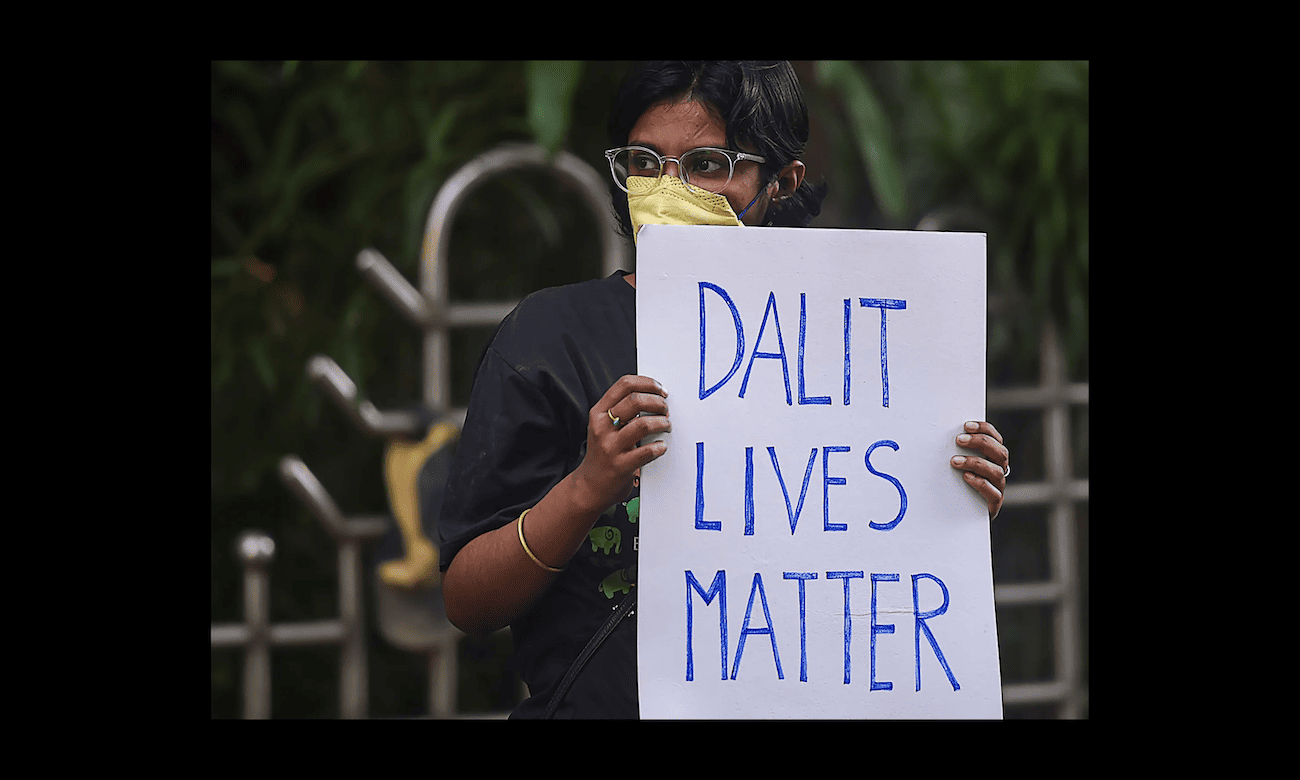
Erasing Dalit identity: HAF and its allies, such as the Hindu Education Foundation (HEF) and Oberoi Foundation, have made multiple unsuccessful attempts in the past (2006 and 2016) to erase or downplay Dalit identity in California school textbooks. Some of them have also openly expressed their hatred for Dalits, as reported in a February 2006 article in the Siliconeer: History Hungama – California Textbook Debate, by Sunaina Maira and Raja Swamy:
Kalavai Venkat, HEF (a project of Hindu Swayamsevak Sangh): “…those who call themselves ‘Dalits’ are hate-mongers and racist.”
S. Kalyanaraman, Senior Advisor to HEF: “These converts are not stupid; they are simply empowered by tainted money…Calling them ‘Dalit’ is an insult to the entire legacy of dharma.”
Today’s version of HAF’s Dalit containment strategy is to to dehumanize and intimidate prominent Dalit activists, such as Thenmozhi Sundararajan, Yashica Dutt, and others. Pointing to a handful of Dalit supporters today does not erase HAF’s transgressions in denying other people’s personal identity.
Silencing critics: HAF may have demonstrated that money can buy expensive lawyers to intimidate its detractors with frivolous lawsuits, but the ability to prove actual defamation in a courtroom is a different story. In May 2021, HAF filed a SLAPP Lawsuit against me and four of my colleagues/friends in an effort to silence us from criticizing Hindu supremacist groups and the Modi regime.
The judge dismissed the case in Dec 2022 and ruled that “…the court has reviewed the allegedly defamatory statements attributed to Defendants…and finds that HAF fails to plausibly plead that any statement made by any defendant is verifiably false. Most of the statements are clearly statements of opinions.”
This should have been the last word on the matter, but not for HAF, which continued to spread false information about the judgement and continued to vilify HfHR.
Blocking Caste Discrimination protections: HAF has been actively trying to block any effort to include caste as a specific category of discrimination in our civil rights laws. HAF’s far-fetched argument against such legal accommodation for caste discrimination is that it would unfairly target South Asians.
This is incredibly similar to claims made by Southern segregationists in 1964 against the landmark Civil Rights Act: Strom Thurmond (D-SC): “This bill, in order to bestow preferential rights on a favored few… would sacrifice the Constitutional rights of every citizen, and would concentrate in the national government arbitrary powers, unchained by laws, to suppress the liberty of all.”


It would behoove the Indian American community to remind ourselves that had lawmakers like Strom Thurmond succeeded in blocking the Civil Rights Act in 1964, this discussion about our rights and privileges in the US wouldn’t be taking place.
Opposing a bill on Transnational Repression (TNR): Following the assassination of a separatist Sikh leader in Canada in 2023, allegedly by operatives linked to the Modi government, and another attempted assassination in California, the Sikh community has been on edge. More Sikh leaders have been warned by the FBI that they may be in danger. As a result, the California legislature passed SB 509 on Transnational Repression, which was unfortunately vetoed by Gov. Newsom in Oct 2025.
Once again, HAF and its allies had actively worked against a bill by making the perverse argument that it would expose Hindu and Indian Americans to danger! It’s my view today that HAF’s opposition to the TNR bill largely serves the interests of the Indian government, not of the Indian American community.
The more I think about it, HAF’s attacks on USCIRF (US Commission on International Religious Freedom); its spirited defense of the discriminatory Citizenship Amendment Act (CAA) in India, which is an instrument to help legitimize undocumented Hindus in states like Assam, while weaponizing it to deny the same opportunity to undocumented Muslims; and its attacks on an academic conference, “Dismantling Global Hindutva (DGH),” all seemed designed to protect the interests of the Indian government more than the welfare of the Hindu/Indian American community.
I hope that HAF appreciates that it can’t expect all those who have been hurt by its trespasses of the past to ‘forget and forgive’ and engage in an open dialogue with HAF.
“Instead of engaging with us in good faith, they label us a “right wing” or “Hindu supremacist” to justify excluding genuine Hindu voices…,” complains HAF.
This is a good example of HAF projecting its own guilt upon others: The fact is, it’s not the others who’re excluding genuine Hindu voices, but it’s the HAF that has been making the claim that it speaks for all Hindu Americans, and then goes out of its way to discredit any genuine Hindu voice that opposes Hindu supremacy and the Modi government. In the case of HfHR, HAF has used every trick in its arsenal to malign us: referring to us as a ‘fringe group’ so often that people are beginning to wonder if HAF is actually threatened by HfHR. Dog whistles like, “They are not even Hindu,” captures the mean spirit of HAF’s engagement on line.
I’m not aware of any overtures from HAF to engage with us. I should know, because I originated the idea for such frank but respectful conversations in the hybrid webinar series “Desh-Videsh Conversations – Speaking across the divide.” These sessions were attended by a diverse audience, including some supporters of HAF and a past Advisory Committee member of HAF.
Finally, we can argue endlessly about what constitutes “genuine” Hindu voices. HfHR has been clear from the very beginning that it’s not for others to judge who is a Hindu and what a genuine “Hindu voice” is. It’s ultimately a person’s self-identity that matters most. In my opinion, the tendency to label and define others is the single most destructive aspect of Hindutva ideology, which HAF executes very well.
*****
HAF says in its appeal that it’s time for unity, not division, and that it remains open to dialogue grounded in mutual respect. While I have shared my misgivings about HAF’s intent, it would not be in the interest of the community to dismiss HAF’s appeal out of hand. On the other hand, HAF must accept the reality that a successful engagement requires a minimal set of values that we can agree on.
HAF can certainly contribute to the initial effort by acknowledging and stopping its attacks on organizations representing progressive Hindus, Sikhs, Muslims, Dalits, and other Indian Americans, which often deploy disinformation and fake conspiracy theories. It can also end its use of dog whistles, which almost always bring out the worst among its followers and result in personal and misogynic attacks.
I have no idea if any of the organizations that I’ve worked with, including HfHR, have any desire to engage with HAF at this point. It’s entirely up to HAF if it wants to work towards earning the trust of others, in the larger interest of the Indian American community. I broadly share the desire for unity and dialogue, and will support any effort to bring together our leaders and supporters.
Raju Rajagopal is the Cofounder, Hindus for Human Rights (HfHR) Views expressed here are personal. @raju4equality