




Sky of Hope: The British Pakistani Artist Who Designed the Most Audacious Part of the Obama Presidential Center

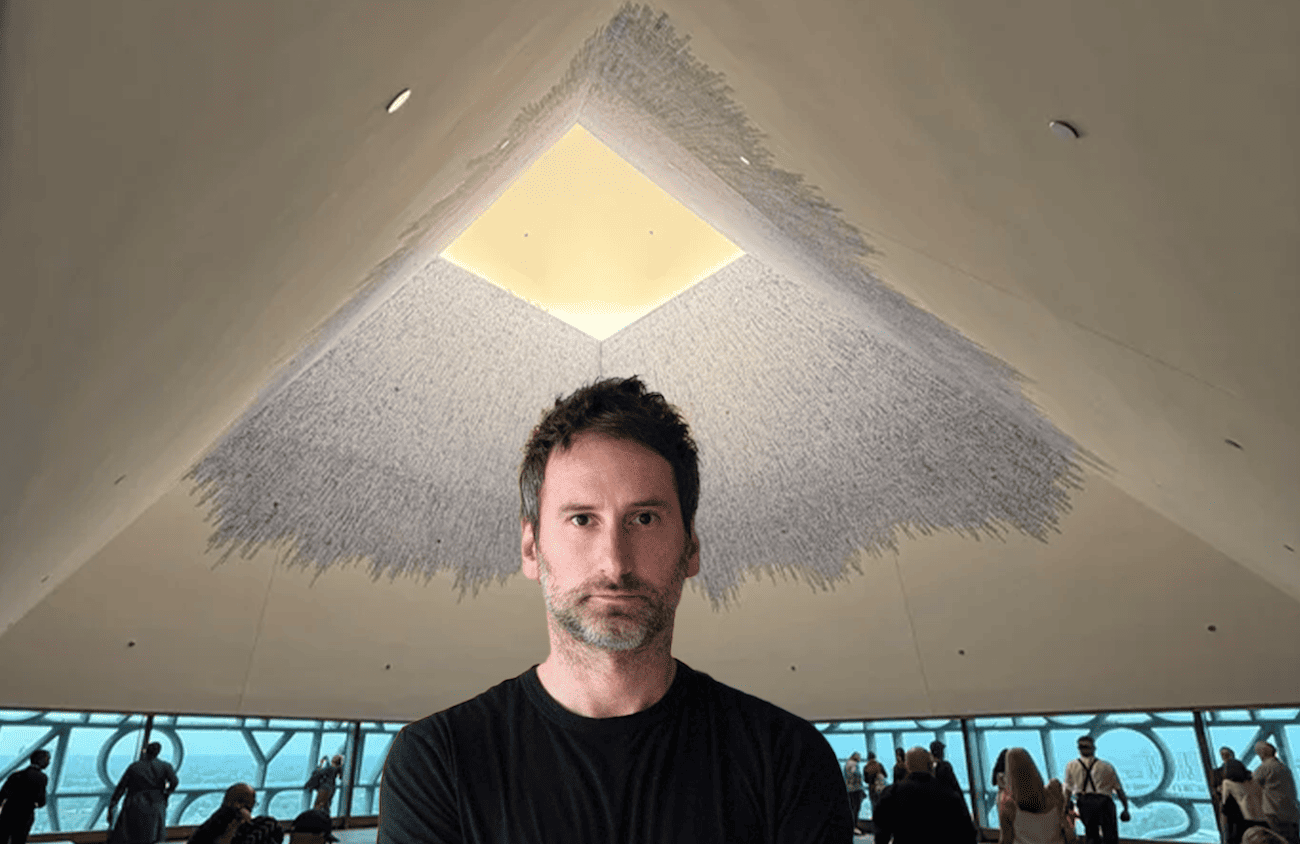
- Idris Khan, a British artist of Pakistani descent who is among the 28 commissioned for the center's landmark art program.

On June 19, 2026 — Juneteenth, the federal holiday commemorating the end of slavery in the United States — the Barack Obama Presidential Center will open its doors to the public in Jackson Park on Chicago’s South Side. The $850 million, 19.3-acre campus has been nearly a decade in the making, and its opening coincides with the 250th anniversary of American independence. It is a monument to hope, democracy, and civic participation — and running quietly through its architecture, its art collection, and its institutional history is a thread of South Asian connection that is worth tracing.
The Sky Room: Idris Khan’s Hand-Stamped Ceiling
The most visible South Asian contribution to the physical fabric of the Obama Presidential Center is also, literally, the highest: Sky of Hope, an immersive site-specific painting that fills the conical ceiling of the museum’s Sky Room on the top floor of its 225-foot tower. It was created by Idris Khan, a British artist of Pakistani descent who is, as he told Galerie Magazine in an interview published days before the opening, the only British artist among the 28 commissioned for the center’s landmark art program.
The work consists of thousands of words, hand-stamped by Khan in his signature shade of blue, drawn from President Obama’s 2015 speech marking the 50th anniversary of the voting rights marches from Selma to Montgomery, Alabama — the same text carved into the building’s exterior facade, allowing light to pass through the lettering into the interior spaces, as ArchDaily documented in its account of the campus. Radiating outward from the apex of the ceiling toward a skylight, the words create what the Obama Foundation’s official description calls “a contemplative environment inviting visitors to reflect on democracy and the power of public voice,” according to the Foundation’s art collection page.
The physical process of making the work was, by Khan’s own account, both exhilarating and punishing. Working on a scissor lift, reaching up to stamp each word individually onto the ceiling for days on end, Khan found the experience almost meditative. “It was a wonderful emotional moment, having those words in our head all that time,” he told Galerie Magazine. The physical toll was real. “My neck was killing me by the end,” he said. The results, he added, surpassed what he had imagined. “People come in and start crying,” he told Galerie Magazine.
The commission came about through the center’s curatorial team. Curator Shore, as Galerie Magazine described it, contacted Khan having concluded he would be the right artist for the museum’s highest space. Khan noted that while he frequently works with text in his pieces, “usually it’s my own poetry.” Using Obama’s Selma speech was, he said, “such a lovely idea.”
The Sky of Hope shares the Sky Room with a text-based piece by Jenny Holzer drawing from the FBI’s files on the Freedom Riders, as ArtNews documented in its September 2025 announcement of the commission. Together, the two ceiling works create what the center describes as a contemplative crown to the museum experience, accessible to all visitors and — in keeping with the center’s broader philosophy — free to enter.
Who Is Idris Khan?
Idris Khan was born on December 1, 1978, in Birmingham, England, to a Pakistani father who worked as a surgeon and a Welsh mother who was a nurse and had converted to Islam, according to the Ben Uri Research Unit and Grokipedia. He was raised in Walsall, near Birmingham, in a devout Muslim household where Islamic practices were central — including weekly Koran lessons and regular attendance at the local mosque, though Khan ceased practicing the faith at the age of 14, according to Grokipedia’s detailed biographical account. His upbringing in the multicultural West Midlands, Grokipedia noted, fostered “an early awareness of cultural intersections between Eastern and Western traditions” that has never left his work.
Idris Khan was born on December 1, 1978, in Birmingham, England, to a Pakistani father who worked as a surgeon and a Welsh mother who was a nurse and had converted to Islam.
He studied photography at the University of Derby, earning a BA with first-class honors in 2000, and completed an MFA with distinction from the Royal College of Art in London in 2004, according to the Ocula artist profile and the Ben Uri Research Unit. It was at the RCA that he developed what would become his signature practice: the dense layering of images, texts, and musical scores — pages from the Quran, Beethoven sonatas, the industrial photographs of Bernd and Hilla Becher — superimposed into abstract compositions that, as Grokipedia described them, “evoke repetition, erasure, and the passage of time.”
His career achievements are substantial. In 2017, he was appointed an Officer of the Order of the British Empire — OBE — for services to art, as Victoria Miro Gallery and the Ocula profile confirmed. In the same year, he won the American Architecture Prize for the design of Wahat Al Karama, a monument at the center of a memorial park in Abu Dhabi commemorating soldiers of the United Arab Emirates, according to the Ocula profile. In 2018, the British Museum commissioned him for its first site-specific artwork — 21 Stones — as part of the Albukhary Foundation Gallery of the Islamic World, as the Ben Uri Research Unit documented. His work is held in the permanent collections of the Solomon R. Guggenheim Museum in New York, LACMA in Los Angeles, the Saatchi Gallery in London, and the Art Gallery of New South Wales in Sydney, according to Ocula.
He lives and works in London, where he shares a studio in Stoke Newington with his wife, the British sculptor Annie Morris, with whom he has two children, according to Wikipedia.
Sky of Hope is, by any measure, the most prominent commission of Khan’s career. It places the work of a British Pakistani artist at the literal apex of a monument to American democratic aspiration — a convergence that the center’s curators clearly intended and that Khan has embraced with characteristic intensity.
The Building Itself: A Collaborative Architecture
The Obama Presidential Center’s campus was designed by Tod Williams Billie Tsien Architects — the New York firm whose principal architects are a husband-and-wife team who have spent decades building institutions that prioritize human scale and community — in collaboration with Interactive Design Architects, a Chicago-based firm, according to Wikipedia and ArchDaily. The landscape was overseen by Michael Van Valkenburgh Associates alongside the local firms Site Design Group and Living Habitats, as The Art Newspaper reported in its April 2026 account of the center’s art program.

While the principal architects of the main museum tower and campus buildings are not of South Asian origin, the collaboration with Interactive Design Architects — a Chicago firm with documented engagement with diverse communities across the South Side — reflects the center’s broader commitment to local and collaborative design practices, as ArchDaily noted.
The Home Court athletic and community facility on the campus was designed by Moody Nolan, one of the largest Black-owned architecture firms in the United States, as ArchDaily’s account of the Obama Foundation’s programming confirmed. The facility was the first structure on the campus to open, doing so in late 2025.
The Opening: A Juneteenth Homecoming
The center will open with four days of programming from June 18 through June 21, beginning with a dedication ceremony at John Lewis Plaza, as the Obama Foundation’s official announcement confirmed. The public will gain access to the museum, playground, art installations, landscaped park, and Chicago Public Library branch starting June 19.
Valerie Jarrett, who has served as CEO of the Obama Foundation since leaving the White House, has overseen the project’s decade-long development. “The opening of the Obama Presidential Center will be a beacon of hope to the world and a place where we hope guests will be inspired to bring change home to their communities,” she said in a statement published by the Archpaper. In a separate statement to Fox 32 Chicago, she described the center as being “about the everyday people who make our democracy work, not just those we see in the headlines.”
Khan’s Sky of Hope will be among the first things visitors encounter when they reach the museum’s upper floor — a ceiling full of words from a civil rights speech, hand-stamped over days by a man from Birmingham whose Pakistani father and Welsh mother gave him a life lived between cultures, and who has spent his career making art about exactly that condition: the layering of history, the collapse of time into a single moment, the words that carry the weight of everything that came before.
“It was a wonderful emotional moment,” he told Galerie Magazine, “having those words in our head all that time.”
The people who walk beneath his ceiling on Juneteenth, looking up at thousands of stamped blue words radiating from a skylight, will perhaps understand what he meant.