




Two Indian Americans, One Political Moment: Saikat Chakrabarti and Nithya Raman Test the Limits of Progressive Politics

- A Bengali American running to replace Nancy Pelosi and a Tamil American running to unseat a Los Angeles mayor are the most prominent Indian American progressives on California's June 2 ballot. Their campaigns reveal both the opportunities and the stubborn constraints facing the left wing of the Democratic Party.
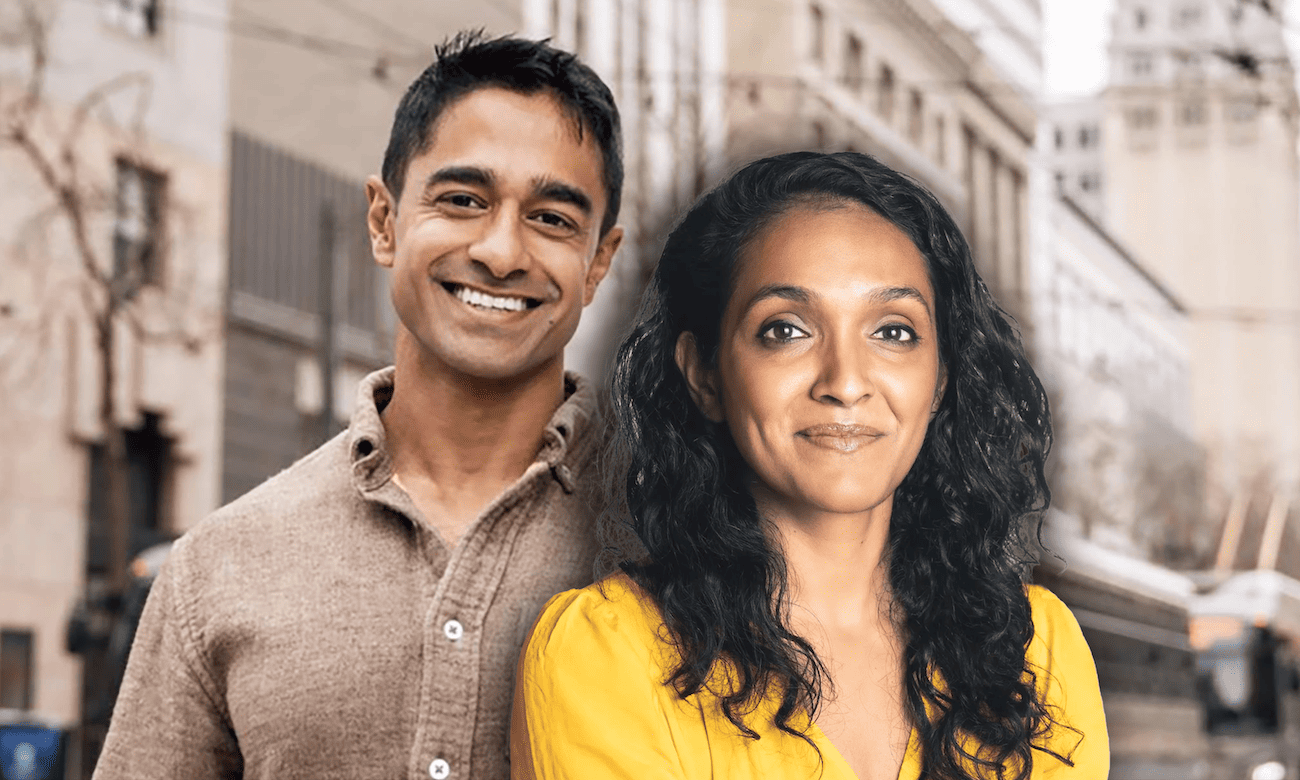

On June 2, 2026, California voters will go to the polls for what may be the most consequential primary election the state has held in years. Two races, separated by nearly 400 miles, share a striking parallel: both feature Indian American progressives challenging the established Democratic order in cities that have long defined American liberalism. In San Francisco, Saikat Chakrabarti — co-founder of Justice Democrats, architect of Alexandria Ocasio-Cortez’s 2018 insurgency, and former chief of staff to the congresswoman — is running for the seat Nancy Pelosi has held since 1987. In Los Angeles, Nithya Raman — Harvard and MIT-trained urban planner, Los Angeles City Council member, and member of the Democratic Socialists of America — is making a last-minute bid to unseat incumbent Mayor Karen Bass.
Their campaigns are structurally different, ideologically adjacent, and each illuminate a different dimension of the challenge facing American progressives in 2026: what it means to run as an outsider inside a Democratic Party that is still searching for its footing in the Trump era.
The Candidates: Parallel Origins, Different Paths
Saikat Chakrabarti was born in 1986 into a Bengali Hindu family in Fort Worth, Texas, to parents who had immigrated to New York City in 1979 from India. His father was born in Dhaka before the Partition and fled to Kolkata. Chakrabarti graduated from Harvard in 2007 with a degree in computer science, worked at Bridgewater Associates and several Silicon Valley startups, and became the second engineer at the payments company Stripe — accumulating, according to his financial disclosures as reported by Wikipedia, at least $50 million in Stripe equity. His political career began when he joined Bernie Sanders’ 2016 presidential campaign as director of organizing technology and accelerated when he co-founded Justice Democrats and recruited Ocasio-Cortez to challenge Joe Crowley in New York’s 14th congressional district. He managed her 2018 campaign, served as her chief of staff for approximately seven months, and then left to lead New Consensus, a think tank promoting the Green New Deal. He announced his candidacy for California’s 11th Congressional District — the San Francisco seat Pelosi announced she would vacate in November 2025 — in February 2025, before Pelosi had made her retirement official.
Nithya Raman was born in 1981 into a Tamil family in Kerala, India, and moved with her family to Louisiana at the age of six, according to Wikipedia. She earned her undergraduate degree in political theory from Harvard and a master’s degree in urban planning from MIT. After years in the United States, she returned to India and founded Transparent Chennai, a research organization focused on improving sanitation and urban infrastructure in Chennai. She came back to Los Angeles in 2013, worked for the city administrative officer, founded a homelessness services nonprofit, and served as executive director of Time’s Up Entertainment. In 2020, she defeated incumbent Los Angeles City Councilmember David Ryu in a race that, as LAist noted, stunned the city’s political establishment. She was re-elected in 2024. She entered the 2026 mayoral race in February 2026, just hours before the candidate filing deadline — a decision she told LAist host Larry Mantle was driven by deepening frustration with the city’s lack of preparation for the January 2025 Palisades Fire and its aftermath.
The Races: What Each Is Running Against
Chakrabarti is running in what Mission Local’s Joe Eskenazi described as a “once-in-a-generation” race: the first open contest for California’s 11th Congressional District in nearly 40 years. The district covers almost all of San Francisco, one of the most progressive jurisdictions in the country, with 40,000 registered Republicans and a population that is roughly one-third Asian American. Eleven candidates are on the ballot, but the race has consolidated around three: Chakrabarti; State Senator Scott Wiener, a prolific Sacramento legislator known for housing supply legislation who has secured the California Democratic Party’s official endorsement according to Ballotpedia; and Supervisor Connie Chan, a progressive local politician who immigrated to San Francisco’s Chinatown from Hong Kong as a child and who has built a formidable coalition of labor and civic endorsements including the California Teachers Association, National Nurses United, the San Francisco Labor Council, and the Harvey Milk LGBT Democratic Club, according to the American Prospect. California’s top-two primary system means that all candidates regardless of party appear on the same ballot, and the two highest vote-getters advance to the November general election — meaning Chakrabarti and Chan are effectively battling for the second spot behind the presumed frontrunner Wiener.
Raman is running in a far messier field. Fourteen candidates are challenging or running alongside incumbent Mayor Karen Bass, whose reelection bid has been complicated by her handling of the January 2025 Palisades Fire — she was in Ghana when the fire broke out, and her administration’s preparation and response drew sustained criticism. According to a UCLA Luskin School of Public Affairs poll reported by Fox 11 Los Angeles, Bass leads the field at 25 percent, followed by reality television personality Spencer Pratt at 11 percent and Raman at 9 percent, with 40 percent of voters still undecided. Tech entrepreneur Adam Miller, who loaned his own campaign $2.5 million according to Fox 11, and housing advocate Rae Huang round out the more prominent challengers. If no candidate clears 50 percent in the June primary — which the current polling makes almost certain — the top two finishers advance to a November runoff.
Money: The Paradoxes of Progressive Fundraising
Chakrabarti’s financial position is the most distinctive and, to his critics, the most contradictory element of his campaign. KQED reported that he donated nearly $5 million of his own money to his campaign — more than every other candidate in the race combined. At a March 31 debate hosted by KQED, Wiener did not let the irony pass unremarked. “I got my little tiny violin out,” Wiener said, as quoted by KQED, “because let’s be clear: Mr. Chakrabarti has spent more of his tech, hedge-fund money than everyone else combined, including outside campaigns.” Chakrabarti, who has pledged to take no corporate or lobbyist PAC money and has collected an array of progressive endorsements including, according to his campaign website, CAIR Action, Muslims United PAC, the US Campaign for Palestinian Rights Action, the Patriotic Millionaires, Blue America, and End Citizens United, responded at the same debate by redirecting attention to Wiener’s donor base: “Who’s funding these attack ads? They’re being funded by crypto billionaires who are Trump donors, by tech VCs,” he said, as reported by KQED.
Neither Chakrabarti nor Raman has made their Indian heritage a centerpiece of their campaigns — their pitches are rooted in policy and political positioning, not identity.
Chakrabarti’s campaign-commissioned poll, conducted by Data for Progress and released in April 2026, placed him within five points of Wiener — 33 percent for Wiener, 28 percent for Chakrabarti, 13 percent for Chan — with a four percent margin of error, as Mission Local reported. The Wiener campaign was swift to challenge the methodology: in a statement to Newsweek, the Wiener team noted that the poll excluded non-English-speaking voters, who include at least 4.5 percent of the district’s electorate and who request ballots in Chinese, and that the poll had mistakenly identified Chakrabarti as the State Senator. Mission Local also noted that Data for Progress, the pollster, had been rated C+ by statistician Nate Silver and assessed as having a slight Democratic bias. Still, the poll represented movement that Chakrabarti’s campaign has used to sustain its argument that the race is competitive.
Raman’s fundraising has been more conventionally grassroots in origin but has gained real momentum. According to Fox 11 Los Angeles, drawing on data from the Los Angeles City Ethics Commission, she raised $530,000 in direct contributions in recent campaign filings — largely from the entertainment industry — outpacing Bass in the most recent fundraising period, though Bass’s overall campaign chest of roughly $3.7 million, built over years, remains formidable. Among Raman’s donors, according to NBC Los Angeles, are Jon Favreau, the former director of speechwriting for President Obama; Mindy Kaling; Adam Scott; and Michael Schur, the creator of Parks and Recreation and Brooklyn Nine-Nine. Bass, in the most recent period after mid-April, raised $1.8 million driven by several PAC donations, according to The Real Deal.
Endorsements: Where the Left Stands — and Where It Doesn’t
On the endorsement front, the contrast between the two campaigns is instructive. Chakrabarti secured the backing of Justice Democrats — the organization he co-founded — in March 2026. His campaign website lists an array of progressive PACs and advocacy organizations, from climate groups to Palestinian rights organizations to campaign finance reform advocates. What he has conspicuously not secured is an endorsement from Ocasio-Cortez herself, despite having pegged much of his campaign to his connection to her. CNN reported that AOC had not endorsed in the race and that a person familiar with the circumstances said she was not pleased to learn from media reports rather than directly from Chakrabarti that he was running. At one campaign forum, as CNN noted, Chakrabarti referenced a time “when I was in Congress” — a characterization that drew gentle mockery given that he was a congressional staffer, not a member. The car that occasionally follows him to events with a sign reading “AOC FIRED SAIKAT” has become, as CNN reported, “a minor obsession in San Francisco political circles.”
Raman’s endorsement situation is more complex and illustrates the fragmentation of the Los Angeles left. She entered the race expecting, or at least hoping, for the support of the Democratic Socialists of America’s Los Angeles chapter, of which she is a member. DSA-LA, whose membership was split between Raman and the lesser-known progressive candidate Rae Huang, ultimately stopped short of a full endorsement — a meaningful distinction in a chapter where an endorsement comes with a serious commitment of organizing resources. Instead, as The Real Deal reported, the chapter placed a recommendation for Raman in its voter guide, a quieter form of support that nonetheless signaled a preference. Huang, speaking to The Real Deal, dismissed Raman as a neo-liberal who was “part of the establishment,” saying she did not believe Raman was “a Progressive candidate. Full stop.” The criticism is pointed coming from a fellow DSA member and speaks to the ideological terrain Raman is navigating.
Bass, meanwhile, secured the endorsement of the Los Angeles County Federation of Labor, AFL-CIO — a significant organizational asset that Raman cannot match, according to reporting from Octagon AI and Fox 11.
The Policy Arguments: Distinctive Emphases, Shared DNA
Both candidates make arguments rooted in the language of progressive governance, but their specific policy pitches reflect the distinct challenges of the offices they seek.
Chakrabarti, whose campaign website lists Medicare for All, affordable housing, political reform, and clean energy as his central commitments, frames his candidacy explicitly as a project of party renewal. He told Newsweek, “The one thing people don’t like more than Donald Trump is a feckless and ineffective leadership in the party.” He has also described himself as inspired by the model of Representative Ro Khanna of California, who used media attention around the Jeffrey Epstein files to build nearly unanimous congressional support for the release of DOJ records, as CNN reported — suggesting an interest in the politics of spectacle as leverage for legislative outcomes. His pledge to accept no corporate or lobbyist PAC money is central to his identity in the race and sets him apart from Wiener, who has received support from the tech and crypto donor ecosystem.


Raman’s policy arguments are more specific to Los Angeles’s immediate crises. In her LAist interview, she described the city’s lack of preparation for the Palisades Fire as the precipitating frustration behind her candidacy, and was candid about her evolution on housing policy — having supported Measure ULA, the city’s mansion tax that generates revenue for affordable housing construction, while also being the only council member to publicly argue for reforming it to exempt new multifamily construction. “I took a lot of heat for that,” she told LAist, “and I think that’s just one of a few different instances where I have been able to stand up and be that independent voice and look at the data and really try and legislate on behalf of the entire city.” She has also been critical of Mayor Bass’s removal of her from the South Coast Air Quality Management District Board shortly before she declared her candidacy — a move that environmental activists, as Wikipedia noted, speculated was related to Raman’s push for more aggressive environmental enforcement.
The Common Vulnerabilities
Both campaigns carry structural vulnerabilities that their opponents have not been shy about exploiting.
Chakrabarti’s most persistent problem is his lack of deep roots in San Francisco. As Mission Local noted, he joined the race with “little to no name recognition in San Francisco, compared to the other two leading candidates, Wiener and Chan, both longtime politicians.” He grew up in Texas, attended college in Massachusetts, and worked in Silicon Valley before settling in San Francisco. His self-funding at a scale that dwarfs all other candidates has provided him with visibility but also feeds a narrative, advanced most pointedly by Chan’s campaign as quoted by KQED, that he is “trying to cover up the skeletons in his closet from his six months in D.C.” The question of why his tenure as AOC’s chief of staff lasted only approximately seven months — Chakrabarti told CNN it was a planned transition because he had a daughter on the way, though he did not dispute that Ocasio-Cortez accepted his resignation when he offered it — has become a persistent subtext in the race.
Raman’s principal challenge is timing and proximity to power. As LAist’s Mantle noted, he had not seen “a candidate come in just the day before the closing of a race” who was as prominent as a sitting city council member. She entered with no time to build traditional organizing infrastructure, relies heavily on name recognition from her council work and a donor network built largely through entertainment industry connections, and is running against an incumbent who, for all her political difficulties, retains the advantages of office and organizational endorsements. Her positioning as a progressive challenger is also complicated by the argument from her left — represented by Huang and the DSA debate over her record — that she is not progressive enough, even as Bass’s supporters characterize her as too far left for the city’s centrist majority.
What These Campaigns Reveal
Together, Chakrabarti and Raman represent something instructive about the state of Indian American progressive politics in 2026. Both are highly credentialed, both are running explicitly against Democratic Party establishment figures or norms, and both are doing so in cities where the Democratic majority is so overwhelming that the real question is not whether a Democrat wins but what kind of Democrat prevails.
The parallel also highlights the demographic moment. Neither Chakrabarti nor Raman has made their Indian heritage a centerpiece of their campaigns — their pitches are rooted in policy and political positioning, not identity. Yet both would make history: Chakrabarti would be the first Indian American to represent California’s 11th, and Raman would be the first woman and first person of color to serve as mayor of Los Angeles.
Whether either clears the June 2 threshold to advance further will say something significant about how far the progressive movement has traveled — and how far it still has to go — in two of America’s most influential cities.