




The American Empire Attempts to Narrate its Own Fragmentation: A Post-Mortem of Western Strategic Solipsism

- When we look back on this era a century from now, the verdict will belong to those structural thinkers who understood that the ultimate shield of any civilization is the educated, disciplined, and sovereign capability of its people.
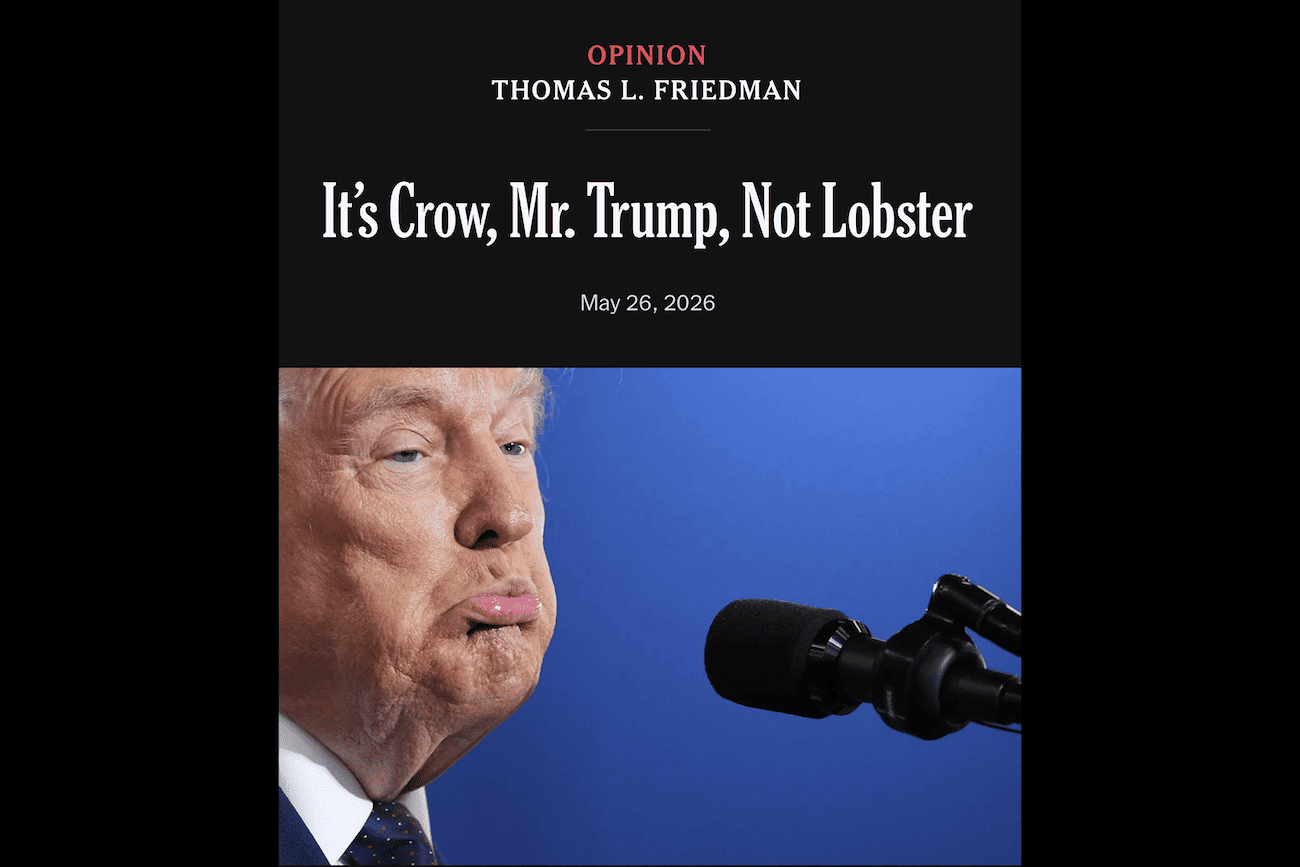

The commentary surrounding the global standoff over Iran’s nuclear program—exemplified by the standard, high-velocity op-ed of a prominent American foreign policy columnist—reveals a profound and recurring pathology in contemporary Western strategic thought.
It is a pathology that mistakes the visible actor for the invisible architecture, treats geopolitical tantrums as a substitute for structural design, and evaluates deep civilizational collisions using the vocabulary of a high-end restaurant menu.
When a columnist bases an entire foreign policy critique on whether a political leader must eat a “plate of crow” or pretend it is “filet mignon,” they are doing something far more insidious than merely deploying a colorful metaphor. They are reducing the existential question of state survival, global equity, and asymmetric conflict into a localized domestic performance. This intellectual framework relies on a series of unverified, transactional assumptions that treat sovereign nations as passive variables to be managed by the economic and kinetic levers of a single hegemon.
To confront this view effectively, one cannot merely dispute its tactical conclusions; one must dismantle the entire strategic and moral foundation that permits such commentary any space at all. We must replace this transactional solipsism with a credible, rigorous, and structural alternative—one that accounts for the architecture of governance, the permanence of human capital, and the unyielding logic of platform sovereignty.
I. The Strategic Fallacies of the Transactional Matrix
The analytical fragility of this mode of commentary becomes obvious the moment its core claims are isolated from their stylistic flourishes. The entire thesis rests upon five unverified assumptions that crumble under serious historic and institutional scrutiny.
1. The Myth of the Linear Deal
The transactional commentator assumes that complex, multi-layered international standoffs can be toggled on and off like a light switch via a “deal.” This perspective treats the surrender of near-weapons-grade uranium as a self-contained transaction, entirely separate from the deeply embedded systemic distrust generated when the United States unilaterally dismantled the Joint Comprehensive Plan of Action in 2018. In the structural reality of foreign policy, trust is an institutional asset; once liquidated, it cannot be reacquired through a simple transactional off-ramp. To pretend otherwise is not realism—it is retail thinking applied to civilizational stakes.
2. The Fallacy of Tactical Stasis
The closure of the Strait of Hormuz by cheap drones is treated as a sudden, permanent shock that has “now, and forever” granted Iran an unmitigated veto over the global economy. This view isolates a temporary tactical asymmetry and freezes it in time—assuming that state actors and the global naval architectures that protect trade corridors possess zero capacity to adapt, counter, or re-engineer their defensive postures. It mistakes a momentary tactical punctuation for a permanent strategic law. History does not offer that warranty.
3. The Assumption of Absolute Scenario Erasure
The assertion that the national security apparatus of a global superpower engaged in zero scenario planning—blindly relying on external foreign intelligence promises—is an unverified assumption designed to serve a partisan narrative rather than capture institutional reality. While executive leadership may exhibit reckless hubris, the deep repositories of state capability—military institutions, intelligence architectures, war-game divisions—model asymmetric retaliation as a matter of professional obligation. Conflating presidential performance with institutional failure is a category error that flatters the columnist’s indignation at the expense of analytical integrity.
4. The Illusion of Causal Simplism
Sanctions relief, we are told, will automatically provide a “huge injection of cash” that the regime can instantly deploy to “buy off or continue to repress” its populace. This mechanical, predictable relationship between cash flow and societal control ignores the reality of internal economic rot, structural governance failure, and the complex sociology of domestic resistance. Cash alone cannot stitch together a frayed social contract when the underlying institutional legitimacy has dissolved. The Islamic Republic’s crisis is not a liquidity problem. It is a legitimacy problem—and those two diagnoses require entirely different medicine.
5. The Equated Identity of Rhetoric and Policy
By constructing an entire sub-argument around a volatile social media post—demanding the mandatory expansion of the Abraham Accords to nations like Pakistan or Turkey—the transactional commentator assumes that erratic public posturing is identical to operational statecraft. This conflation elevates political theater into formal strategic doctrine, ignoring the quiet, institutional channels where foreign policy is actually designed, negotiated, and executed. Statecraft has always had two registers: the one performed for the crowd, and the one built for the archive. Confusing the two is not analysis—it is audience capture.
The visceral condemnation of Iran as a “vile, murderous regime”—juxtaposed against silence on other nuclear actors—exposes the profound double standard embedded within the current global order.
II. The Asymmetry of the Rules-Based Order
The visceral condemnation of Iran as a “vile, murderous regime”—juxtaposed against silence on other nuclear actors—exposes the profound double standard embedded within the current global order. When we strip away the selective legalities of the Non-Proliferation Treaty, an objective, uniform index of nuclear risk reveals a vastly different reality than the one presented in mainstream Western commentary.
If we evaluate nuclear-armed nations by a uniform standard—measuring Doctrine Stability (the threshold for pre-emptive use), Institutional Transparency (the presence of stable command and control), and Brinkmanship (the willingness to weaponize instability)—the traditional Western hierarchy of “rogue states” collapses entirely.
North Korea features a doctrine profile built on a pre-emptive strike constitutional mandate, combined with absolute autocratic centralization; its primary systemic risk vector remains technology proliferation.
Pakistan operates on a doctrine of tactical battlefield low-yield deployment within a fractured civil-military command, making its internal infrastructure extensively fragile against sabotage. Russia utilizes escalatory nuclear coercion while lowering its retaliation threshold, driven by de-institutionalized executive power that has caused strategic guardrails to collapse. Israel maintains total opacity—the policy of amimut (deliberate nuclear ambiguity)—with unverified existential redlines completely outside treaty verification, acting as a permanent regional escalation trigger.
The United States itself holds a unilateral presidential launch mandate with highly dispersed tactical storage across the globe, creating a unique risk profile for footprint miscalculation.
Under this uniform framework, the profound hypocrisy of the transactional paradigm stands exposed. Iran—a nation that historically submitted to the most intrusive, verifiable, and comprehensive multilateral inspection framework ever negotiated under the JCPOA—is targeted with total economic blockade and kinetic destruction. Meanwhile, nations that explicitly chose to remain outside the NPT framework, maintaining uninspected military nuclear complexes and expanding low-yield tactical arsenals, are integrated into global supply chains and aided militarily by the global superpower.
This reveals that the designation of a “rogue state” in modern journalism has little to do with an objective metric of human casualties or adherence to international verification. It is an ideological label applied to non-nuclear nations that attempt to challenge or rewrite the regional balance of power within critical economic corridors. The superpower targets the defiance, not the weapon. The label follows the geometry of interest, not the grammar of law.
III. The Alternative Paradigm: A Design of Capability and Dignity
The transactional worldview does not merely misread the present — it forecloses the future. Its deepest failure is not analytical but architectural: it offers no vocabulary for what nations actually need in order to become resilient, sovereign, and free from the disciplinary cycles of external pressure. That vocabulary must be built from different materials entirely.
Nations do not achieve durable stability through the choreography of transactional deals or the short-term manipulation of sanctions. True national capability is accumulated quietly, structurally, and from the ground up — determined not by a country’s current GDP or its proximity to the favor of a global hegemon, but by the tensile strength of its internal institutional design.


1. The Principle of Structural Sovereignty
True sovereignty in the twenty-first century is no longer just a matter of drawing borders on a map or maintaining a conventional military. It requires complete ownership over the systemic platforms of the modern era: digital public goods, regulatory frameworks, and indigenous technological infrastructure. When a state allows its media, its educational data, or its financial transactions to be mediated by external, centralized monopolies, it forfeits its independence by another name. A nation must build its own platforms to shield itself from the erratic whims of external superpowers who weaponize connectivity to enforce compliance. Sovereignty today is not declared in constitutions. It is demonstrated in code, in data architecture, and in the refusal to outsource the nervous system of the state.
2. The “Full Plate” of Human Capital
As observed in developmental ecosystems across the Global South, true national transformation cannot be engineered from above through top-down policy directives or flashy technological interventions. Dropping hardware or capital into an institutional vacuum does not create progress; it creates waste—sometimes spectacular, internationally celebrated waste.
A sustainable national architecture requires a complete, non-negotiable ecosystem of human capital—what development practitioners have come to call the “Full Plate” framework. The metaphor is precise and deliberately unflashy: just as a full meal requires a balanced alignment of core ingredients, a functioning society requires engaged local institutions that meet citizens at their current baseline of capability; the patient, decentralized development of grassroots talent; and the absolute rejection of the false binary between global scale and local human dignity. Technology and capital are merely the salt—they enhance the underlying system, but they can never be the meal itself.
The distinction matters for geopolitics precisely because it dismantles the sanctions logic at its root. Economic pressure—the West’s preferred instrument of civilizational discipline—operates on the assumption that states are hollow vessels whose behavior can be altered by adjusting the flow of external resources. But nations built on a Full Plate architecture are not hollow. They have internal metabolisms. They generate capability endogenously. They absorb shocks rather than collapse under them. The history of Iran’s indigenous missile program, its domestic pharmaceutical industry, and its parallel financial networks—all constructed under maximum economic pressure—demonstrates exactly this metabolic resilience. Sanctions, in such cases, do not produce compliance. They produce adaptation, and occasionally, defiant mastery.
South Korea historically demonstrated how investing in a complete, self-sustaining educational and institutional ecosystem can transform a resource-scarce geography into a global pillar of technological leadership. This is the only long-term strategy a country truly possesses. Everything else—trade deals, tactical military alliances, economic sanctions—is transient noise in the frequency of centuries.
IV. The Post-Colonial Verdict
The commentary this essay has interrogated represents something more than a single columnist’s blind spot. It represents the dying grammar of a centralized, media-driven world order that views the Global South as an arena for tactical discipline rather than a collection of sovereign civilizations with their own legitimate calculus of survival. By reducing the structural failures of Western intervention to a debate over whether a president is eating “crow or filet mignon,” this school of journalism confesses its own intellectual bankruptcy. It exposes a profound inability to look past the immediate news cycle and comprehend the deeper currents of history.
The deeper current is this: the age of unipolar narrative—in which one civilization’s strategic preferences were laundered as universal law—is ending. Not because of Iranian drones, or Russian coercion, or Chinese manufacturing supremacy. It is ending because the intellectual architecture that sustained it has been exposed as selective, self-serving, and structurally incapable of accounting for the agency of the majority of the world’s population. When the explanatory framework of the powerful can no longer explain the behavior of the many, the framework itself becomes the crisis.
The future of the global balance of power will not be determined by the shallow transactions negotiated across a bar, or the asymmetric drone skirmishes in the shipping lanes of the Gulf. It will be decided in the quiet, persistent laboratories of institutional construction. It will be won by the nations that focus their collective imagination on expanding the dignity, capability, and opportunity of their citizens from the bottom up—nations that understand that the most durable geopolitical asset is not a missile or a sanction, but a generation educated into sovereign confidence.
When we look back on this era a century from now, the viral op-eds of the day will be forgotten as mere ephemera—the superficial noise of an empire attempting to narrate its own fragmentation. The historical verdict will belong instead to those structural thinkers who understood that true development is the expansion of human freedom, and that the ultimate shield of any civilization is the educated, disciplined, and sovereign capability of its people.
The transactional screen was always an illusion. What lies behind it—patient, structural, and deeply human—has always been the only thing that was real.
Satish Jha, former Editor, Indian Express Group and The Times of India Group writes on geopolitics, international affairs, and development.