




Trump’s Grammar: How He has Recoded the Rules of Power, How it is Asserted, Contested, and Made Real

- His true measure is not policy. It is alteration. He did not lower the bar of political speech. He relocated the entire field — shifted the coordinates so that what was once the fringe is now the center.

“The limits of my language mean the limits of my world.” — Ludwig Wittgenstein
In the second presidential debate of October 2016, Hillary Clinton spent four minutes explaining her position on Syrian safe zones — the humanitarian calculus, the no-fly-zone logistics, the Russian entanglement. Trump waited. Then, when the microphone returned to him, he said: “She doesn’t have a clue.”
Four words. The audience stirred. Clinton’s four minutes dissolved. This was not accident. This was not even instinct. This was method — refined across decades of tabloid combat, boardroom theater, and reality television — arriving, in that moment, at its fullest expression. Clinton had attempted to govern the room with information. Trump had erased the room and built a new one, with himself as the only fixed point.
There are leaders who inherit institutions. There are those who rewrite their grammar. Donald Trump belongs to the second kind.
Over more than a decade, he has recoded the rules of power itself: how it is asserted, contested, and made real. In his grammar, brevity defeats argument. Assertion crushes evidence. Naming is conquest.
Once reduced and named, anything can be moved — or destroyed. His language is not chaotic. It is ruthlessly disciplined. It flattens complexity before it can breathe. It turns people into symbols, symbols into targets. Ally or enemy. Strong or weak. Winner or loser. The map becomes brutally simple.
Naming is the core weapon. “Crooked Hillary.” “Sleepy Joe.” “Little Marco.” “The enemy within.” These are not insults. They are verdicts. A name fixes identity, strips context, and makes the target portable. Repetition then hammers it into truth — not by persuasion but by sheer volumetric pressure, the way water, repeated long enough against stone, does not argue its way through but simply goes.
Studies confirm the method: Trump’s speeches sit at a fourth-to-sixth-grade reading level, violent words have nearly tripled across his public addresses since 2015, and the structural signature — short burst, superlative, short burst, superlative — has remained so consistent across three decades that linguists now treat it as a stable idiolect, the way ornithologists identify a bird not by a single call but by the invariant pattern of calls, a grammar so fixed it persists regardless of subject, regardless of audience, regardless of whether the topic is a trade war with China or a dead woman on a golf course in Scotland — the vessel changes, the cadence never does, because the cadence is not a style but a mechanism, and mechanisms do not require inspiration to function. He does not debate reality. He overwrites it.
This is why his comments on nations and leaders — from Xi to Modi — are no accidents. The world, in his rendering, is not a negotiation table. It is a hierarchy to be declared. Words do not invite dialogue. They foreclose it.
This is why his comments on nations and leaders — from Xi to Modi — are no accidents. The world, in his rendering, is not a negotiation table. It is a hierarchy to be declared. Words do not invite dialogue. They foreclose it.
Yet his rise was no accident either. It answered a deep exhaustion. Institutions spoke in long paragraphs but seemed deaf to real pain. Expertise accumulated credentials and produced stagnation. Others qualified and deferred. Trump declared and confronted.
What looked like chaos to elites felt like clarity to millions — and that asymmetry of perception is itself the most important political fact of the last decade, more important than any single policy or scandal, because it reveals that the population and its interpreters had ceased to inhabit the same emotional reality.
His authenticity is compression: depth sacrificed for raw impact. It matches the age perfectly. Algorithms reward velocity. Velocity favors force. The method is now locked: reduction, naming, repetition, amplification. Targets change. The structure never does. Conflict is fuel. Attention must be fed.
The presidency has changed shape in his hands. Restraint gave way to endless assertion. Norms became props to smash, their fragility — which we had mistaken for solidity — revealed only in the breaking. Normalization came through exhaustion, not agreement: a population worn down not by conviction but by the sheer metabolic cost of sustained outrage. The costs are real and compounding.
Disagreement curdles into enmity. Institutions bleed legitimacy in increments too small to constitute a crisis but too persistent to permit recovery. Diplomacy strains under the weight of a leader for whom unpredictability is not a failure of nerve but a deliberate tactic — the threat value of the irrational actor, borrowed from game theory and deployed as temperament.
The public square shrinks into an arena, and arenas have only two kinds of participants: combatants and spectators. But the appeal endures for the same reason. In uncertain times, his grammar delivers certainty, force, and speed. It simplifies. And in simplifying, it binds loyalty — not the loyalty of agreement, which is fragile and conditional, but the loyalty of shared enemy, which is nearly indestructible.
I will say what most analysts avoid: there is something clarifying about watching this happen, even from a position of alarm. The long consensus that liberal democratic norms were self-sustaining — that they required no active defense because they were simply what modernity looked like — was always a comfortable illusion.


Trump did not create the vulnerabilities he exploited. He illuminated them, with a cruelty that functions, despite itself, as a kind of civic education. We now know which walls were load-bearing and which were decorative. That knowledge, purchased at enormous cost, is not nothing.
Picture a map redrawn not by geography or history, but by thick, repeated labels stamped across the terrain. Cities vanish beneath the stamps. Rivers reroute themselves around the verdicts. The label becomes the land — and the land, once renamed, becomes someone else’s sovereign territory. FAKE. CROOKED. ENEMY. WITCH HUNT. RADICAL LEFT.
Trump is no freak of history. He is the loudest, most disciplined voice of tensions America has long carried: deliberation versus spectacle, patience versus raw impatience, the paragraph versus the tweet. He gave an old hunger a new, digital tongue — and the tongue, it turns out, was faster than the hunger it was meant to express.
Future leaders will inherit more than the office. They will inherit this grammar. They may fight it, adapt it, or surrender to it. They cannot unlearn it, because the population has already learned it with them — has learned, at a cellular level, that the sentence fragment lands harder than the subordinate clause, that the nickname outlasts the biography, that the man who controls the label controls the landscape.
His true measure is not policy. It is alteration. He did not lower the bar of political speech. He relocated the entire field — shifted the coordinates so that what was once the fringe is now the center, and the center, careful and qualified and evidence-laden, now reads as evasion.
He made language faster than thought. Force now outruns meaning. Repetition rivals evidence. Description replaces reality. Others spoke to lead. He speaks to decide what can be said at all. Donald Trump turned language into terrain. Power became the right to name — and rename — everything. And in that difference, an age finds its grammar. The portrait stays open. The project continues.
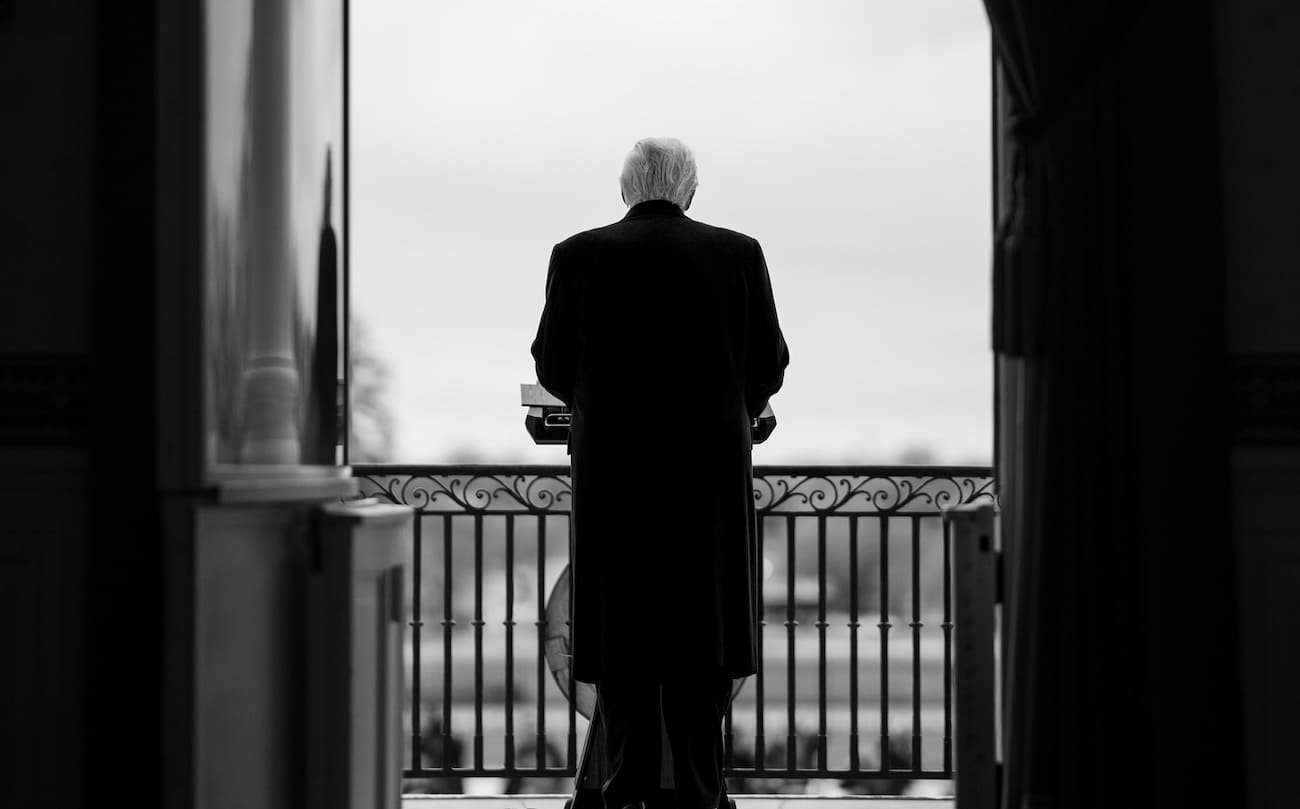
Top image: Courtesy of the White House.
(Boston based strategic analyst Satish Jha is a former Editor of newsweekly Dinamaan of The Times of India Group)