




Usha Vance Calmly Guides Trump Back Toward Book Reading After Each Extended Digression On Her Children’s Podcast

- The president pre-taped a special Fourth of July episode of "Storytime with the Second Lady" in the Oval Office — meant to encourage children to read. What followed was a tour through American history filtered entirely through the Trump lens, complete with jabs at Obama, Nixon, and William Howard Taft.
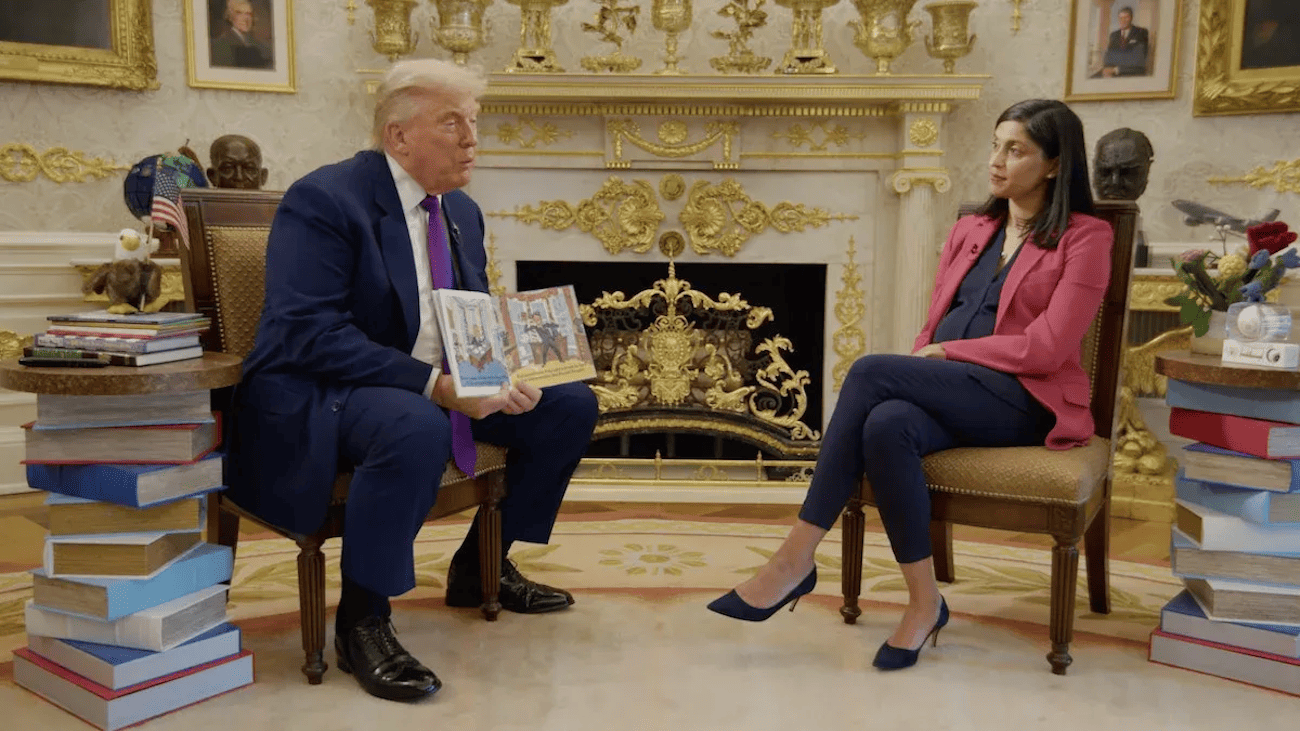

The premise was simple, wholesome, and distinctly American. Usha Vance — the Yale Law-educated second lady, daughter of Indian immigrants from Andhra Pradesh, and wife of Vice President JD Vance — has built a quiet reputation since January 2025 through her podcast “Storytime with the Second Lady,” a children’s literacy initiative in which guests read picture books aloud to young audiences. For a special episode timed to the Fourth of July and the nation’s 250th anniversary, she invited the most famous man in American politics to sit across from her in the Oval Office and read a book.
The book was “Presidents Play!” — a White House Historical Association children’s title featuring colorful illustrations of former presidents enjoying sports, leisure, and recreation on the White House grounds. The occasion was intended, as the Associated Press reported, to motivate children to read more and to celebrate America’s semiquincentennial.
What followed, when the episode was posted online on July 3, 2026, was something else entirely — a rolling monologue that veered between self-promotion, presidential history filtered through personal grievance, gentle self-deprecation about his weight, and a surprising moment of unscripted candor about the state of the nation. It was, as HuffPost described it, “peak Trump.”
The Oval Office, Decorated for the Occasion
The episode was pre-taped in mid-June in the White House’s Oval Office, according to the Associated Press’s reporting by Michelle L. Price. For the occasion, the room’s abundant gold accents — installed by Trump in keeping with the aesthetic preferences he has applied to the space — were supplemented with a bald eagle stuffed animal, tables made from stacks of oversized books, and a globe constructed from Legos, according to the Associated Press and PBS NewsHour. The combination of Trump’s own decorative sensibility and the children’s-programming staging created a visual incongruity that was, in its way, entirely fitting.
Usha Vance, whose own measured and quietly composed public presence has made her one of the more distinctive figures in the current administration’s constellation of family members, welcomed the president as her guest. Vice President JD Vance, for his part, promoted the episode in advance on X. “One of my favorite episodes so far,” he wrote, as HuffPost reported.
Page by Page: A Tour Through American History, Trump-Style
As he turned through the pages of “Presidents Play!” — a book designed to introduce young readers to the ways America’s leaders have relaxed and exercised on the White House grounds — Trump offered a running commentary that departed almost immediately from what the book itself contained.
When Usha Vance asked whether he finds much time to read for pleasure while serving as president, he answered without hesitation: “I usually read stories about myself.” He then clarified that he mostly reads newspapers.
The book’s pages prompted a parade of unsolicited assessments of his predecessors.
On Lyndon Johnson, he was characteristically blunt: “tough cookie.”
On Ronald Reagan, he was warmer: “a high-quality person” and, in a phrase that carried a certain wistfulness, “like your father was president.”
The episode represents the highest-profile guest yet on “Storytime with the Second Lady,” a podcast that Usha Vance has built quietly alongside her responsibilities as second lady.
On John F. Kennedy, Trump offered what he apparently considered a compliment: “the second-most good-looking president.” He left unresolved the question of which president he believed occupied the top position on that particular ranking.
On Richard Nixon — depicted in the book, Trump noted, before observing that Nixon “got himself into trouble, I guess” — he was understated. The observation, to the extent it contained implicit sympathy, was the closest thing in the episode to historical generosity.
On Barack Obama, he was less restrained. Referring to Obama by his full name — “Barack Hussein Obama” — Trump said he doubted Obama was a good basketball player. He then volunteered that Obama’s favorite sport is actually golf, before adding: “He won’t be in the Masters anytime soon.” The remark appeared to be a reference to the Masters Tournament, the professional golf major held annually at Augusta National in Georgia.
A page depicting a drawing of Bill Clinton jogging on the White House track prompted a simple reaction: “I don’t think I’ll ever do that,” Trump said.
Abraham Lincoln on horseback gave Trump pause in a different direction — toward aspiration rather than dismissal. “That’s great. I’d like to ride horses, too,” he said. He then reflected briefly on the dangers of equestrian activity. “When you fall off a horse… I’ve seen too many things happen. Falling off horses is not good.” His proposed solution: “A nice old horse that’s extremely slow, lazy” that he would “maybe ride.”
A picture of John Quincy Adams swimming in what was then the Tiber Creek prompted Trump to redirect to a current project: “I think we’re building a beautiful ballroom on top of it,” he said, referring to the construction of a White House ballroom he has championed.
Gerald Ford swimming in a pool gave Trump his most self-aware moment of the episode. “I don’t know if I look good in a bathing suit,” he reflected. “I haven’t had a bathing suit in a long time,” he said.

William Howard Taft — described in the book as the heaviest president in American history — prompted Trump’s most carefully calibrated self-commentary of the recording. “I have to be careful, because I don’t want to supersede his record,” Trump said. “And a thing like that would be possible if I allowed it to happen. For all of you out there watching, keep yourself in good shape.”
A page featuring Dwight Eisenhower and a putting green on the South Lawn provided an opportunity for Trump to address a question the episode had not raised. “I’ve never used it,” he said of the putting green, “because I don’t want to be seen putting at the White House. I want to be seen working at the White House.”
The Literacy Mission — and One Unscripted Moment
When Usha Vance asked her guest, at the episode’s conclusion, what advice he would give to children about why they should celebrate their country on July 4th, the response was notably less sharp-edged than what had preceded it — and unexpectedly revealing.
“We have a great country,” Trump said. “We have a country that, it’s on a little bit of a ledge right now. It can go one way or another, you understand that. But we’re going to make it go the other. And we’re going to make America greater than ever before.”
The remark — addressed to a children’s audience in the context of a Fourth of July literacy podcast — was, as the Associated Press noted, “a somewhat cloudy message.” It was also, by the standards of political communication aimed at children, unusually candid: an acknowledgment, from the president of the United States, that the nation he leads exists in a condition of genuine precariousness.
Whether that candor was intentional or incidental is a question the episode’s format — a children’s picture book reading in a gold-accented Oval Office decorated with Lego globes and stuffed bald eagles — was not designed to answer.
Usha Vance and the Platform She Has Built
The episode represents the highest-profile guest yet on “Storytime with the Second Lady,” a podcast that Usha Vance has built quietly alongside her responsibilities as second lady. The show’s premise — inviting guests to read picture books aloud to children — is a deliberate and consistent literacy advocacy initiative, and its booking of the sitting president for a special America250 episode reflects both Vance’s access to the administration’s inner circle and her own public profile’s quiet growth over the past 18 months.
That composure was on display in the episode, as she guided her guest back toward the book after each extended digression — a task that required, by any observer’s reckoning, significant patience. JD Vance, watching from outside the room, called it one of his favorite episodes of the podcast.