




Under Scrutiny: The Alzheimer’s Drug That Made Vivek Ramaswamy Rich — And His Mother’s Role in It

- Geetha Ramaswamy's specific role is a genuinely new detail, first reported this week, and one that has not yet been corroborated by an outlet independent of the original investigation.
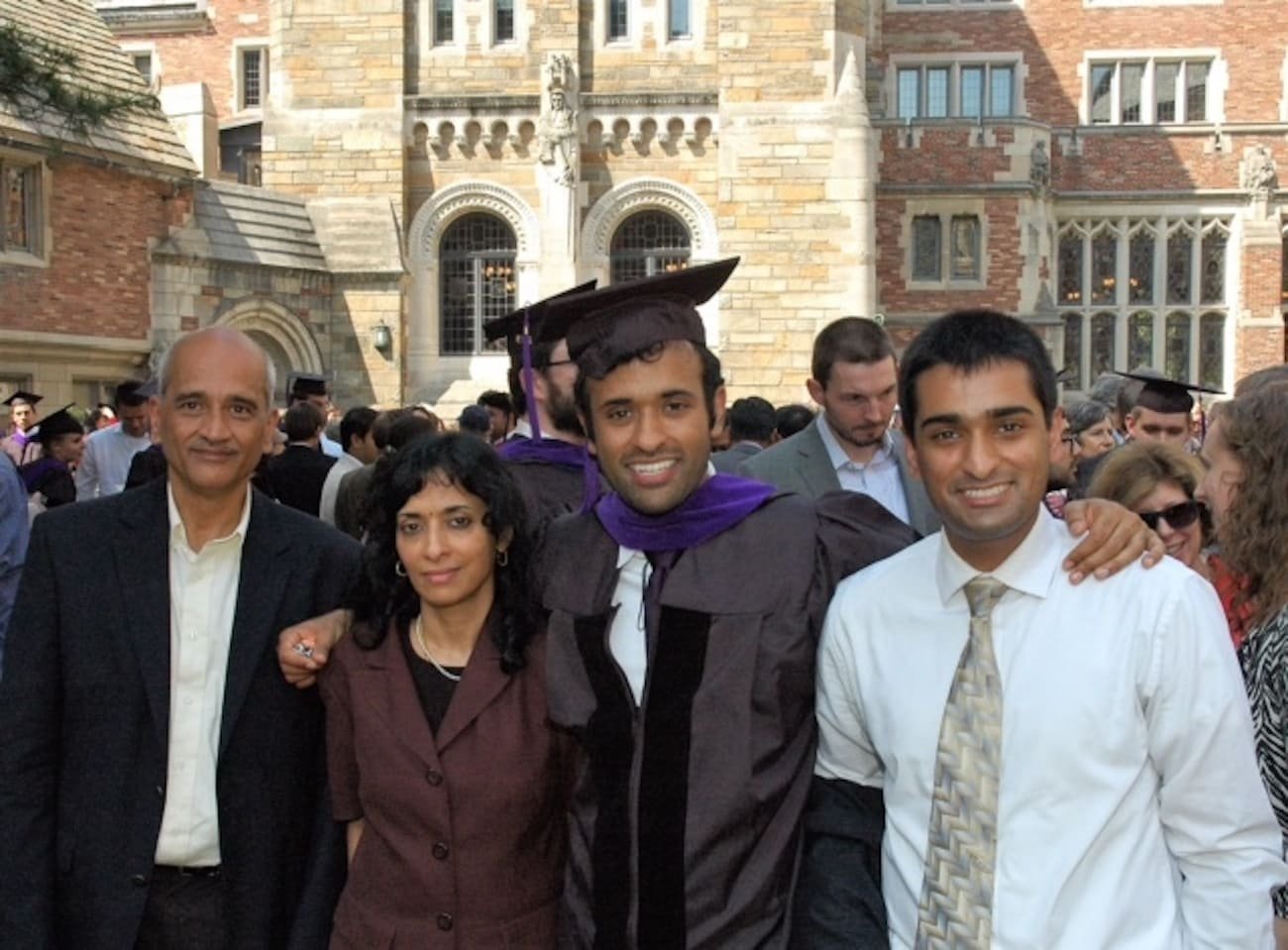

Ohio Republican gubernatorial nominee Vivek Ramaswamy built part of his fortune on a failed Alzheimer’s drug and an unusually large IPO. A recent investigation adds a new wrinkle to that story: it alleges his mother, hired into a company leadership role despite no clinical-trial background, helped reshape unfavorable drug data into something that looked promising to investors.
What the new investigation alleges
The claims originate from a report published this week by the outlet Oligarch Watch, which found that Ramaswamy’s mother, Geetha Ramaswamy — a geriatric psychiatrist by training — was brought on as Axovant’s vice president of medical and scientific strategy in 2015, shortly after the company’s record-setting IPO. According to the investigation, she went on to co-author two reanalyses of a previously failed clinical trial for the Alzheimer’s drug Intepirdine, and both reinterpretations used statistical methods that outside experts have criticized as prone to overstating a drug’s benefits.
The underlying trial, run years earlier by GlaxoSmithKline, had already concluded that Intepirdine failed to reach statistical significance on its primary measures. Axovant licensed the drug from Glaxo for $5 million in December 2014. Rather than run a new trial before going public, the Oligarch Watch investigation says Axovant relied on reworked versions of Glaxo’s old data — a “responder analysis” that sorted patients into pass/fail categories instead of measuring their actual cognitive scores, and a “completer analysis” that excluded more than 30% of patients who had dropped out of the original study. Both approaches, the report notes, are the kind that biostatisticians have long warned can manufacture a more favorable-looking result from the same underlying data.
What can be independently confirmed
Several elements of this story are documented well beyond the new report and are not in dispute:
- The IPO was real and it was enormous. Axovant’s 2015 public offering raised roughly $315 million and valued the company at close to $1.4–2.2 billion — the largest biotech IPO at the time, a fact confirmed by contemporaneous trade coverage and Ramaswamy’s own biography.
- The drug had already failed once. Axovant bought Intepirdine from GlaxoSmithKline for a bargain-bin $5 million after it underperformed in Glaxo’s own Phase 2 trials, according to the drug-industry database AlzForum.
- It failed again, decisively, in 2017. Intepirdine failed its Phase 3 trial that September, and Axovant’s stock collapsed by roughly 70–75% in a single trading day, a crash confirmed by multiple outlets covering biotech markets at the time, including BioPharma Dive.
- Ramaswamy profited substantially before the collapse. His own tax filings, cited by the independent outlet Geopolitical Economy Report in a 2024 investigation that predates this week’s story, show he reported more than $38 million in income — mostly capital gains — in the year of the IPO. Estimates of his total take from Roivant’s Axovant stake, cited by Forbes, run as high as $260 million.
- Ramaswamy has stood by the decision. In on-the-record comments at industry conferences after the drug’s failure, he called it his “single greatest failure” but said repeatedly that he didn’t regret how the company was run, framing the collapse as the natural cost of taking a scientific risk.
The specific claim that Geetha Ramaswamy’s involvement amounted to intentional “data manipulation” is, at this point, sourced essentially to one outlet’s investigation.
Where the story is thinner
The specific claim that Geetha Ramaswamy’s involvement amounted to intentional “data manipulation” is, at this point, sourced essentially to one outlet’s investigation. It has since been repeated — sometimes verbatim — by the Democratic Governors Association, the Ohio Democratic Party, and rival gubernatorial candidate Amy Acton’s campaign, all of which have an obvious political interest in damaging Ramaswamy’s candidacy. Their statements amplify the original report rather than independently verify it, and none appear to add new documentation beyond what Oligarch Watch published. Readers should weigh the framing accordingly: the underlying facts about the analyses and the trial data are drawn from public filings and published critiques of these statistical methods, but characterizations like “scam” and “pump-and-dump scheme” are opinions and allegations, not settled legal findings. Ramaswamy has never been charged with wrongdoing in connection with Axovant, and a health-policy professor quoted in the original report, Daniel Skinner of Ohio University, was careful to make that distinction even while calling the trading pattern the kind that invites scrutiny.


The Ramaswamy campaign did not respond to the original outlet’s request for comment on this story. On the broader question of whether he benefited financially from Axovant’s failure, his campaign has previously given shifting answers: a spokesperson initially denied he profited from the stock’s decline, then later acknowledged he had sold shares in 2015, describing the sale as something he was “forced” to do to bring in an outside investor — an explanation that outside reporting has disputed, given the scale of the gains involved.
The bottom line
The verifiable facts are these: Axovant bought a previously failed drug on the cheap, went public on the strength of reworked versions of that failed data, and its stock later collapsed after the drug failed again — costing outside investors, including a teachers’ pension fund, real money while Ramaswamy walked away tens of millions of dollars richer. His mother’s specific role in reinterpreting the data is a genuinely new detail, first reported this week, and one that has not yet been corroborated by an outlet independent of the original investigation or of Ramaswamy’s political opponents. Whether that role rises to deliberate manipulation, as the original report frames it, or reflects a more defensible — if aggressive — statistical judgment call, as Ramaswamy’s own public comments suggest he believes, remains a matter of interpretation rather than established fact.
Top image: courtesy Vivek2024