




Global Opinion of India Is Split — And Americans Are Growing More Skeptical With 50 Percent Viewing It Unfavorably

- The Pew Research Center survey report does not assign a single cause to the American decline, but it situates the U.S. drop within a broader — if uneven — global trend.

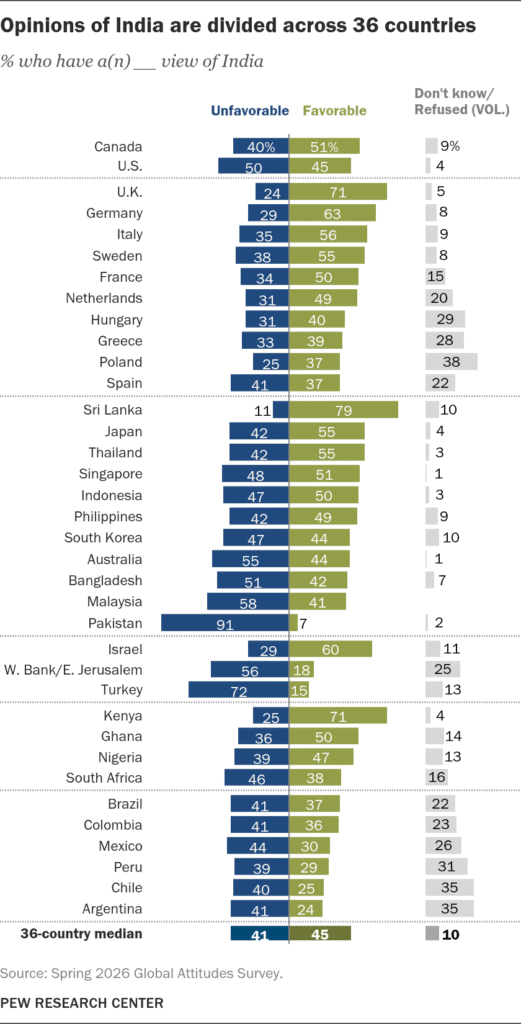
A new Pew Research Center survey, fielded February 9 through May 13, 2026, across 36 countries and more than 42,000 respondents, paints a portrait of a world that cannot quite make up its mind about India. The median favorable rating lands at 45 percent, the median unfavorable rating at 41 percent — a country that inspires admiration in some capitals and deep wariness in others, sometimes just a border away.
A Map of Extremes
Nowhere is that split more dramatic than among India’s immediate neighbors. Sri Lankans view India favorably by a lopsided 79 percent, the warmest rating anywhere in the survey. Pakistanis, by contrast, register just 7 percent favorability — the coldest reading in the entire study, a reminder that geography does not guarantee goodwill.
Beyond South Asia, the warmest audiences for India are found in Kenya and the United Kingdom, where roughly seven in ten adults hold a favorable view. Solid majorities in Germany, Israel, Italy, Sweden, Japan and Thailand feel the same way. At the other end of the spectrum, Turkey (15 percent favorable) and the West Bank and East Jerusalem (18 percent favorable) stand out as the most skeptical populations outside Pakistan.
Regional patterns emerge as well. European opinion tends to tilt positive, even where large shares decline to offer a view at all. Latin American opinion tilts the other way — modestly unfavorable almost everywhere, from Brazil and Colombia to Mexico, Peru, Chile and Argentina.
The View From the United States
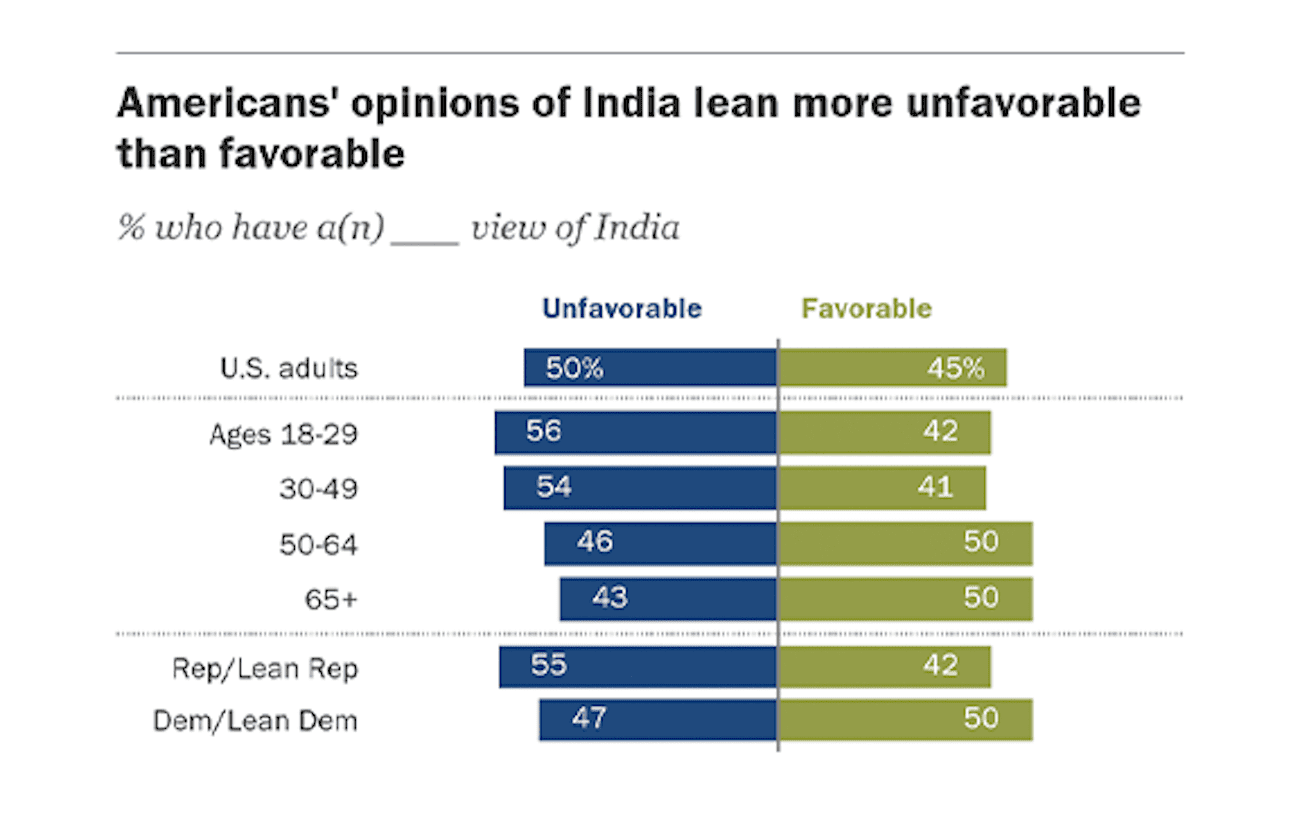
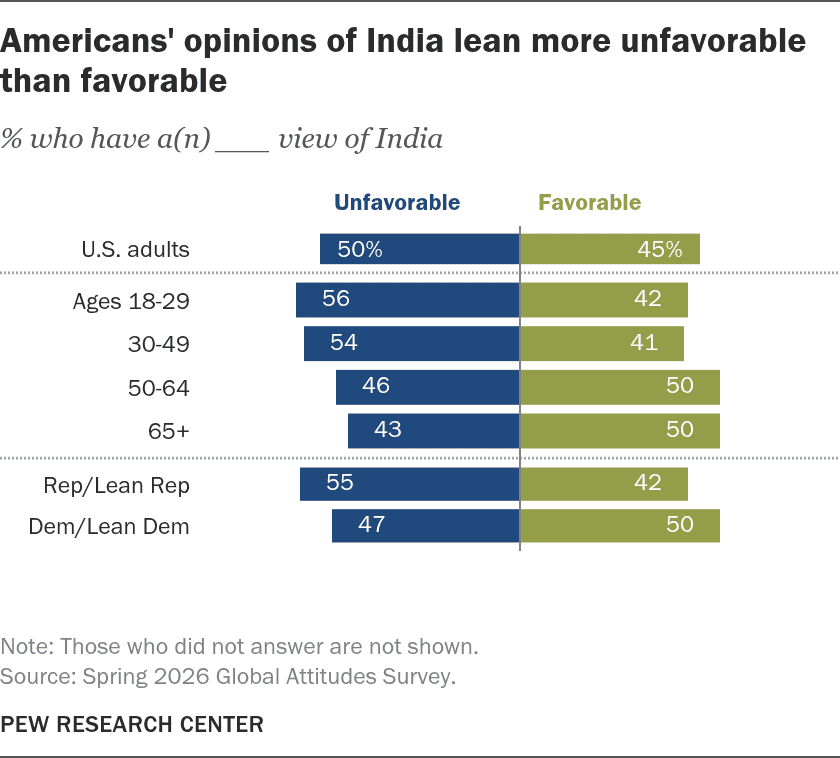
Inside this global picture, American attitudes toward India have taken a distinctly cooler turn. Today, 45 percent of U.S. adults view India favorably, while a slim majority — 50 percent — view it unfavorably. That combination puts the United States among the more negative outliers in the wealthy world, closer in tone to Latin America than to the rest of North America or Western Europe. Pew notes that this is among the lowest favorability ratings recorded for India in the U.S. since the question was first asked in 2008.
The erosion has been gradual rather than sudden. As recently as 2023, 51 percent of Americans held a favorable opinion of India. That figure slid to 43 percent in 2024, recovered somewhat to 49 percent in 2025, and has now settled at 45 percent — a four-point decline just in the past year, one of the larger year-over-year drops recorded anywhere in the 2026 survey.
Age is a significant dividing line. Older Americans are considerably warmer toward India than younger ones. Half of adults 65 and older hold a favorable view, as do 50 percent of those 50 to 64. Among adults under 50, the picture flips: only 42 percent of 18-to-29-year-olds and 41 percent of 30-to-49-year-olds see India favorably, with clear majorities in both age groups leaning unfavorable instead.
Party affiliation matters too, though less dramatically. Democrats and Democratic-leaning independents are somewhat more favorable toward India than Republicans and Republican leaners, 50 percent to 42 percent. Ideology sharpens that gap further: 54 percent of Americans who describe themselves as liberal view India positively, compared with just 40 percent of conservatives — one of the largest ideological splits Pew measured on this question anywhere in the survey, mirrored in Canada but running in the opposite direction from Israel, where the political right is more favorable toward India than the left.
On the question of India’s standing in the world, Americans are largely inclined to see stability rather than dramatic change. A majority, 54 percent, say India’s global influence has stayed about the same in recent years. Three in ten say that influence is growing, while 13 percent believe it is fading.
Why the American Numbers Are Sliding

Pew’s report does not assign a single cause to the American decline, but it situates the U.S. drop within a broader — if uneven — global trend. Excluding Europe, favorability toward India has generally softened since 2023 in a number of countries, including South Korea, Indonesia, Mexico and South Africa alongside the United States. Ten countries registered statistically significant shifts in either direction since the prior year’s survey, and in seven of them, opinion moved down rather than up. The steepest declines were recorded in Turkey and Nigeria (down 10 points each since 2025), with the U.S., Indonesia, South Africa and Mexico also posting notable drops.
That stands in contrast to much of Europe, where the trend line has moved the opposite way. Germany’s favorability rating has climbed from 47 percent in 2023 to 63 percent today; France’s has risen from 39 percent to 50 percent over the same period; the United Kingdom gained 11 points just since 2025, reaching 71 percent.
The Bigger Picture
Pew’s companion research this cycle also examined how India is viewed by its immediate neighbors specifically, finding that regional rivalries and shifting alliances are reshaping South Asian public opinion in real time — Bangladeshi favorability toward India fell 15 points since 2024, even as Sri Lankan favorability rose 14 points over the same span. Indians and Pakistanis, for their part, overwhelmingly regard each other as their country’s top geopolitical threat.
Taken together, the 2026 data suggest that India’s global image is not moving in one direction. It is fragmenting — rising in parts of Europe, softening across much of the Americas and parts of Asia, and remaining bitterly contested along its own borders. American opinion, once fairly steady, now sits closer to the skeptical end of that spectrum than it has in nearly two decades of Pew polling.
Source: Pew Research Center, “Public Opinion of India Is Mixed Across 36 Countries,” published August 13, 2026, based on the Spring 2026 Global Attitudes Survey of 42,092 adults interviewed February 9–May 13, 2026. Full methodology and survey questions are available at pewresearch.org.
I have not looked at Pew. But even without it, I could feel this one… the image has taken a beating, and anyone paying attention over the last couple of years already knew it.
Age. Americans over 65 are the warmest toward India. The under-50s are the coldest. Less strange than it looks. The older cohort’s India was assembled decades ago. Non-alignment, Gandhi, the spiritual romance, later the software success story. The younger cohort has only ever known the current one. Which is a combination of things. They’re just looking at different countries.
And the quietest one. 54 percent say India’s influence has stayed about the same. After a decade of Vishwaguru, the most common American response is a shrug. That should sting more than the 50 percent does.