




‘Spider-Man: Brand New Day’: With Great Power Comes Great Responsibility of Staying in Touch

- Underneath the villains, genetic mutations, psychological manipulations, horrendous battles and collapsing buildings, “Brand New Day” is asking a single question: How do we stay connected?

There are movies we remember because they were extraordinary, and then there are movies we remember because of who was sitting beside us when the lights went down.
For me, Spider-Man will always belong, in some small way, to my father.
I watched “Spider-Man: Homecoming” (2017) with him when he was visiting me in Alabama. We went to a weekday matinee after the film had been playing for several weeks, and the theater was almost empty. It felt as though someone had arranged a private screening just for the two of us.
What I remember most is watching my father watch the movie. He was completely absorbed in the screen. For those couple of hours, he seemed to forget whatever worries he had carried into the theater. There was something almost childlike in his concentration and delight. I could suddenly imagine the schoolboy he must once have been—the boy who could surrender himself completely to a story and allow his imagination to grow in leaps and bounds with the impossible things happening on the screen.
And Spider-Man was perfect for that.
Unlike superheroes who seem to belong to distant planets, like Superman, or heroes caught up in grandiose mythic battles, like Odysseus, Spider-Man has always felt close enough to touch. He swings between skyscrapers and across bridges we recognize. He worries about ordinary, mortal things: a baby trapped in a burning building, a runaway train, panicked bystanders in danger from falling debris. Beneath the mask is Peter Parker, an earnest young man trying to do the right thing and frequently failing. But he keeps trying to do his best as our friendly neighborhood Spider-Man.
Over the passing years, Spider-Man movies have continued to mark chapters of my family life. I watched later movies with my daughter, and with my son and grandson, dressed up in a Spiderman costume. The people sitting beside me changed, the actors changed, and the Marvel universe became bigger and more complicated. But that original feeling of “restful hope” remained at the bottom of my heart, like the gift God reserves in George Herbert’s poem “The Pulley,” which my father and I analyzed many times when I was in ninth grade.
After watching Tom Holland in “The Odyssey,” I was eager to see the talented actor return in “Spider-Man: Brand New Day.” I was struck by the way he conveys both weariness and vigor.
At the beginning of this new chapter, Peter Parker is lost. The world has forgotten him. Even his friends MJ and Ned, the two people who were once in his inner circle, no longer remember the life they shared with him. Peter is protecting New York while living alone. Introspective. Anonymous. Unknown.
This echoes the loneliness of our screen-obsessed lives. We can theoretically reach hundreds of people without leaving our homes, yet loneliness is pervasive. We scroll through photographs of friends and strangers on social media instead of seeing them. We send thumbs-up signs, hearts, folded hands and laugh-out-loud emojis instead of sitting together. Days turn into weeks, weeks into years, and sometimes we lose touch with relationships we once took for granted.
My daughter felt the overwhelming loneliness of Peter Parker in “Brand New Day” and called her best friend as soon as the movie was over. To her, one of its strongest messages was about not giving up on childhood and college friendships simply because a busy professional life has taken you to a different city. I was proud of her when she later made the time to fly out of town and attend a Backstreet Boys concert with her friend for her birthday.
Because underneath the villains, genetic mutations, psychological manipulations, horrendous battles and collapsing buildings, “Brand New Day” is asking a single question: How do we stay connected? Peter can climb walls. He can swing over Manhattan. He can survive things an ordinary human being could not. But none of those powers protects him from the loneliness he feels in his empty apartment.
And perhaps the most poignant part of this Spider-Man is that Peter’s answer to his own loneliness is to recognize loneliness in other people and help them overcome it-including Jean Grey, whom he initially perceives as a perpetrator of evil.
My daughter felt the overwhelming loneliness of Peter Parker in “Brand New Day” and called her best friend as soon as the movie was over. To her, one of its strongest messages was about not giving up on childhood and college friendships.
When Bruce Banner transforms into an enormous, enraged Hulk under Jean’s manipulation, Peter doesn’t simply treat him as a monster who needs to be defeated. He reaches for the human connection still buried inside him. It is a small but important distinction, and it says something fundamental about Peter Parker. His greatest ability may not be his strength, his webbing or his spider-sense. It may be his instinct to search for the redeemable person when everyone else sees only the monster.
One of the movie’s novel ideas involves a mysterious being capable of entering other people’s consciousness. At first glance, she seems simply monstrous. But Peter gradually recognizes something more complicated beneath the “acting out”: anger, confusion and suffering.
Peter and the shape-shifting Jean Grey are connected through their grief. Both know what it means to feel isolated after losing someone they love—Aunt May for Peter, and a sister for Jean. Instead of responding to Jean’s supernatural power only with fear, Peter responds with compassion. He reaches into his own memories of Aunt May and offers Jean the “moral compass” he inherited from her, forged by love and loss.
I could feel my daughter sink heavily into her seat and reach for my hand during this scene, just as, in my memory, I reached for my father’s.
Peter and Frank Castle are hardly natural companions. Their ideas about justice can be radically different. They can fight on the same side and still disagree about what should happen to the person they are fighting. Their encounters have rough edges. They make mistakes. And yet, when Peter is badly wounded, it is Frank who carries him to the hospital.
Peter’s interactions with the Hulk, Jean and Frank all seem to circle the same idea: people are more than the worst moment in which we encounter them.


Perhaps that is also why Tom Holland’s Spider-Man remains so appealing. Even in the aged suit, with his eyes visible behind the mask, there is vulnerability. He never seems completely invincible. His movements aren’t always perfectly controlled. Plans go wrong. He fails before he succeeds.
Yet Peter’s willingness to look beyond the label of “villain” feels quintessentially Spider-Man. He doesn’t merely ask, How do I defeat this person? He asks, What happened to this person? That distinction may be one reason Spider-Man has survived for so many generations.
The movie also returns Peter to the New York streets where he belongs. I prefer him there. There is something reassuring about seeing him among apartment buildings, sidewalks and ordinary New Yorkers.
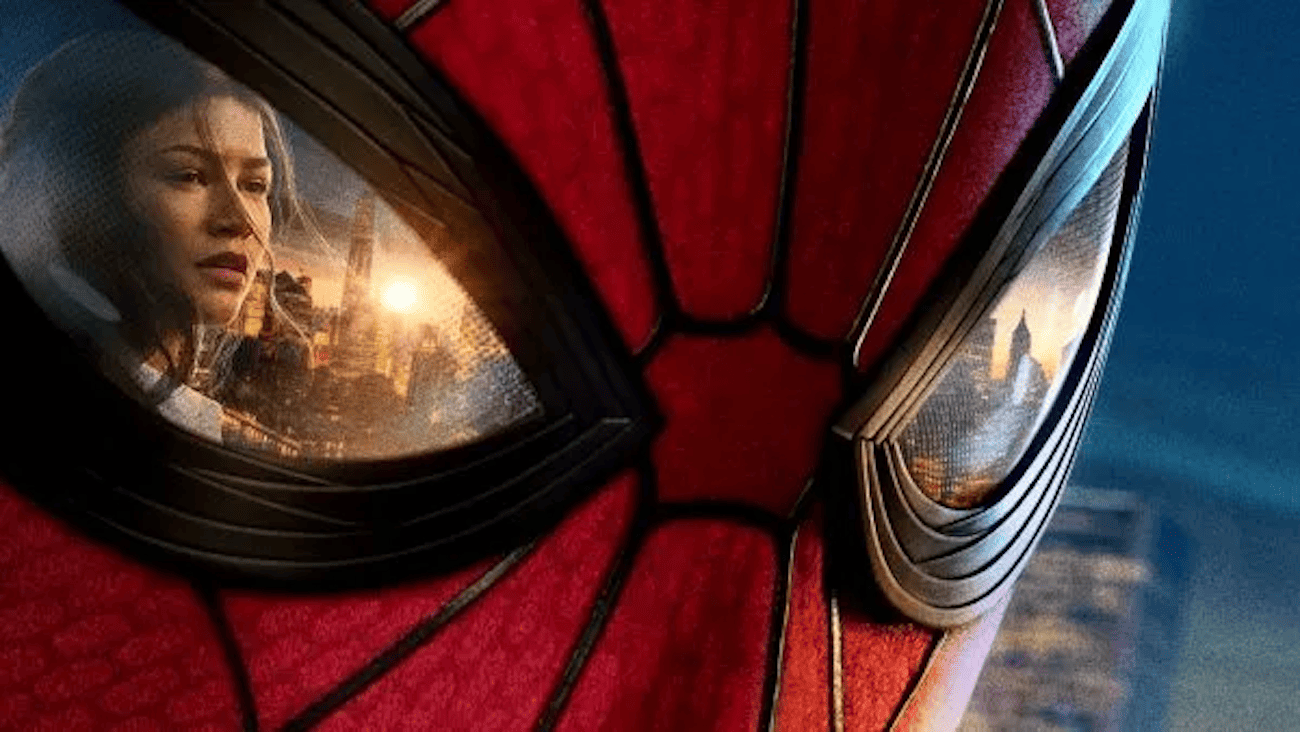
And then there is Zendaya as the inimitable MJ.
The sadness of Peter and MJ’s relationship is that love and memory no longer exist equally between them. Peter remembers. MJ does not. Even when traces of their old connection seem tantalizingly close after she reads the hidden note, the past cannot simply be commanded back into existence.
That brought back another, far more painful memory for me: the heartache we felt when our mother stared vacantly into our faces, trying to unravel the tangles of Alzheimer’s and recognize the people she had once known intimately.
Sometimes one person carries a relationship’s entire history while another can no longer reach it. Love remains real even when memory can no longer restore what once existed.
Movies are supposed to be about what happens on the screen. I laughed as Peter Parker and Ned reconnected with a clumsy “secret” handshake, and felt comforted by the family and friends who sat beside us in the theater.
With roots in Georgia and the Bay Area, and her heart still tethered to a childhood mango tree in Mumbai, India, Monita Soni approaches writing as a contemplative practice. A path to honor humanity. She has published hundreds of movie reviews, book critiques, poems, and essays, and contributed to combined literary works. Her two books are “My Light Reflections” and “Flow Through My Heart.” You can hear her commentaries on Sundial Writers Corner, WLRH 89.3 FM.
This is an excellent review. In my own I try to look at the experience of watching a film just as much as the film itself, and you’ve accomplished the same in a much shorter form than most of my work. Very well done.