




Thin Air: Netflix’s ‘Operation Safed Sagar’ Wins its War With Arithmetic Instead of Noise

- Restraint is this show’s great virtue, and restraint always has an author. This one was made by an ex-IAF showrunner, on active bases, under Defense Ministry scrutiny — which means the tasteful and the officially sanctioned version happen to coincide.
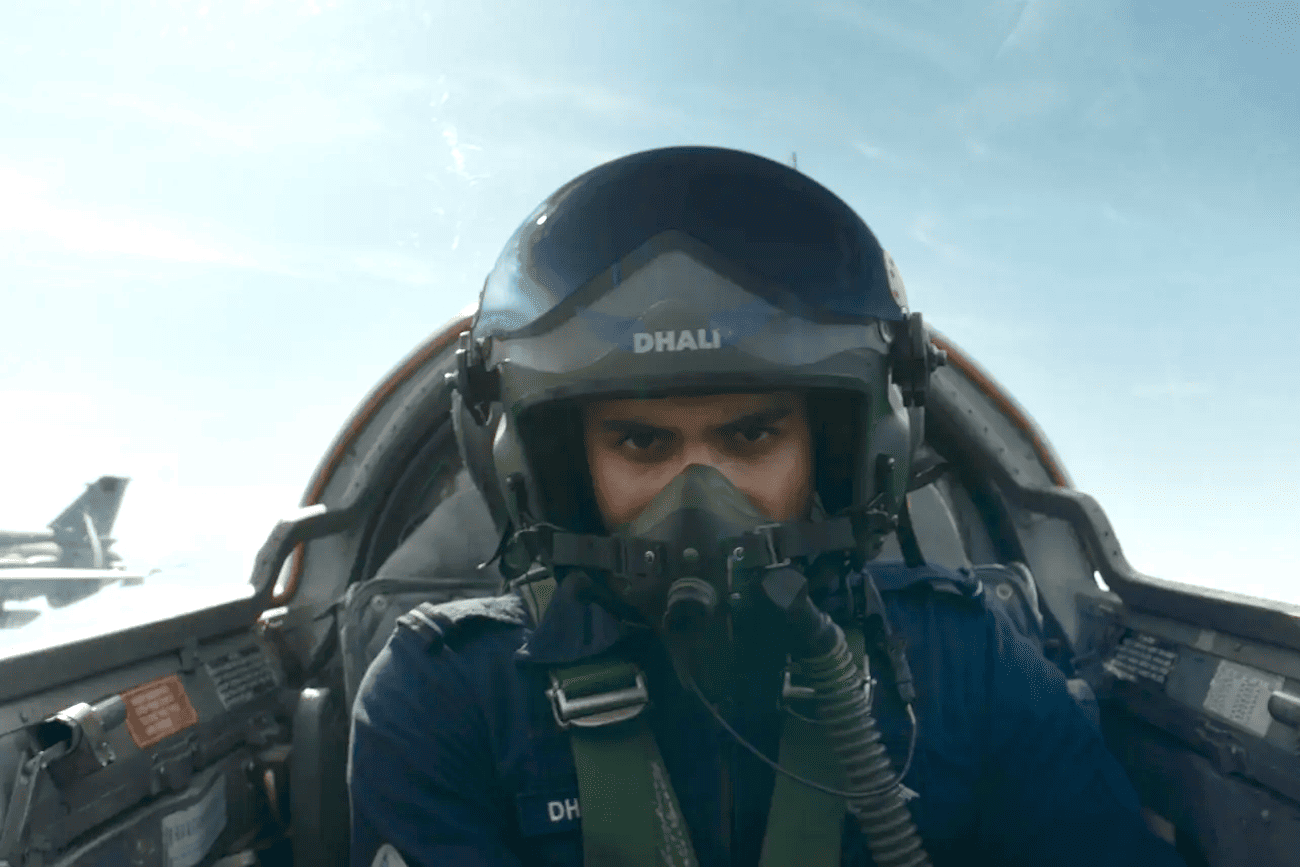

In 1982, Govind Nihalani put a camera inside a fighter cockpit and left it there. “Vijeta” borrowed MiG-21bis aircraft from the Indian Air Force’s №4 Squadron at Jodhpur, and for the first time an Indian feature film showed what an aerial life looked like from the inside — the instrument panel, the horizon tilting, a father and son who could not talk to each other on the ground. It remains a critical favorite, and it wasn’t about a war at all. Since then, Indian aerial cinema has mostly meant noise, most recently “Tere Ishq Mein,” in which a fighter jet was deployed as a romantic gesture.
Four wars, and perhaps three films that treat flying as a profession rather than a mood.
“Operation Safed Sagar,” six episodes on Netflix, is the fourth (if I may take the liberty of clubbing this limited series into the films category). What makes it work is almost embarrassingly simple: it lets people talk shop.
The Pleasure of Specificity
I have no way to verify most of what the show tells me, and neither does anyone else watching. I can’t confirm the height of each peak, the order in which the intruders took them and the order in which they were taken back, or whether a Stinger’s seeker head really does struggle to hold a lock after dark. But the show says these things with such unhurried confidence, and locates them so precisely in a named valley on a named date, that they carry the texture of truth. When Ahuja teaches the Golden Arrows a specific formation, the formation has a logic you can follow, and later, when it matters, you recognize it.
Specificity is the natural enemy of myth. A story that wants you to feel something vague about the nation has to keep its details soft, because details anchor events to a particular Tuesday in a particular valley, where particular men made calculations under a fuel constraint. Once you are inside the arithmetic of a mission, you stop being asked to admire heroism in the abstract. You start admiring competence. And competence is a form of respect that doesn’t require anybody else to be subhuman.
The showrunner, Kushal Srivastava, served in the IAF. The series was shot on active air bases with real MiG-21s and Mirage 2000s, possibly the last production to film with the MiGs before retirement, and you can feel that access in the grain of it. There was Defense Ministry scrutiny too — a fact I’ll come back to.
What the Show Does that ‘Dhurandhar’ Couldn’t
Here is my real reason for liking it. For several years the dominant register of the Indian war picture has been the taunt. The enemy is not an adversary with a strategy; he is a caricature who exists to be humiliated, and the audience is invited to enjoy the humiliation. “Dhurandhar” was the apotheosis of that mode, and it did real damage to what a mainstream Indian audience now expects from a story about the border.
“Operation Safed Sagar” declines the taunt. It is a show about two general staffs, and it takes both seriously.
Manu Rishi Chadha’s Musharraf is the best thing in it — a man of real tactical intelligence running a scheme whose brilliance is inseparable from its recklessness, watching it curdle and refusing, right to the end, to say so out loud. Vinay Pathak’s Nawaz Sharif has the more thankless part and the more interesting predicament: a prime minister who has staked something on the Lahore process, discovering his army has been busy in the mountains behind his back, then discovering the world holds him responsible anyway. You come away thinking about how a civilian government survives its own military — not a question I expected a Netflix war show to raise.
Are the lines simplified? Certainly. Is the Islamabad-and-Washington statecraft partly imagined? Almost certainly. Simplification that produces a comprehensible antagonist is a different thing from simplification that produces a cartoon.
The Scenes That Stayed with Me Aren’t in the Air at All
Pakistan, to hold the fiction together, disowned its own dead — they were mujahideen, nothing to do with Rawalpindi — so the bodies on those slopes belonged to nobody. The show’s answer is not triumph. It is a question. Standing over them, Colonel Sartaj Singh asks whether these men have people at home still alive, still waiting. Told the Pakistan Army won’t take the bodies back, he orders the last rites performed according to their religion. Then he adds the line the scene didn’t need: they may have forgotten who these men were, but the Indian Army hasn’t, and that is the difference.
That last clause is the closest the show comes to saying the quiet part aloud, and the claim is not unfair. The series has already shown what happened to Ajay Ahuja, taken alive after ejecting and shot at point-blank range. It has shown how one army treats a prisoner, and it is in the middle of showing how the other treats the dead. The ledger is real, and the show invented no part of it: when Pakistan refused its dead, India did bury them with rites.
A touch cheesy, and the images had already proved it. The line was still needed. It is the only moment in six hours where the show says outright what it believes, and it says it in a voice with nothing triumphant in it, to no audience but his own men. The question that opens the scene earns it — whether anyone at home is still alive, still waiting. Grant those bodies that much and the rest follows.
Manu Rishi Chadha’s Musharraf is the best thing in it — a man of real tactical intelligence running a scheme whose brilliance is inseparable from its recklessness, watching it curdle and refusing, right to the end, to say so out loud.
The Ensemble, and the Ensemble Problem
Siddharth is the surprise, partly because he turns up so rarely in Hindi work. His Ahuja isn’t an icon; he’s a good manager — wry, watchful, generous with his juniors, aware that the job is to bring people home. Jimmy Shergill, after years of being cast for menace, is back to what made him worth casting in the first place: a face you believe.
But the two who made a lasting impression on me are the younger men. Abhay Verma’s Dhali arrives as a spoiled, needling bully, and the show is happy to let you dislike him. Then, across six hours, it converts your irritation into investment so gradually that you can’t identify the moment it happened. That’s the hardest arc in the ensemble and Verma lands it. Mihir Ahuja’s Baldy is the counterweight — the strongest technician in the room, the least equipped for his own romantic life — and the vulnerability is beautifully judged, even if the arc never quite closes into a shape.


Which is where my wishes begin. I wanted a small, private closure between Dhali and Alka Ahuja: not a speech, just two people in a room who each know what the other lost. And I wanted more of Tony and Ahuja’s history, because that friendship is the load-bearing wall of the series and the show sketches it in a handful of lines. So when Tony stands in front of Alka at the funeral and she asks how she had trusted him to bring Ajay home — a devastating question, beautifully placed — the scene has to do all its work alone. It asks me to feel the collapse of twenty years I watched for ninety seconds.
This is the standing curse of the war ensemble: too many people, all worth following, every minute spent on one man taken from another. Most critics have read the domestic subplots as distractions from the aerial material. I think that’s backwards. They belong there. They’re just underbuilt.
The Same Problem, One Scale Up
The omissions work the same way. “Safed Sagar” was a combined-arms campaign, and the series tells it through one squadron. The MiG-25 Foxbats of №102 Squadron, whose reconnaissance imagery of Tiger Hill and Muntho Dhalo made the targeting possible, are absent. So are the Mirage 2000 squadrons, №7 and №9, who flew hundreds of sorties without a loss, fitted at speed with munitions they were never designed to carry. The helicopter units get nothing. Nachiketa is present chiefly as the reason Ahuja is airborne the day he is shot down: a hinge rather than a person.
I don’t read these as oversights so much as arithmetic. Six episodes need protagonists with arcs, so a forty-seven-day campaign across two services becomes five young men with call signs and a coach. The show concedes the gap by having a general narrate the wider plan aloud, leaving the Army’s Operation Vijay to be taken on trust. It works, and it costs something. The irony is that a production with real Mirages on the flight line still built its story around the MiGs.
A word in defense of the visual effects, which have taken some knocks. They are not photoreal. They are also never cartoonish, the failure mode of nearly every Indian aerial film of the last decade, and the show refuses to linger on them. It gives you the bomb run and cuts to the men who have to fly home. Air power arrives through consequence rather than duration.
The Uncomfortable Part
Restraint is this show’s great virtue, and restraint always has an author. This one was made by an ex-IAF showrunner, on active bases, under Defense Ministry scrutiny — which means the tasteful version and the officially sanctioned version happen, this time, to coincide. The true story of Kargil is flattering enough to need no embellishment, and India’s decision not to cross the Line of Control is a genuinely honorable fact the series is right to place at its center.
I’ll take it. A generation is going to meet 1999 through this show, and they will come away understanding that the war was won by arithmetic, improvisation, and men who were not permitted to cross a line. They will not come away wanting to spit at anybody. Given where the genre stood a year ago, that is not nothing. But I notice the coincidence. And I’d like to see these filmmakers try it when the history is less kind.
Ganpy Nataraj is an entrepreneur, author of “TEXIT – A Star Alone” (thriller) and short stories. He is a moody writer writing “stuff” — Politics, Movies, Music, Sports, Satire, Food, etc.