




The Class of 2026’s Indian American Voices: From Stanford to the Hudson Valley, a Community Takes the Commencement Stage

- Sundar Pichai, Vivek Murthy, Sanjay Gupta, Reshma Saujani, and Fareed Zakaria headline a remarkable year — each arriving with a distinct message shaped by the political and professional moment they inhabit.
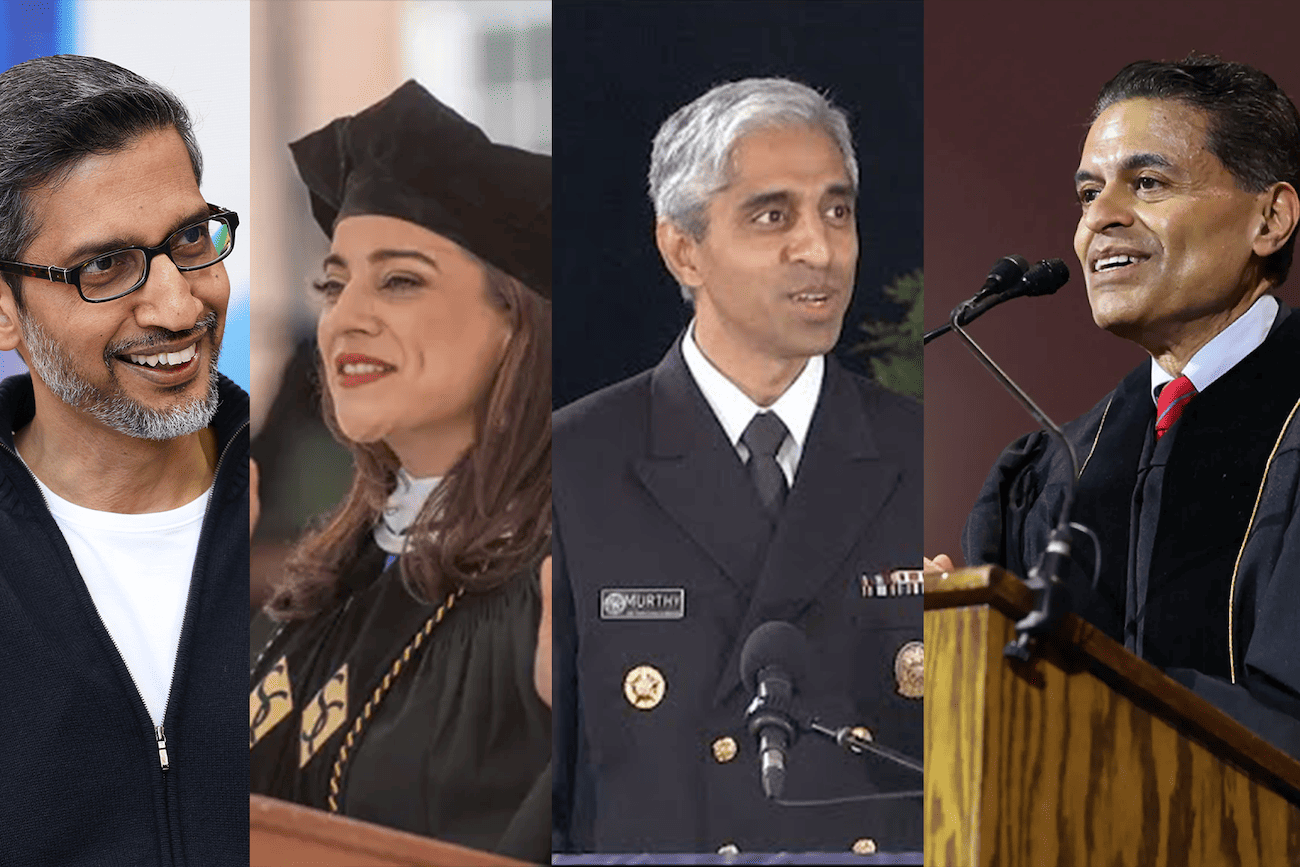

Every spring, American universities send their graduating classes into the world accompanied by the words of people the institutions have chosen to embody something worth aspiring to. The class of 2026 — navigating a convulsive job market shaped by artificial intelligence, a fraying social contract, and a political climate that has tested civic institutions at every level — is being addressed, at a remarkable number of podiums, by Indian Americans.
Four stand out as the most prominent: Sundar Pichai, the Tamil Nadu-born chief executive of Google and Alphabet, who delivered what became one of the most widely discussed commencement addresses of the year at Stanford University; Dr. Vivek Murthy, the first U.S. Surgeon General of Indian descent, who spoke at the Perelman School of Medicine at the University of Pennsylvania and at PCOM, and will receive an honorary degree from Dartmouth in June; Reshma Saujani, the Gujarati American founder of Girls Who Code and Moms First, who spoke at Olin College of Engineering; and Fareed Zakaria, the Mumbai-born CNN anchor and author, who delivered the undergraduate commencement address at Bard College on May 23. Together they represent four distinct modes of Indian American influence in American public life — and, strikingly, four variations of the same fundamental argument: that the things most worth protecting in 2026 are the ones that cannot be automated, and that the current political moment demands more from graduates than competence alone.
Sundar Pichai at Stanford: A Boo Strategy, an Honest Reckoning
The most anticipated and most scrutinized Indian American commencement appearance of the season was Sundar Pichai’s address at Stanford University, where he earned his master’s degree in materials science and engineering in 1995. The Stanford Daily announced his selection on April 2, 2026, and Stanford Report confirmed that his alumni connection made him a natural choice for the institution most closely identified with the Silicon Valley ecosystem he now leads.
But the lead-up to his address was dominated not by anticipation but by a question: what would Pichai say about artificial intelligence to a generation of graduates whose job prospects had been materially shaped by the technology his company has done as much as anyone to advance?
The context was documented and uncomfortable. As AOL reported, graduates at multiple 2026 commencement ceremonies had heckled technology executives who made optimistic comments about AI. Former Google CEO Eric Schmidt was loudly booed at the University of Arizona. Big Machine Records CEO Scott Borchetta drew backlash at Middle Tennessee State University. Jensen Huang of Nvidia told Carnegie Mellon graduates the current moment was ideal for career entry — a comment that landed uneasily, given that unemployment among recent graduates had climbed to a four-year high as companies cited AI-driven efficiency in announcing layoffs, as Storyboard18 documented.
The hosts of the technology podcast “Hard Fork” asked Pichai directly what his “boo strategy” would be. His answer was measured and notably candid. “I’ve always been extraordinarily optimistic about the next generation,” he told the hosts, adding that AI did not change that fundamental orientation. He acknowledged, in the most honest thing he had said publicly on the subject, that “humans aren’t evolved to process that much change” — a concession that graduate anxiety was not irrational but structurally understandable. “These graduates are actually both going to be a big part of driving that progress and also dealing with the impact,” he said.
Sanjay Gupta at Michigan: Coming Home to Teach What the Classroom Cannot
On May 15, 2026, Dr. Sanjay Gupta — CNN’s chief medical correspondent, practicing neurosurgeon, and #1 New York Times bestselling author — returned to Ann Arbor to deliver the University of Michigan Medical School’s 2026 commencement address at Hill Auditorium. The occasion was, for Gupta, explicitly personal.
“Not only was the foundation for most of my life conceived in this town, I myself was likely conceived in this town,” he told the graduating class in remarks drawn from his previous Michigan commencement address, a homecoming quality that has defined every time he has returned to this stage. He holds a B.S. from Michigan (1990), an M.D. from the University of Michigan Medical School (1993), and completed his neurosurgery residency there in 2000, according to the University of Michigan Medical School’s official announcement. One of his daughters is now a Wolverine herself.
In a pre-commencement interview with Michigan Medicine’s health publication, Gupta offered the graduates advice that was at once practical and philosophical. “It’s such a big transition time in life — there are so many things that are happening — there is a tendency for people to have life become procedural,” he said. “I think one thing that I wished I had done more at that stage was probably just reflect on everything that I had just gone through.” He urged the new physicians to protect the friendships forged in medical school. “Those bonds are pretty unique bonds,” he said. “They’re hard to forge in other places in society.”
His address, delivered to a class of new physicians entering a health system under unprecedented political and financial pressure, carried a particular resonance: here was a man who had chosen, at the height of his career options, to remain simultaneously a practicing doctor and a public communicator — a model of what medicine could look like when it refused to choose between the bedside and the broader public.
Fareed Zakaria at Bard: The Cracks That Let the Light In
On May 23, 2026 — just days before Pichai’s Stanford address — Fareed Zakaria delivered the undergraduate commencement address at Bard College’s 166th Commencement on its Annandale-on-Hudson campus. The circumstances were, by any measure, unusual. It was the final commencement presided over by Leon Botstein, stepping down after 51 years as the college’s president. Botstein was briefly booed when introduced and a number of graduating students declined to shake his hand as they crossed the stage, related to the fallout from the Jeffrey Epstein scandal’s impact on his office.
Into that charged atmosphere, Zakaria delivered a speech whose central argument was a striking counterpoint to the AI optimism emanating from Silicon Valley. His theme, as documented in the official Bard College transcript, was human intelligence as the necessary corrective to artificial intelligence — what he framed as HI versus AI. He urged graduates to become “champions of HI: Human intelligence, human imagination, human inspiration, and human interconnection.” The human brain, he told the Class of 2026, is “a three-pound organ capable of mathematics and music, logic and love, memory and imagination, ambition and compassion.” Its imperfections, he argued, are not flaws to be engineered away. “Our imperfections are not bugs in some system’s code,” he said, in the passage the Bard website highlighted as the address’s emotional core. “They are the cracks that let the light come in.”
His political register was direct. Zakaria told graduates: “We may be facing the nadir of democracy and freedom in America and a high-water mark of corruption and cruelty in our politics. Resolve to do something about it.”
Zakaria was born in Mumbai in 1964, the son of Rafiq Zakaria, a prominent Islamic scholar and Indian National Congress politician, and Fatima Zakaria, longtime editor of the Sunday Times of India — a family background in public letters and civic engagement that has never been far from his professional identity. He earned his undergraduate degree from Yale and his doctorate from Harvard, and has built a career as host of CNN’s “Fareed Zakaria GPS,” Washington Post columnist, and author of five New York Times bestsellers, most recently “Age of Revolutions: Progress and Backlash from 1600 to the Present.”
Where Pichai asked graduates to hold both optimism and honest anxiety about AI simultaneously, Zakaria asked them to resist the framing altogether — to insist on the irreplaceable value of the imperfect human mind.
Vivek Murthy at Penn Medicine and PCOM: A Doctor’s Prescription for Connection

On Sunday, May 17, 2026, the Perelman School of Medicine at the University of Pennsylvania held its commencement at the Kimmel Center in Philadelphia with Dr. Vivek Murthy — the 19th and 21st Surgeon General of the United States and the first person of Indian descent to hold that office — as its featured speaker. The Penn Medicine Dean’s Office announced his selection in March 2026, describing him as having “widened the lens through which we understand forces that shape our health and well-being.”
Murthy had already delivered the commencement address at PCOM — Philadelphia College of Osteopathic Medicine — on April 28 at the Pennsylvania Convention Center. In June, he will receive an honorary Doctor of Science degree at Dartmouth College’s June 14 commencement, as confirmed by the Dartmouth administration and covered by The Dartmouth student newspaper. Dartmouth President Sian Leah Beilock described each honor and as having made “an outsized impact on their respective field through unparalleled leadership, boundless creativity and transformative innovation,” according to the Dartmouth official announcement.
Reshma Saujani at Olin College: Bravery Over Brilliance
On May 15, 2026, Reshma Saujani addressed Olin College of Engineering’s 21st graduating class in Needham, Massachusetts. Olin’s official announcement described her as a leading activist, the founder of Girls Who Code, the founder and CEO of Moms First, a New York Times bestselling author, and TIME Magazine’s 2026 Woman of the Year — recognized in part for advocacy that contributed to a recently announced universal childcare policy for children under five in New York State.
On her Substack, where she published the full text of her remarks, Saujani opened by locating herself in the history of South Asian diaspora displacement. “I’m the daughter of immigrants,” she told the graduating engineers. “My parents were political refugees, forced out of Uganda in the 1970s when dictator Idi Amin came on television and announced that all Asians had to leave.” It was a personal history that anchored what followed: an argument that bravery, not brilliance, is what the current moment demands.
Her political frame was the most explicit of the four speakers. “For those graduating in 2026, the future may not feel as hopeful as I would like for them,” she wrote in the Substack version accompanying her speech. “DEI is being dismantled. Rights are being rolled back. AI is quickly rewriting how we work and live. And the people calling the shots about, well, almost everything are five billionaires who have a track record of choosing profits over people.” She told the engineers in front of her that right now the country needed their bravery more than their brilliance.
Saujani, whose parents fled Uganda and eventually settled in Illinois, founded Girls Who Code in 2012 after a congressional campaign loss she has described as the most formative professional experience of her life. The organization has since reached more than 500 million girls across 60 countries. She founded Moms First in 2022, focused on childcare and paid leave. Her TED talk “Teach girls bravery, not perfection” has more than 54 million views globally, according to the Olin announcement.
The Wider Circle: Student Voices Across the Country
Beyond the four headline speakers, Indian Americans appeared in student commencement roles at institutions across the country. At UMass Amherst’s ceremonies held between May 9 and 16, two students of Indian origin were among the three student commencement speakers. Shhreya Anand, of Bangalore, India, graduating with dual degrees in computer science and mathematics, was named the undergraduate student speaker after earning the Undergraduate Academic Achievement Award and Outstanding Leadership Award, according to the UMass Amherst official announcement. Mansi Maheshwari, of Gwalior, India, graduating with a master’s in computer science, was selected as the master’s degree student speaker. The first in her extended family to study abroad, Maheshwari had her first-authored research paper accepted as a full paper and oral presentation at the 2026 International Conference on Autonomous Agents and Multiagent Systems, a top international AI conference, the UMass announcement noted.