




Complexion Of The Game: Colored Children Of The Colonized World Are The Pride Of World Football

- The sport is no longer dominated by ‘white bodies’, white histories, white churches or white bloodlines. It is led by the children of Africa, the Caribbean, the Arab world, Asia, Latin America – migrant neighborhoods, refugee homes, working-class suburbs and postcolonial memory.
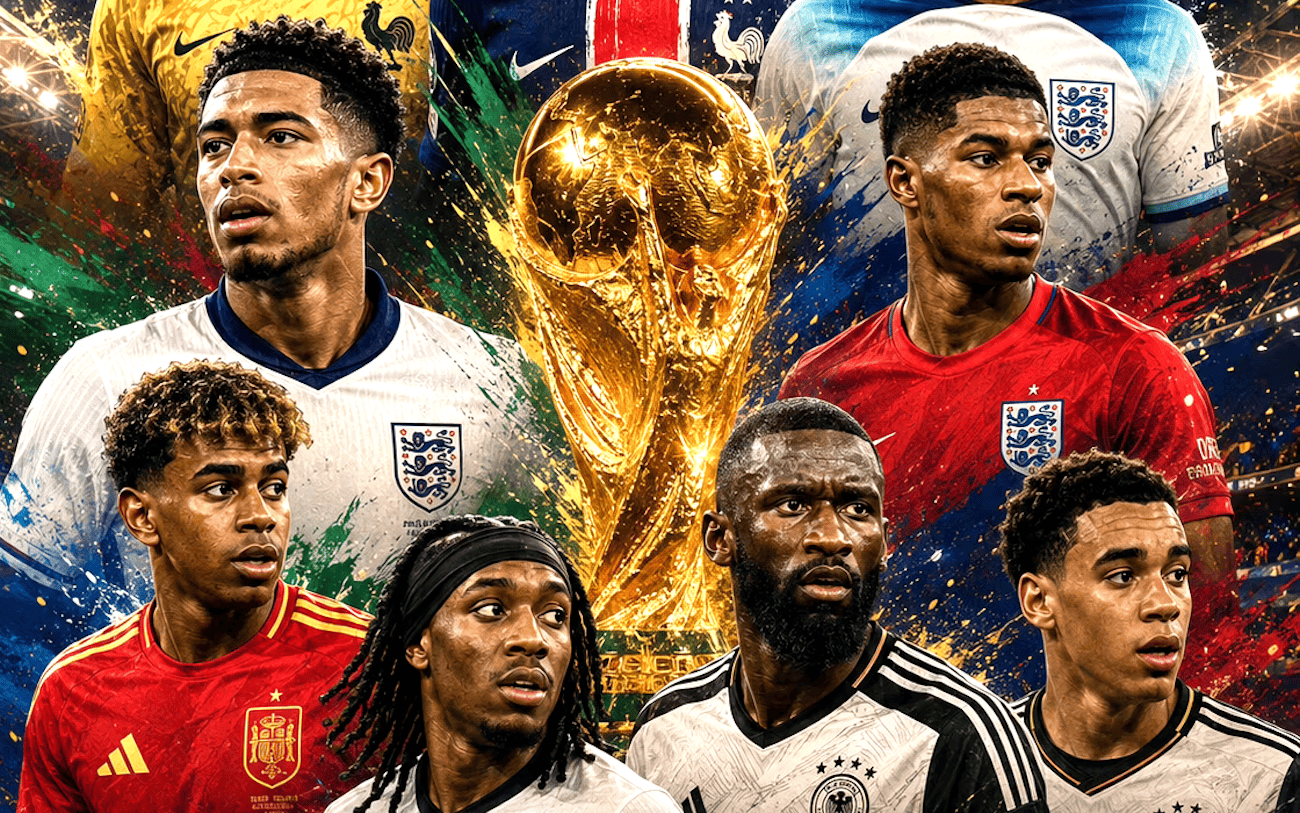

What is the most striking question the FIFA World Cup throws at us today?
Not merely who scored, who topped the group, who advanced to the next round. The deeper question is this: who is carrying the dreams of the old empires on their feet?
Look at France. Look at England. Look at Belgium, Spain, Germany, the Netherlands, Switzerland, Portugal, the United States, and Canada.
Look carefully — not with the lazy eye of nationalism, but with the historical eye of politics. The so-called white nations of world football are no longer carried only by white bodies, white histories, white churches, or white bloodlines. They are carried, again and again, by the children of Africa, the Caribbean, the Arab world, Asia, and Latin America — by people from migrant neighborhoods, refugee homes, working-class suburbs, and postcolonial memory.
That the global North is being carried on its feet by the global South is not a small footnote to football.
France is the most striking example. Kylian Mbappé, born in Paris to Cameroonian and Algerian parents, is not an exception in the French team. He is the center of a wider truth.
Around him stand Ousmane Dembélé, Aurélien Tchouaméni, N’Golo Kanté, Mike Maignan, William Saliba, Ibrahima Konaté, Jules Koundé, Dayot Upamecano, Michael Olise, Rayan Cherki, Bradley Barcola, Marcus Thuram, Désiré Doué, and others. They are French. They are also the children of histories that France once ruled, exploited, extracted from, policed, and racialized.
Now those once-called outsiders are France’s center.
The old empire wanted labor without equality, colonies without citizenship, resources without memory, culture without justice. Football has staged a brutal reversal. The children of the colonized now sing the Marseillaise, wear the French blue, win the trophies, take the penalties, absorb the racist abuse, and still rescue the republic from its own narrow imagination of itself.
The irony is not merely symbolic. It is historic.
England, too, is no longer explicable through the mythology of island purity. Its footballing hope now runs through Bukayo Saka, Jude Bellingham, Marcus Rashford, Eberechi Eze, Kobbie Mainoo, Noni Madueke, Marc Guéhi, Ezri Konsa, Ivan Toney, Djed Spence, and others. Some are of African or Caribbean descent. Some come from immigrant families. Some carry names and histories that were once assigned to the margins of Englishness.
Yet without them, England is not a World Cup contender. It is just nostalgia in a white shirt.
Then there is the question of faith. Europe, which still imagines itself as a Christian civilizational space, now finds its footballing future deeply shaped by Muslim, migrant, and minority histories. Spain’s Lamine Yamal, born in Catalonia to a Moroccan father and an Equatorial Guinean mother, is one of the most dazzling young talents in world football. His very presence unsettles old categories.
Every sprint by Mbappé, every dribble by Yamal, every tackle by Rüdiger, every run by Saka, every burst by Doku, every save by Maignan — cheered by nationalist fans — is also a commentary on race, empire, conquest, belonging, and nationhood.
Is he Spanish? Yes. Is he African in lineage? Yes. Is he a child of migrant struggle? Yes. Must he choose only one history? No.
That is precisely what football is teaching Europe: identity is not a prison.
Djed Spence, a Muslim player in the England national team, is not merely a sports trivia point. He is a political image — a player of minority background wearing the shirt of a country where Islamophobia has been normalized by tabloids, politicians, and street racism, and which is still struggling to reckon honestly with what empire did to the world.
This is not token diversity. This is demographic truth breaking through an old national lie.
Germany has its own version of this story. Antonio Rüdiger, Jamal Musiala, Malick Thiaw, and now Deniz Undav — a German-born player of Kurdish Yazidi heritage — demonstrate that Germany’s footballing body is nothing like the Aryan fantasy of its darkest past. Undav’s story is particularly moving. The son of a persecuted Yazidi refugee family, he plays for Germany and becomes a symbol of dignity for a stateless and wounded people. This is football doing what parliaments often refuse to do: making the invisible visible.
Belgium’s story is equally powerful. Jérémy Doku, Romelu Lukaku, Amadou Onana, Dodi Lukebakio, Youri Tielemans, and others represent a country whose wealth was historically built on the violent extraction of resources from Congo and the broader continent. Today, Belgium’s footballing pride is inseparable from players of African origin. The descendants of those who were once colonized now carry the flag of the country that profited from colonial brutality.
History has a strange left foot.
The Netherlands, Switzerland, Sweden, and Portugal are no longer culturally sealed European teams. They are teams shaped by migration, empire, labor, and refuge. Virgil van Dijk, Cody Gakpo, Xavi Simons, Denzel Dumfries, Manuel Akanji, Breel Embolo, Alexander Isak, Rafael Leão, Nuno Mendes, Danilo Pereira, and many others are reminders that Europe’s footballing quality is built not on ethnic purity but on pluralism.
North America tells the same story in a different grammar.


The United States team is not a white American story. It is Christian Pulisic, yes — but also Tim Weah, Weston McKennie, Tyler Adams, Folarin Balogun, Haji Wright, Malik Tillman, Sergiño Dest, Antonee Robinson, Chris Richards, Mark McKenzie, Miles Robinson, Auston Trusty, Ricardo Pepi, and Alejandro Zendejas. It is Black America, African migration, Caribbean routes, Latino histories, mixed families, and the children of movement. In a country where racism remains structural and police violence remains a political flashpoint, the national team quietly displays what the republic has not yet fully become. In a very real sense, the United States team at this FIFA World Cup contradicts, simply by existing, the exclusionary politics that currently dominate Washington.
Canada, too, is unimaginable without its players of the diaspora. The first team to advance to the round of 16 at the 2026 FIFA World Cup, Canada is nothing without Alphonso Davies, Jonathan David, Ismaël Koné, Tajon Buchanan, Moïse Bombito, Ali Ahmed, Cyle Larin, Tani Oluwaseyi, Promise David, and others. Canada’s footballing rise is powered by Black, Caribbean, African, and migrant-origin players. The new Canada on the pitch is far ahead of the old Canada of settler innocence.
This is why football is political — and why it is the most political sport in the world.
Not because players must issue manifestos, but because their bodies already carry history. Every sprint by Mbappé, every dribble by Yamal, every tackle by Rüdiger, every run by Saka, every burst by Doku, every save by Maignan — cheered by nationalist fans — is also a commentary on race, empire, conquest, belonging, and nationhood. It is a poetry against colonization, written in blood and sweat.
The far right understands this. That is why it attacks these players the moment they miss a penalty. They are French when they score, African or Arab when they miss. English when they win, immigrant when they fail. Belgian when they dribble, Congolese when they demand respect. The racist mind wants minority bodies to produce national glory without claiming national equality.
But football is defeating that bargain. The colonized are not merely asking for entry anymore. Their children are carrying the keys. They are not guests in Europe’s house. They are rebuilding it. They are not symbols of charity. They are makers of national pride. They are not evidence of decline, as racists claim. They are proof that pluralism works.
This World Cup is therefore not just a globalized, glamorized tournament. It is a people’s census of modern history — a standing rebuke to the logic of settler colonialism. It tells us that no nation is pure, no flag is innocent, no anthem belongs to one race, and no empire can forever control the descendants of those it once tried to rule.
Centuries after colonialism, the ball has rolled back. The children of the colonies, the children of migrants and Muslims, of Africans and Arabs, Asians, Caribbeans, and refugees are now the standard-bearers of possibility for the very countries that once treated them as inferior.
And they are not whispering. They are scoring, and roaring, and winning hearts for exactly who they are.
This story was first published in www.independentink.in and republished here with permission.
M.J. Vijayan, a football fanatic, is a political analyst and writer, based in What is the most striking question the FIFA World Cup throws at us today?