




Socialists Among Us: Indian and South Asian Americans Are Shaping the Most Consequential Leftward Shift in U.S. Politics

- From the executive director of Bernie Sanders' political organization to the co-chair of the largest socialist group in the United States to the founding editor of the movement's most influential magazine, South Asians are at the intellectual and organizational heart of America's socialist revival.
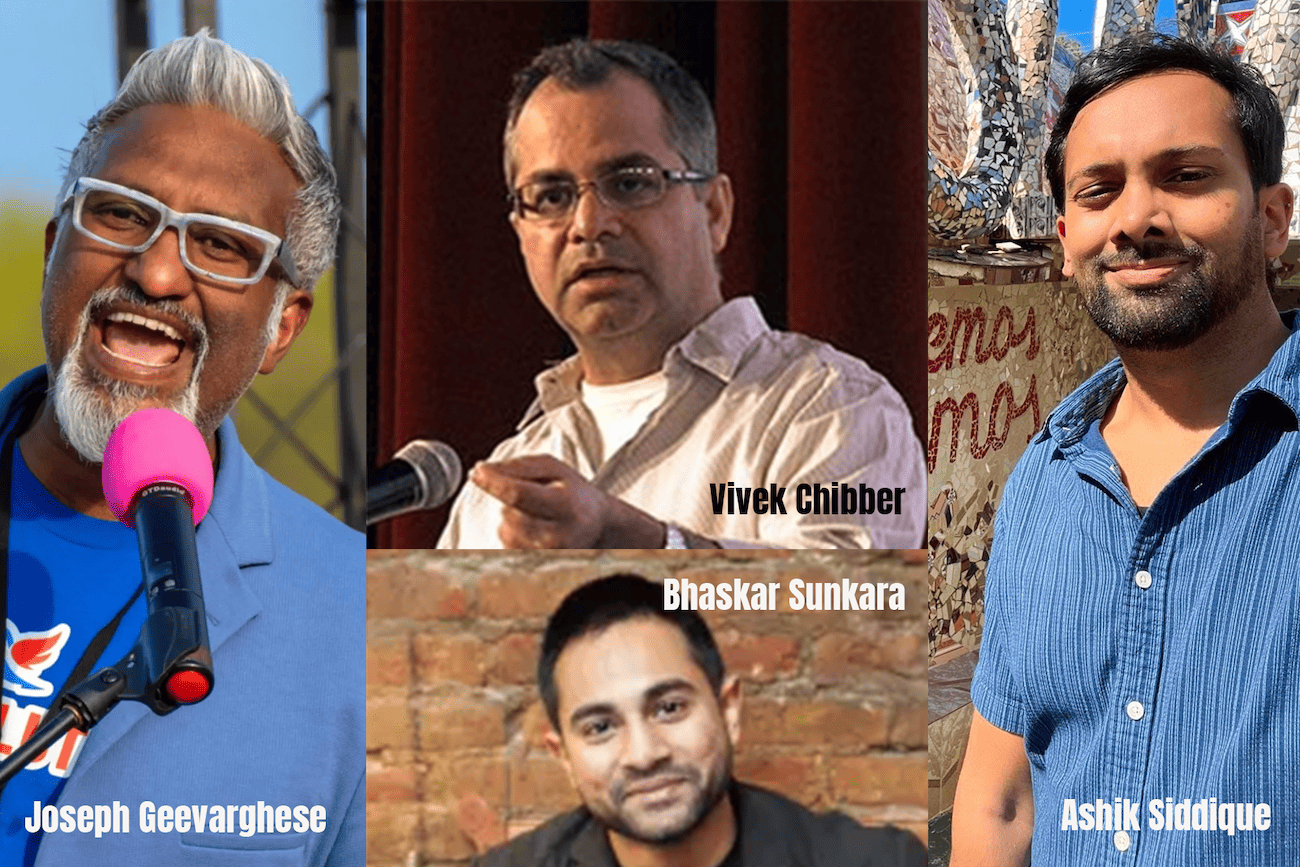

In the summer of 2025, when Zohran Mamdani — the Ugandan-born, Indian-origin democratic socialist — won the Democratic primary for Mayor of New York City in what the Wall Street Journal called the biggest political story of 2026 alongside the decline of Trump’s popularity, he did so with a coalition that had been years in the building. Behind him were organizations, editors, theorists, and organizers whose names are less familiar to the general public but whose contributions to the American left’s revival are, by any serious accounting, foundational.
A striking number of them are South Asian.
Joseph Geevarghese: The Kerala Connection at the Heart of Our Revolution
Joseph Geevarghese carries a name that announces his origins before he says a word. It is a name from Kerala — the southwestern Indian state whose Syrian Christian community has borne surnames like Geevarghese, a Malayalamization of the Greek Georgios, for nearly two millennia. He is the executive director of Our Revolution, the grassroots political organization founded by Senator Bernie Sanders out of the wreckage of his 2016 presidential campaign, and described by The Nation as “the largest independent grassroots political action organization in the US,” according to his author profile there.
Our Revolution endorsed Alexandria Ocasio-Cortez in 2018 when she was an underdog challenging the longtime incumbent Joe Crowley. It backed Zohran Mamdani in his New York state assembly race years before his mayoral bid became a national phenomenon. It is, in other words, one of the primary organizational vehicles through which democratic socialist politics has moved from the margins to the mainstream of American political life — and Geevarghese has led it through that transformation.
His public commentary reflects both the strategic thinking and the moral urgency of the movement he leads. At a June 2021 demonstration outside Amazon’s Arlington, Virginia, offices, organizing around the PRO Act — which would expand workers’ rights to organize and bargain collectively — he told the crowd that Amazon’s warehouse workers “work nonstop, get few breaks, have to piss into water bottles,” adding: “This is unacceptable — not just at Amazon, but at other low-wage companies such as Walmart and McDonald’s,” as KeyWiki documented from the event.
More recently, as the 2026 election cycle has seen democratic socialist candidates notching primary victories at an accelerating pace, Geevarghese has been the movement’s most consistent public explainer. “This isn’t a sudden surge,” he told Newsweek in June 2026. “It’s ten years of work becoming visible.” He rejected the idea that voters were embracing an ideology — arguing instead that what the polling revealed was a deeper anger at corporate power. “They’re not falling in love with an ideology,” he told Newsweek. “They’re done with a government that answers to corporations instead of to them.”
He placed the surge of socialist electoral success in the context of broader urban discontent with both the Trump administration and the Democratic establishment simultaneously. “It’s a reaction to Trump,” he told NBC News. “Trump has attacked major cities, which have a higher concentration of Democratic voters. He’s infiltrated them with ICE and National Guard troops. He’s cut off funding. The cost of living is just unaffordable, and so you’re seeing a referendum not just on Trump but also on this Democratic establishment in their governance of these cities.”
On the question of scale, he was precise: “There are currently two DSA members in Congress, and this cycle’s primary wins alone are on track to roughly double that, with more contested races still ahead before November,” he told Newsweek. “What is new is the scale and speed of growth happening inside the Democratic Party itself, with institutional backing.”
Ashik Siddique: From Brooklyn Bangladeshi Family to DSA Co-Chair
Ashik Siddique — pronounced, as his Wikipedia page helpfully notes, ah-SHEEK sih-DEEK — was born in 1988 and raised in Brooklyn, New York, in a Bangladeshi immigrant family, according to KeyWiki’s detailed biographical account. His is a political biography that is almost entirely a product of the American experience rather than the subcontinent one: he was politicized, as KeyWiki documented, not by events in Bangladesh but by what happened to his own family in the United States. After September 11, 2001, family members were surveilled and profiled by law enforcement as part of the security crackdown that followed the attacks. He was a Muslim teenager in Brooklyn watching his relatives become objects of suspicion. The experience left a mark.
He encountered Occupy Wall Street in 2011 while working at a veterans hospital in the Bronx with combat veterans of Iraq and Afghanistan who were being treated for PTSD, according to KeyWiki and his Institute for Policy Studies biography. The combination — the surveillance state’s impact on his family, the human wreckage of America’s wars encountered daily in a VA ward — gave him a political framework that has been consistent ever since: American militarism, the surveillance apparatus, inequality, and climate change are not separate problems but expressions of the same structural failure.
He joined the Democratic Socialists of America in early 2017 and graduated from Wesleyan University with a degree in Neuroscience and Behavior before working for several years as a research coordinator on a study of PTSD in combat veterans at the Bronx VA Medical Center, according to the Institute for Policy Studies, where he now works as a research analyst for the National Priorities Project, focusing on the federal budget and military spending.
His rise within DSA was rapid. He was elected to the DSA National Political Committee at the 2021 National Convention. After the 2023 National Convention, he and Megan Romer were elected as national co-chairs in a newly created position — and in 2025, both were re-elected, according to Wikipedia. He is a member of DSA’s Groundwork caucus, an ecosocialist caucus committed to the democratic road to socialism.
He has used his platform to articulate what DSA’s politics actually are, against considerable misrepresentation. “We’re out to transform society in a very basic way across the board, but we want to do it with everybody making decisions together as much as possible,” he told The Hill in a 2026 interview. In Newsweek, writing under his own byline, he argued against the establishment’s attempt to blame DSA for Democratic losses: “The only way to win the masses is with the kinds of life-changing policies that Democrats are fighting for and winning nationwide.” He was among those who participated in a five-day hunger strike outside the White House in December 2023 calling for a ceasefire in Gaza, alongside Mamdani, Rashida Tlaib, Cori Bush, and Cynthia Nixon, according to Wikipedia.
In July 2025, following Mamdani’s primary victory, Siddique took a one-hour slot on C-SPAN’s Washington Journal to discuss DSA and democratic socialism with the public — a platform that reflects the degree to which the organization he co-chairs has moved from the margins to the mainstream of political conversation, according to C-SPAN’s program archive.
The concentration of South Asian Americans in the leadership of the American democratic socialist movement is striking enough to warrant explanation. It is not coincidental.
Bhaskar Sunkara: The Indo-Trinidadian Who Built the Left’s Most Important Magazine
Bhaskar Sunkara’s biography contains a layering of South Asian diaspora history that is itself a kind of compressed story of how the Indian subcontinent traveled the world. He was born in June 1989 in the United States, according to Wikipedia, to parents of Indian ancestry who had immigrated from Trinidad and Tobago a year before he was born. His father was a Telugu migrant from Andhra Pradesh. His mother’s family had migrated to the island in the 19th century as indentured laborers from Punjab and Bihar — part of the massive post-abolition indenture system that the British Empire used to move Indian labor across its tropical colonies after slavery’s formal end. Sunkara is, in the most precise genealogical sense, the product of imperial labor migration twice over: his father’s family moved voluntarily from Andhra Pradesh to the Caribbean; his mother’s family was moved by the Empire a century before that.
He joined the Democratic Socialists of America at the age of 17 and enrolled at George Washington University in Washington, D.C., where he studied history and conceived the idea of a magazine that would do for the contemporary left what the National Review had done for postwar conservatism: cohere people around a set of ideas and engage with the mainstream from a clearly defined ideological position, according to Wikipedia and NBC Asian America.
He launched Jacobin in September 2010 — his junior year — and in print at the beginning of 2011. “You have to create the institution and do the unglamorous laborious work before the big upsurge happens,” he told NBC Asian America in 2018. The upsurge, when it came via Bernie Sanders’ 2016 campaign, found Jacobin positioned as what the Columbia Journalism Review called “the most successful American ideological magazine to launch in the past decade” and what Sanders supporters quickly identified as the unofficial house organ of the movement. Subscriptions tripled from 10,000 in the summer of 2015 to 32,000 by early 2017, according to Wikipedia. By 2023, Jacobin reported a paid print circulation of 75,000 and over 3 million monthly online visitors.
Sunkara has since expanded his portfolio. He is the the president of The Nation — one of America’s oldest and most distinguished progressive magazines — and the publisher of Catalyst: A Journal of Theory and Strategy. He has served as former vice-chair of the Democratic Socialists of America. He is also the author of “The Socialist Manifesto: The Case for Radical Politics in an Era of Extreme Inequality,” published in 2019.
His personal biography sits at the heart of his political understanding. “I had access to opportunities that my brothers and sisters didn’t have,” he told NBC Asian America in 2018. “So you see how much life is an accident of birth.” The remark is characteristically direct: the intellectual case for socialism, for Sunkara, is not abstract. It is rooted in the contingency of his own origins — in the indenture contracts that brought his maternal ancestors to Trinidad, and the migration decisions that brought his father’s family to America, and the accident of his own birth in a country prosperous enough to make a journalism career thinkable.
Vivek Chibber: The Marxist Theorist Behind the Movement’s Intellectual Engine
If Sunkara built the movement’s most prominent popular publication, Vivek Chibber built its most rigorous theoretical one. Born in India and educated at Northwestern University, where he completed his BA in political science in 1987, and at the University of Wisconsin, where he completed his Ph.D. in sociology in 1999 under the supervision of the eminent Marxist theorist Erik Olin Wright, Chibber is now a professor of sociology at New York University.
In 2017, working with historian Robert Brenner and with Jacobin as publisher, he launched Catalyst: A Journal of Theory and Strategy — a peer-reviewed quarterly designed to address theoretical gaps in left-wing strategy and to provide the intellectual rigor that more popular publications necessarily trade away in pursuit of accessibility, according to the Grokipedia account of Jacobin’s publishing history. He serves as Catalyst’s editor.


His scholarly work is substantial and contested. His 2013 book “Postcolonial Theory and the Specter of Capital,” published by Verso, launched one of the most intense debates in left-wing academia of the past decade — a systematic critique of postcolonial theory and the Subaltern Studies collective, arguing that the framework mischaracterizes capitalism’s operations in the Global South by positing an unbridgeable East-West divide rooted in cultural exceptionalism, according to Wikipedia and Grokipedia. His defense of Marxist universalism against postcolonial particularism drew responses from across the academic left and established him as one of the most significant theoretical voices in contemporary socialist thought.
For Jacobin’s popular readership, he has been the consistent explainer of Marxist economic theory in accessible terms — writing and being interviewed on topics ranging from the inevitability or otherwise of capitalism’s demise to the relationship between class dealignment and the collapse of social democratic parties in Western democracies to the impact of artificial intelligence on labor. Artificial intelligence, he has argued in Jacobin, is unlikely to produce permanent mass unemployment — a position he grounds in the history of previous technological revolutions and their relationship to labor markets, according to his Jacobin author page.
The Wider South Asian Left: Kshama Sawant, Nikil Saval, and the Electoral Vanguard
The three figures profiled above are the organizational, editorial, and theoretical pillars of South Asian involvement in American democratic socialism. But the roster is wider.
Kshama Sawant, an Indian immigrant and member of the Socialist Alternative party, became in 2013 the first socialist in a century to win a citywide race in Seattle when she was elected to that city’s council, as NBC News documented in its 2020 account of South Asian socialist electoral success. Her victory preceded the DSA surge by several years and was, for many observers, the first evidence that explicitly socialist politics could win in a major American city.
Nikil Saval, a former magazine editor and member of DSA who was born in the United States to Indian parents, became the first Asian American elected to the Pennsylvania State Senate when he won his Philadelphia district seat in 2020, as NBC News documented. He has since built a record as one of the most progressive state legislators in Pennsylvania history.
Nithya Raman, the Tamil American urban planner and Los Angeles City Council member who is now running for LA Mayor in the November 2026 runoff against Karen Bass, is a DSA member whose candidacy continues the South Asian presence in what NBC News called “the growing prominence of young South Asians on the left” in its 2020 analysis.
And Saikat Chakrabarti — the Bengali American Justice Democrats co-founder and former Ocasio-Cortez chief of staff who is currently running for California’s 11th Congressional District in San Francisco — represents the next potential chapter of South Asian socialist representation in the U.S. Congress, as reported by Ballotpedia and previously by this publication.
The Historical Thread: Why South Asian Americans?
The concentration of South Asian Americans in the leadership of the American democratic socialist movement is striking enough to warrant explanation. It is not coincidental.
NBC Asian America’s 2020 account of South Asian socialist electoral success noted several contributing factors: the disproportionate representation of South Asian Americans in professional and academic environments where left politics have historically been incubated; the experience of being visibly racialized in a country that has simultaneously valorized South Asian immigrants as “model minorities” and subjected them to surveillance, discrimination, and — most recently — coordinated online hostility; and the specific experience of first-generation immigrants and their children watching the country’s promised meritocracy deliver unequally based on race and wealth.
For Ashik Siddique, the radicalization came from watching family members surveilled after September 11. For Bhaskar Sunkara, it came from recognizing the accident of his own birth and what it meant for his siblings and their peers in Trinidad. For Vivek Chibber, it came from an academic encounter with Marxism that was deepened by his comparative research into why India’s post-independence development failed where South Korea’s succeeded — and what that failure meant for the workers and poor whose interests the developmental state was supposed to serve.
The Wall Street Journal declared in June 2026, that the biggest political story of the year alongside Trump’s declining popularity was the rise of the DSA. Several of the most important people in that story carry names that begin in Kerala, Andhra Pradesh, Bangladesh, and the West Indies. Their presence at the movement’s center is, among other things, a reminder that the left’s revival in the United States is not a purely nativist phenomenon — and that the question of who America is for has been answered, in practice, by some of the people who were told most insistently to stay in their lane.