




The Morning After in Tamil Nadu: I Was Wrong About How Big the Wave Was. I’m Not Wrong About What It Means

- Not unlike in America, the working class voted against its own interests — it voted to kneecap the welfare system that was built for it.
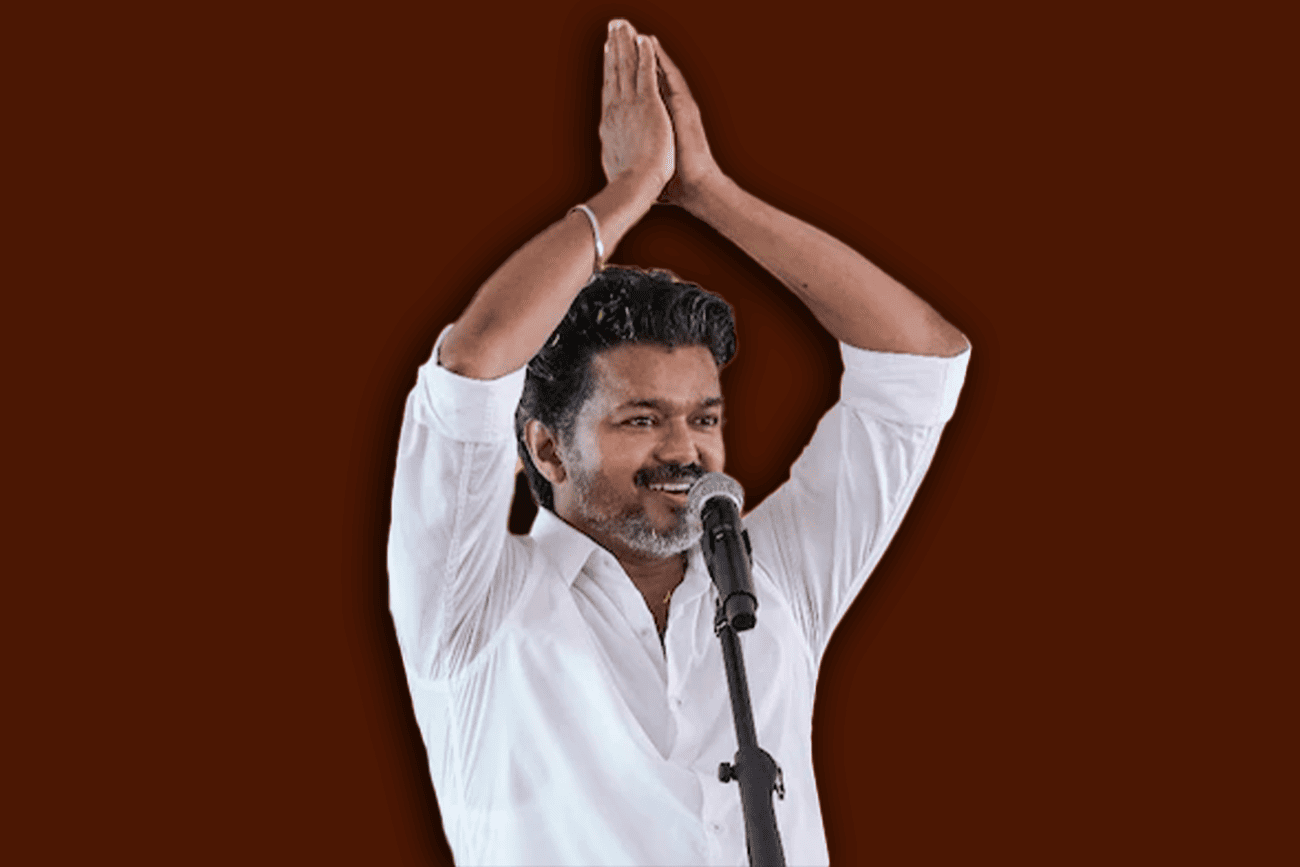

Twelve days ago, I published The Trump of Tamil Nadu. In it, I argued that Chandrasekaran Joseph Vijay was a Trump-like cult figure dressed in whistle flags, that TVK was a vehicle built around one man’s grievance economy, and that the real fight against him would be 2031, not 2026. My specific prediction for May 4 was that the DMK would return to power, and the number to watch would be TVK’s vote share — anything at or above 10 percent, I wrote, would be “a base from which to contest 2031 for real.”
Well. Here we are.
TVK didn’t cross 10 percent. It cleared 34.9 percent of the Tamil Nadu electorate and won 108 seats out of 234 in its debut election. It is now the single-largest party in the Tamil Nadu Assembly — short of the 118-seat majority, but only just, and the post-poll coalition arithmetic now looks less like ‘if’ TVK forms the government and more like ‘which junior partners get stitched in to push it past the line.’
The DMK has been reduced to a rump — fifty-nine seats, seventy-three with the alliance, down from one-hundred-and-thirty-three. Stalin himself — Stalin, who built Kolathur from the ground up over a decade, who delivered eleven percent growth, who ran the most extensive welfare delivery machine in any Indian state — lost his own seat by 8,795 votes to a former DMK district secretary who had drifted to TVK just before the election. Only one sitting Chief Minister has ever lost his own seat in Tamil Nadu’s Dravidian era — Jayalalithaa, in 1996. Karunanidhi, across six decades, never once lost a seat he contested.
We also lost PTR. We lost TRB Raja. The man who defeated PTR in Madurai Central — by all accounts a man with no clear sense of why he was even contesting — has already given his first post-victory interview in Hindi. The first elected Tamil Nadu MLA, by my reckoning, to do so. Tamil Nadu has spent sixty years resisting that imposition. It used to be unthinkable. Apparently, it is now thinkable.
So before I get to the analysis, let me say the unfashionable thing first: I underestimated the wave. By a long stretch.
The cope is to say nobody saw this coming. But that’s a cope. The job of a political essayist is not to predict tallies; it is to read currents. And the current I most underread was not Vijay’s pull. It was the depth of the anti-DMK feeling among voters who, on every economic indicator, should have been DMK’s most loyal constituency.
I have been here before. November 2016. I sat in front of the television in Michigan watching Pennsylvania, then Wisconsin, then my own state turn red. Every credible pollster had told me a story that turned out to be wrong. The morning after, I stared at the ceiling and thought: I do not understand the country I live in. The map I have been using is wrong.
That feeling is back, and it is for the state I was born in this time, not the one I moved to. When the voters surprise you twice in one decade, the problem is not the voters. The problem is your map.
So let me re-do the work.
The Three TVK Voter Banks
TVK’s roughly one-third vote share is not one bloc. It is three.
Bank one: the fans. Vijay’s twenty-five-year-old fan club — one of the largest organized celebrity fanbases in India — got reskinned as a political party. Conservatively, 8 to 10 percent of the electorate. I was right about this bucket.
Bank two: the genuinely fed-up. Five years is a long time to govern, and any administration accumulates real grievances — caste violence the party did not pre-empt, panchayat-level rowdyism, the sediment of incumbency. Another 7 to 9 percent. I had this bucket factored in.
What I did not factor in is the third one.
Bank three: the privileged abstainer-turned-disruptor. The English-medium urban professional, the IT worker on OMR, the small-business owner in Tiruppur whose financial life is fine but who has consumed five years of WhatsApp-forwarded “DMK is finished” content. This voter is doing economically well. The DMK welfare machine is not aimed at her — it is aimed at the bottom 60 percent. She has no acute grievance, no specific policy demand. What she has is a vibe. A change vibe.
This is the bank I underestimated. At least 15 percent of the electorate, possibly more, and overwhelmingly the reason a 10–12 percent debut performance ballooned into the earthquake we are now living through. So let me tell them what I really think.
You have no idea what the last five years have actually done.
The Kalaignar Magalir Urimai Thogai — the women’s monthly entitlement that the third-bank voter rolls her eyes at as a “freebie” — currently transfers ₹1,000 a month to over 1.15 crore women heads of households. The single largest direct cash transfer to women in any Indian state. The Pudhumai Penn scheme, which pays girl students ₹1,000 a month if they studied in government schools and went on to higher education, has driven a thirty-four percent increase in women’s enrollment in higher education — eight lakh girls, with 99 percent of marginalized-community beneficiaries enrolled in professional and STEM-adjacent fields. The Chief Minister’s Breakfast Scheme drove an 85 percent attendance improvement; more than 20 lakh children eat hot, nutritious breakfast at school every morning because the man you just voted out signed a budget line item.
These are not abstractions. They are your maid’s daughter who got into a B.Com program. The kid in your driver’s village who is in school for the first time. Your office-tea-lady who saved enough on bus fare last year to buy her son his first pair of leather shoes.
And here is the part that should genuinely embarrass the third-bank voter, if she had the historical literacy to notice it. The reason you are sitting in your air-conditioned flat in OMR posting a reel of yourself dancing to Appadi Podu — the reason you have an English-medium education, a tech job, a smartphone, a passport — is that exactly this kind of welfare scheme, layered generation upon generation since 1967, lifted your family out of the same conditions the woman in Perundurai is still navigating today. Your grandfather got free rice when MGR widened the PDS. Your aunt got the cataract surgery Karunanidhi made free in 1971. Your cousin and your gardener’s son both got into government colleges on reservation quotas that Karunanidhi expanded in the seventies and that the Dravidian parties have defended in every Supreme Court challenge since.
You are the beneficiary. You just do not know it, because the only history you absorbed came through a screen, in fifteen-second clips, with no context.
And now you have voted to kneecap the machine that built you.
The American parallel is exact. They voted against the Affordable Care Act while being on it. They voted to defund education while sending their kids to schools that ran on federal money. They voted against the social safety net they did not realize they were standing on.
The American parallel is exact. The single largest demographic of Trump voters in 2016 was not the dispossessed white working class that the Atlantic cover stories pretended it was. It was suburban professionals — and especially suburban white women — people doing economically fine, who had health insurance, whose kids were in good schools. They voted against the Affordable Care Act while being on it. They voted to defund education while sending their kids to schools that ran on federal money. They voted against the social safety net they did not realize they were standing on. And then, when the structures cracked, they expressed bewilderment. We didn’t think they meant us.
That is the third-bank Tamil voter, in advance. We didn’t think they meant the breakfast scheme. We didn’t think they meant Pudhumai Penn. We didn’t think they meant the free bus pass our amma uses every Tuesday to go to her dialysis appointment. You will think it. You will know it. It will just be too late by then, the way it was too late for the suburban Trump voter in Wisconsin in 2018, in 2020, in 2024.
Why This is Bad
This is a vote against constitutional values. It is not principally a “pro-BJP” vote — but anyone who claims this outcome is unrelated to what India has been becoming since 2014 is either lying to you or to themselves. The same media-and-information ecosystem that made Modi inevitable in the Hindi belt has now demonstrated it can manufacture a state-level Trump in the one corner of the subcontinent that was supposed to be inoculated against it by Periyar, Anna, and sixty years of rationalist political education. The inoculation has a half-life. We are past it.
Here is what happens next.
Vijay coasts. Tamil Nadu’s industrial base, FDI pipeline, public-health metrics, road and metro and port investments — all five-to-ten-year projects with momentum locked in. The headline numbers will look fine for three years no matter who is at the helm. By 2029, when cracks show, the playbook will be ready: blame the previous government, blame the Centre, blame conspiracies. This is the Modi 2014 redux. It is also the Trump 2017–2020 and 2025-now playbook. Coasting works.
The BJP-RSS gets its inroads. This is the part I am most worried about, and the part TVK supporters who insist “this is not a pro-BJP vote” need to think harder about. Vijay has an active CBI case from the Karur stampede. The case will not move quickly, but it will not go away — and Amit Shah’s Home Ministry controls the dial. That is the leverage. Watch Thirupparankundram. I wrote about that hill in The Politics of Light in December — about how the Sangh has been engineering a manufactured conflict over a sacred lamp lighting site, and how the DMK had been holding the line. The line was the line because the DMK was the DMK. What happens this Karthigai Deepam, six months from now, with TVK in charge?
When They Go Low, You Go High and What 2016 Taught Us
In the days after the Karur stampede, when nine out of ten leaders would have extracted advantage from a rival’s catastrophe, MK Stalin said something I will remember for a long time: no leader would wish their followers to die. A short, human, decent sentence offered while his principal opponent had just buried forty-one supporters because of his own mismanagement. That is the kind of sentence that ends up in history books.
I keep thinking about Michelle Obama at the 2016 DNC. When they go low, we go high. It was a beautiful line. It was also exactly the wrong instinct. The lesson the Democrats spent the next ten years trying to learn — and arguably still have not internalized — is that going high against an opponent who has weaponized going low is not virtue. It is unilateral disarmament.
The historical record is unforgiving. Hillary Clinton out-fundraised Trump nearly two-to-one and lost. Kamala Harris ran the most disciplined campaign of 2024 against an opponent under multiple felony indictments and lost. Joe Biden won in 2020 not by going higher than Trump but by being just willing enough — late, reluctantly, only after the pandemic forced his hand — to call Trump a liar to his face on a debate stage. Decency, in the cult-of-personality era, is a posture, not a strategy.

I see the same dynamic in Stalin’s concession on May 4. Gracious. Dignified. Exactly the right way to lose. It is also the wrong instinct for a movement that just got its head handed to it by a celebrity disruptor whose cadre will treat that grace as weakness. The same social media accounts that called Stalin a kollai-karan yesterday are calling him a fool today for conceding so quickly. There is no version of grace that the cult registers as grace.
For the movement Stalin leads, the next five years cannot be only about decency. The party of Anna and Kalaignar built the rhetorical architecture of Indian federalism. It can build a counter-narrative architecture for the social media era. It just hasn’t bothered to, yet.
The Whisper of Optimism
Let me close with the case for not despair.
The institutions are still there. Tamil Nadu’s bureaucracy, judiciary, university system, public-health network — none are five-year creations. They survived MGR. They survived Jayalalithaa. They survived demonetization and a pandemic. They will survive Vijay.
The DMK is opposition-fit. The party was born in opposition. Anna built it in opposition. Kalaignar rebuilt it from the ashes more than once. Stalin will too. A DMK that is not running a state but running an argument is a DMK closer to its own DNA.
And the kids will figure it out. The twenty-three-year-old who voted whistle in 2026 will, over the next five years, have a child or get a job or watch a parent get cancer. Reality is going to keep happening to her. At some point she is going to remember who actually built the scholarship that paid her fees, the bus pass that took her to college, the hospital that treated her amma. That memory is slow, but it is durable. It is the same memory that, in the United States, has finally begun to break the MAGA grip among young voters tired of grievance as a permanent emotional state. Grievance fatigue is a real political force. Tamil Nadu’s young voters will get there too. The question is only how much damage gets done in the meantime.
A confession, in the dialect of the man who is about to govern us.
Tamil Nadu had the option of watching a very well-made film. A little old, sure. Not perfect. But solid direction, a strong lead, a deep ensemble cast, several genuinely great scenes, and the kind of repeat value that means you find new things in it on the second and third viewing. Tamil Nadu chose, instead, to walk into the next theatre over — the one with no advance reviews, an unknown director who has never made a feature before, a producer whose previous work was canceled by his distributor, and a cast so untested that nobody can tell you who is playing the second lead.
The sad truth is that this is the film Tamil Nadu now has to sit through for five years. There is no walking out at intermission. There is no refund. There is no streaming version with the lights low. There is no fast forward. Whatever Tamil Nadu just bought a ticket to, Tamil Nadu is now watching, in full, in a theatre with the doors locked from the outside.
I sincerely hope the film turns out well. I hope the unknown director surprises us. I hope, in some unexpected way, the gamble that 34.9 percent of my fellow Tamilians took on April 23 pays off.
But hope is not a strategy. It is just what you do while you sit in your seat in the dark, watching the credits roll on a film you did not choose.
Forty-one people died at Karur on September 27. Their families are still grieving. The man whose rally killed them is now the chief-minister-in-waiting of Tamil Nadu. If you think 108 seats and 34.9 percent of the vote retroactively absolve the man and his party of those forty-one bodies — then you and I have very different ideas about what democracy is supposed to do.
I am not done arguing for the other idea. I just have to argue for it from a smaller chair now.
The fight for social justice should continue no matter who runs the state.
This is the fourth in a series — together with The Trump of Tamil Nadu, Stars and Stampedes, and Will Tamil Nadu’s Legacy of Coexistence Become a Model for India’s Future, or a Casualty of Its Present? — a quartet I hoped not to have to write.
Ganpy Nataraj is an entrepreneur, author of “TEXIT – A Star Alone” (thriller) and short stories. He is a moody writer writing “stuff” — Politics, Movies, Music, Sports, Satire, Food, etc.