




Romila Thapar’s ‘Just Being’: A Historian Reflects on a Life Lived Within the Flow of History

- For readers seeking to understand not just ancient India but the contemporary battles over how that history should be told, Thapar's memoir offers an invaluable perspective.
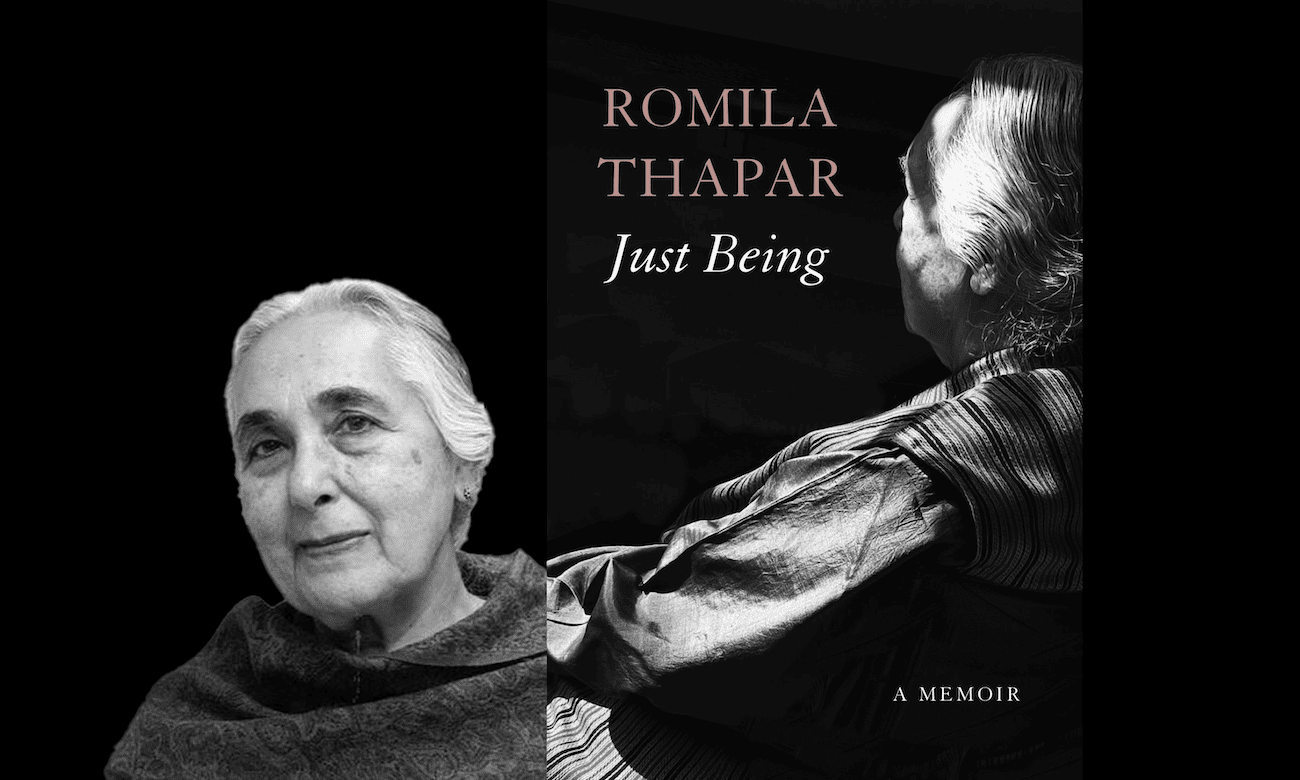

Romila Thapar, one of India’s most influential historians, has published an extensive memoir that traces her journey from childhood in British India to her role as a pioneering scholar who profoundly shaped the understanding of India’s ancient past — and her emergence as a public intellectual defending secular values in an era of rising Hindu nationalism.
“Just Being: A Memoir,” published by Seagull Books in May 2026, represents a departure for the 94-year-old scholar who spent decades writing academic works on ancient Indian history. The 540-page memoir invites readers into what has been described as “her illustrious world — a rich, extensive memoir from a scholar who has profoundly shaped our understanding of India’s past and present,” according to the publisher.
A Reluctant Memoirist
In an interview with Hartosh Singh Bal, The Caravan’s executive editor, Thapar explained her initial hesitation about writing a memoir. “It took a long period of gestation, because I really kept feeling I was incompetent to write a memoir, as I had become so used to writing academic books on academic subjects,” she said, according to The Caravan.
“Over the last few years, you have been actively engaged in public debate on our times. This is your most personal book. How did it come into being? What led you to write this memoir?” Bal asked her.
Thapar’s response revealed the tension between her identity as an academic historian and the demands of writing about her own life — a different kind of historical narrative altogether.
From her childhood growing up in British India, through her years of education in London, her extensive travels to archaeological sites across Asia and beyond, and her trailblazing role in shaping the Centre for Historical Studies at Jawaharlal Nehru University, Thapar reflects on a life lived in the service of inquiry and education, according to Seagull Books.
“Composed over the past few years, Just Being is a testimony to Thapar’s ability to view herself within the larger flow of history, and to illumine it with a scholar’s depth and a storyteller’s sensitivity,” the publisher states.
According to the University of Chicago Press, which is distributing the book in North America, the memoir “reveals not only an extraordinary, boundary-defying life but a profound conviction that understanding our past in the light of irrefutable evidence is essential to an insight into the present and to shaping a more thoughtful future.”
Childhood in British India
Excerpts published by various outlets offer glimpses into Thapar’s early life. In an excerpt published by Outlook India, Thapar writes: “In 1937, we moved to Peshawar. It was a typical house in the cantonment, single-storied and set in an open space, some of which was garden and some just unkempt.”
The excerpt reveals personal connections that would later prove politically significant. Thapar’s father had a close friendship with Sikandar Mirza, who would later become a supporter of the idea of Pakistan.
“My father recalled later that in the course of an argument, Sikandar did once say that those who are not Muslims cannot visualize the threat to the minorities when the British leave. This was ironically a turn-around statement. The British had maintained in the nineteenth century that the Hindus were victimized under Muslim rule, and it was British rule that kept them safe!” Thapar writes, according to Outlook India.
“A few years later, when the two friends met in Delhi, Sikandar affirmed that he supported Partition. They argued endlessly, with my father trying to convince him that he was making a mistake. But Sikandar was adamant. They really had been close friends, and my father regretted the change in Sikandar’s thinking,” she writes.
Scholarly Friendships and Intellectual Life
The memoir also captures Thapar’s relationships with fellow scholars. In an excerpt published by dsimian.com, she writes about historian Simon Digby: “Historian Simon Digby was a master storyteller and often drew from medieval Indian literature. We would sometimes visit the Urdu bazaar near Jama Masjid and then settle down to lunch in a neighbouring dhaba.”
“On one occasion, I mentioned Gul–e–Bakavali and Simon had me spellbound with his interpretations of the story, with all its contextual embellishments from Persian and Urdu literature,” she recalls.
The memoir also includes reflections on friendship itself. “Maybe we have lost the quality of friendship in becoming too particular about whom we choose to have as friends, and in a sense eroding what is, after all, the essence of friendship—camaraderie of various kinds and a fundamental trust in the other,” Thapar writes, according to an excerpt on dsimian.com.
Confronting Historical Controversies
Perhaps the most significant portions of the memoir address the controversies that have surrounded Thapar’s work, particularly her clashes with Hindu nationalist interpretations of history.
As Hindu nationalist politics have reshaped India’s cultural and educational landscape, professional historians like Thapar have found themselves defending not just particular interpretations of history but the very principles of evidence-based historical inquiry.
In an excerpt published by The Caravan under the headline “Romila Thapar on confrontations over the reading of history,” Thapar explains: “LET ME THEREFORE TURN to how the controversy between professional historians and non-professional and some even fake ‘historians’ has emerged in India and why some of us are attacked for the history we write. This in time was converted into the contestation between the professional historian and the populist non-historian writers, each with a different agenda.”
“Borrowing from the colonial construction of Indian history, and basing themselves on the ideology of Hindutva,” she writes, these non-professional historians have challenged established historical scholarship.
A Scholar’s Depth
Dilip Simeon, writing on dsimian.com, offered a tribute to Thapar that contextualizes the memoir’s significance: “NB: Professor Romila Thapar is a stalwart of our times and a witness to history, aside from being a great historian. I first heard her speak at a lecture in my college at the University of Delhi in 1966. I was a first year student. Sixty years later she remains a lively and dynamic part of public life; defending secular values, university autonomy and democracy.”
“She is renowned in India and the world, for good reason: she exemplifies the decency and good will which is so essential for a just society. And she continues to inspire and educate younger generations in a troubled time. Thank you Professor Thapar,” Simeon wrote.

He described the memoir as “A sweeping memoir in which renowned historian Romila Thapar reflects on her life, travels, and scholarly journey, showing how understanding the past shapes our view of the present and future.”
Distinguished Career
Romila Thapar is an emeritus professor of history at Jawaharlal Nehru University, New Delhi, and she was previously general president of the Indian History Congress.
She is a fellow of the British Academy and holds honorary doctorates from the University of Calcutta, Oxford University, and the University of Chicago, among others. She is an Honorary Fellow of Lady Margaret Hall, Oxford, and SOAS, London. In 2008, she was awarded the prestigious Kluge Prize from the Library of Congress.
Scroll.in featured “Just Being” in its May 2026 roundup “May Indian nonfiction: Romila Thapar’s memoir and five other books to read this month,” describing it as a work that “reveals not only an extraordinary, boundary-defying life but a profound conviction that understanding our past in the light of irrefutable evidence is essential to an insight into the present and to shaping a more thoughtful future.”
Even as the memoir was published, Thapar remained actively engaged in public debates about history and education. At the Kerala Literature Festival in January 2026, she addressed the removal of entire dynasties such as the Mughals from textbooks, calling the practice “nonsense,” according to Careers360.
“History is a continuous process and cannot be taught in fragments,” she said, according to the report. The historian also addressed issues such as the rise of popular history on social media, the importance of feminist history, and the role of education in questioning existing knowledge at the festival.
“Just Being” arrives at a moment when Thapar’s scholarly work and public interventions have taken on heightened significance. As Hindu nationalist politics have reshaped India’s cultural and educational landscape, professional historians like Thapar have found themselves defending not just particular interpretations of history but the very principles of evidence-based historical inquiry.
The memoir’s title — “Just Being” — suggests a life lived with integrity and purpose, one that has refused to compromise scholarly rigor even in the face of political pressure and public attacks.
For readers seeking to understand not just ancient India but the contemporary battles over how that history should be told, Thapar’s memoir offers an invaluable perspective from someone who has been both a creator of historical scholarship and a participant in the debates about how history shapes national identity.
The book is available in hardcover (ISBN 978-1-80309-630-8), with ebook and audiobook formats also planned, according to South Asia Times. It is distributed in North America by the University of Chicago Press and internationally by Seagull Books.
As Thapar herself notes in the memoir, understanding our past “in the light of irrefutable evidence is essential to an insight into the present and to shaping a more thoughtful future” — a conviction that has guided both her scholarship and her life, and one that animates every page of “Just Being.”