




The Trump of Tamil Nadu: Why Vijay’s Rise Should Terrify Us All — And Why I’m Done Being Polite About It

- For a decade, I have watched MAGA metastasize from a bumper sticker into a worldview. Vijay’s TVK is the same machine translated into Tamil. Swap red caps for whistle flags. Swap “stop the steal” for “joint machination.”
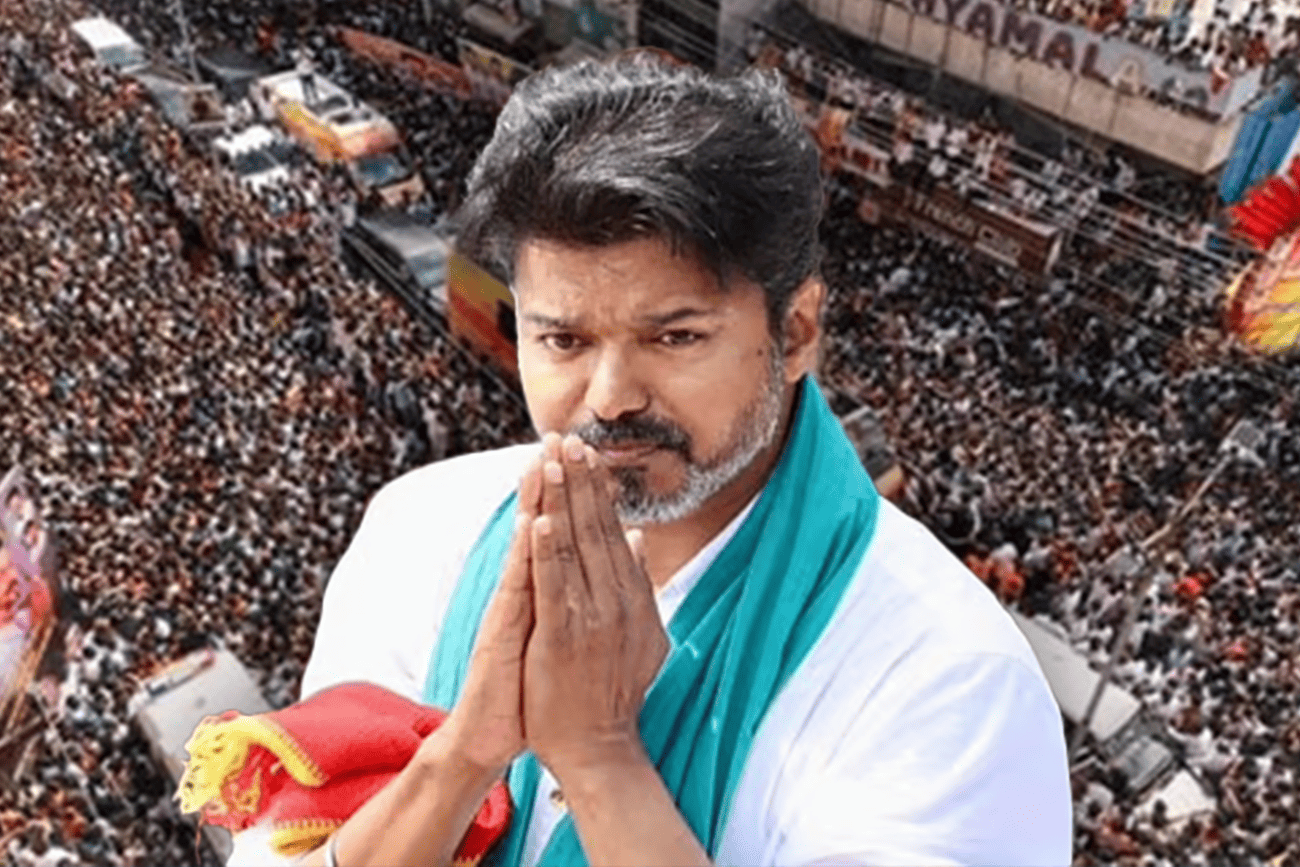

Back in late September, a few days after the Karur stampede, in which 41 lives were lost at actor-turned-politician Vijay’s rally, I wrote about the broader Indian pathology of movie star worship, crowd mismanagement, and civic failure that made such a tragedy inevitable. I was deliberately careful in that essay. I opened with a disclaimer saying the piece was not meant to personally criticize Vijay or his party TVK (Tamilaga Vettri Kazhagam). Families were still mourning. Grief had to take precedence. There would be time, I told myself, for the harder conversation later.
Later is now. Tamil Nadu votes on April 23. And I am done being polite.
I have been calling Vijay (Joseph Vijay Chandrasekhar) the “Donald Trump of Tamil Nadu” from the day he announced his party. Back then it sounded like a provocation. After Karur, after six months of deflection and conspiracy-mongering, after watching his followers harden into something I have only ever seen before in MAGA rallies in the American Midwest — it sounds, to me, like a plain diagnosis.
The American Parallel is Not a Stretch
For a decade, I have watched MAGA metastasize from a bumper sticker into a worldview. It is a politics that does not run on ideas or coalitions or policy platforms. It runs on one man, his grievances, his enemies, and his capacity to convince millions that reality itself is whatever he says it is on a given afternoon. It is cult, not party. Theater, not governance.
Vijay’s TVK is the same machine translated into Tamil. Swap red caps for whistle flags. Swap “stop the steal” for “joint machination.” Swap Mar-a-Lago for a bungalow in Pannaiyur or a resort in Mamallapuram (where grieving Karur families were bussed in for a closed-door performance of condolence a month after the tragedy). The template is identical. The man does not so much lead a party as host a traveling revival meeting. The ideology, to the extent one exists, is “believe in me.” The platform is “the others are the enemy.”
In “The Price of Fandom,” I treated Karur as a systemic failure — a convergence of parasocial worship, VIP culture, poor planning, and the particular combustibility of South Indian film-politics. All of that remains true. But what has happened since September 27 has made me realize that the deeper issue to analyze goes beyond the stampede — and is no longer about systems. It is about one man’s character, his narcissism, his lack of empathy, his endless grievance list, and the politics he has chosen to build around it.
What the Last Six Months Have Taught Us
On April 2, at a Tiruchirappalli rally after filing his nomination papers, Vijay stood in front of a crowd and called Karur a “joint machination.” A conspiracy, he said, involving the same dark forces that had also, coincidentally, delayed the release of his film Jana Nayagan. Think about what that sentence actually means. Forty-one corpses from his own mismanaged rally, lumped into the same grievance package as a delayed movie certificate. His pain and their pain, equalized, both at the hands of a shadowy they. “I, who have come to ask justice for you, also want justice,” he told the crowd.
That is not politics. That is the exact rhetorical move Trump made with January 6 — recast the tragedy as a persecution, recast yourself as the victim, recast accountability as conspiracy.
The Supreme Court ordered a CBI investigation. Vijay has been questioned three times — most recently for seven hours on March 15 at CBI headquarters in Delhi. The Madras High Court has criticized TVK leaders and noted that Vijay left the scene. Not once has he accepted meaningful responsibility. Not once has he said the simple sentence any adult leader should be able to say: my team failed, my logistics failed, I was seven hours late to a rally where people were already dying, and the buck stops here. And I am sorry.
Instead, the pattern has been deflection, deflection, deflection. Every interview a reframing. Every rally a recasting. Every tragedy a talking point against the DMK.
Compare this to Donald Trump and try to recollect a single instance the man took responsibility for his actions and said “I am sorry.” Leaders who suffer from NPD or have shades of NPD never say sorry. I am no psychiatrist, so I am not characterizing anyone here, but it’s not hard to see the patterns and compare.
The Movie-Shoot Question That Won’t Go Away
Firsthand accounts suggested Vijay himself seemed intoxicated by the size of his crowds — that his inner circle appeared to feed that ego, and that the decision to arrive seven hours late could be read as a deliberate strategy to let the crowd swell into something photogenically vast. I want to push further on that now, because something has been nagging at me.
Multiple sources online and in local Tamil reporting have alleged that the Karur rally was doubling as footage collection for Jana Nayagan, Vijay’s last film before full-time politics. TVK’s joint general secretary, CTR Nirmal Kumar, has denied it. Fine. Maybe it is nonsense.
But the very fact that the allegation is plausible — that a political gathering of tens of thousands, in the sun, without adequate crowd control, could credibly be read as a crowd scene for a commercial movie — tells you something about how this man operates. The line between film and politics has been erased deliberately, because the erasure is the strategy. The crowd is the candidate. The candidate is the brand. The brand sells both tickets and votes.
Trump’s rallies famously blurred the line between campaign event and WWE broadcast. Vijay has perfected the same collapse — candidate as spectacle, spectacle as product, product as political capital. When the theater produces casualties, the showman acts hurt that anyone would question the show.
And with the latest online leak of the said unreleased film, conveniently two weeks before the elections, one wonders who tried to gain benefit from that. So far, everyone in his film fraternity came out condemning the leak and piracy, but not a single word from Vijay himself, who allegedly risked more than 400 crore rupees by producing the film under a different banner.
The Cult and Its Alternate Reality
Spend ten minutes on Tamil political X or YouTube comments and you will find TVK supporters who sound indistinguishable from American MAGA voices. They do not defend a policy record, because there is none. They do not defend a legislative agenda, because there is none. They defend him. The man. The aura. The promise that he, uniquely, will fix a state they have been told is irredeemably broken — even though Tamil Nadu remains, by almost every developmental metric, among India’s best-performing states.
In my earlier piece I wrote about parasocial relationships and how high celebrity worship correlates with social anxiety and problematic internet use. That was the academic framing. Here is the political consequence: an electorate that has been cultivated into parasocial loyalty is an electorate that can be told anything. The DMK planted the stampede. The Centre is blocking my film. The media is biased. The surveys are rigged. Vijay literally told supporters in his final rally on April 21 not to believe polls. Any of this sound familiar to anyone who watched an American election between 2020 and 2024?
Trump’s rallies famously blurred the line between campaign event and WWE broadcast. Vijay has perfected the same collapse — candidate as spectacle, spectacle as product, product as political capital.
The facts of Karur are on record. Forty-one dead. Eighteen women. Nine children. CBI investigation. High Court rebuke. Rally after rally since then with people fainting from heat, more hospitalizations, more ambulances. None of it lands in the parallel universe his followers inhabit. In that universe, Vijay is the victim. Always the victim. Eternally the victim.
Using Children as Campaign Props
And then there is the part that made me sit down to write this piece.
In his final campaign speech before the silence period, at YMCA Grounds in Nandanam on April 21, Vijay appealed directly to children. Not as future voters. As current organizers. He told kids to go home and pressure their parents, aunts, uncles, elder siblings to vote for the whistle symbol. His exact framing: just as you ask for chocolates from your mother, father, elder brother, or relatives — ask them to vote for the whistle. And if they refuse to go to the polling booth, “blow a whistle in their ears politely.” He called himself their maama.
This is not the first time. In Salem, a child named Nethra — reportedly named by Vijay himself — was paraded on stage to deliver a speech calling him “Thalaivar.” The National Commission for Protection of Child Rights has been unambiguous that using children as political campaigners violates their rights. The Election Commission has said the same. Vijay and TVK do it anyway, because spectacle outranks law in cult politics.
Political rallies are not safe spaces for the elderly, children, pregnant women, or the disabled — yet they are often drawn into them. I meant that as an observation about crowd safety. I should have seen the deeper rot. It is not that children are accidentally present at these events. It is that Vijay is actively recruiting them as emotional shock troops against their own parents.
Weaponizing children against the adults responsible for them, in service of a man who cannot be bothered to take responsibility for the 41 bodies already on his ledger — that is not charm. That is not folksy. That is coercion of people too young to consent. If that does not disturb you, check your compass.
Why Next-Gen Voters are the Fault Line
I keep hearing from younger Tamil voters — smart, well-meaning, often first-time voters — that Vijay represents “change.” That the Dravidian parties are tired. That dynasty politics has to end. I sympathize with every part of that instinct. Anti-incumbency is healthy. Skepticism of political families is healthy. Wanting something new is healthy.
But “new” is not a political program. Charisma is not governance. Anger is not ideology. And a man who cannot answer a simple question about the 41 people who died at his feet cannot be trusted with 234 constituencies.
The tragedy of next-gen Vijay voters is the same tragedy that befell next-gen Trump voters in 2016: they confused a man’s ability to perform rebellion with an ability to govern a complex state. They confused his enemies list for a platform. They confused the thrill of defying their elders for the wisdom of having thought something through. And by the time the bill came due — in insurrections, in pandemics, in a hollowed-out civil service — the showman had already moved on to the next grievance.
Tamil Nadu cannot afford that discovery. Not with the state’s industrial base, its health indicators, its education systems, its social welfare architecture, and its Dravidian constitutional culture all on the line.

What to Watch for on April 23 — and Why 2026 is Not the Real Test
Let me say the reassuring part first, because it is true. I do not believe TVK is forming the next government of Tamil Nadu. My own read — and I think it is the consensus read among serious political watchers — is that the DMK will return to power when counting concludes on May 4. The Dravidian ground game is still too deep and the welfare delivery too broad. The AIADMK has fractured and lost much of its identity by aligning with the BJP. NTK is growing from strength to strength and pushing to establish itself as a viable and authoritative alternative to the Dravidian parties, but it is not quite there yet. And TVK, for all its crowd-pulling power, is still a first-time party built around a single man — not the kind of vehicle that vaults straight into Fort St. George in its debut election. On the night of May 4, most of us who have been sounding the alarm about Vijay will probably breathe a cautious sigh of relief.
Here is why that relief should last about one news cycle.
The number I am watching on April 23 (or May 4) is not the seat count. It is the vote share. If TVK crosses 10 percent in its debut election — and a good chunk of political arithmetic suggests it will — that is not a failure. That is a foundation. Tamilaga Vettri Kazhagam was formally launched only in February 2024. A two-year-old party converting actor-worship into double-digit vote share in its first outing is not a vanity run. It is a base from which to contest 2031 for real.
And that is where my worry lives.
Because the question Tamil Nadu needs to ask itself is not “will Vijay become Chief Minister this week?” The question is: can Vijay sustain, between 2026 and 2031, the kind of grievance politics that Trump sustained between 2020 and 2024?
Remember what Trump actually did in those wilderness years. He lost an election. He was impeached. He was indicted. He was convicted. He was written off by every establishment columnist in America. And every single one of those setbacks — every indictment, every unflattering verdict, every op-ed declaring him finished — was metabolized by his movement as further proof that they were out to get him. Persecution became fuel. Accountability became conspiracy. The wilderness years did not weaken the cult. They concentrated it.
Vijay has all the raw material to run that same play over the next five years. But he also has the allure of making crores of rupees by getting back to films. A CBI case that will grind on. Almost-certain court rulings that will not go his way. A Madras High Court that has already rebuked TVK leaders. Years of losing on the floor of the Assembly, where as an opposition MLA he will either show up and look ordinary or stay away and look arrogant. Every one of those pressures can be absorbed into the grievance economy. Every adverse verdict can become “joint machination.” Every political defeat can become persecution.
The question is whether he has the discipline, the stamina, and the staff to run that play. Trump had Bannon, Miller, a captured conservative media ecosystem, and forty years of his own branding practice. Vijay has a fledgling party whose general secretary Adhav Arjuna has already embarrassed the outfit with intemperate remarks about Rajinikanth, and a few second-tier leaders who don’t seem to have a grasp of grassroots politics as they seem to be riding the celebrity wave. Overall, a leadership core that appears to revolve entirely around Vijay’s mood, and a political instinct that leans toward absence and spectacle rather than grinding legislative work. That fragility is, in a dark way, Tamil Nadu’s best friend right now.
So here is what I will actually be watching after Thursday:
Watch the vote share. Anything at or above 10 percent means the cult is electorally viable. Watch whether Vijay takes his seat in the Assembly if he wins Perambur or Thiruchirapalli East, or treats it as beneath him. Watch whether he ever sits for an unscripted press conference and answers questions about Karur. Watch whether his party produces a single detailed white paper on education, agriculture, industry, or urban policy — as opposed to the manifesto’s freebie arithmetic of 200 units of free power and free bus travel for women.
Watch whether he names a credible shadow cabinet, or whether the whistle continues to be about one man forever. Watch how much he is willing to invest his new political life into functioning as a responsible opposition party and learning governance. Watch how TVK metabolizes the first real political setback — because one is coming, and how they respond will tell us everything.
And watch the young voters. They are the real battleground. The 18-year-old who votes for TVK on Thursday will be 23 in 2031. If the cult holds her for five more years — five years of grievance, conspiracy, and the delicious feeling of being on the outside looking in at a corrupt establishment — then the version of this piece I write in 2030 will be a very different piece. Tamil Nadu’s political traditions are strong enough to survive Vijay. What hasn’t been tested yet is whether they can survive five years of cultivated contempt — propelled by a younger generation blinded by the cult today, among the very voters who should be inheriting those traditions.
Tamil Nadu has given India some of its most thoughtful political traditions — rationalist, federalist, Periyarist, Ambedkarite, welfarist. Whatever one’s quarrels with the DMK or AIADMK, those parties are products of an argument about society. TVK is a product of a man. And a politics that is only a man is, sooner or later, a politics that breaks on him.
The good news is that Thursday will probably not be that breakage point. After taking a deep breath, one must get ready to ingest the bad news. The bad news for Tamil Nadu’s future is that Thursday is not the election that matters.
Forty-one people already found that out in Karur. The question the rest of Tamil Nadu needs to answer — not this week, but over the next five years — is whether it wants to find out the same way.
Ganpy Nataraj is an entrepreneur, author of “TEXIT – A Star Alone” (thriller) and short stories. He is a moody writer writing “stuff” — Politics, Movies, Music, Sports, Satire, Food, etc.