




Mango Season: Beyond the Divisions, a Sense of Belonging and a Shared Past That Binds the Subcontinent

- At a time when politics across South Asia so often leans on differences of religion, language, and nation, the mango offers something exquisite, almost unique in comparison.
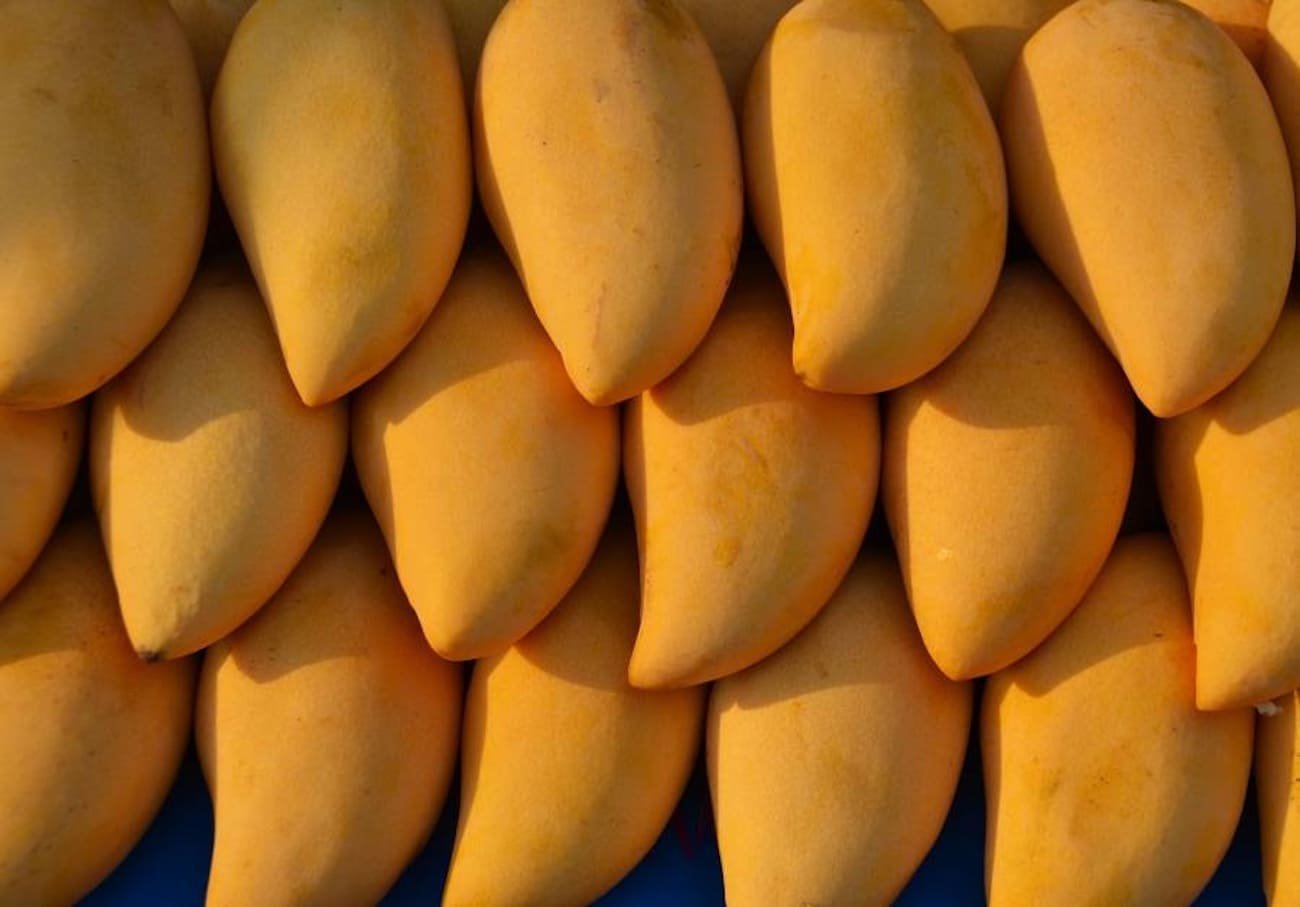

Each summer, the mango reappears across South Asia and into its far-flung diasporas, bringing with it something more crucial than just taste. Moving through kitchens, markets, and memory, as a persistent yet subtle thread, it briefly reconnects a region whose histories of partition and nation-building, along with contemporary politics, have otherwise pulled it apart.
For many in the South Asian diaspora, summer does not arrive on a calendar. It arrives in South Asian grocery stores with the first mangoes from the subcontinent. The fruit itself may be available from different parts of the world throughout the year, but it is these particular varieties from the subcontinent, traveling in carefully packed cardboard boxes, that silently signal the shift in season. Stacked near the entrance, taped shut, a little damaged from the journey. When one is opened, the smell comes first, sweet, thick, impossible to miss. For a moment, it cuts through everything else in the store.
It’s easy to think of mangoes as just another fruit imported, priced, and seasonal. But for South Asia and its diaspora, the mango carries the remembrance of a season, a sense of belonging, and a shared past that has never fully disappeared. It belongs to a season people don’t just notice, but wait for. Mango has long been the seasonal harbinger of summer in much of the subcontinent.
Long before it is labeled as Indian, Pakistani, Bangladeshi, or Sri Lankan, the mango feels unmistakably South Asian.
Before the Borders
To talk about mangoes in the subcontinent is to speak in a language older than countries. Even the word itself carries this history. “Mango” comes into English through Portuguese trade, but its roots go deeper into the languages of the subcontinent; Tamil’s mankay, Malayalam māṅga, Sanskrit āmra, and many other regional tongues where the fruit was known, named, and existed long before it entered global trade. Botanically, too, its origins lie here, in the forests and river plains of South and Southeast Asia, where it grew long before it was ever renamed or moved across oceans.
In South Asia, mangoes are still tied to places. Alphonso and Kesar from western India. Chaunsa and Anwar Ratol from Pakistan. Langra from North India. Himsagar from Bengal. Each one carries its own texture, its own reputation, its own memory.
These are not just varieties. They carry a sense of a map that once felt looser, more open, one that doesn’t quite match the sharp dividing lines we live with today.
When the Lines were Drawn
There was a time when none of it felt so complicated. Mangoes moved as people did, easily, almost naturally, across regions, through crowded markets, and along the rhythm of seasons. The heat, the monsoon winds, the soil itself didn’t just grow the fruit; they shaped the way people waited for it, talked about it, and shared it.
Then borders hardened.
What once moved freely, people, goods, even everyday habits, began to slow, then stop, then require permission. Now, mangoes cross borders through paperwork and inspections, through decisions made far from orchards or markets. Shipments are delayed. Prices change. Sometimes they don’t arrive at all.
There came a time when diplomatic tensions could stop shipments just as quickly as they could stop conversations (even though the mango has been a diplomatic gift favored particularly by political leaders in South Asia).
A Pakistani Chaunsa is remembered in Delhi. An Indian Alphonso is longed for in Lahore. A Bengali Himsagar exists, almost simultaneously, in Kolkata and Dhaka, even when it cannot move freely between them.
Something as simple as a box of mangoes now carries the weight of politics.
Online Summers
And yet, alongside these limits, something else has opened up. In recent years, digital spaces have brought South Asians into a kind of constant conversation across borders. Each summer, the mango shows up there too on timelines, in group chats, across feeds. People share pictures, compare varieties, argue over which region produces best, and return, almost instinctively, to the tastes they grew up with.
A Pakistani Chaunsa is remembered in Delhi. An Indian Alphonso is longed for in Lahore. A Bengali Himsagar exists, almost simultaneously, in Kolkata and Dhaka, even when it cannot move freely between them.
Taste and memories find ways to travel where people sometimes cannot. These exchanges might seem small, even trivial. But beneath it, there’s something familiar being held onto and passed around. They are moments of recognition, ways of saying that we may be separated, but we still understand and feel the same things.
Among the Diaspora
And in diaspora, that connection begins to feel different. In cities far from home, mango season now often begins with a message. Someone spots the first shipment of Kesar, Alphonso or Chaunsa stacked behind the counter at a desi grocery store, priced higher than it should be, and suddenly there’s urgency. You go sooner than planned, wondering if they might run out, or worse, not taste the way you remember. The boxes are heavier than they look. By the time you carry them home across parking lots, onto kitchen counters, there’s already a quiet sense of relief: finally, the season has arrived.
The mangoes available there are never quite the same as those eaten under a tree or bought from a roadside stall. It costs more. It’s handled more carefully. Sometimes it isn’t as sweet. But when you cut it open, when that smell fills the room, it still brings something with it.
A season. A memory. A way of being in the world that once felt ordinary. In diaspora spaces, whether it is New Jersey, London, or Dubai, the mango is no longer just about where it comes from. It’s about what it brings back. People still debate Alphonso versus Chaunsa, and still insist one is sweeter or more “authentic” than the other. But underneath all of that is something personal and elusive: a moment of recognition.
This is what summer felt like.


This is what we knew growing up.
In those moments, the mango loosens its national labels.
It becomes, simply, South Asian again.
The Archive of Taste
What remains here is not just a fruit, but a path to memory. The story of the subcontinent is often told through Partition, through displacement, through conflict, and those histories are real. They still linger, unsettling in many ways.
But alongside them, something else has stayed. Quieter, less visible. Hard to name, even harder to hold on to, and yet it keeps returning in ways we don’t always notice.
A kind of memory that doesn’t live in textbooks or borders, but in taste, in smell, in memory; in the way a season suddenly returns, and you recognize it before you even think. The mango lives in that kind of recollection. It carries with it a time when people didn’t understand the world primarily through borders, when what connected them mattered more than what divided them.
Where Taste becomes Memory
At a time when politics across the subcontinent so often leans on differences of religion, language, and nation, the mango offers something exquisite, almost unique in comparison. It doesn’t heal old wounds or rewrite history. But it does point, softly, towards a kind of belonging that is harder to dismantle. It suggests that beneath everything that has been separated, something continues: sensory, cultural, and deeply human.
It reminds millions of South Asians all around the world of a season they share. And thereby it does something political without ever declaring itself political. And in doing so, it reminds a small, inconvenient truth: that not all geographies are drawn on maps. Some still exist in taste.
Sarita Dash is an independent researcher working on culture, memory, and identity across South Asia and its diaspora. She is the author of Cultural Dimensions of India’s Look-Act East Policy: A Study of Southeast Asia (Palgrave Macmillan) and holds a PhD from the Centre for South Asian Studies, School of International Studies, Jawaharlal Nehru University, New Delhi. Her work explores how culture, memory, and identity shape and are shaped by foreign policy in South Asia, particularly through everyday practices, lived experience, and questions of belonging.
Rare to find words for that diaspora longing, when a simple fruit becomes a shared language of belonging. Thank you for capturing the ‘archive of taste’ so intimately.
I’m wondering if the author lives in America or some such place. No mango-loving resident of India could imagine that Chaunsa, a mango of UP, is from Pakistan. That country does of course now have its own Chaunsas. They are actually sweeter than the real ones, but of course lacking in flavour.
As for Anwar Ratoul, who would know better than Anwar Ratoul himself. That gentleman, from Ratoul village near Merath, was very upset when Pakistani ruler Zia gifted Mrs Gandhi with a basket of “Pakistani” Anwar Ratouls.
No doubt Pakistan has some fine fruit of its own. Blood red maltas, for one. But mangoes?