




The Suspension of Indian American Professor Savneet Talwar and the Silencing of Palestine in Classrooms

- A tenured art therapy professor at one of America's most prestigious art schools was suspended and investigated for a two-page case study that mentioned violence against Palestinian civilians. Her story has become a flashpoint in the national debate over academic freedom, antisemitism, and the policing of speech on American campuses.
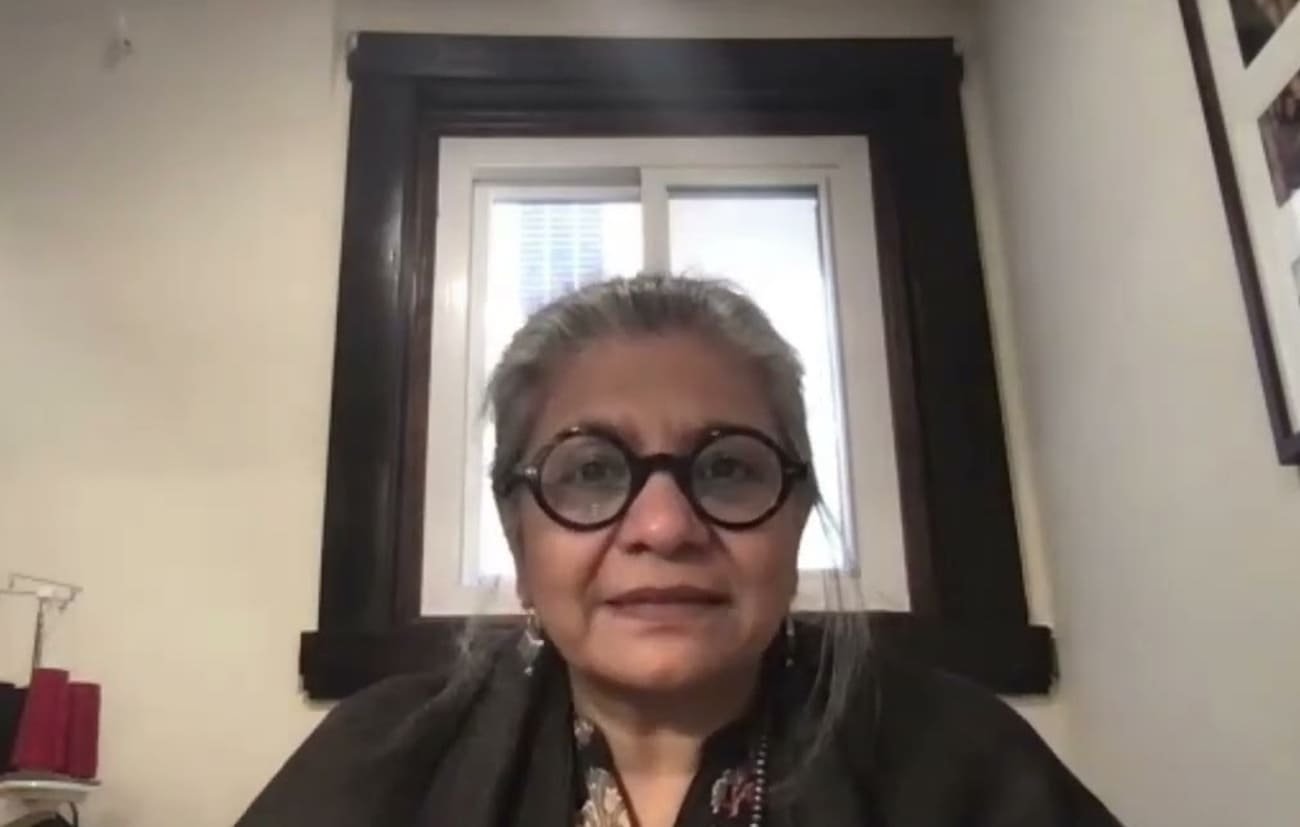

In April 2026, Professor Savneet Talwar — a tenured faculty member, program chair, published scholar, and practicing art therapist with three decades of experience at the School of the Art Institute of Chicago — distributed a two-page assignment to students in her graduate-level course on the cultural dimensions of psychological treatment. The assignment was, in form and purpose, entirely standard for a course of its kind: a hypothetical patient case study asking students to develop an ethical treatment plan for a fictional client.
The client was a queer Muslim immigrant woman living in the United States. The assignment described her family history, her relationships, and her status as an immigrant. In one paragraph among several, it noted that while she was not particularly politically active in her home country, protests in support of Palestine “resonated with her on a personal level” and that she felt deeply affected by violence against Palestinian civilians and “was critical of the home government’s limited response,” as The Guardian, which reviewed the full document, reported.
There was no additional mention of Palestine in the assignment. There was no mention of Israel at all.
Within days, Talwar received a phone call from the dean of the faculty asking whether she had assigned “anything with Palestine in it.” She was summoned to an urgent meeting with a vice president. The following day’s class was cancelled. On April 17, she was officially placed on paid administrative leave, barred from discussing the matter with students or colleagues, and told in a formal letter that distributing the assignment could constitute “discrimination, harassment and/or retaliation,” according to The Guardian and Ynetnews. The course material was removed from the online learning platform.
The case has become one of the most sharply debated academic freedom controversies of 2026 — and a bellwether for what critics argue is the institutional self-censorship of any reference to Palestinian civilians on American university campuses.
A Hyphenated Life, Three Decades in the Making
To understand what is at stake in Talwar’s suspension, it helps to understand who she is — and what she has spent her career building.
“For 30 years, I have led a hyphenated life in the United States: Indian-American, Sikh, middle class, brown skinned, and able-bodied,” she wrote in the preface to her 2019 book “Art Therapy for Social Justice: Radical Intersections,” published by Routledge. “I am all too familiar with the challenges of negotiating my identity and privilege as a U.S. citizen and a university professor. On an everyday basis, I am hyperaware of my representation as a woman of color working in a predominantly white institution.”
Talwar is South Asian and Sikh, of North Indian Punjabi heritage — her first name drawn from the Punjabi tradition. She is multilingual, according to her practitioner profile at the Asian Mental Health Collective, and describes herself as a “South Asian, Sikh, multilingual cis woman” who has spent three decades teaching and facilitating verbal and arts-based trauma therapy. She holds a Ph.D. in American Studies — a disciplinary choice that reflects an immigrant intellectual’s determination to understand her adopted country from the inside out — and is a Registered and Board-Certified Art Therapist, with clinical specializations in child and family trauma therapy, Eye Movement Desensitization and Reprocessing, and somatic approaches to treatment, according to the Asian Mental Health Collective.
She has taught at SAIC, George Washington University, and Southern Illinois University Edwardsville across her career. Her scholarly publications span ethics of care, culture and identity, trauma-informed art therapy, intersectional feminism, feminist pedagogy, and the politics of crafting, according to her personal website and Lottozero profile. She served as Associate Editor of the Art Therapy journal from 2015 to 2018, according to her SAIC faculty profile. Google Scholar records more than 1,285 citations to her work — a significant body of scholarly engagement by any measure.
“For 30 years, I have led a hyphenated life in the United States: Indian-American, Sikh, middle class, brown skinned, and able-bodied,” she wrote in the preface to her 2019 book “Art Therapy for Social Justice: Radical Intersections.”
She is also a practicing fiber and textile artist. As the Woman Made Gallery described her, her interdisciplinary work “exists at the intersection of archives, memory, language, feminist politics and questions of resistance.” While artist-in-residence at Lottozero, the Italian textile research center, in early 2025, she described her central artistic inquiry as organized around two questions: “What and who is worthy of being a subject of discourse? What colonial narratives and images continue to define matters of the global south?” These are, notably, the same questions that animate the assignment now at the center of her suspension.
Her community work is equally grounded in the lives of immigrant women. She founded the Creatively Empowered Women Design Studio — the CEW — at the Hamdard Center, one of Chicago’s most significant South Asian community organizations, as a craft and fabrication enterprise specifically for Bosnian and South Asian women, according to her SAIC faculty profile. She also founded the Wandering Uterus Project to facilitate conversations on reproductive justice, and is a member of the P O Box Collective in Rogers Park, Chicago, according to her personal website. The hypothetical Muslim immigrant client at the center of the suspended assignment inhabits, in pedagogical form, exactly the community Talwar has spent her career serving in practice.
She is, in other words, precisely the kind of scholar whose course assignments would be expected to reflect the lived realities of Muslim, South Asian, and immigrant women — because those realities are the substance of her life’s work.
The Complaint, the Investigation, and the Context
The complaint came from an Israeli student enrolled in the same art therapy and counseling program. According to Ynetnews and other outlets reporting on The Guardian’s investigation, this was not the first complaint from the same student: the department had already been the subject of multiple prior investigations about an alleged hostile environment toward Jewish students, and faculty had been required to undertake mandatory anti-bias training workshops as the school sought to address the department’s “climate.”
SAIC had also previously been sued in late 2023 by an Israeli student in the same program over alleged antisemitism — a lawsuit that included a complaint about a separate assignment in which students had been asked to review images drawn by children depicting violence by Israeli soldiers against Palestinian civilians. A judge dismissed that lawsuit twice, according to The Guardian’s account.
In this context, the administration’s response to the latest complaint appeared to follow an established pattern. After the phone call from the dean, the urgent meeting with a vice president, and the cancellation of the next day’s class, Talwar was placed on paid leave on April 17. The formal administrative letter warned her that the assignment might constitute discrimination, harassment, or retaliation. The course material was removed from the online platform, and she was barred from speaking with students or colleagues about the matter, according to The Guardian and Ynetnews.
Nearly a month later, on May 13, school officials provided Talwar with a broader accounting of the concerns underlying the investigation — going beyond the case study to cite prior exchanges with the same student. These included instances in which Talwar allegedly characterized the Bondi Beach terror attack in Australia as “gun violence” without sufficiently acknowledging its antisemitic character, and instances in which she had suggested the student “consider” something the student found objectionable, according to The Guardian as cited by BRICUP.
Talwar’s Response: “The Mere Mention of the Word Palestine”
Speaking to The Guardian in an exclusive interview, Talwar described her reaction to the suspension with a single word.
“Stunned,” she said. The suspension appeared to her to be motivated by “the mere mention of the word Palestine,” as The Guardian and BRICUP reported.
She placed her case within a broader and rapidly accelerating pattern of suppression. “We call it the ‘P-word’ now,” she told The Guardian, referring to the hesitation among her faculty colleagues to discuss Palestine at all amid what she described as a repressive climate on American campuses. It was a phrase that traveled widely after the story was published — precise, bitter, and immediately recognizable to anyone who had been watching the constriction of academic speech on the subject over the past two years.
Her attorney, Rima Kapitan, was more pointed in her formal grievance letter to school officials. Kapitan argued that the administration had not presented a coherent theory of discrimination — that it had not explained how a hypothetical case study describing a Muslim woman’s emotional response to Palestinian civilian casualties constituted discrimination against the complaining student. “Are SAIC faculty expected to ethnically cleanse Palestinians from their course materials?” Kapitan wrote, as BRICUP reported. “Are Arab Muslims unworthy of their own case studies?”
Kapitan posed a pointed hypothetical of her own. “If a white supremacist student filed a discrimination complaint with the University alleging that he was triggered by a case study about a Black client who was struggling with police violence against Black people, would SAIC proceed with an investigation against the professor who drafted the assignment?” she wrote, as BRICUP reported.
Through her attorney, Talwar submitted a formal grievance arguing that the suspension itself might be discriminatory — a legal counterclaim that remained unresolved at the time of The Guardian’s publication.
A spokesperson for SAIC declined to comment on personnel matters or the ongoing investigation. The school said only that it was committed “to learning environments in which ideas are freely exchanged and students and faculty are welcomed, respected, and valued,” according to The Guardian and the Infonasional account. The Guardian was unable to reach the student who filed the complaint.
The Broader Context: A Campus Climate Closing Down
Talwar’s suspension arrived in a higher education landscape in acute tension over Palestine, antisemitism, and academic freedom since the Hamas attacks of October 7, 2023 and Israel’s subsequent military campaign in Gaza. Across American universities, administrators have faced sustained pressure from donors, members of Congress, and advocacy organizations to treat pro-Palestinian speech as presumptively antisemitic. Several university presidents have resigned or been removed. Federal funding has been threatened at Columbia and Harvard. Title VI investigations under the Civil Rights Act have been deployed against institutions for their handling of campus speech about the conflict.
The result, critics argue, has been a chilling effect now extending to graduate-level academic content. Talwar’s case — in which a tenured, senior faculty member was suspended not for organizing a protest or making public statements, but for crafting a pedagogically standard case study in which a hypothetical client expressed empathy for Palestinian civilians — represents, in the view of her supporters, the furthest downstream expression of that suppression.
The irony of the institutional setting is not lost on observers. The School of the Art Institute of Chicago has a long tradition of attracting students and faculty committed to socially engaged practice. That an institution with that history suspended one of its most senior faculty members, and warned her in a formal letter that her assignment might constitute discrimination, all in response to a two-page document describing a Muslim immigrant woman’s grief over civilian casualties, is a fact that Talwar — who has spent 30 years examining what she calls “the subtle power arrangements” of American institutional life — has not let pass unnoticed.
Whether the investigation results in formal disciplinary action, a finding of no wrongdoing, or a negotiated resolution has not been publicly announced. The case remains ongoing.
What is already documented is that a South Asian, Sikh scholar who has spent three decades bringing the experiences of Muslim women, South Asian immigrants, Bosnian refugees, and other marginalized communities into the classroom and the therapy room is now herself the subject of an institutional proceeding for doing exactly that. She built a career on the proposition that the people her hypothetical client represents are worthy subjects of academic discourse.
The institution she has served for three decades is, for the moment, investigating whether she was right.