




Navi Pillay, South African Jurist of Indian Tamil Descent, Wins Nobel Peace Prize Amid Controversy Over Israel

- Her journey from a family of Indian Tamil origin in apartheid-era Durban to the highest levels of international justice also gives her achievement a distinctive place in the history of the Indian diaspora.
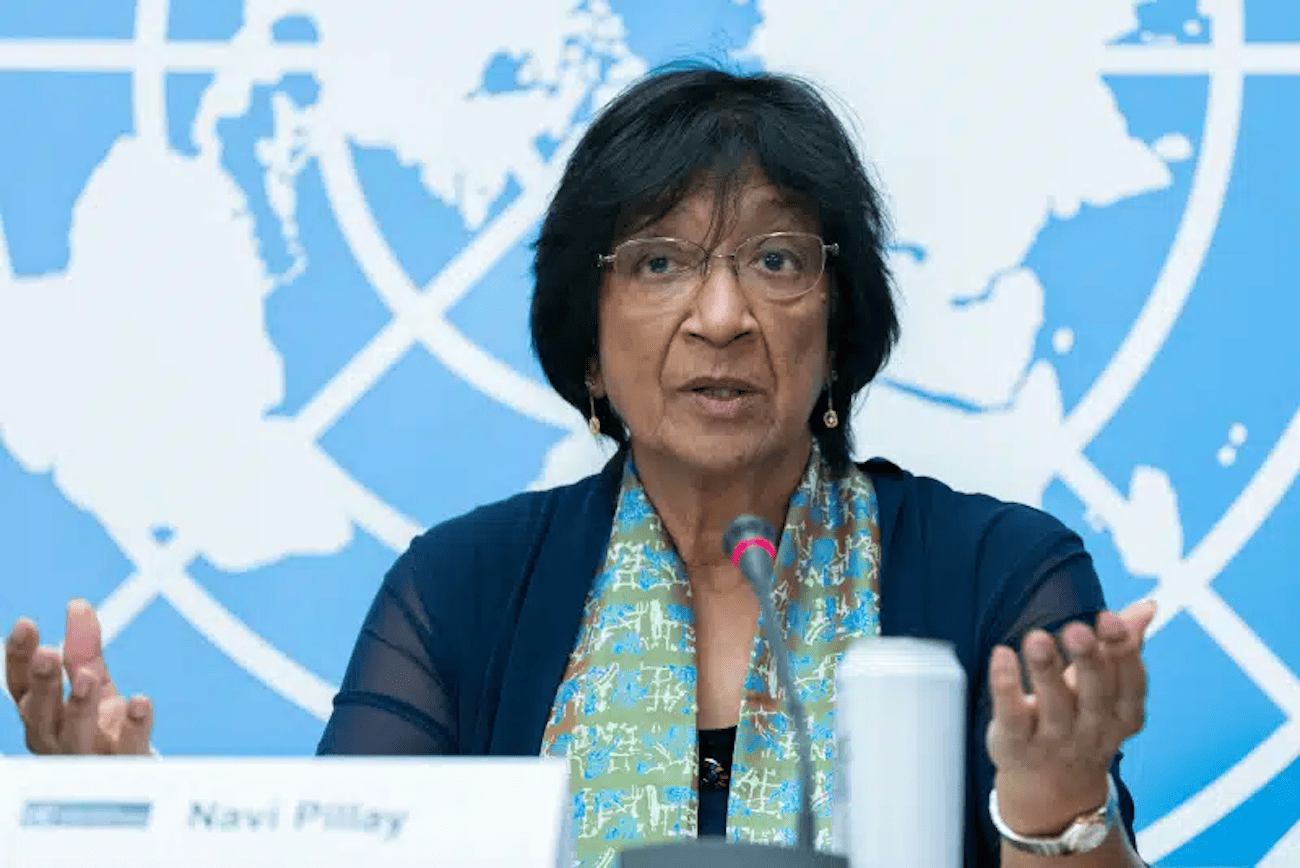

The former U.N. human rights chief is being recognized for advancing international law and accountability for atrocities. Her leadership of a commission that concluded Israel committed genocide in Gaza has made her a prominent and contentious figure in the debate over the war.
Navanethem “Navi” Pillay, a South African jurist of Indian Tamil descent who spent decades confronting apartheid, prosecuting international crimes and defending human rights, was awarded the 2026 Nobel Peace Prize on Friday for her efforts to promote peace and international law.
The Norwegian Nobel Committee cited Pillay’s contributions to strengthening international justice and ensuring that war crimes, crimes against humanity and genocide can be prosecuted. The award also comes at a time when international courts and institutions are facing mounting political pressure over their investigations of powerful states and their leaders.
At 85, Pillay has built a career that spans South Africa’s struggle against apartheid, the international tribunal established after the 1994 genocide in Rwanda, the International Criminal Court (ICC) and the United Nations. Most recently, she chaired the U.N. Independent International Commission of Inquiry on the Occupied Palestinian Territory, including East Jerusalem, and Israel.
That role has brought her work into the centre of one of the world’s most divisive conflicts. A commission under her leadership concluded in September 2025 that Israel had committed genocide against Palestinians in Gaza, a finding the Israeli government forcefully rejected. The controversy has followed Pillay into the Nobel spotlight, underscoring the political consequences of efforts to hold governments accountable under international law.
From an Indian Tamil Family in Apartheid South Africa
Pillay was born in Durban in 1941 to a family of Indian Tamil origin. Her ancestors had come from India, and she grew up under South Africa’s apartheid system, which enforced racial segregation and denied the majority Black population basic political and civil rights.
Pillay was one of seven children in a poor family in Durban. Her father was a bus driver. In an interview with the U.N. in 2025, she recalled that her family struggled financially, challenging the assumption that Indian South Africans necessarily enjoyed greater privilege than Black South Africans under apartheid.
She married Gaby Pillay, a lawyer and anti-apartheid activist, in 1965. According to an RTE profile based on AFP reporting, he was also a political prisoner during apartheid, and Navi Pillay represented him while he was detained and tortured. The couple later divorced; Gaby Pillay died in the late 1990s.
Her Indian heritage is an important part of her personal history, but her career was shaped by the particular circumstances of growing up as a non-white woman in a society organized around racial hierarchy.
In a 2009 address to India’s National Human Rights Commission, when she was serving as U.N. High Commissioner for Human Rights, Pillay spoke of her affinity with India because her ancestors came from the country. She also drew a connection between her own experience of discrimination and the struggles against oppression in India and South Africa.
Pillay broke barriers in the legal profession early in her career. In 1967, she became the first woman to establish a law practice in Natal Province. She represented people targeted by the apartheid state, including political prisoners and anti-apartheid activists.
After apartheid ended, she became the first Brown woman appointed to South Africa’s High Court, in 1995. Her career subsequently took her beyond South Africa, where she helped shape the institutions and principles of international criminal justice.
A Landmark Role in Prosecuting Genocide
In 1995, Pillay joined the International Criminal Tribunal for Rwanda, established to prosecute those responsible for the genocide and other serious crimes committed during the country’s 1994 catastrophe. She later served as the tribunal’s president.
One of the most consequential cases during her tenure was the prosecution of Jean-Paul Akayesu, a former Rwandan mayor. The tribunal’s 1998 judgment established an important precedent by recognizing that rape and sexual violence could constitute acts of genocide when committed with the requisite intent to destroy a protected group.
The ruling helped establish that sexual violence in conflict was not simply an incidental consequence of war but could be central to the commission of international crimes.
Pillay subsequently served as a judge at the International Criminal Court from 2003 to 2008. She then became U.N. High Commissioner for Human Rights, serving from 2008 to 2014. In that position, she addressed human rights violations across regions and pressed governments to meet their obligations under international law.
The Nobel Committee’s recognition of Pillay reflects this long record rather than a single investigation. Its announcement emphasized her contribution to international legal institutions and the principle that state power does not place leaders beyond the reach of the law.
Pillay’s Position on Israel and Gaza
Pillay’s work on Israel and the Palestinians has become the most contentious chapter of her recent career.
As chair of the U.N. Commission of Inquiry on the Occupied Palestinian Territory and Israel, she oversaw an investigation into events and policies affecting Palestinians and Israelis. In a report released in September 2025, the commission concluded that Israel had committed four acts of genocide in Gaza, with the specific intent to destroy Palestinians in the territory as a group. It also concluded that senior Israeli officials had incited genocide. Israel rejected the findings and criticized the commission.
The commission’s findings followed the Hamas-led attack on Israel on October 7, 2023, in which about 1,200 people were killed and hostages were taken, and the subsequent Israeli military campaign in Gaza. Pillay’s position has been that the conduct of the war must be examined under international humanitarian and criminal law, regardless of the identity of the state or actors involved.

Importantly, the commission also investigated crimes committed by Hamas and other Palestinian armed groups. Its earlier reporting found that crimes and violations of international humanitarian law were committed during the October 7 attack and the subsequent conflict. Pillay has rejected accusations that scrutiny of Israel means ignoring crimes against Israeli civilians.
The genocide conclusion is a finding of the U.N. commission she chaired; it should not be confused with a final judgment by an international court. The distinction matters because genocide is a specific legal crime requiring proof of particular acts and intent. Israel has strongly disputed the commission’s conclusions.
Pillay’s critics, including Israeli officials, have accused her and the commission of bias. Supporters argue that investigating allegations of grave crimes is precisely what international human rights mechanisms are meant to do, particularly when civilian suffering is extensive and accountability is contested.
The Nobel Committee did not present the award as a judgment on every finding in the Gaza report. Its stated rationale was Pillay’s broader work to advance international law and accountability. But the timing and prominence of her Gaza investigation inevitably place the Israeli-Palestinian conflict within the public discussion of the prize.
A Prize for International Law at a Time of Pressure
Pillay received news of the award while attending a legal conference in Nuremberg, Germany, a city associated with the post-Second World War trials that helped establish modern international criminal law.
The award was announced on the same day the United States imposed further sanctions on the International Criminal Court, part of a campaign by President Donald Trump’s administration against the court and its actions involving Israel. The juxtaposition highlighted the growing conflict between international legal institutions and governments that view their investigations as illegitimate or politically motivated.
Pillay continues to serve as an ad hoc judge at the International Court of Justice in the case brought by The Gambia against Myanmar under the Genocide Convention. The case concerns allegations of genocide against the Rohingya Muslim minority. Her continued involvement in international judicial work reflects a career devoted to applying legal standards across national and political boundaries.
The Nobel Peace Prize places Pillay among a small group of South Africans recognized for their contributions to peace and justice, including Nelson Mandela, Archbishop Desmond Tutu and Albert Luthuli.
For Pillay, the award recognizes a lifetime spent challenging the proposition that governments can act without accountability. Her journey from a family of Indian Tamil origin in apartheid-era Durban to the highest levels of international justice also gives her achievement a distinctive place in the history of the Indian diaspora.
Her conclusions on Gaza will remain fiercely contested. But the central principle behind her career—and the Nobel Committee’s stated reason for honoring her—is that international law must apply even when the accused are powerful, politically influential or allied with the world’s strongest states.