




A Cultural Confluence: Jaipur Literature Festival in New York Showcases Leaders in Different Fields of Endeavor

- As part of its North American tour, Jaipur Literature Festival in the Big Apple featured acclaimed writers, thinkers, artists and scholars exploring art, literature, culture, politics and AI, to understand the forces that shape our world.
The New York edition of the Jaipur Literature Festival (JLF NY) was held over two days in Brooklyn and Manhattan at the end of September, 2026. JLF NY, the international edition of JLF, is at its 10th edition while the original JLF in the Pink City of Jaipur in India turns twenty next year.
Given the popularity of the original festival, visitors like me can only be glad that the festival’s international chapter is held in New York. In his 2026 inaugural address in Jaipur in January the festival’s co-director, historian William Dalrymple said that “there is a reason why this Festival has taken root in quite the spectacular fashion that it has…sometimes half a million people turn up to hear writers speak about books.”
In the recent past, JLF NY has hosted a vast array of well known names from a range of human creative endeavors such as filmmaker, actor and creative entrepreneur Shekhar Kapur, politician, author, and former diplomat Shashi Tharoor, bestselling author and diplomat Amish, physician and author Siddhartha Mukherjee, fashion designer Tarun Tahiliani, and publisher and media executive Aroon Purie, just to name a few.
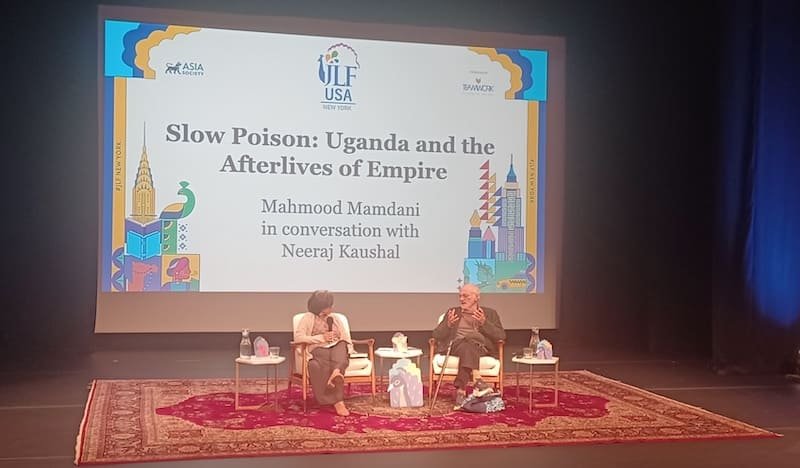
Above, Mahmood Mamdani, right, in conversation with Neeraj Kaushal at the
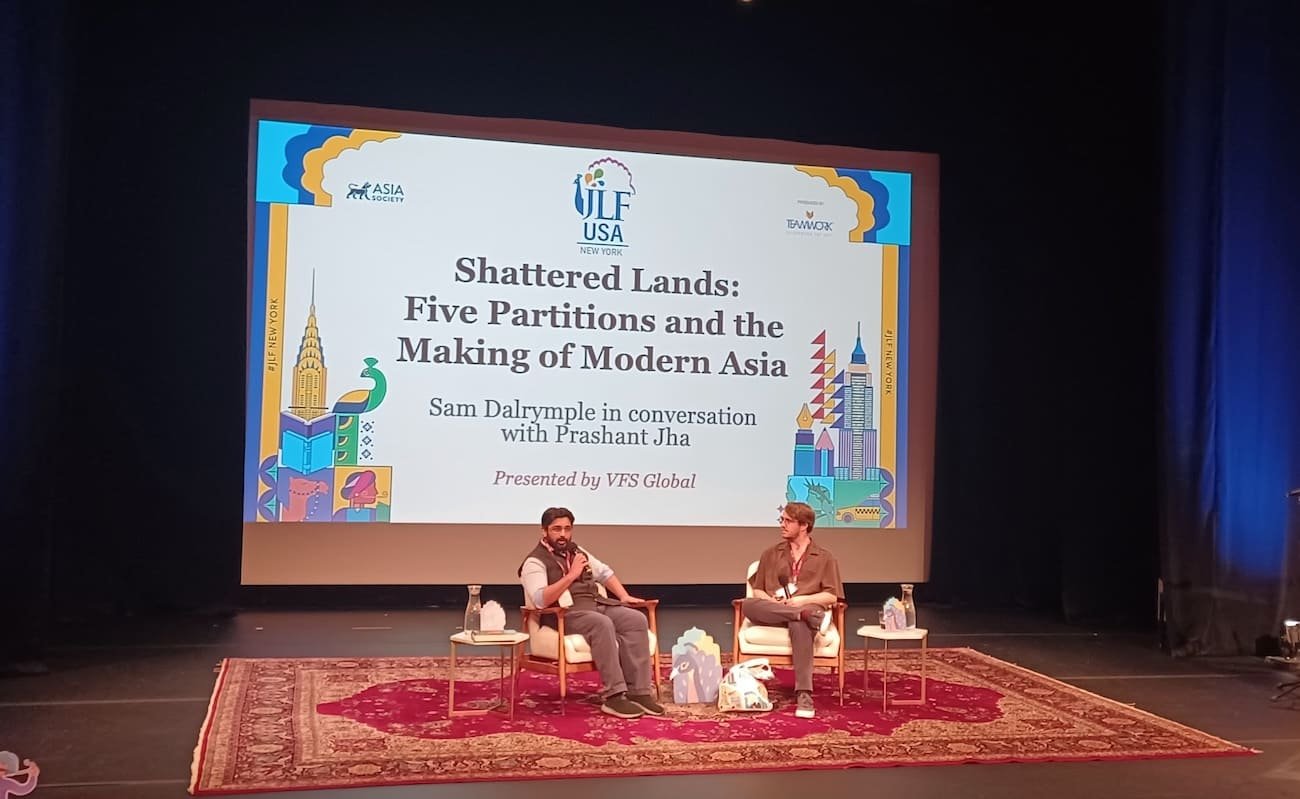
Jaipur Literature Festival in New York. Top, Sam Dalrymple, right, talking to Prashant Jha. Photos by Madhura Bandyopadhyay.
New York is not foreign to literary and cultural extravaganzas, especially in these autumn months. There are events such as the Brooklyn Book Festival, which was also held in the city the same month, that are very vast and then there are more focused events on specific cultural heritages involving communities from different parts of the world that are also intrinsic to the city’s culture.
What draws me to JLF NY every year is the event’s ability to bridge aspects of disparate social and cultural spheres seamlessly even as it focuses on certain specificities. JLF NY is for all, not just for the South Asian community. As Sanjoy K. Roy, Managing Director of Teamwork Arts, the organization which brings the international edition of JLF to NY and develops programs with local partners shared in a text exchange with me, “given the width and depth of the conversations,” it is a festival for everyone.
The panels and performances featured a vast array of issues, including AI, tech, travel, history, biographies, science, health, paranormal experiences, fiction, and more. JLF NY deals with deep, complex issues and yet does not forget to remain entertaining and fun, even funny at times.
The participants seemed as diverse as the subject matters they covered. The sessions were held at three venues: Asia Society and The National Arts Club in Manhattan and The Center for Fiction in Brooklyn. Two sessions on art featured stalwarts such as Vishakha Desai, art historian, educator and former President of Asia Society and Sonya Rhie Mace, scholar and curator of Southeast Asian and Indian art at the Cleveland Museum of Art. Other panels featured Indian American novelist Alka Joshi, historian, author and filmmaker Sam Dalrymple, renowned scholar Mahmood Mamdani, author and Pulitzer Prize winning historian Kai Bird and researcher Susan Goldmark.
In conversation with the participants in the panels were specialists in their fields as well, such as writer, cultural critic, and former dean of Columbia University’s School of the Arts Carol Becker, screenwriter and academic Sabrina Dhawan (who also happens to be the screenwriter for the film “Monsoon Wedding”), journalist Prashant Jha and journalism and digital communications expert Sree Sreenivasan. Sanjoy K. Roy participated in a session as an author in conversation with writer Sohaila Abdulali where they discussed Roy’s memoir when he talked about his encounters with ghosts, mischievous, mysterious, scary or simply annoying. Roy was very funny as he described his encounters with these supernatural creatures across the globe blending reality, imagination and tradition.
The last act of the festival was “HeartBeat,” a solo, emotive dance performance by dancer and actor Mayuri Bhandari, conceptualized by architect, jazz musician and multidisciplinary artist Christopher Janney set against the actual heartbeat of Bhandari.
A panel on AI and human collaboration featured Nitin Seth, Vinita Gupta and Meredith Broussard in conversation with Roopa Unnikrishnan. This panel’s members were entrepreneurs, professors and corporate strategists who all had the unique commonality of also being authors. There were creative arguments and healthy disagreements about AI in the age of co-intelligence and “about knowledge, trust, originality, and what remains uniquely human.” Unnikrishnan, who moderated the panel, is not only an author like the others and a business strategist, she is also a Rhodes Scholar and a Commonwealth Games gold medalist in rifle shooting.
.
A theme in multiple panels was colonialism and its aftermath and how empire has molded our lives today. Panelists talked about how colonialism has shaped our borders, created fractured identities and given rise to issues of immigration and migration through the legacies of empire.
Sam Dalrymple discussed his book “Shattered Lands: Five Partitions and the Making of Modern Asia” in conversation with Prashant Jha, tracing the dramatic unmaking of Britain’s colonial Empire, once spanning from the Red Sea to Southeast Asia that carved out twelve nations. He proved as articulate and as convincing a researcher as his father, historian William Dalrymple, who is a co-founder of JLF. In the session, Sam Dalrymple first debunked the myth that the only man-made structure reputed to be visible from space was the Great Wall of China (it isn’t visible even if you squint, he said). Then he showed us a dramatic photograph of the India-Pakistan border region from space where a river winds through like a (partial) natural division as it runs through the region between present day India and Pakistan. None of the other nations out of the twelve have anything natural about their borders as seen from above.
Mahmood Mamdani discussed his book “Slow Poison: Idi Amin, Yoweri Museveni, and the Making of the Ugandan State” with Columbia professor Neeraj Kaushal, “reflect[ing] on Uganda’s turbulent postcolonial journey through the rise of Idi Amin, the long rule of Yoweri Museveni, and the global forces that shaped both.” Biographer Kai Bird and his co-author and researcher Susan Goldmark talked about their book “American Scoundrel,” the biography of Roy Cohn, where they “[uncover] the extraordinary and unsettling life of Roy Cohn, the ruthless lawyer, fixer, and political operator whose methods and worldview helped shape modern American politics and whose most enduring protégé was Donald Trump.”
It felt different hearing from the authors themselves about their books. Kai Bird told us about his surprise when a simple phone call to Trump had yielded a “Hello.” Sam Dalrymple quoted the lyrics of an old Bollywood song, “Mere piya gaye Rangoon…,” well known to the audience, as he expressed his puzzlement as to why no one ever thought about why anyone’s love would have to go to Rangoon at all, as he explained the domino effect of Burma’s partition in Asia.
When discussion of an aspect of Mahmood Mamdani’s new book led to a nuanced point about the expulsion of South Asians from Uganda, the moderator Neeraj Kaushal playfully commented that New York City believes in being welcoming to immigrants. From the depths of this complex discussion, Professor Mamdani, who otherwise has a very academic demeanor, suddenly looked up and quipped: “You have been listening to the Mayor.” Even though no one had mentioned the Mayor, his son, Zohran Mamdani, the audience burst into laughter and a very loud applause.

It is moments like these that made JLF NY very special. As I heard about the corruption that plagues postcolonial Uganda, I thought of India. As I heard about the promises and dangers of AI and its possibilities for creative thinking, I was reminded of the session on art the previous day when the speakers challenged the assumption that art was a luxury, to indulge in only sometimes, okay as a pre-pubescent activity almost, before one moved on to more serious pursuits. I thought of the young audience member in that panel who claimed that she worked on AI art, in a panel that was mostly about conventional art and artists. She was an artist too, she said, but she painted with code instead of the paintbrush. The role of imagination in any sphere of activity was repeatedly stressed in that panel which carried over, for me, into subsequent panels at other venues.
Another remarkable moment was when Carol Becker alluded, without naming names, to New York City’s support for the arts in the current administration. She said that we are now being governed by someone who supports the arts. He is someone who not only campaigned in poetry, but contrary to expectations critical of his methods, governs in poetry as well. This comment received much applause.
The session on Kai Bird and Susan Goldmark’s book too seemed tailored to a New York and largely immigrant audience as compared to another recent event I had been to in Manhattan which had featured the same speaker duo. As Sree Srinivasan, who moderated that JLF NY session said, it is true that Roy Cohn might have been very familiar to people in the New York scene before most of the people in the current audience arrived in New York. However, his protege, Donald Trump’s influence on immigrants was not unknown to this present audience at all.
The last act of the festival was “HeartBeat,” a solo, emotive dance performance by dancer and actor Mayuri Bhandari, conceptualized by architect, jazz musician and multidisciplinary artist Christopher Janney set against the actual heartbeat of Bhandari who danced to rhythmic heartbeats heard through onstage speakers that changed rhythm expressing moods and physical movements against music by an ensemble of musicians on stage. Symbolically, the performance, which drew “parallels between Indian ragas and jazz — both rooted in structured improvisation,” seemed to bring together the disparate, sometimes converging, sometimes conflicting threads of the event together into a creative, calming conclusion.
While JLF NY is over this year, Devjani Dev, the newly-appointed Executive Director of JLF New York has announced that it will continue to be in this media capital every month with a new Author Spotlight series and The Readers’ Circle (which will take New Yorkers beyond the traditional author talk).
This is certainly something to look forward to. Perhaps South Asian aunties (present author not excluded) can now turn to their young nieces and nephews and point to a great literary festival in the city that celebrates the arts, books, ideas and culture that young people can attend even if they are slated to become the doctors, lawyers, engineers or finance professionals their parents want. Perhaps along the way, the festival will inspire some of these young folks to write books or become artists or simply, “follow knowledge like a sinking star/ Beyond the utmost bound of human thought.” Perhaps creativity, fostered by festivals like these, will be key as young people learn to navigate being human in the age of AI.
Madhura Bandyopadhyay teaches in the English Department at John Jay College, City University of New York (CUNY) in Manhattan, New York. She grew up in Kolkata, India and has lived in Florida, California and Singapore. She now lives and works in the New York City area.