




An Indian American Voice on America’s Most Painful Questions: Anand Giridharadas’s ‘Man in the Mirror’ Is One of the Decade’s Defining Works

- A National Book Award finalist published on September 29, the son of Indian immigrants who grew up in Shaker Heights, Ohio, has written his most ambitious and most immediate book — a 480-page narrative account of Jordan Neely's death and Daniel Penny's trial that asks what America owes its most abandoned citizens.
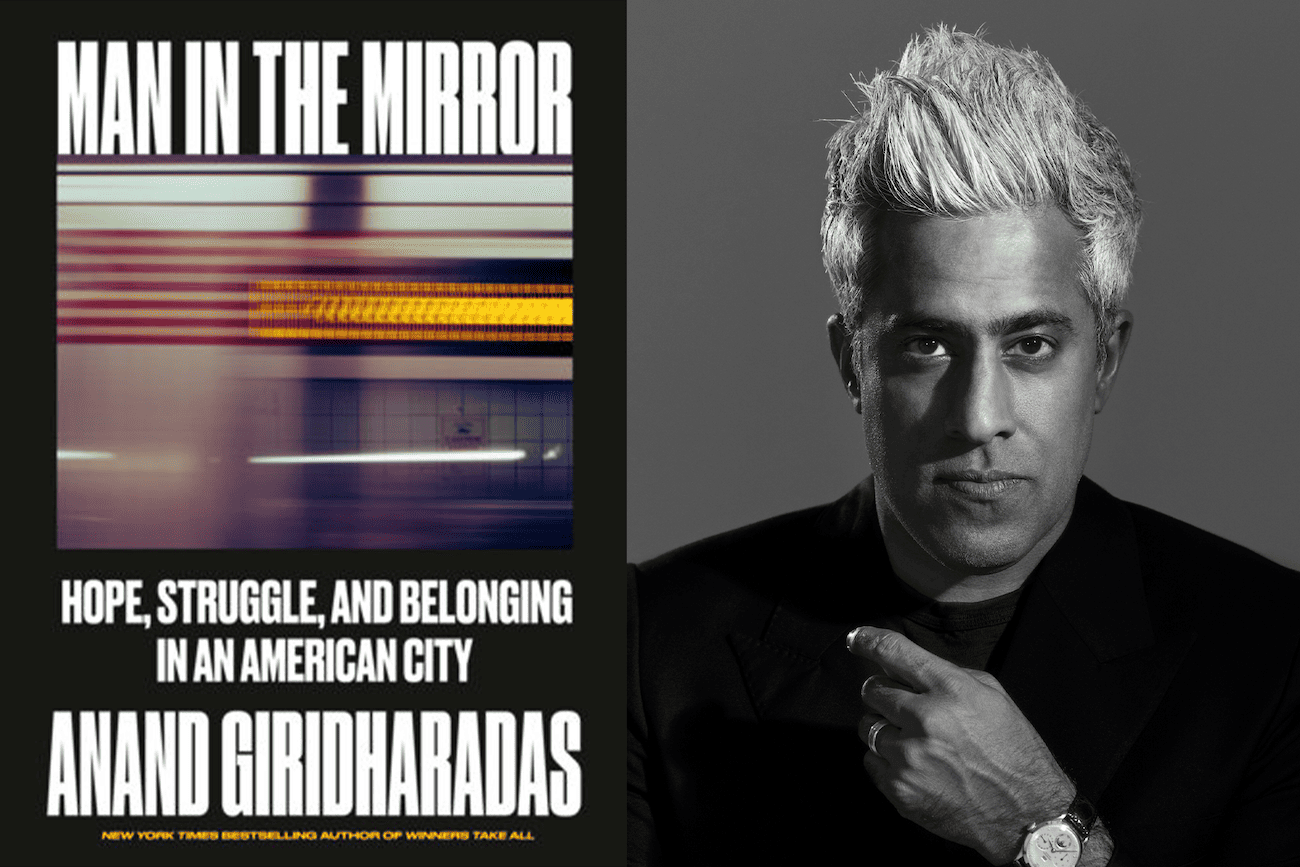

On Monday, September 29, 2026, Anand Giridharadas announced the arrival of “Man in the Mirror: Hope, Struggle, and Belonging in an American City” on his Substack newsletter The.Ink — his primary public-facing platform since he stepped back from regular television punditry to focus on long-form journalism.
“Today MAN IN THE MIRROR is in the world,” he wrote. He noted that the New York Times review had landed — written by Scott Turow, the bestselling legal thriller author who is himself a former prosecutor — alongside a New Yorker excerpt published three days earlier, a three-day residency on “Morning Joe” devoted to discussing the book, and a New York Times essay on “abandonment as a defining political emotion of the age.”
By publication day, the book was already a National Book Award finalist, a New York Times bestseller, and an IndieBound bestseller, according to the Kirkus Reviews listing. It had received starred reviews from Kirkus and BookPage. It had collected endorsements from George Packer, Min Jin Lee, Andrew Solomon, Robert Reich, Scott Turow, and Richard Price — a roster of literary, intellectual, and progressive establishment voices suggesting that the book had been received, before its commercial release, as precisely what its subtitle claims: an indispensable portrait of an age.
The Shaker Heights Kid: A Biography of American Aspiration
Anand Giridharadas was born in Shaker Heights, Ohio — the Cleveland suburb whose history of deliberate racial integration and upper-middle-class professional culture has also produced, among others, the Obama-era Secretary of Defense Ash Carter and a disproportionate number of writers and academics — to parents who had left India in their twenties to pursue new opportunities and greater freedom in the United States, as the Goodreads biographical summary of “India Calling” documented from the book’s own framing.
His parents’ immigration — the specific Indian professional migration that brought engineers, doctors, and academics to American suburbs in the 1970s and 1980s — is the biographical substrate of his first book and the cultural formation against which every subsequent book has been a kind of extended argument. He is, as he has acknowledged in multiple interviews, the product of exactly the meritocratic immigrant success story that American mythology celebrates and that his later work subjects to sustained critical pressure.
He attended college and then moved to India as a foreign correspondent for the New York Times — the paper where he eventually served as a foreign correspondent based in Mumbai and later as a columnist from Paris. He was the Times’s India correspondent from approximately 2005 to 2009, before returning to the United States and building the combination of journalism, book writing, newsletter publishing, and television commentary that has defined his career since.
He is the author of five books, all reviewed substantially below: “India Calling” (2011), “The True American” (2014), “Winners Take All” (2018), “The Persuaders” (2022), and “Man in the Mirror” (2026). He has also written for The New Yorker, The Atlantic, and Time, hosted the talk show “Seat at the Table with Anand Giridharadas,” and publishes The.Ink — his own paid newsletter on politics, democracy, and public life. He is an on-air political analyst for MS NOW. He has received the Radcliffe Fellowship, the Porchlight Business Book of the Year Award, Harvard University’s Outstanding Lifetime Achievement Award for Humanism in Culture, and the New York Public Library’s Helen Bernstein Book Award for Excellence in Journalism, as the Goodreads author biography confirmed.
He lives in New York.
The Book: Jordan Neely, Daniel Penny, and the Question at the Heart of America
The story at the center of “Man in the Mirror” began on May 1, 2023, on a New York City F train. Daniel Penny, a white former Marine, placed Jordan Neely, an unhoused Black man suffering from schizophrenia and behaving erratically on the subway car, in a chokehold that killed him. Penny was acquitted of criminally negligent homicide in a trial that reflected broader tensions in a polarized country.
The case was widely reported in real time. The contrasting New York Times and New York Post headlines during Penny’s trial reflected the political divide — a divide in which Neely was simultaneously a tragic victim of mental health system failures and a symbol of urban disorder, and Penny was simultaneously a heroic defender of vulnerable subway riders and a vigilante killer of a Black man whose mental illness was treated as a presumption of danger rather than a medical emergency, as Goodreads reader summaries contend.
Giridharadas does not begin the book with the chokehold. He begins, as BookPage’s Virginia Reeves noted in the starred review, with the story’s reflections: the title’s “Man in the Mirror” is an exploration of reflections — who we see when we look at others, who we refuse to see, and what that refusal costs us. Oddly, as a NewsBeep-cited review noted, Bernard Goetz — the white New Yorker who shot four Black teenagers he claimed were threatening him in a 1984 subway incident, and who became a national symbol of vigilante urban self-defense — isn’t mentioned until page 60. The book takes its time situating the Neely-Penny encounter within the long history of New York’s relationship with race, mental illness, housing, and public space before arriving at the specific events it chronicles.
Inhabiting the perspectives of an unforgettable cast of characters, Giridharadas immerses us in the places where this story plays out, from the corridors of power in City Hall to subway benches where New Yorkers spend the night, from a Marine Corps base to a Harlem church in mourning — and, ultimately, to a courtroom where a riveting battle unfolds, as the Penguin Random House publisher description notes.
His street-level reporting is interwoven with analysis of generational changes in mental health care — specifically the deinstitutionalization movement that dismantled the state hospital system in the 1970s and 1980s, leaving millions of mentally ill Americans without structural support and producing the population that now sleeps on subway benches.
Neely’s own biography, as multiple advance readers noted from Goodreads, is one of the book’s most devastating threads. His story begins with the death of his mother Christie when he was 14 — she was killed by her boyfriend, most likely by way of a chokehold. The echo between the mother’s death and the son’s — both by chokehold, both ignored by systems that might have intervened — is not a coincidence Giridharadas deploys for cheap effect. It is the structural tragedy at the book’s center: the failure of institutions to protect people who needed protecting, accumulated across a lifetime, until the F train.
The book’s central moral question, as BookPage’s Reeves articulated it from her starred review, is one Giridharadas asks explicitly: “Who gets to be granted the assumption of humanity, of being a complex person full of wants and dreams and stories?” It is a question that organizes everything the book contains — the portraits of prosecutors and defenders, of Neely’s family and supporters, of Penny’s supporters and their specific cultural encoding — and it is the question that makes “Man in the Mirror” something more than a trial narrative.
The Critics: Nearly Unanimous, With One Pointed Caveat
The critical reception to “Man in the Mirror” is, across its published reviews as of publication day, overwhelmingly positive — with Kirkus and BookPage both awarding starred reviews, and both the Chicago Tribune and the New York Times publishing substantive assessments.
The Chicago Tribune called it “destined to become one of the decade’s defining works of narrative reporting,” as the Penguin Random House book page notes.
BookPage’s Reeves, in her starred review, concluded with a formulation that captures the book’s moral and journalistic achievement: “A stark and haunting snapshot of modern America, ‘Man in the Mirror’ reflects our divided nation and the costs of our disconnection from one another.”
Scott Turow, reviewing it in the New York Times, called it “an exhaustively reported book by a ferociously talented writer,” as the Amazon and Penguin Random House book pages both documented — high praise from a writer who is himself a former prosecutor and whose endorsement carries specific weight given the book’s courtroom dimensions.
The endorsements from fellow literary figures are unusually strong. Andrew Solomon, the National Book Award-winning author of “Far From the Tree” and “The Noonday Demon,” called it “a brave volume, profoundly researched, beautifully written, moving, and deeply felt.” Min Jin Lee, the National Book Award-nominated author of “Pachinko,” called it “a gripping American tragedy” and “a tremendous achievement.” George Packer — the National Book Award-winning journalist whose “The Unwinding” is “Man in the Mirror’s” closest contemporary analogue in the American narrative nonfiction tradition — called it “both riveting and deeply moving.” Robert Reich, the former Labor Secretary, called Giridharadas “a powerful and compassionate writer of extraordinary conviction.” Richard Price, whose crime novels have defined literary New York City street life, called it “a crisply written and compelling journalistic deep dive.” These are not perfunctory endorsements from publishing friends. They are substantive assessments from writers and thinkers who are themselves practitioners of exactly the kind of work “Man in the Mirror” attempts.
Kirkus was the most balanced of the major pre-publication reviews, calling it “penetrating narrative journalism” while noting two specific weaknesses. First: Giridharadas “empties his notebook of seemingly every utterance he recorded, bogging down some chapters with a surplus of repetitive and minimally informative quotes.” Second: “Even less productive are his observations on the appearance of the ‘Sephora-glazed’ women supporting Penny, who wore ‘heavily caked’ makeup and ‘were liable to dress like their daughters too long.’ Snark undermines the book’s moral seriousness.”
These are fair criticisms and not minor ones. A book that asks, as its central question, who gets to be humanized, risks undercutting that question when its author reduces Penny’s supporters to their makeup. Kirkus’s assessment — “Snark undermines the book’s moral seriousness” — is the single most important critical note the book has received, and it is one that Giridharadas, whose public persona has not always been free of a certain moralistic self-certainty, will need to reckon with.

An Indian American Voice
There is something specific and worth noting about the position from which Giridharadas writes “Man in the Mirror.” He is the son of Indian immigrants who came to the United States pursuing the promise of opportunity and made a life in Shaker Heights — a suburb built, in significant part, on the premise that racial integration was achievable through deliberate policy. He has spent his career arguing that the systems and institutions that enabled his parents’ successful immigration and his own comfortable suburban childhood are not working the same way for everyone — that the promise of American opportunity is systematically withheld from the Jordan Neelys of the country, and that the comfortable classes have structured their philanthropy, their politics, and their moral self-understanding to avoid confronting that fact.
In “Man in the Mirror,” that argument — which in “Winners Take All” was directed at the Davos class and in “The Persuaders” was directed at progressive organizers — is directed at the F train itself: the specific, enclosed space of a New York City subway car where a mentally ill Black man and a white former Marine encountered each other, and where the question of who would be humanized and who would be feared was answered in the most irreversible possible way.
Giridharadas has spent fifteen years asking, from his specific vantage point as an Indian American intellectual who has moved between Mumbai and Ohio and New York and Paris, what America is and who it is for. “Man in the Mirror” is the book in which that question is least academic and most immediate — asked not of hedge fund managers at Davos or progressive activists at retreats but of a city whose subway system contains all of humanity at once, and where the answer was written, on May 1, 2023, in a matter of minutes.
The mirror of the title is the one that the story holds up to America. What the country sees reflected in it is something “Man in the Mirror” documents but does not resolve — because the resolution, if one is coming, is not a book’s to provide.
The Trajectory: Five Books, One Expanding Argument
Giridharadas’s five books constitute one of the most coherent and deliberately constructed intellectual trajectories in contemporary American letters — each one building on the questions raised by its predecessor and expanding the frame of analysis.
“India Calling: An Intimate Portrait of a Nation’s Remaking” (2011) was the first and most personal — a young Indian American’s return to his ancestral country during its post-liberalization economic boom, filtered through the stories of specific individuals navigating that boom’s opportunities and dislocations. The Plain Dealer called him “a marvelous journalist — intrepid, easy to like, curious.” Gaiutra Bahadur, reviewing it for the New York Times, wrote that the book “has what Hanif Kureishi once described as ‘the sex of a syllogism.’ Full-figured ideas animate every turn.”
“The True American: Murder and Mercy in Texas” (2014), published by Norton, was Giridharadas’s first sustained venture into American narrative journalism — the story of Mark Stroman, a white supremacist who killed two South Asian immigrants and blinded a third, Rais Bhuiyan, in the aftermath of the September 11 attacks. Bhuiyan subsequently campaigned to save Stroman’s life, arguing against his execution on grounds of forgiveness and human dignity. The book prefigures “Man in the Mirror” in its interest in the moral complexity of victims, perpetrators, and the systems that produce both.
“Winners Take All: The Elite Charade of Changing the World” (2018), published by Knopf, was the book that made Giridharadas a genuinely contentious public intellectual — beloved by those who agreed with its argument that the wealthy and powerful had captured the language and institutions of social change to perpetuate their own advantage, and resented by the Davos class it targeted. Nobel laureate economist Joseph Stiglitz, reviewing it in the New York Times, praised Giridharadas for writing “on two levels — seemingly tactful and subtle — but ultimately he presents a devastating portrait of a whole class, one easier to satirize than to reform,” as Wikipedia confirmed. It won the Porchlight Business Book of the Year Award.
“The Persuaders: At the Front Lines of the Fight for Hearts, Minds, and Democracy” (2022) shifted from critique to possibility — examining political organizers, campaigners, and communicators who were attempting to change minds rather than simply condemn those who disagree. It reflected a maturation in Giridharadas’s thinking: from the sharp indictment of “Winners Take All” to the more measured question of what actually changes people.
“Man in the Mirror” (2026) represents yet another evolution — and, in the assessment of the critics who have reviewed it, his most accomplished single work.