




Two Indian Americans, Two Uphill Climbs: Where Vivek Ramaswamy and Nithya Raman Stand Four Weeks From Election Day

- An Ohio Republican who was once the presumptive favorite finds himself nine points down in two new polls. A Los Angeles progressive who entered the race three hours before the filing deadline is now leading the incumbent mayor by double digits. November 3 will decide whether either of them makes American political history.
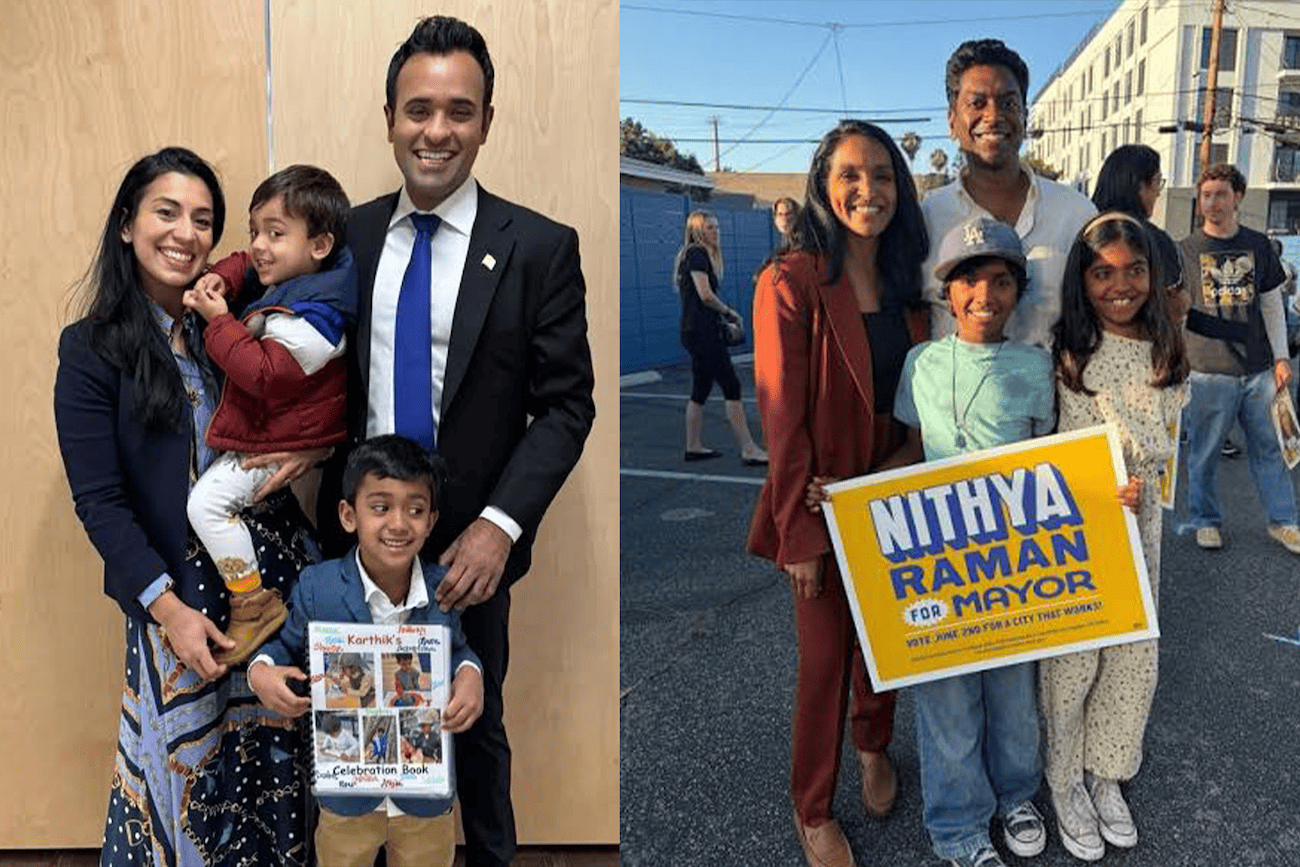

On November 3, 2026, voters in Ohio and Los Angeles will go to the polls in what have become two of the most closely watched races of the midterm election cycle — each of them featuring a candidate of Indian origin, each of them with historic implications, and each of them, as of the first week of October, pointing in a direction that would have seemed implausible at the start of the year.
In Ohio, Vivek Ramaswamy — the biotech entrepreneur, former Republican presidential candidate, and son of Indian immigrants from Kerala — has been dealt what Newsweek called a “double polling blow” in the past week, with two major surveys showing him trailing Democrat Amy Acton by nine points in one poll and six points in another. A race that Cook Political Report and Sabato’s Crystal Ball both rate as a tossup is being described as one in which Ramaswamy faces “political headwinds, questions about his appeal as a candidate, and attacks over his Hindu faith and Indian heritage.”
In Los Angeles, Nithya Raman — the Tamil American city council member, Harvard and MIT-educated urban planner, and Democratic Socialists of America member who entered the mayoral race three hours before the filing deadline in February — leads incumbent Mayor Karen Bass by 11 points in the most recent independent poll, commands a 60-to-39 percent edge in the Polymarket prediction market, and has opened a lead of 45 to 21 percent among Latino voters in the Berkeley IGS/LA Times poll. Bass has a 63 percent unfavorable rating. Raman is 45. Bass is 72.
Both races will be decided on November 3. Both would produce Indian American firsts if their respective South Asian candidates win. And both are, right now, telling very different stories about which direction the electorate is moving.
Ohio: The Tossup That Is No Longer Looking Even
Vivek Ramaswamy entered the 2026 Ohio gubernatorial race in February with every structural advantage a Republican candidate could want. Ohio has not elected a Democratic governor since 2006. The state has moved decisively toward Republicans in successive presidential elections, with Donald Trump carrying it by more than ten points in 2024. Ramaswamy had Trump’s personal endorsement, his own multimillionaire self-funding capacity, and a national profile built through his 2024 presidential campaign. He looked, to many analysts, like a man who could not lose in his home state.
Four weeks from Election Day, the polling landscape has deteriorated significantly.
The Suffolk University/USA TODAY Network Ohio poll, released on September 29 and confirmed by Political Wire, found Acton ahead 50 to 41 percent among likely voters — her strongest lead in that poll to date and a margin outside the poll’s 4.4 percentage point margin of error. A Marist poll released the same week found Acton ahead 50 to 44 percent among registered voters. A third poll, by Big Data Poll, showed Ramaswamy with a slight lead of 45.1 to 42.7 percent, as Newsweek reported from its comprehensive polling roundup.
Both the Suffolk and Marist polls showed that Acton’s strengths are coming from women and independents, both groups President Donald Trump carried in Ohio in 2024 by low single digits. In the Suffolk poll, she led Ramaswamy 55-36 percent among women and by 64-27 percent among independents. In the Marist poll, Acton led among women 53-41 percent and independents 57-32 percent.
The polling trajectory — from a Ramaswamy lead of 50-45 in an April Bowling Green State University poll, to a tied race at 47-47 in the Times/Siena survey, to a nine-point Acton lead in Suffolk — describes a race in which the challenger has gained steadily across the summer and fall. The governor’s race is currently rated as a “Toss-up” by forecasters Cook Political Report and Sabato’s Crystal Ball, as the Ironton Tribune confirmed from the official forecaster designations.
Ramaswamy’s difficulties, as Jayujyoti Mullick documented in a comprehensive October 4 analysis in American Bazaar, stem from multiple sources. The Suffolk University/USA TODAY Network Ohio poll found widespread pessimism about the state’s economy, dissatisfaction with the direction Ohio is heading, and disapproval of Trump’s job performance — factors the pollsters said are contributing to Ramaswamy’s difficult race. Ohio’s Republican incumbent Governor Mike DeWine — whose endorsement Ramaswamy secured but whose governing record has diverged from Ramaswamy’s rhetorical positioning on multiple issues — has complicated the Republican coalition. DeWine’s defense of Acton over Ramaswamy’s attack ads, specifically disputing a Ramaswamy claim about Acton “calling off Ohio’s election at the last minute” in 2020, has denied Ramaswamy the unified Republican establishment support that an Ohio Republican candidate normally takes for granted.
The Acton campaign has not been without its own complications. The union endorsement picture is split — several large public employee unions including AFSCME Ohio and the Ohio Association of Public School Employees have backed Acton, while the Ohio State Association of Plumbers and Pipefitters and the Central Midwest Regional Council of Carpenters are backing Ramaswamy.
Their politics — Ramaswamy’s libertarian-inflected Republican nationalism and Raman’s democratic socialist progressivism — are as far apart as two American politicians can be. Their current electoral situations are, in the most important sense, mirror images.
On prediction markets: Kalshi gave Ramaswamy a 51 percent chance of victory while Polymarket gave Acton a 52 percent chance — the tightest possible split suggesting that sophisticated market participants view the race as genuinely uncertain despite the polling trend.
If elected, Ramaswamy would become Ohio’s first Indian American and billionaire governor and the first Hindu governor in the United States. Acton would be the first woman elected to the office and the state’s first Jewish governor.
Democrats have not won a gubernatorial election in Ohio since Ted Strickland’s 2006 victory.
Los Angeles: The Frontrunner Who Entered Three Hours Before the Deadline
Nithya Raman’s trajectory in the Los Angeles mayoral race is, arithmetically, the inverse of Ramaswamy’s in Ohio: a candidate who started the year as a distant challenger is now the clear polling frontrunner with four weeks to go.
The UC Berkeley Institute of Governmental Studies poll, co-sponsored by the Los Angeles Times and released Wednesday, surveyed about 2,000 likely voters. The poll, conducted September 15-20, gives Raman an 11-percentage-point advantage, although other recent surveys have shown a closer race.
The specific numbers from the Berkeley IGS poll are: Raman at 39 percent, Bass at 28 percent, with approximately 33 percent of likely voters still undecided.
Mark DiCamillo, director of the Berkeley IGS poll, said the numbers point to a bigger challenge for Bass: voters’ perception of her. “One of the reasons Bass is trailing is that her image among voters is highly negative, much more negative than Raman,” DiCamillo said.
Bass’s 63 percent unfavorable rating, as confirmed by the Berkeley IGS poll and documented by KTLA and Fox News, is the defining feature of her political situation. She has not recovered from the reputational damage inflicted by her absence in Ghana when the January 2025 Palisades Fire broke out — an absence she has explained but that the electorate has not, by these numbers, forgiven.
Zev Yaroslavsky, director of the LA Initiative at the UCLA Luskin School of Public Affairs, offered a measured assessment. “The mayor’s challenge, as it is Raman’s challenge, is to articulate a vision for the next four years,” Yaroslavsky said, as CBS Los Angeles reported from his analysis. He characterized the Berkeley IGS result as an outlier among other recent surveys showing a much closer race — a caveat that the prediction markets and the internal polling landscape partially support.


An internal Raman campaign poll conducted earlier this month showed her ahead 44% to 39%, while an August poll commissioned by an independent expenditure group supporting Bass had the mayor ahead 41% to 35%. The divergence between the candidate-commissioned polls and the independent Berkeley IGS result suggests a genuine range of uncertainty about the race’s true state.
The demographic breakdown of the Berkeley IGS poll’s Latino voter findings is striking. Among likely Latino voters in the Los Angeles Times poll, Raman leads Bass 45 percent to 21 percent, with 34 percent undecided. But the generational split within that community is even sharper: among Latino voters ages 18 to 49, Raman leads Bass 60 percent to 9 percent. Among Latino voters 50 and older, Bass leads Raman 36 percent to 26 percent. That youth-Latino coalition — if Raman can turn it out — would represent a formidable electoral base in a city where Latino voters have historically been underrepresented in mayoral election turnout.
“Her task is a little less onerous than Bass’,” poll director Mark DiCamillo told the Times.
Among younger voters overall, the Berkeley IGS poll found 66 percent of likely voters ages 18 to 29 choosing Raman while just 4 percent chose Bass, as KTLA confirmed from the poll’s demographic crosstabs.
The Polymarket prediction market, which as of October 4 had $14.85 million in volume traded on the race, gave Raman a 59.7 percent probability of winning and Bass 39 percent.
Bass has continued to campaign on her record on affordable housing — which the Berkeley IGS poll identified as one of the top issues for likely voters alongside crime and infrastructure — and has downplayed the Berkeley IGS lead while defending her tenure. “I don’t see Raman as the frontrunner,” Bass said.
If Raman wins, she would become the first woman and first person of color to serve as mayor of Los Angeles — and the first person of Tamil Indian heritage to lead one of the three largest cities in the United States.
A Tale of Two Campaigns — and Two Communities
The parallel candidacies of Ramaswamy and Raman in the final stretch of the 2026 midterms illuminate a community in transition. Both are the children of Indian immigrant professionals. Both would make American history if elected. Their politics — Ramaswamy’s libertarian-inflected Republican nationalism and Raman’s democratic socialist progressivism — are as far apart as two American politicians can be. Their current electoral situations are, in the most important sense, mirror images.
Ramaswamy is fighting to keep a state that Republicans should own. Raman is fighting to take a city that the Democratic establishment is defending. The same November 3 that could make Ramaswamy Ohio’s first Indian American governor could also make Raman Los Angeles’s first woman of color mayor.
Or it could do neither. There are four weeks left. There are a lot of undecided voters in both places. And as the polling in both races has consistently demonstrated, the gap between where the numbers stand and where the votes fall on Election Day is not always as small as the models suggest.