




Why It Matters Now: Pakistani American Akbar Shahid Ahmed’s Definitive Account of How Biden and Harris Failed Gaza

- The journalist who reported from Israel-Palestine has written, “Crossing the Red Line: Biden, His Advisors, and Israel's War in Gaza,” a book that Pulitzer Prize winners are calling "devastating" and “essential."
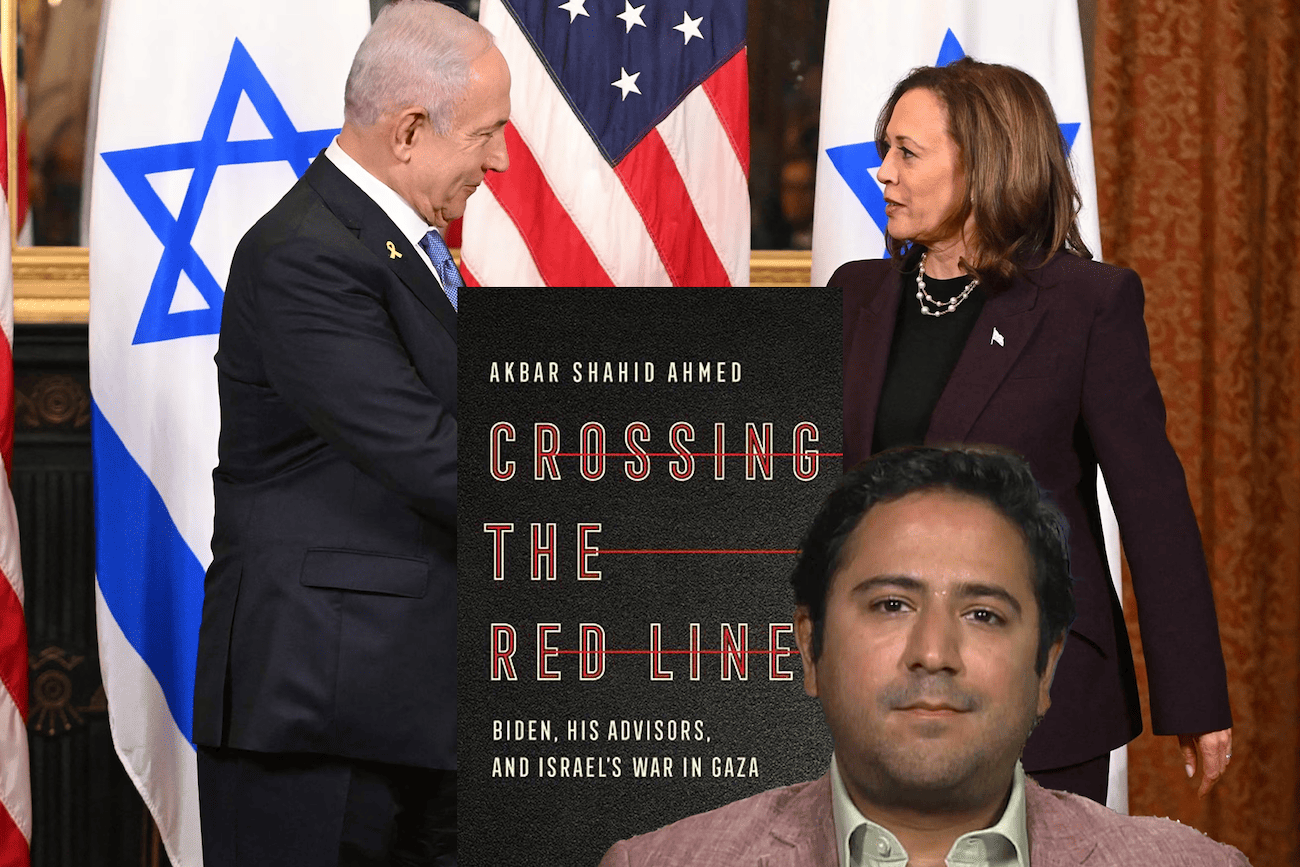

“Crossing the Red Line: Biden, His Advisors, and Israel’s War in Gaza” by Akbar Shahid Ahmed was published today, September 22, 2026, by W. W. Norton & Company in the United States. It arrives at a moment when the political consequences of the events it chronicles are still unfolding: an administration that enabled what the book documents as tens of thousands of avoidable deaths is out of office, but the patterns of impunity it established are, Ahmed argues, actively shaping the even darker foreign policy course of the Trump administration that followed it.
The timing is not coincidental. The book is also the most thoroughly reported account yet of a period whose full history the Biden administration’s principals have not yet offered in their own words — and whose documentation, drawn from Ahmed’s years of daily reporting, now constitutes the closest thing to an authoritative record that the immediate journalistic moment has produced.
The Book: What It Argues and How It Argues It
“Crossing the Red Line” is structured around the central image contained in its title: the moment in April 2024 when President Biden declared that a major Israeli assault on Rafah, where more than one million displaced Palestinians were sheltering, would constitute a “red line” that would risk Israel’s pipeline of American bombs. Israel proceeded with the Rafah offensive. The weapons kept flowing.
As the W. W. Norton publisher description and Amazon listing both documented, the book offers extensive reporting and chilling new details about how the Biden administration enabled Israeli Prime Minister Benjamin Netanyahu — ignoring warnings from government experts and implicating Americans in thousands of apparent war crimes. Washington did little to free Israeli hostages or shield innocent Palestinians as protests grew nationwide and international human rights principles crumbled.
The book’s indictment operates on two levels simultaneously. The first is operational: what specific decisions were made, by whom, at what moments, and with what consequences on the ground in Gaza, Lebanon, and Israel. The second is political: how those decisions contributed to the erosion of American credibility, the collapse of the Biden coalition, Kamala Harris’s 2024 election defeat, and the establishment of patterns of impunity that have, Ahmed argues, made Trump’s even more permissive approach to Israeli military operations politically and diplomatically possible.
The Biden administration’s decisions drove voter backlash that helped Donald Trump regain power, and established patterns of impunity that have spurred wider bloodshed under Trump.
The book’s sourcing is its greatest structural asset. With input from copious anonymous insider sources, as Publishers Weekly documented in its starred review, Ahmed portrays Biden as “deeply averse to wielding American leverage” against Israel and surrounded by a tight inner circle of pro-Israel hardliners, which left other staff “censoring themselves” and “doubting their instincts.” The book depicts the administration’s approach as both inhumane — with some officials overtly dismissive of Palestinian death tolls — and shockingly inept, such as in a callous response to reports of famine deaths that left one humanitarian aid expert “flabbergasted,” as the Publishers Weekly starred review documented.
The most damning single episode Ahmed documents, according to Publishers Weekly, is the brief improvement in humanitarian aid following Israel’s killing of seven World Central Kitchen workers in April 2024 — which demonstrated that American pressure could produce Israeli behavioral change — followed by the rapid reversal of that improvement, demonstrating that the administration chose not to sustain the leverage. He claims that, even after Trump’s reelection, the Biden administration kept fueling preventable, likely illegal killing, as Publishers Weekly documented.
Kirkus Reviews described it as a “robustly reported…detailed, damning assessment of President Biden’s response to the war in Gaza,” according to Bookshop.org’s compiled blurbs from the book’s critical reception.
The Blurbs: A Cross-Ideological Consensus
The endorsement list for “Crossing the Red Line” is itself a document of unusual ideological range — a reflection of the fact that criticism of Biden’s Gaza policy has united figures who agree on very little else.
Spencer Ackerman — the Pulitzer Prize-winning journalist and author of “Reign of Terror,” which examined the long-term consequences of the War on Terror — offered the most unsparing assessment: “Akbar Shahid Ahmed, the best journalist covering the Biden-Harris administration’s foreign policy, devastatingly chronicles just how evil its support for the Israeli genocide of Gaza was,” as the Amazon listing documented.
Joy Reid, the NAACP Image Award winner and New York Times bestselling author, wrote that Ahmed “reveals Israel’s U.S.-enabled genocide in Gaza as the greatest moral failing of the Biden administration… that stained what could have been a transformative presidency,” as both the Amazon Canada and Bookshop.org listings documented.
Ben Rhodes — who served as deputy U.S. National Security Advisor under President Obama and has been one of the most prominent establishment foreign policy voices to criticize Biden’s Gaza approach — called it “a meticulously reported record of the key moments, behind-the-scenes decisions, and political rationalizations of a Biden administration that could not find a way to say no to the unthinkable. This is essential reading,” as the Bookshop.org listing documented.
Ben Rhodes — who served as deputy U.S. National Security Advisor under President Obama — called the book “a meticulously reported record of the key moments, behind-the-scenes decisions, and political rationalizations of a Biden administration that could not find a way to say no to the unthinkable. This is essential reading.”
Omer Bartov — Dean’s Professor of Holocaust and Genocide Studies at Brown University and author of “Israel: What Went Wrong?” — offered what is perhaps the most explicitly scholarly endorsement: “This clearheaded and well-documented account constitutes a devastating condemnation of the fecklessness and incompetence of the Biden administration’s response to the Hamas massacre of October 7, and its wholesale complicity in the genocidal assault by Israel on Gaza… A must-read for anyone who still cares about the use of American power for good rather than evil and a clarion call to liberate U.S. policymakers from the hold of Israeli extremists and their American lobbyists,” as the Bookshop.org listing confirmed.
What the Book Is Not
The book’s critical reception has not included a significant counterargument from those who supported or continue to defend the Biden administration’s approach — a silence that is itself politically telling. Biden administration alumni have not publicly engaged with Ahmed’s specific documented claims in any sustained way.
It is worth noting what the book’s framing does and does not claim. It consistently describes Hamas’s October 7 attacks as “horrific” in both the publisher description and Ahmed’s own language, as the Amazon, Apple Books, and Shakespeare and Company listings all confirmed. The book’s moral architecture is not a defense of Hamas but a prosecution of the American policy choices that followed — a distinction that his critics will test and that his documented sourcing is designed to withstand.
The book also makes no claim to being a comprehensive history of the Gaza war itself. It is a Washington book — a book about decisions made inside the White House, the State Department, and the National Security Council — rather than a ground-level account of events in Gaza, Lebanon, or Israel. Its authority rests on its access to American decision-makers and its twelve years of institutional knowledge of the foreign policy bureaucracy Ahmed covered daily.
A Pakistani American Voice on America’s Deepest Foreign Policy Failure
The biographical dimension of the book’s authorship is worth dwelling on. Akbar Shahid Ahmed is a Pakistani American journalist who grew up in Karachi, who covered the Muslim-majority world for over a decade, who became the first Pakistani journalist ever credentialed to report from Israel-Palestine, and who has now written the most extensively sourced single account of how the United States government enabled what multiple United Nations bodies and international human rights organizations have described as potential war crimes and what several officials quoted in the book’s pages acknowledge as a catastrophic policy failure.
He came to the United States for his undergraduate education at Yale University, where he studied global affairs and completed the Brady-Johnson Program in Grand Strategy — Yale’s prestigious interdisciplinary certificate program that trains students in the historical and strategic dimensions of foreign policy — and served as an editor of the Yale Daily News, according to the Grabien media profile and the Georgetown biography.
At Yale, he also completed the Studies in Grand Strategy program, developing the theoretical framework for international relations analysis that would inform his subsequent career as a foreign affairs journalist. In addition to English, he speaks Urdu, Hindi, and French.
He joined HuffPost as a foreign affairs reporter and spent nearly twelve years there — eventually rising to Senior Diplomatic Correspondent — covering foreign policy from Washington while also reporting from across the Muslim-majority world, Europe, Asia, and the United States, as his HuffPost author page and Washington Sun biography both confirmed. His beats at HuffPost included the State Department, the National Security Council, and the foreign policy dimensions of the White House — precisely the institutional territory his book now excavates.
Among his career milestones: in 2019, he became the first-ever Pakistani journalist to secure an Israeli press credential to report from Israel-Palestine — a distinction that carries both biographical and professional significance, given that the country whose policies toward Palestinians he has spent years covering had never previously accredited a reporter from his country of origin. The same year, he was selected as part of the inaugural class of LGBTI fellows at the Atlantic Council.
His identity does not determine his journalism, but it informs the questions he has been most persistent in asking and the sources who have been most willing to speak to him — including the Muslim American government officials, the Arab American staff members, and the foreign service officers who found themselves, in his account, “censoring themselves” and “doubting their instincts” in a White House where the inner circle’s pro-Israel orientation foreclosed the policy conversations that the situation demanded.
For his Gaza coverage — the daily journalism from which this book grew — he received a 2025 Writers Guild Award for Outstanding Writing and a 2025 New York Press Club Award. He is now the diplomatic correspondent at The Washington Sun.
NPR’s Leila Fadel spoke with Ahmed about the book in a segment that aired today, the same day as publication, according to KLCC public radio’s documentation of the interview. A launch event at McNally Jackson Books in New York pairs him with New York Times columnist Michelle Goldberg, as McNally Jackson’s official event listing confirmed.
“Crossing the Red Line” is published today by W. W. Norton. It is 336 pages. It is, by the assessment of the journalists and scholars who have read it before publication, the most important book about American foreign policy to appear in 2026 — and possibly the most important American foreign policy book since Ahmed’s blurb-writer Ben Rhodes published his own account of the Obama years.
The red line was crossed. The weapons kept flowing. The book is in stores.
Neither President Biden nor Vice President Kamala Harris failed the Palestinians or Gaza. The fact is the rulers of Arab countries did not do the “walk the talk and Walk the Walk”. The Arab rulers in their quest for preserving their ruling status have outsourced their foreign and defence policies to the Western world and the United States. Neither Gaza nor the Palestinians genuinely figure much in the design of those policies.