




Do’s and Don’ts for Indian Americans: What a Viral Post Reveals About Cultural Friction Between Americans and Indian Immigrants

- Julie Borowski, a D.C.-area libertarian commentator's good-faith attempt to explain American social norms to Indian immigrants drew hundreds of thousands of views and a complex, often surprisingly nuanced conversation about culture, belonging, and the difference between adjustment and assimilation.
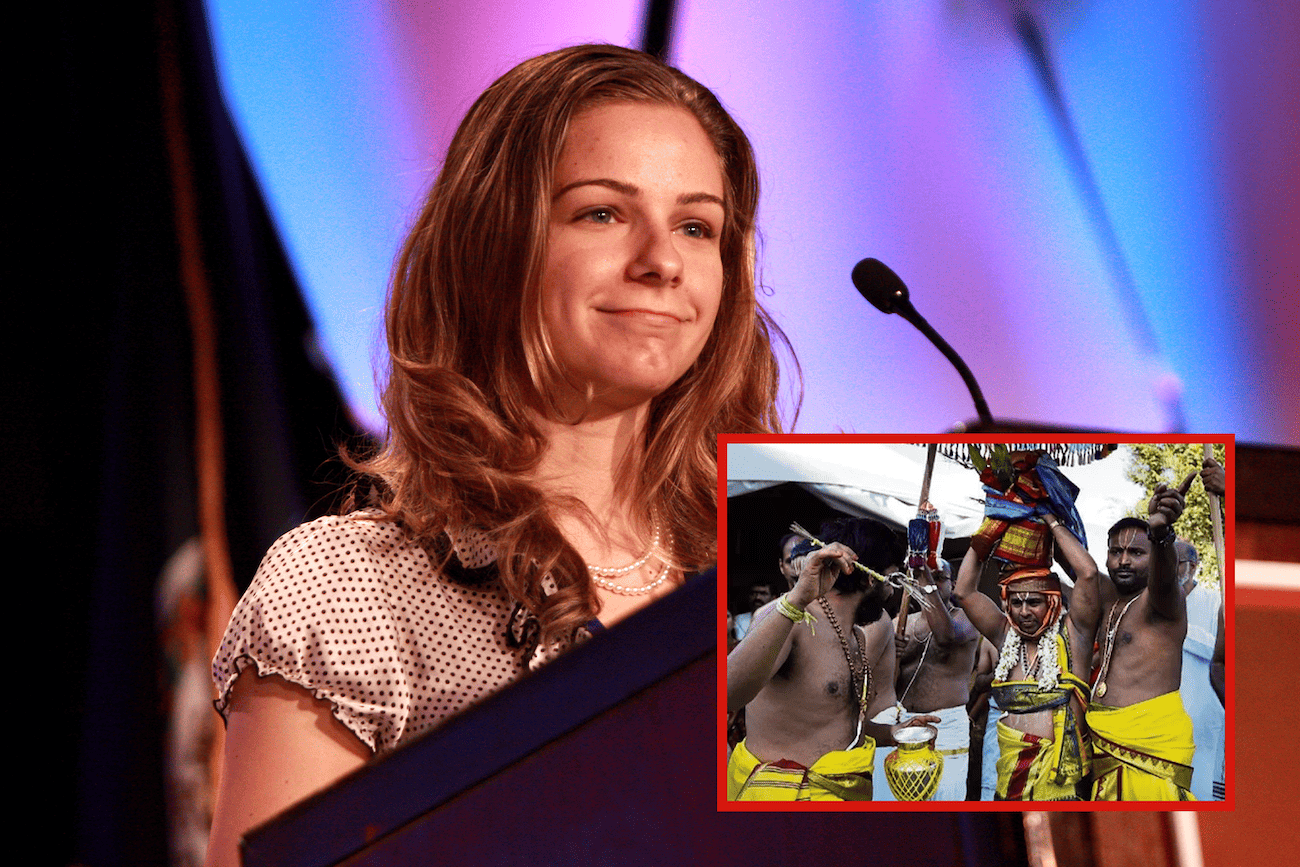

Julie Borowski is a libertarian political commentator and YouTuber based in the Washington, D.C. area, known for accessible, humor-inflected commentary on current events. Her YouTube channel has accumulated a substantial following over more than a decade of consistent video output, and she maintains an active presence on X where she regularly engages with questions of culture, immigration, and everyday social life alongside her more explicitly political commentary.
Her post on X — a list of American social norms she described as worth knowing for Indian immigrants who want to better understand American culture — was notable for what it was not. It was not a screed. It contained no ethnic slurs, no generalizations about Indian character, no claims about intellectual inferiority or cultural incapacity. It began and ended with explicit caveats: “obviously, none of these behaviors describes every Indian immigrant” and “some cultural friction simply comes from not knowing another country’s unwritten social expectations.” It was, in form and apparent intent, a practical guide — closer in spirit to a cross-cultural etiquette pamphlet than to the kind of nativist content that has dominated the anti-Indian rhetoric on X documented by the Center for the Study of Organized Hate.
And yet it generated significant discussion — because the norms it listed are, in fact, the norms that appear most frequently in verified social media discussions and informal surveys of mainstream American perceptions of Indian immigrants. Understanding what those perceptions actually are, where they come from, and how to evaluate them honestly is a genuinely important exercise — one that requires separating the observation from the prejudice, and the cultural difference from the character judgment.
Here is the full text of Borowski’s post on X:
I’ve been looking at some common complaints Americans have about Indian immigrants, and many seem to come down to differences in everyday social norms.
For Indian immigrants who want to better understand American culture, here are some unwritten norms worth knowing:
• Americans value personal space. Give people some room, especially strangers.
• We take lines very seriously. First come, first served. Cutting or crowding people in line is considered rude.
• Americans tend to value privacy. Questions about someone’s salary, weight, age, medical issues, marriage plans, or why they don’t have children can be considered too personal, especially if you don’t know them well.
• Respect personal property. Don’t touch or use other people’s belongings without asking. Americans generally place a high value on personal boundaries and private property.
• Absolutely do not litter. If there’s no trash can nearby, hold onto your trash until you find one.
• Driving norms can be quite different. Stay in your lane, yield to pedestrians, take turns at four-way stops, and don’t use the horn unless there’s a good reason.
• Be on time. Punctuality matters, especially for work, appointments, reservations, and scheduled events.
• Loud phone conversations, especially on speakerphone, are generally considered rude in public places.
• Keep the noise down in residential neighborhoods, particularly at night.
• Be polite to people working in customer service. Very direct commands can come across as rude or demanding in American English. Instead of “You will give me this in a medium,” try “Could I please get this in a medium?” or “Do you have this in a medium?” Saying “please” and “thank you” goes a long way.
• Tipping is part of American culture. At a sit-down restaurant with table service, around 18–20% is customary. That doesn’t mean you have to tip every time a checkout screen asks you.
• Men and women are expected to be treated equally in professional settings.
• Let people get off the elevator, train, or bus before you get on.
• Don’t haggle everywhere. Negotiating is normal for things like cars, houses, flea markets, yard sales, and private sales, but most American stores and restaurants have fixed prices.
• If a store is giving out free samples, the general expectation is that you take one unless you’re offered another. Free doesn’t mean unlimited.
Obviously, none of these behaviors describes every Indian immigrant. Some cultural friction simply comes from not knowing another country’s unwritten social expectations. Something completely normal where you grew up might come across as rude here even when no disrespect was intended.
What Social Media Says — the Mainstream Conversations
The behaviors Borowski listed track closely with what social scientists, immigration researchers, and cross-cultural communication specialists have independently documented as the most common sources of friction between Indian immigrants and mainstream American social norms.
Reddit’s r/AskReddit, r/AmericanExpats, r/Immigration, and r/India threads — which represent some of the largest and most demographically diverse online forums available for this kind of informal cultural anthropology — have hosted hundreds of discussions on this subject over the past decade. While individual Reddit posts are too numerous and insufficiently attributed to cite individually, the themes that emerge from the most-upvoted discussions in those forums track Borowski’s list with striking consistency.
The social psychologist Professor Michele Gelfand of Stanford University, whose research on “tight” versus “loose” cultures has been published in Science magazine and in her book “Rule Makers, Rule Breakers” (Scribner, 2018), offers the most academically rigorous framework for understanding the patterns Borowski describes. Gelfand defines tight cultures as those with strong social norms and low tolerance for deviance, and loose cultures as those with weak social norms and high tolerance for deviance. In her cross-national research, India consistently scores as a relatively tight culture in some domains — particularly around family hierarchy, respect for elders, and religious observance — while being relatively loose in others, including public behavior, queuing, and traffic norms. The United States, by contrast, is relatively loose in family and social hierarchy but tight in certain public behavior norms — particularly those governing personal space, queuing, and punctuality.
This asymmetry, Gelfand argued in her book and in subsequent media interviews including a 2018 NPR appearance, is precisely the kind of difference that generates friction between immigrant communities and their host societies: when someone from a society with different norm-tightness patterns in public behavior encounters American expectations, neither party necessarily understands what is happening as a cultural difference rather than a moral failing.
The Specific Observations: What the Evidence Shows
Personal Space. Edward T. Hall, the American anthropologist who coined the term “proxemics” in his 1966 book “The Hidden Dimension,” documented systematic cross-cultural differences in interpersonal distance preferences. South Asian cultures, alongside Middle Eastern and Latin American cultures, tend toward what Hall classified as closer conversational distances than Northern European and American norms. This is not a value judgment — it is a documented anthropological difference. The friction it generates is real and non-malicious on both sides.
Queuing. This is, by the weight of social media commentary, the single most frequently cited behavior. A 2014 YouGov survey, cited by The Guardian’s global database of cross-cultural differences, found that queue-jumping was considered among the ruder public behaviors in the United Kingdom and the United States, with majority respondents rating it more offensive than swearing in public. Independent travel writers and expatriates writing about India — including The Rough Guide to India and multiple accounts in Lonely Planet’s India editions — consistently note that queuing norms in India are significantly different, with more fluid, pushing-forward approaches to crowd management, particularly at public transport and ticketing facilities. This is a documented cultural difference, not a character trait.
Personal Questions. The sociologist Sherry Cavan, writing in “Liquor License: An Ethnography of Bar Behavior” (Aldine, 1966), and subsequently Erving Goffman in “Interaction Ritual” (Anchor, 1967), both documented that American social norms around stranger interaction involve what Goffman called “civil inattention” — a studied lack of intrusive interest in others’ personal circumstances. The Indian tradition of asking about salary, age, marriage status, and children is not, within its own cultural context, intrusive — it is a form of social bonding and expression of genuine interest. The collision between that practice and American norms of privacy is one of the most consistently documented cultural friction points in the Indian-American immigrant literature. Journalist Gita Mehta noted this dynamic in her 1994 book “Snakes and Ladders: India Rising” (Nan A. Talese/Doubleday), describing the disorientation that Indian visitors felt when their standard conversational openers were received as intrusive.
Driving Norms. This is one of the more empirically complex items on Borowski’s list. Traffic fatality and accident data in India — published by the Ministry of Road Transport and Highways and cited by the World Health Organization’s Global Status Report on Road Safety — show substantially higher rates of pedestrian fatalities, horn use, and lane violations than in the United States. These are not ethnic traits; they are learned behaviors reflecting the traffic enforcement environment in which people learned to drive. Indian immigrants who learned to drive in Indian urban environments are applying the rules they were taught. The Driving to Safety research framework developed by Nidhi Kalra at RAND — profiled elsewhere in this publication — is relevant here: driving behavior is a function of system design and enforcement, not of national character.
Haggling. The cross-cultural economist Paco Underhill, in his book “Why We Buy” (Simon and Schuster, 1999), documented that American retail behavior is built around fixed-price norms established during the late 19th century department store era. Most of the world, including India, maintains more negotiated pricing environments. The expectation that prices are fixed is itself a cultural artifact, not a universal norm.
Tipping. This is genuinely confusing for immigrants from most countries, including the United Kingdom, France, Germany, Japan, and India — all of which have different tipping customs. A 2019 survey by Credit Karma, cited by USA Today, found that 37 percent of Americans found tipping culture confusing, suggesting the norm is not as universally understood even among native-born Americans as its defenders sometimes imply.
For Indian Americans — particularly those who have spent years navigating American social life, adapting their public behavior, and watching their children do the same — the Borowski list produces a specific and somewhat painful reaction that is worth understanding.
The Responses: What the Comments Revealed


Borowski’s post drew responses that sorted, roughly, into five categories — each of which reveals something about the state of the conversation.
The first was straightforward affirmation from Indian Americans themselves — including many who were born in the United States or arrived as young children and said the list resonated with observations they had made about their own parents or grandparents. These responses were notably generous in spirit, treating the cultural differences Borowski described as real, navigable, and worth discussing honestly rather than defensively.
The second was affirmation from non-Indian immigrants — Nigerians, Chinese Americans, Brazilians, Eastern Europeans — who said the behaviors on the list applied equally to immigrants from their countries and that the underlying issue was culture shock rather than anything specific to Indian identity.
The third was pushback from Indian Americans who argued that the list, however carefully caveated, was being produced and consumed in an environment already saturated with anti-Indian hostility, and that the good-faith framing could not guarantee good-faith reception. This is a legitimate concern that the data supports: the Center for the Study of Organized Hate, as this publication has previously documented, found that more than 281 million anti-Indian views were recorded on X in a single ten-week span in 2025.
The fourth was commentary — from academics, cross-cultural trainers, and long-term observers of the diaspora — noting that the behaviors Borowski described are largely associated with first-generation immigrants and diminish significantly across generations, which is precisely the pattern documented by the Pew Research Center’s 2012 survey “Asian Americans: A Mosaic of Faiths” and subsequent Indian American Attitudes Surveys by the Carnegie Endowment for International Peace.
The fifth — a smaller but not insignificant portion of the responses — was commentary that used Borowski’s post as a launching pad for more explicitly hostile content about Indian immigrants, confirming the concern raised in category three.
The Academic Framing: Culture Shock, Not Character
The academic literature on immigrant adaptation is clear and consistent on the distinction Borowski drew at the end of her post: social norm friction is a function of cultural difference, not of moral character.
John W. Berry’s foundational research on acculturation, published in “Cross-Cultural Psychology: Research and Applications” (Cambridge University Press, 2002), documented that all immigrant groups go through a period of cultural learning that involves both behavioral adjustment and psychological stress. Berry’s framework identifies four acculturation strategies — integration, assimilation, separation, and marginalization — and finds that integration, in which the immigrant maintains elements of their home culture while adopting new cultural practices, produces the best psychological outcomes for both the individual and the host society.
Anthropologist Arjun Appadurai, in his influential essay collection “Modernity at Large” (University of Minnesota Press, 1996), argued that the cultural practices of diaspora communities should be understood as living adaptations to multiple cultural environments rather than static importations from a frozen homeland. Indian Americans in the second and third generation are not practicing Indian social norms; they are practicing the specific hybrid norms that their particular family and community context has produced.
Sociologist Devah Pager, whose research on discrimination in hiring was published in the American Journal of Sociology in 2003, provided the framework for the critical distinction the conversation around Borowski’s post demands: the difference between the descriptive claim (some Indian immigrants engage in behaviors that Americans find socially jarring) and the normative claim (this reflects something negative about Indian immigrants as a class). The first can be evaluated empirically. The second is where prejudice enters.
What the Indian American Community Hears
For Indian Americans — particularly those who have spent years navigating American social life, adapting their public behavior, and watching their children do the same — the Borowski list produces a specific and somewhat painful reaction that is worth understanding.
Sree Sreenivasan, the former chief digital officer of the Metropolitan Museum of Art and a co-founder of the South Asian Journalists Association, has written and spoken publicly about what he calls the “two-way street” of cultural adaptation: the expectation that immigrants adjust to American norms is entirely reasonable, but the conversation is incomplete if it does not acknowledge that host communities also adapt, and that the behaviors listed as friction points are not fixed cultural characteristics but generational patterns that change rapidly in the American context.
The Carnegie Endowment’s 2026 Indian American Attitudes Survey, as previously reported in this publication, found that 50 percent of Indian Americans reported experiencing some form of personal discrimination in 2025 — a figure that sits uncomfortably alongside any conversation about cultural norm friction that does not acknowledge the hostile environment in which that friction is currently being discussed. The question of whether an Indian immigrant’s failure to tip correctly at a restaurant is a cultural norm misunderstanding or evidence that they do not belong in America is not a question that the behavior itself answers. It is a question whose answer depends entirely on the good faith, or bad faith, of the person asking it.
Borowski’s post was produced in good faith. The American social norms she listed are real and documentable. The cultural differences she described are neither invented nor trivial. And her final caveat — that cultural friction “simply comes from not knowing another country’s unwritten social expectations” and that “something completely normal where you grew up might come across as rude here even when no disrespect was intended” — is, by the weight of the academic and journalistic evidence, correct.
The challenge facing the Indian American community, and the broader American conversation about immigration, is that correct observations do not travel only through good-faith channels. The work of distinguishing between the observation and the prejudice — between the cultural-norm guide and the exclusion demand — is never finished, and it is never done by one side alone.
Top image, Julie Borowski. Inset, priests at Sri Venkateswara Temple of Central Ohio.
I say, Bah Humbug!
Indian-American generally follow the etiquettes described in Ms.Borowski’s article. I agree that we Indian-Americans must try to follow the cultural norms of our adapted country. She has made some good recommendations that all Americans should practice.
However, I think Ms. Borowski is coming from her libertarian mindset that basically believes in American- European cultural superiority . Those “Americans” who discriminate and hate Indian-Americans ,not because of their social practices, but they are intolerant of Indian-Americans’ remarkable economic and political accomplishments. They are feeling insecure of their dominant socio-economic status in view of Indian-Americans’ rise in all aspects of American society.