




Race, Ethnicity, Nationality, Citizenship and the Sports Arena: Will Indian American Cricket Fans Pass the Tebbit Test?

- When Saurabh Netravalkar ran in to bowl at Viral Kohli, which way was my heart supposed to lean?
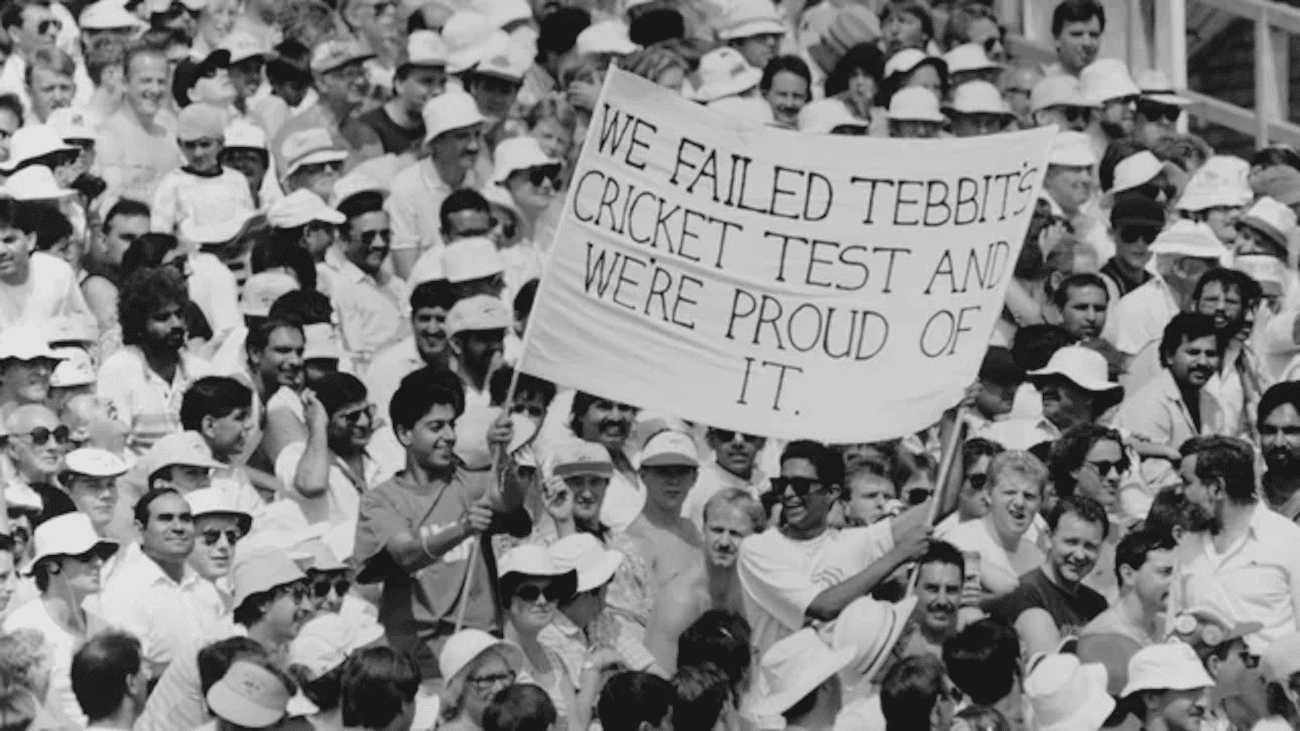

Rishi Sunak has been thinking about cricket, which is a respectable occupation for a former prime minister, and one that more former prime ministers might usefully take up. Having delivered the Cowdrey Lecture at the MCC, he wrote this week about growing up in Southampton, where his father’s medical practice sat between the football ground and the cricket ground, and about the Tebbit test, which was the great argument of his boyhood (In April 1990 Norman Tebbit told the Los Angeles Times that a large share of Britain’s Asians failed what he called the cricket test. He wanted to know which side they cheered for, and he thought the answer revealed whether they were looking back to where they came from or had settled where they were.)
“Ten-year-old me passed the test without even knowing about it,” he wrote. He cheered for England because England was home. And yet, having passed, and having gone on to govern the place, he now finds himself informed by some of his countrymen that a brown Hindu cannot be English at all. He calls this the reverse Tebbit test, and he is entitled to his bewilderment.
Sunak’s post is more gracious than the people it answers deserve, and there is little in it to quarrel with. The more useful exercise is to go back behind it, to the original proposition of Tebbit test, which has been denounced far more often than it has been examined.
Something should be granted him first. The worry underneath — that a country needs its people to feel they share a life and not merely a tax code — is not a foolish worry. Sunder Katwala, who has spent years dismantling the cricket test, concedes as much. The question is whether the noise a man makes at a sports ground is evidence of the thing Tebbit cared about. A test worth the name should be set for everyone in the same position, it should measure what it claims to measure, and passing it should count for something. Take these in turn.
Was it set for everyone? More than a million Britons sailed to Australia after the war on assisted passage, ten pounds a head. Their grandchildren are at the MCG every Boxing Day, a fair number of them singing with the Barmy Army, and no Australian minister has proposed examining them. The British retirees of the Costa del Sol are not expected to weep for Spain. Closer to home, rugby supplies the cleanest case. Some two hundred thousand South African-born people live in Britain, along with a great many New Zealanders and Australians, and when England met South Africa in the 2019 World Cup final, the pubs of southwest London were full of green and gold. England lost. Nobody wrote a column asking whether the South Africans of Putney had failed to integrate. A Springbok jersey in a London pub is taken for what it is, a man enjoying a game. An India shirt at Headingley was taken for a position on citizenship. When an examination is set for only some of the candidates, one begins to suspect that it is the candidate who is being marked.
Mesut Özil, leaving the German football team in 2018, said that in the eyes of the German federation’s president and his supporters, he was German when they won and an immigrant when they lost.
Does it measure what it claims? Consider the 2019 cricket World Cup final at Lord’s. England were captained by Eoin Morgan, a Dubliner who had already played a World Cup for Ireland. Their Super Over was bowled by Jofra Archer, born in Barbados. And the match was won, very nearly alone, by Ben Stokes, who was born in Christchurch and came to Cumbria at twelve because his father, a New Zealand rugby league man, had taken a coaching job there. The opposition that afternoon was New Zealand. Stokes was later nominated for New Zealander of the Year and said, politely, that Kane Williamson should have it. His father Ged, back home in Christchurch, remarked that he was probably the most hated father in the country.
Now put Tebbit’s question to Ged Stokes. His son, or his country? It is hard to say which answer counts as a pass, which suggests the fault lies with the question. Rugby has quietly given up asking it. Under the game’s own rules a few years’ residence qualifies a player for a national side, so England have been captained by Dylan Hartley, born in Rotorua, and Ireland won a series in New Zealand in 2022 with New Zealand-born players in the team. The sport treats national allegiance as something a grown man may choose and change. It is odd to demand more constancy from the spectators than from the players.
What Ged Stokes felt that day at Lord’s was affection, pulled two ways, and affection is not the sort of thing anyone can owe. A country may fairly ask its citizens to obey its laws, pay its taxes, sit on its juries, and in the last resort defend it. These are things a person can do or decline to do, and so they can be demanded. No country can require that a heart lift when a particular opening batsman walks out, because nobody chooses that. A child is ten, someone does something impossible with a bat or a ball, and the matter is closed for life, at least in most cases. David Dabydeen still supports the West Indies side of his adolescence, the team that let a Guyanese boy walk taller in a cold country. Katwala, an England man, was nine and thrilled when India won in 1983. Sunak was ten at the County Ground. These are biographies. They record where a person was standing when the magic happened.
Katwala also noticed that it had to be a cricket test, because a football or rugby test would dissolve the United Kingdom by teatime. England and Scotland played the first international football match against each other in 1872, and the Union has carried four national teams ever since; a Glaswegian roaring against England at Hampden Park has never been thought to have failed anything.
Tebbit, in his later years, said plainly what he had meant all along: if it came to war, whose side would you be on? That is a serious question, and it happens to have been answered. Two and a half million Indians volunteered for Britain’s war, seven years after India played its first Test at Lord’s and was, one assumes, cheered by Indians. Sport is the one arena in which a divided heart costs nobody anything, which may be what it is for.
That leaves the third requirement, that passing should count. Sunak passed at ten. At forty-two he was Prime Minister. He is still being asked for his papers. Mesut Özil, leaving the German football team in 2018, said that in the eyes of the German federation’s president and his supporters, he was German when they won and an immigrant when they lost. Marcus Rashford, Jadon Sancho, and Bukayo Saka wore the England shirt in a European final, which is about as emphatic a pass as the test allows, and were racially abused within the hour for missing penalties. For the brown or black citizen, the pass is provisional and can be withdrawn on a bad night or in a matter of seconds. For the South African in Putney, the test is never set. The thing being examined, in both cases, is visible before anyone opens his mouth to cheer.


Nor is this an English habit alone. In India, students have been booked under sedition law for celebrating a Pakistani win, and the students in question were Kashmiri Muslims. The country changes and the pattern holds: the loyalty examination is set by the majority, for the minority it already doubts, and the sport is incidental.
Which returns the matter to Christchurch. Ged Stokes was pulled two ways in July 2019, in public, with the whole cricketing world watching, and nobody has ever asked him to explain himself.
Others are not excused so easily, and sometimes the examiner is oneself. In June 2024, India played the United States in a temporary stadium on Long Island. The American eleven was a small atlas of departures: two men from Mumbai, two born in Pakistan, two South Africans, the North American-born sons of Caribbean and Indian families, and Corey Anderson, who had once played a World Cup final for New Zealand. Saurabh Netravalkar, formerly of India’s Under-19s and lately of Oracle, removed Virat Kohli first ball. Every man on that side had already answered Tebbit’s question with his life, by leaving, and there they stood in the colors of the country that took them in.
I was born to one of those teams and chose the country of the other. The blue shirts hold a childhood in them: the summer of 1983, borrowed bats, streets that emptied when the right batsman walked out. The other eleven hold the rest of the story, the visa queue and the one-way ticket and the accent that never quite settles, which is to say they hold mine. Where does an Indian American’s loyalty lie on such an afternoon? When Netravalkar ran in to bowl at Kohli, which way was the heart supposed to lean? And who, exactly, is owed the answer?
Ganpy Nataraj is an entrepreneur, author of “TEXIT – A Star Alone” (thriller) and short stories. He is a moody writer writing “stuff” — Politics, Movies, Music, Sports, Satire, Food, etc.