




My Vatsalaya: How I Plan to Teach AI was Inspired By How I Learned to Cross the Arcot Road in Chennai

- When I cross Arcot Road, I am not alone because my mother in law is with me. When I get back to my classroom this fall, my students and I won't be alone either.

Every year, my wife and I travel to Chennai, India to stay with her family. As an outsider, Arcot Road terrifies and amazes me. It’s not just a road. It’s a thoroughfare; an Indy 500 without caution flags. Cars moving in every direction, stop lights as mere suggestions, lorries, buses, scooters, motorcycles, pedestrians, and bullock carts all in constant motion.
And I’ll never cross it alone.
My 4’ 10’’ mother-in-law insists I don’t. I explain in my broken Tamil that I can, and thousands do every day. Yet, she is adamant. If I need to cross, she will walk me. When I ask her why, she says two words:
“It’s scary.”
Crossing Arcot Road is analogous to my journey with AI in my classroom this past fall. It was, to quote my mother-in-law, scary. While there is much out of my control, how I view these journeys can get me through.
Having a vision establishes a journey’s purpose and meaning. My mother-in-law’s purpose in Sanskrit is vatsalaya– a deep, binding, and unconditional love towards one’s children. The depth of my mother-in-law’s vatsalaya is not a social expectation. It’s being her best self as a mom, ensuring she never leaves anything unturned when it comes to her kids. She shares it with me when she makes sure my food is seasoned just right, or in the way she will give me a look when I am working late at night—her way of asking me to close the computer and sleep. Her vision is evident in how she insists that no harm comes to her children, a cosmological faith that her kids are always going to be ok.
That everything will be ok.
My mother-in-law’s vatsalaya vision is firm, but flexible. She shows it in different ways, adapting her vision to the situation. Sometimes, it comes out in joy at her kids’ happiness; other times worrying over their welfare. The honking from the buses, the traffic signals not adhered to, and the auto rickshaws coming out of nowhere all have to face this woman’s vatsalaya as she takes my hand.
When I think of my classroom with AI this coming fall, my second year of using AI with my students, I will need to cling to my vision. My vatsalaya is rooted in my students’ advancement towards scholarship, so that every one of them can be a scholar. It will be tested by a disruptive technology for which there is no playbook, and by students who arrive with wildly different relationships to it. Some constantly use AI in homework and assessments, while others have no AI fluency. My vision of scholarship must bridge these divides while finding an entry point for all.
It will also be tested because the technology is rapidly growing, and with it, uncertainty. Many of my colleagues consider AI cheating. Others openly declare, “It will fizzle out,” and some simply refuse to acknowledge its existence in their teaching. These reactions come from fear. I have seen education in the past 30 years meet every disruptive technology this way. This must stop. When adults are scared on their journey, young people lack a guide for theirs. If my mother-in-law was scared, I could never cross Arcot Road.
When I think of my classroom with AI this coming fall, my second year of using AI with my students, I will need to cling to my vision. My vatsalaya is rooted in my students’ advancement towards scholarship, so that every one of them can be a scholar.
My vision for teaching with AI this fall must ground me, be communicated to students and adults alike, and be pliable enough to hold both AI’s fears and opportunities. It can help me make something seemingly insurmountable more manageable, replacing my fears of uncertainty with a vision’s love.
The people we encounter on our journeys make them better. My mother-in-law talks to everyone on Arcot Road. When an auto driver asks her for a fare, she politely declines and says how we are crossing, inevitably creating a moment where both of them talk about how crowded Arcot Road is. Another pedestrian will join in, adding that the buses never stop at their required stop. Someone else approaches who has a physical condition requiring help to cross, and my mother-in-law will take their hand along with mine. The heat index could be over 115 degrees, but she is going to invite people into her world, sometimes taking help from and offering help to unlikely sources, as we share the moment of waiting for a tiny break in traffic to move.
In the same way, I will have to pair my vision this fall with the most important allies: my students. AI is an opportunity to partner with them, learning from them while they learn from me. Together, we can co-design personalized learning, giving students a stage to play with AI. For my emerging scholars to have control over AI, they must first be trusted with it as partners, not protected from it as students. This has to involve co- establishing AI rules and practices, helping both of us understand this technology and how to leverage it together.

It also means getting out of the way and letting students use AI to find solutions, “letting them cook.” What if students could vibe code their own personalized study guide for an upcoming exam? What if they could use AI to deepen their passions? What if students could teach their teachers how to make AI part of their instruction? Personal instruction through conferencing with students does what traditional approaches can’t: Centering students, letting them know their voice can and should drive their learning.
What if conversations with students could be grounded in, “What are you thinking about when it comes to…” or “I think you got it- what do you need from me?” or “What do you want to do?” or even, “Imagine if we…” These moments leverage a disruptive technology to empower students, transforming school. Working with students in personalized settings to create their own AI pathway is how we are transformed into allies on a difficult journey.
If I hold my vision and the people I take along the way, I will get where I need, wherever that may be. It won’t be a fixed target, but it will be a true journey: Effervescent, yeasty, sometimes uncharted, and with difficulties around me.
When I cross Arcot Road, I am not alone because my mother in law is with me. When I get back to my classroom this fall, my students and I won’t be alone either. We will have one another. Together, we will learn when to hold on to our vision, when to simply “play” with AI, and when to say “Let’s try” or even “I don’t know.” It is scary, but no journey worth taking has ever been completely safe.
Even one across Arcot Road.
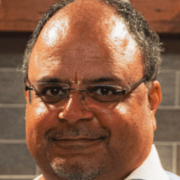
Ashley Kannan teaches 8th grade American History and African American Studies at Percy Julian Middle School in Oak Park. He is a Teach Plus Leading Edge Fellow.