




‘Cockroaches Don’t Die’: How a Dalit Student Built India’s Most Disruptive Gen Z Political Movement

- When India's Chief Justice called unemployed youth "cockroaches," Abhijeet Dipke turned the insult into a movement. Two months later, the 30-year-old Boston University graduate leads what may be the most significant street protests against Narendra Modi since he came to power in 2014.
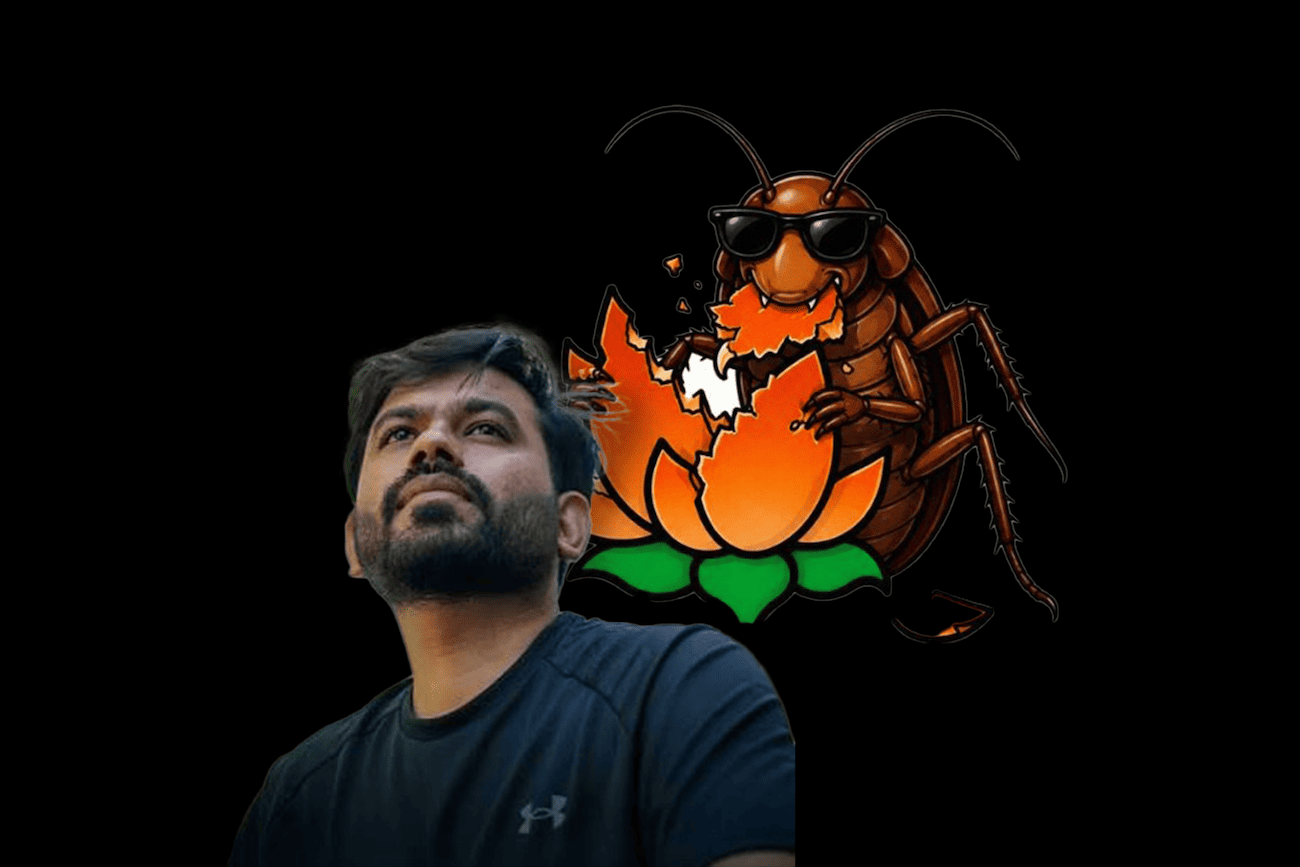

On May 16, 2026, a 30-year-old political communications strategist sitting in Chicago typed six words on X — or something close to that number — in a moment of frustration, and posted them into the void of Indian social media.
The frustration had a specific origin. One day earlier, on May 15, India’s Chief Justice Surya Kant had made remarks during a court hearing that were widely reported as comparing unemployed Indian youth to “cockroaches” and “parasites of society.” The Chief Justice later said his comments had been misconstrued by the media. But the damage — or, depending on your perspective, the spark — had already been struck.
Abhijeet Dipke, the man who typed those six words, was not the kind of person the Indian establishment had learned to fear. He was a Dalit from Aurangabad — a city in Maharashtra that has since been officially renamed Chhatrapati Sambhajinagar — the son of a man who grew up in extreme poverty and whose own father was just a farmer. He had a journalism degree from Pune and a master’s degree in public relations from Boston University. He had worked for three years on the Aam Aadmi Party’s social media and election campaign team before moving to the United States to study. He did not hold elected office, command organizational resources, or control a media platform. What he had was a phone, a social media account, and a clarity of purpose that the moment seemed to demand.
He announced the founding of the Cockroach Janta Party — CJP, a deliberate echo of Modi’s Bharatiya Janata Party’s initials — on May 16, 2026, as a satirical response to the Chief Justice’s remarks. The name was the point: if the powerful called India’s unemployed young people cockroaches, then cockroaches they would be. The party’s slogan — “Voice of the Lazy and Unemployed” — was both self-deprecating and precise. Its founding document described itself as “a political front for the youth, by the youth, for the youth.”
What happened next surprised even Dipke. Lakhs of people registered on the party’s website within days. On Instagram, the CJP account accumulated nearly 22 million followers — more than twice the follower count of the BJP’s own Instagram presence, as NPR reported. The satirical party had, in the space of weeks, become something more than satire.
The Dalit From Aurangabad: A Biography Written in Caste
To understand what Abhijeet Dipke represents — and why the movement he has built carries the specific charge that it does — you have to understand where he comes from.
He was born on September 29, 1995, in Aurangabad, Maharashtra, into a Dalit family, as Reuters documented in a detailed profile published July 23, 2026. His family originally traces its ancestral roots to the rural village of Santuk Pimpri in the Hingoli district, before relocating to the MIDC Waluj area of the city following his father’s employment with the Maharashtra Industrial Development Corporation, as BiographyKind’s documented account noted.
“My father comes from a very humble background. He grew up in extreme poverty. My grandfather was just a farmer,” Dipke told Reuters in a phone interview from Chicago in May. The family’s trajectory — from subsistence farming in rural Hingoli to an industrial township in Aurangabad to, eventually, a Boston University graduate school — is precisely the kind of upward mobility that post-independence India promised and that, Dipke argues, has become increasingly difficult to achieve.
His Dalit identity has not been incidental to his politics. When he arrived in Delhi on June 6, 2026, to lead his first in-person protest, he held aloft a copy of “My Autobiography” by B.R. Ambedkar — the Dalit jurist, economist, and social reformer who drafted India’s Constitution and who remains the defining hero of Dalit political consciousness in modern India, as Reuters documented. The gesture was not accidental. Ambedkar’s life — born into caste oppression, educated abroad, returned to India to demand constitutional rights for the most marginalized — maps onto Dipke’s own trajectory in ways he has made explicit.
The Ambedkar connection carries an additional resonance specific to the current moment. Aurangabad sits in the shadow of the Maratha empire’s history and of Ambedkar’s own Maharashtrian roots. Dipke’s city is Ambedkar’s country. And when the Chief Justice of India called unemployed youth cockroaches, a Dalit man from that city was among those who heard the insult most clearly.
His caste identity also made him a target as soon as he went public. The Print documented that Dipke faced casteist attacks on social media after he revealed he was Dalit — a pattern that his supporters recognized as consistent with the treatment of Dalit activists and commentators across Indian public life. When a woman threw blue ink at him as he was addressing supporters, smearing his face — in a protest gesture, later explained as an accusation that the CJP had insulted Lord Ram — Dipke posted a video of the incident with the caption “The blue is my color,” as Reuters documented. The reference was unmistakable: blue is the color closely associated with the Ambedkarite movement.
Boston, the AAP, and the Making of a Political Strategist
Dipke’s route from Aurangabad to the barricades at Jantar Mantar runs through Pune, Boston, and a three-year stint with one of India’s most media-savvy political parties.
He completed his undergraduate degree in journalism in Pune before moving to the United States for graduate school. At Boston University — one of the country’s leading communications and public affairs programs — he earned a Master of Science in Public Relations. That academic background, as the Young India biographical account observed, is a significant part of why the CJP’s communications strategy reads less like grassroots activism and more like a deliberately engineered media campaign. Even his critics concede the point.
Before founding the CJP, he worked from 2020 to 2023 with the Aam Aadmi Party’s social media and election campaign team. The AAP — Arvind Kejriwal’s anti-corruption party, which swept Delhi’s legislative assembly elections in 2015 and has built a reputation for sophisticated digital organizing — gave Dipke a practical education in how to convert online energy into political outcomes. He has since described his departure from the AAP as a professional transition rather than an ideological break, though his current positioning is pointedly independent of all existing party structures.
When he founded the CJP from Chicago, he was, in his own telling, already thinking about the political communications architecture required to turn a viral moment into a sustained movement. The party’s three official spokespeople — an investigative journalist, a filmmaker, and a former McKinsey employee — reflect that strategic thinking. “We are a youth political movement and our demand is this: there has to be accountability in the system,” said Sourav Das, the investigative journalist among the three, at a news conference in June, as CNN reported. “The system has collected so much rot. The people have been very vocal.”
The Viral Machine: 22 Million Followers, One Banned Account, and the Cockroach Philosophy
The CJP’s social media footprint is, by any measure, one of the most remarkable in Indian political history.
The Indian government banned the party’s first X account, citing “threats to national security.” as NPR reported. Dipke’s response — creating a second account with the statement “Cockroaches don’t die” — became one of the movement’s defining moments and one of its most effective communications strategies.
The Indian government banned the party’s first X account, citing “threats to national security,” as NPR reported. Dipke’s response — creating a second account with the statement “Cockroaches don’t die” — became one of the movement’s defining moments and one of its most effective communications strategies. The insult had been reclaimed. The suppression had been reframed as proof of the movement’s power. The resilience of the cockroach had been demonstrated precisely when the government was trying to stamp it out.
On Instagram, the CJP accumulated nearly 22 million followers — more than twice that of the ruling BJP, as NPR documented. The party’s website registered lakhs of members within days of its founding. The Cockroach Students Union of India — a related organization focused specifically on student concerns including affordable education, transparency in recruitment examinations, mental health awareness, and youth representation in governance, emerged as a campus-level organizing body connected to the broader CJP movement.
The movement’s demands have remained consistent and specific. It has called for the resignation of Education Minister Dharmendra Pradhan, who has faced sustained criticism over alleged irregularities in several key examinations — including the NEET-UG exam scandal that became one of the defining controversies of Indian higher education in 2024, as NPR and CNN both documented. Youth unemployment, the cost of education, the integrity of competitive examinations, and the accountability of institutions — these are the CJP’s campaign issues, and they are issues that resonate with the precise demographic — educated, aspirational, increasingly frustrated Gen Z Indians — that the existing political parties have consistently struggled to mobilize.
“My Friends Were Scared”: The Return to Delhi

Dipke’s decision to fly from the United States to India in early June 2026 — knowing he might be arrested at the airport — was the moment that transformed the CJP from a purely digital phenomenon into a street-level political movement.
“My friends and family are scared that I could get arrested at the airport,” he wrote on Instagram before departing. “But how long can I fear jail? This country belongs not just to one party, but to all of us. This is a question of our future. Our future is getting ruined,” as CNN reported.
When he landed at Delhi’s Indira Gandhi International Airport on Saturday, June 6, a large security presence was waiting — but he was granted permission for his protest and allowed to proceed, as TRT World documented. He was met by supporters who had gathered to receive him. He held the Ambedkar autobiography aloft as he walked through the terminal. “I am pretty confident there may be consequences upon my return, but I am also sure about coming back,” he had told the Times of India before departing, as TRT World reported.
Since his arrival, he has become a constant presence at the protest site at Jantar Mantar — the historic public demonstration ground in central Delhi where political protests have been staged for decades. Bearded and dressed in a T-shirt and jeans, he addresses crowds of hundreds from a raised platform, urging them to remain peaceful while maintaining pressure on the government, as Reuters documented. A police crackdown on demonstrators in late July sparked public outrage and drew the CJP’s protests to a march toward Parliament on the opening day of the monsoon session on July 20, according to Reuters.
“The Government Has Stopped Listening”: The Challenge to Modi
The political significance of what Dipke has built is contested — as all significant political phenomena are — but it is difficult to dismiss.
“In India, if you’re rich, the system dances at your fingertips. If you’re poor, nobody will be there for you,” Dipke told NPR. “We’re frustrated because the government has stopped listening.” He told Reuters that “five years ago, nobody was ready to speak up against Modi or the government,” but that times are now “changing.”
The BJP’s response has been to portray the protesters as threats rather than to engage with their demands. “These are people who want to make the country hollow,” BJP chief Nitin Nabhi said in a speech, as NPR reported. On Monday, July 20, however, the government appeared to make its first outreach to the protest group — a development NPR described as significant, given the administration’s consistent posture of dismissal toward civil society protesters during twelve years of BJP rule.
The CJP does not plan to contest elections, as Dipke and its documentation have consistently stated. It positions itself as a pressure platform — a vehicle for Gen Z political consciousness rather than a traditional electoral force. “People are messaging us saying they’ve lost hope in both the government and the Opposition,” Dipke told The Print. The comment captures the CJP’s specific political niche: it speaks to a generation that has grown up watching the BJP govern and the Congress atrophy, and that has not found an institutional home in either.
Whether the cockroaches will outlast the conditions that produced them — or whether, like so many Indian youth protest movements before them, they will be metabolized by the political establishment and rendered harmless — is the question that Jantar Mantar cannot answer. What it can confirm is that a 30-year-old Dalit from Aurangabad, armed with a Boston University degree and an Ambedkar autobiography, has done something that the established opposition has failed to do in twelve years of Modi governance: put hundreds of people in the street and made the government call them dangerous.
Cockroaches, it turns out, are hard to kill.