




Highway Horror: A Sikh Truck Driver is Stabbed 17 Times in Wyoming — Did Government Rhetoric Make it Possible

- Less than a week after the Department of Homeland Security published an AI-generated post telling a turbaned Sikh man to "get off our roads," a 28-year-old Sacramento truck driver was followed into a Wyoming rest stop bathroom and stabbed nearly to death.
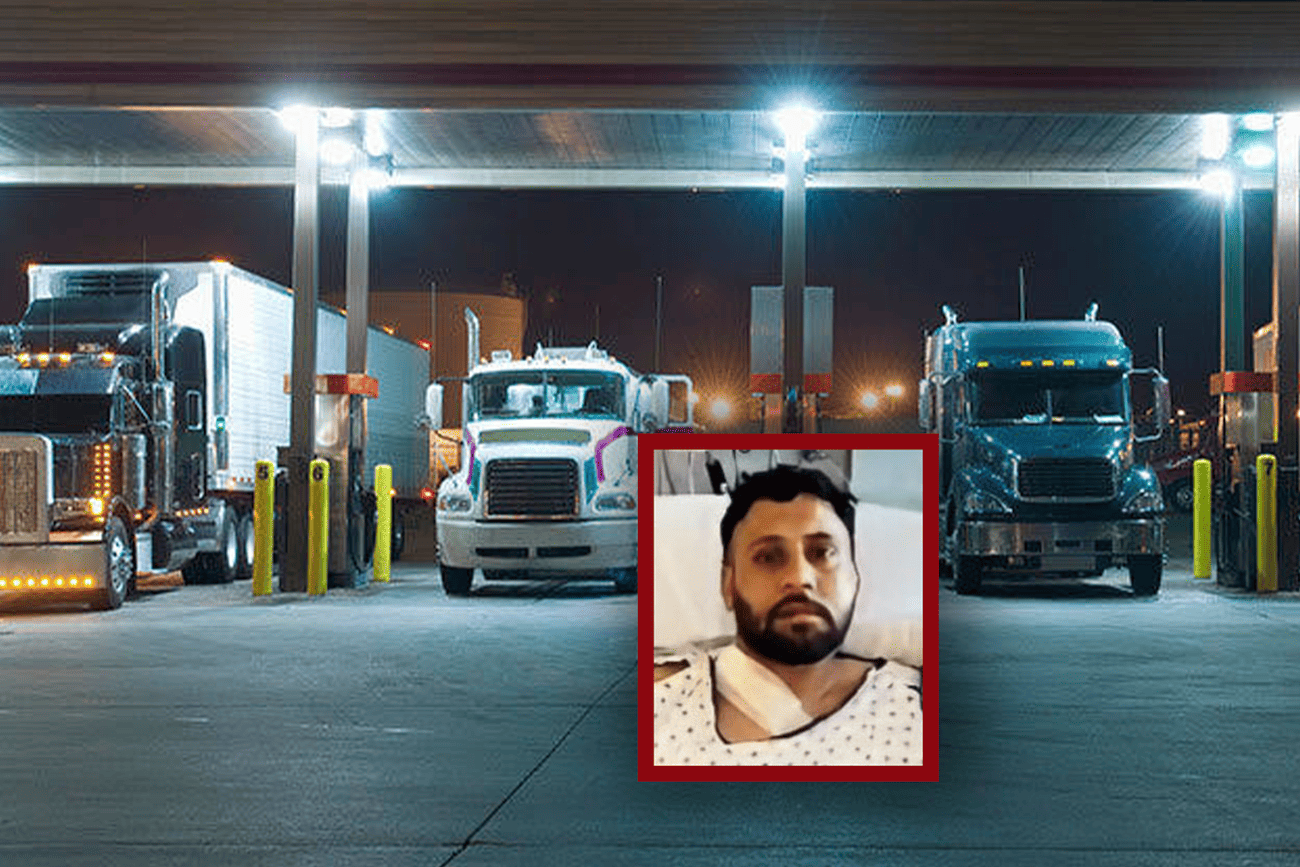

Early on Sunday morning, September 13, 2026, a 28-year-old Sikh truck driver from Sacramento pulled his commercial vehicle off Interstate 80 at the Bitter Creek Rest Area in southern Wyoming. He was headed to Pennsylvania. He needed to use the restroom.
A Punjabi Sikh truck driver in Wyoming said he was followed into a bathroom and stabbed repeatedly in an attack that has stoked fear across the greater South Asian community. In an interview with NPR, the driver Singh said he was shaken by the violent encounter from earlier this week, which he described as unprovoked.
Singh asked to be identified only by his surname due to fear for his safety. “I don’t know why this happened,” he said from his hospital room. “I don’t know why they attack[ed] me.”
What the charging documents make clear, as CBS News Sacramento documented, is that the attack unfolded with terrifying speed. As he looked in the bathroom mirror, a stranger wearing a blue tracksuit rushed in, punched him in the neck, and pushed him against the wall. When the driver pushed his assailant away, the man launched a second attack with a knife. Charging documents show the attack unfolded in less than a minute. Singh entered the restroom before a man followed him inside. Singh told NPR that the man began beating him and then pulled out a knife, stabbing him repeatedly.
Singh managed to push the attacker off and run outside. He collapsed onto the pavement outside as the attacker fled the scene. A Hispanic family stopped at the rest stop heard the commotion, rushed to his aid, tended to his wounds, and provided police with critical information about the suspect’s truck.
A father and son followed the suspect, who attempted to drive off in his own tractor-trailer, until Wyoming Highway Patrol troopers arrived. The family returned to the rest area to help Singh, who called 911. Singh was transported by helicopter to a trauma facility, according to the sheriff’s office.
The Arrest: Caught 70 Miles Down the Road
Police arrested Andrew Kris Bzdak, 45, less than 90 minutes after the first emergency call. He has been charged with attempted first-degree murder. The Wyoming Highway Patrol intercepted the suspect’s vehicle near Rawlins, about 113 kilometres from the rest area, and arrested a man.
Prosecutors said that he acted with premeditated malice and intended to kill Singh. The charge carries a possible life sentence under Wyoming law.
On the question of why it happened: Jeff Sheaman, a public information officer with the Sheriff’s Office, noted via email that there is no known motive for the attack at this time, and there is no threat to the public. Charging documents filed in the case also omitted any statement of motive, and the local prosecutor did not immediately respond to requests for additional information.
Some Sikh organizations have raised concerns about the wider climate surrounding the Wyoming attack, but authorities have not linked the stabbing to Singh’s ethnicity or religion.
The Context: Five Days After “Mr. Singh, Get Off Our Roads”
The attack occurred five days after the Department of Homeland Security published — and then deleted — an AI-generated social media post featuring a brown-skinned, turbaned man alongside the words: “Get off our roads, you don’t know how to drive Mr. Singh. Self-deport or find out.”
The post, which DHS said referred to an Indian truck driver accused of causing a fatal crash in Florida, was removed following criticism from politicians and Sikh and Indian-American groups. It had accumulated 4.2 million views before its deletion.
The driver was not wearing a turban at the time. He is nonetheless Sikh, and his surname — Singh — is the same surname that the DHS had used in its now-deleted post as a shorthand for an entire community it wanted off American roads.
The Sikh Coalition, the largest Sikh civil rights organization in the United States, drew the connection explicitly. “When our own federal government uses a Sikh name and image to tell people like us that they do not belong on America’s roads, our community has every reason to be concerned about the environment that kind of rhetoric creates,” the organization said.
Raman Dhillon, the head of the North American Punjabi trucking community’s advocacy organization, visited the Wyoming victim in person in his hospital room, as NPR documented from his account of the visit.
DHS rejected the connection between its post and the attack categorically. When asked about the Wyoming attack, the DHS said the agency will not speculate on motives, adding, “Any attempt to blame DHS for an unrelated attack is RECKLESS and FALSE.”
A Workforce Under Pressure
The Wyoming stabbing arrives in the context of a sustained and documented campaign by the Trump administration against Indian-origin commercial truck drivers — a campaign that has combined enforcement action, deportation, and public messaging into what advocacy groups describe as a hostile environment for an entire occupational community.
The debate over whether the DHS post contributed to the climate in which Singh was stabbed is one that law enforcement, in the absence of a documented motive, cannot resolve — and that the political actors on both sides of the question will not resolve for themselves, given the symmetry of their interests.
The trigger event was the August 2025 crash involving Harjinder Singh — a 28-year-old Indian-origin truck driver who was arrested after investigators alleged he caused a fatal accident in Florida that killed three people. DHS used that case as the basis for a broader public messaging campaign that extended well beyond the individual case, associating South Asian names and Sikh imagery with reckless driving, immigration violations, and the need for self-deportation.
In a report published this month, Stop AAPI Hate found that slurs used online against South Asians rose by 109% between January 2023 and December 2025. The report found that the rise in anti-South Asian rhetoric was fueled by the Florida truck crash, President Trump’s re-election, debates over H-1B visas, and Zohran Mamdani’s New York City mayoral campaign.
The stabbing has heightened safety concerns among Sikh, Punjabi truck drivers in the United States and also about the safety of the larger Indian community, who are repeatedly prone to targeted attacks and racist acts.
Singh himself, speaking from his hospital room, expressed a fear that was both personal and communal. “I am just worried … it can happen again,” Singh said. Singh, who has worked as a commercial truck driver for around three years.
The trucking workforce context is significant. Punjabi Sikh truck drivers represent a substantial proportion of the long-haul commercial trucking workforce in California and across the western United States — an industry that has historically provided first-generation immigrants with a pathway to middle-class income and business ownership. Many hold commercial driver’s licenses, own their own trucks, and have operated legally in the United States for years or decades. The DHS campaign targeting South Asian drivers, and its explicit messaging around self-deportation, has been experienced by that community not as targeted law enforcement but as a generalized threat directed at an entire occupational and ethnic group.


Singh, the driver, is getting support from the Jakara Movement, a California-based grassroots community-building organization that empowers, educates, and organizes Punjabi Sikhs and other marginalized communities.
Politicians Respond: From Sacramento to Washington
The political response to the attack was immediate and, in the context of the DHS post’s recent deletion, explicitly connected to the federal government’s communications.
In response to the Wyoming rest stop attack, Newsom’s chief deputy director of communications shared a statement with CBS News Sacramento. “Our thoughts are with this individual and his family during this time. The Trump Administration for over a year has been pushing misinformation to smear an entire workforce and target diverse communities. The President’s now-redacted social media post is one proof point — his hateful rhetoric is hurting our communities,” Diana Crofts-Pelayo said.
Sen. Adam Schiff, a California Democrat, posted a statement calling the attack “A sickening reminder that hateful rhetoric will never be just rhetoric.” “What an absolute, unmitigated travesty,” he wrote.
Congressman Raja Krishnamoorthi, an Illinois Democrat, said in a statement that he is “horrified by the brutal attack on a Sikh truck driver who was stabbed 17 times at a Wyoming rest stop.” Krishnamoorthi issued a sharp rebuke on X, expressing horror at the brutal Wyoming stabbing and demanding that officials stop spreading inflammatory rhetoric. He also referred to the recent DHS post, saying that those spreading hatred, including officials in the federal government, should stop, while those who turn hatred into violence should be held accountable.
“It Can Happen Again”
The debate over whether the DHS post contributed to the climate in which Singh was stabbed is one that law enforcement, in the absence of a documented motive, cannot resolve — and that the political actors on both sides of the question will not resolve for themselves, given the symmetry of their interests.
What is not in dispute is the sequence of events. A federal department published a post associating a Sikh name and image with the demand to self-deport from American roads. The post was seen 4.2 million times before it was taken down. Five days later, a 28-year-old Sikh truck driver was followed into a Wyoming bathroom and stabbed seventeen times.
Whether Andrew Kris Bzdak ever saw the DHS post, whether he knew or cared that his victim was Sikh, and whether the attack was motivated by the victim’s ethnicity, religion, or simply by the private pathology of a violent individual — those questions are for the investigation, the prosecution, and ultimately the jury.
What Singh knows, from a hospital bed in Wyoming, is what he told NPR from that room.
“I don’t know why this happened,” he said. “I don’t know why they attack[ed] me.”