




My Marriage to America: Reflections of an Odia Hindu Man on His Life’s Journey With a White Southern Christian Woman

- I came to America as a stranger. Through Beverly, this country gave me a second family, a second culture, and a second home.
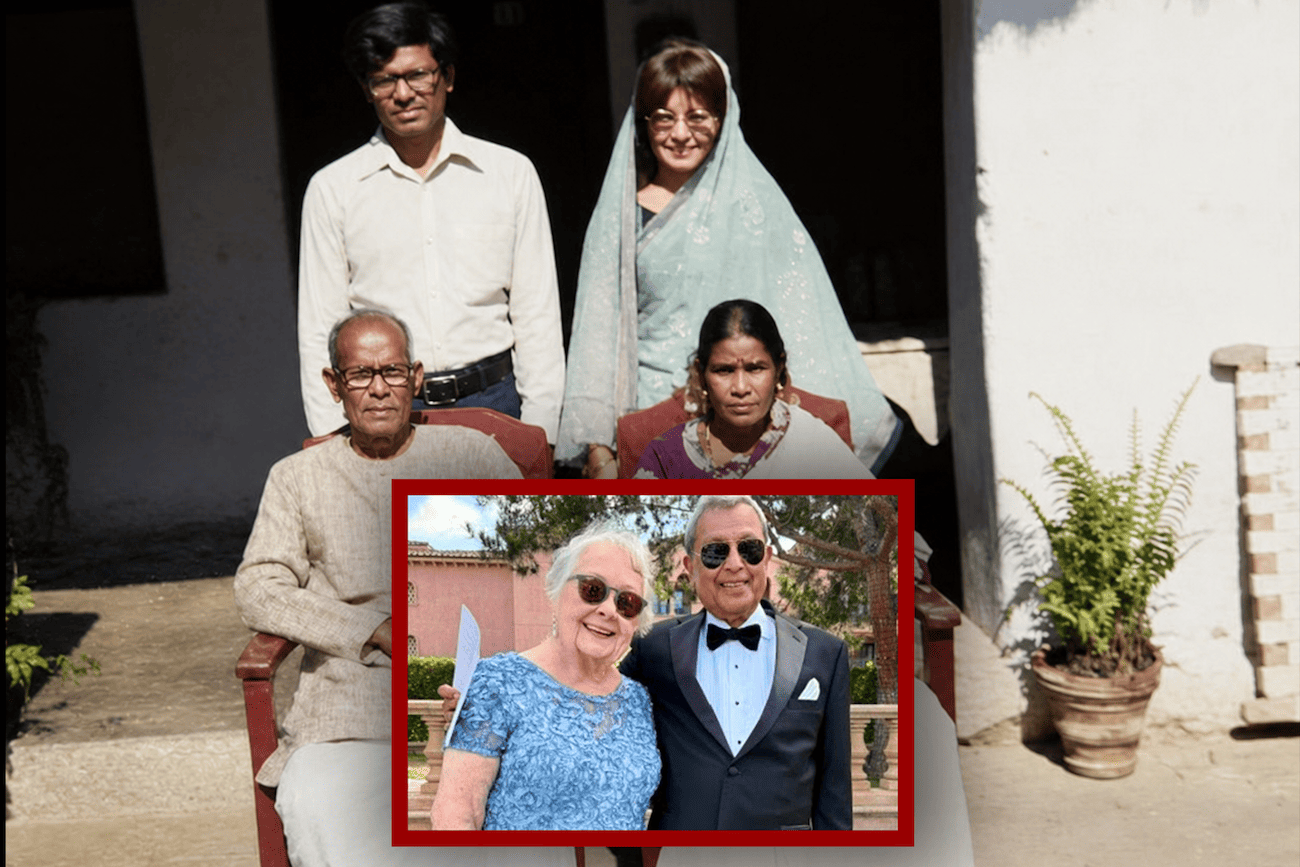

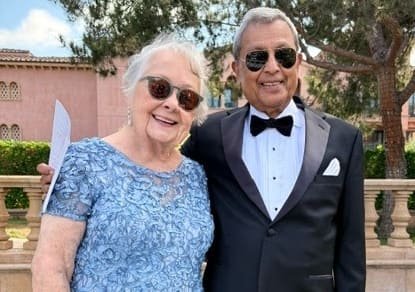
On May 13, 2026, Beverly and I celebrated our 54th wedding anniversary. Fifty-four years.
It is easy to say but difficult to comprehend. It represents more than half a century of shared mornings and quiet evenings, celebrations and disappointments, arguments and reconciliations, dreams fulfilled and dreams abandoned. Like every marriage, ours has known rainy days and sunshine. Yet through it all, one thing has endured: we have continued to choose each other.
Looking back, I have learned that a lasting marriage is not built on perfection. It is built on commitment—the decision to stay when leaving might seem easier; patience when understanding does not come quickly; forgiveness when two imperfect people hurt one another; and respect when two people see the world differently.
Above all, it is built on love.
Beverly and I believe marriage is a divinely inspired institution—not simply companionship between two people, but a way of strengthening God’s will on earth. After 54 years, we have learned that marriage does not necessarily make life easier. Its greatest gift is that we do not have to face life alone.
Marriage Made in Heaven
I was born in a tiny village in Odisha, on India’s eastern coast. As a child, I often heard a beautiful folk belief: marriages are made in heaven.
The story is simple. A dharmic woman—one who lives by righteousness, compassion, and moral values—waits in heaven holding a pot of boiled water. Somewhere, a dharmic man is chosen for her. He comes and places a handful of uncooked rice into her pot. With God’s blessing, the two begin a lifelong journey together, walking the path of dharma side by side.
As a child, I heard it simply as a folk tale. With the wisdom of age, I see something deeper in it.
The boiled water and uncooked rice represent two lives, two histories, two families, and two traditions becoming one shared journey.
Marriage does not require two people to become the same. It asks them to become one without losing who they are.
Sometimes I wonder whether Beverly and I were destined to meet long before either of us knew what destiny had in store. Two people, each raised in rural small-town communities—one in Odisha and one in America—would somehow find love thousands of miles apart.
Perhaps some marriages really are made in heaven.
An Unexpected Love Story
I came to America as a young man seeking education and opportunity.
Two years after arriving in Atlanta, Georgia, to pursue my MBA, I completed my studies in June 1968. Soon afterward, I became Acting Business Manager at Stillman College, a small Presbyterian liberal arts college in Tuscaloosa, Alabama.
Tuscaloosa gave me a fascinating window into American society. Yet I was still an outsider—a young immigrant from India trying to understand a country that was gradually becoming my home.
I was thinking about education and career and perhaps, one day, returning to India. I had no idea that the most important part of my American journey was waiting for me in a person.
I met Beverly through a mutual friend.
She was intelligent, beautiful, strong-minded, deeply committed to her Christian faith, progressive in her social views, careful with money, and devoted to serving others. I found her intriguing.
She was a woman worth pursuing.
What began as attraction gradually became something deeper. I realized that I was no longer simply building a life in America.
I was falling in love.
On paper, we seemed unlikely to belong together: an Indian Hindu man and a white Southern Christian woman; two cultures, two religions, two families, two histories.
Yet beneath those differences, we discovered something more important.
We shared values.
We cared about people regardless of their race, religion, gender, and nationality. We believed in responsibility. We valued family. We wanted to live meaningful lives.
Those shared values became the foundation of our marriage.
When Love Was Not Enough
But love did not make our journey easy.
We were crossing racial, religious, cultural, and family boundaries that were not easily crossed in America or India in the late 1960s and early 1970s.
Beverly was the only daughter of a Wesleyan Methodist minister in a small rural town in North Carolina. I was an Indian Hindu whose family lived thousands of miles away in a tiny village in Odisha.
In 1972, when Beverly and I went to the Tuscaloosa courthouse to apply for our marriage license, the clerk asked me to identify my race. The form had only two categories: White and Black.
I fit neither.
Seeing my dilemma, the clerk smiled, added an “I” for Indian, and issued our license. It was a small gesture, but I have never forgotten it.
Sometimes history changes through great court decisions and political movements. Sometimes it changes quietly through the kindness of one person behind a courthouse counter.
Our parents also struggled with our decision.
My parents had imagined that their eldest son, an MBA graduate in America—a rarity in 1960s in Odisha—would marry a woman from an established Odia family, just like them. Instead, I had fallen in love with an American woman they had never met.
Beverly’s parents had their own fears.
Before we could seriously consider marriage, Beverly asked me to seek her father’s permission. On an Easter weekend, I traveled to Asheboro, North Carolina, to meet her parents. Beverly warned me that some of her relatives might be members of the Ku Klux Klan.
I had been in America only four years. Suddenly, I was walking into a part of American history I had previously known only through newspapers and stories.
Her mother approved of our relationship. Her father did not.
At one point, he asked me if I would convert to Christianity. I said no.
The long conversation ended with both of us emotionally drained.
For a time, it seemed love had reached a wall neither of us could climb. With both families opposed, I told Beverly that perhaps we should end our relationship.
We did.
She went to Texas to pursue her master’s degree. I remained in Tuscaloosa.
But we did not stop loving each other.
Eventually, love prevailed—not because one family defeated the other, but because we learned that respect does not require agreement.
Two Ceremonies, One Marriage
Eventually, our families found a way to accept what Beverly and I had already decided.
My mother traveled from Odisha to Tuscaloosa carrying two suitcases filled with everything needed for a Hindu wedding. She had come a very long way for her eldest son.
Beverly’s parents naturally wanted a Christian wedding.
So, we did both.
On a rainy May 13, 1972, Beverly and I were married twice.
In the morning, we stood together in a Presbyterian church and were married in a Christian ceremony.
That afternoon, we were married again in my apartment in a Hindu ceremony.
Two faiths.
Two traditions.
Two families.
Two cultures.
Yet only one marriage.
Looking back, those two ceremonies seem like a metaphor for the life we were beginning. We were not choosing one tradition over the other. We were making room for both.
Neither of us had to surrender our identity for the sake of the other.
Our marriage was not built by erasing our differences.
It was built by respecting them.
My family also wanted us to match our Jataka—our horoscopes—to determine whether we were compatible. I declined. By then, I had already made my decision. No horoscope could determine whether Beverly and I belonged together.
Years later, the question became a source of laughter between us.
Perhaps our Jataka had matched after all.
Perhaps my uncooked rice had simply found its way into the right pot.
When Our Families Became One
Beverly’s father, Reverend Hoover Smith, was a Wesleyan minister and missionary. Eventually, he and his son, also a Wesleyan minister, traveled to Odisha to meet my parents—and, of course, to preach. They did both.
When Reverend Smith returned to America, he told us how impressed he had been with my parents. He found them gracious, humble, comfortable in their rural environment, and genuinely happy to welcome Beverly as their eldest daughter-in-law.
My father, in turn, wrote to me about the Smiths. He found them genuine, humble, and respectful. Then came the part that made Beverly and me laugh: my father said they possessed qualities that reminded him of good Hindus.
Two fathers who had once stood on opposite sides of a cultural and religious divide had discovered something familiar in one another.
Within months of our marriage, my father-in-law overcame his resistance. We became lifelong friends. He treated me like his own son, and I reciprocated by helping facilitate his missionary work in countries where I was doing business.
Perhaps that was when our two families finally understood what Beverly and I had learned much earlier:
People may worship differently, speak different languages, and come from different cultures. But goodness has no religion. Respect has no race. And love needs no passport.
A Grand Welcome in Odisha
One of the most poignant moments came in 1973, a year after our marriage, when Beverly and I traveled to my village in Odisha.
My cousins had warned me that my uncles might not allow her to enter the family home. When we arrived, however, my eldest uncle was standing at the front door.
Following Hindu tradition, Beverly covered her head and touched his feet.
That simple gesture settled everything.
From that moment, he embraced her as his own daughter-in-law, with all the rights and privileges that came with her place in our joint family.
Another moment of acceptance followed in our village, where my father and his two elder brothers had built temples. On a sacred day, my father invited Beverly, as his eldest daughter-in-law, to join him in offering homa—a Hindu fire ritual in which offerings are placed into a consecrated flame while Vedic mantras are chanted.
When the priest asked Beverly for her name, my mother answered before she could:
“Bharati.”
In that instant, Beverly was no longer merely a visitor from America. She had been given a place and a name within our family.
The villagers also welcomed her warmly. They gathered to see their gori bohu—their “white bride”—and presented her with gifts. Our tenant farmers brought freshly squeezed sugarcane juice, newly caught fish, and vegetables. The woman who supplied my parents with dairy products offered Beverly freshly made water-buffalo yogurt and ghee suggesting that those were better for health.
The village washerwoman even promised to wash Beverly’s clothes with clean well water rather than water from the village pond.
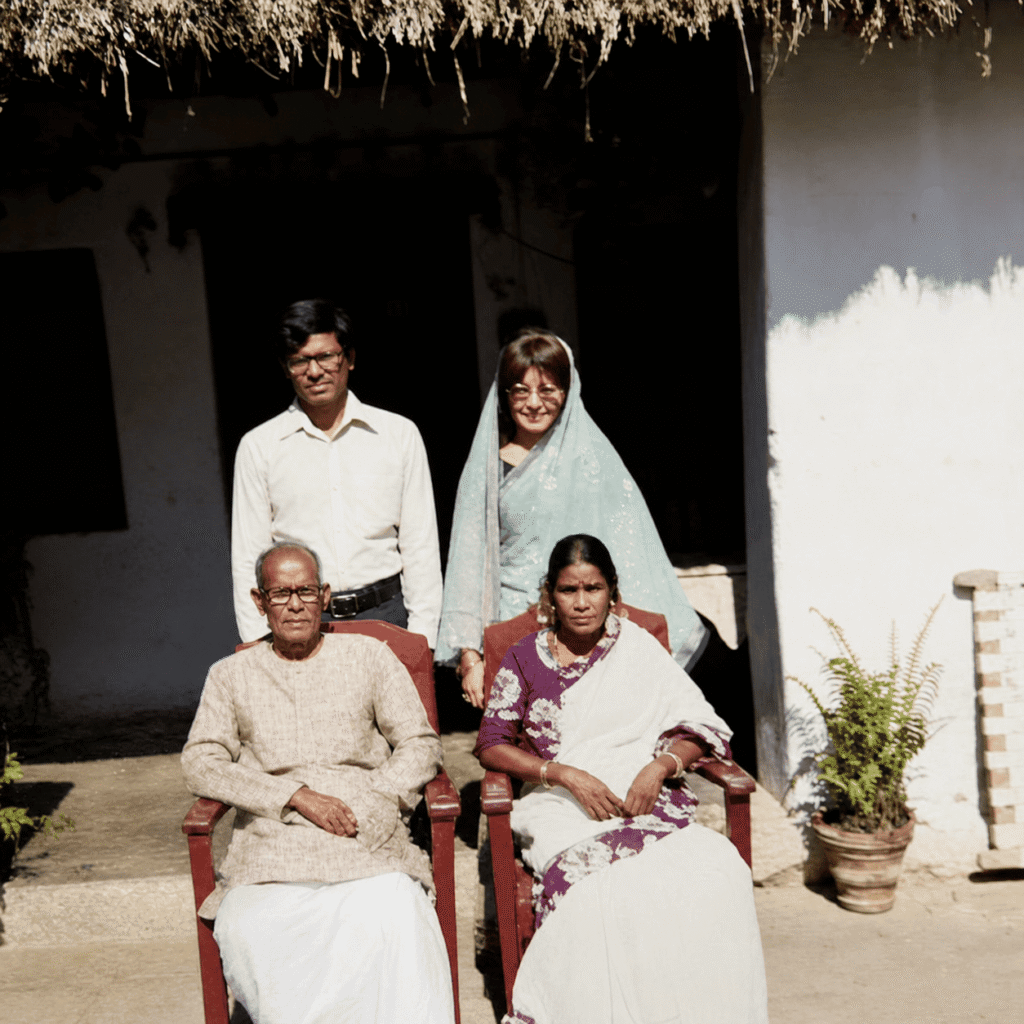
For a month, Beverly lived in our thatched village home. She adapted to kerosene lanterns, cold well water, and meals cooked on a wood-burning chulha. She kept her head covered as a sign of respect for our traditions.
She did not merely tolerate our differences.
She embraced them.
And by doing so with grace and humility, she won the affection of an entire village. I was very proud of her. My parents and immediate family members were overwhelmed with joy. They did not expect that from a western woman.


What 54 Years Have Taught Us
Before we married, I explained to Beverly that, in my culture, marriage was not simply the union of two individuals. It was also a commitment to family.
I told her about Kutumb, the idea of family, and Vasudhaiva Kutumbakam— “the world is one family.”
As the eldest son, I felt responsible for my six younger siblings. Their education, opportunities, and well-being were responsibilities I could not simply set aside.
Beverly understood. More than that, she shared those responsibilities with me.
Fifty-four years have changed the way I understand love.
In an interfaith and intercultural marriage, radical respect can be more powerful than agreement.
Beverly never needed to become Hindu for me to love her.
I never needed to become Christian for her to love me.
We did not need to convert one another.
We simply needed to make room for each other.
That lesson is what we passed on to our two sons. They chose their own spouses, and both had Christian and Hindu wedding ceremonies. As a family, we celebrate both traditions.
The Marriage That Became America
After 54 years, I no longer think of marriage as a destination.
It is a journey.
There have been rainy days and sunny ones, disagreements and reconciliations, uncertainty and confidence, sacrifice and reward.
Through it all, we kept walking.
Together.
I came to America as a young man seeking education and opportunity.
I thought America would give me an MBA.
It gave me a career in entrepreneurship.
But those were not America’s greatest gifts to me.
America gave me Beverly.
I came to America as a stranger. Through Beverly, it gave me a second family, a second culture, and a second home.
That is why, after all these years, the title “My Marriage to America” feels so right.
My relationship with America began like many immigrant stories—with a suitcase, a dream, and the belief that education could open a door to a better future.
But somewhere along the way, the story changed.
America stopped being merely the country where I came to study.
It became the place where I learned to love.
It became the place where two cultures met in one home, where two religions stood beside each other at two wedding ceremonies and became one marriage, and where two families, once separated by oceans and traditions, eventually discovered their common humanity.
I came to America looking for a future.
I found a life.
I came looking for opportunity.
I found a family.
I came seeking an education.
I found love.
And perhaps that is the greatest lesson my 54-year marriage has taught me:
We spend much of our lives believing that we are choosing our destiny.
Sometimes, however, destiny is quietly choosing us.
Perhaps, somewhere beyond what we can see, a dharmic woman was waiting with a pot of boiled water.
And perhaps a young man from Odisha was destined to arrive with a handful of uncooked rice.
He simply had to find his way to her.
I did.
Her name was Beverly.
And after 54 years, I still believe that some marriages are indeed made in heaven.
Pradeep Patnaik was a businessman for 35 years. He is now semi-retired and engaged in international development activities. He lives in Brentwood, Tennessee, USA. He can be contacted at pkpatnaik022@gmail.com.
Superb life story. Very well presented. Congratulations. May you all live a very Happy, Healthy and Blissful life.