




Revolt of the Roaches: How India’s Most Significant Student Uprising in a Generation Came to Be

- What began with six words on X has produced India's largest street protests against the Modi government since 2014 — and a police crackdown whose images have circled the globe.
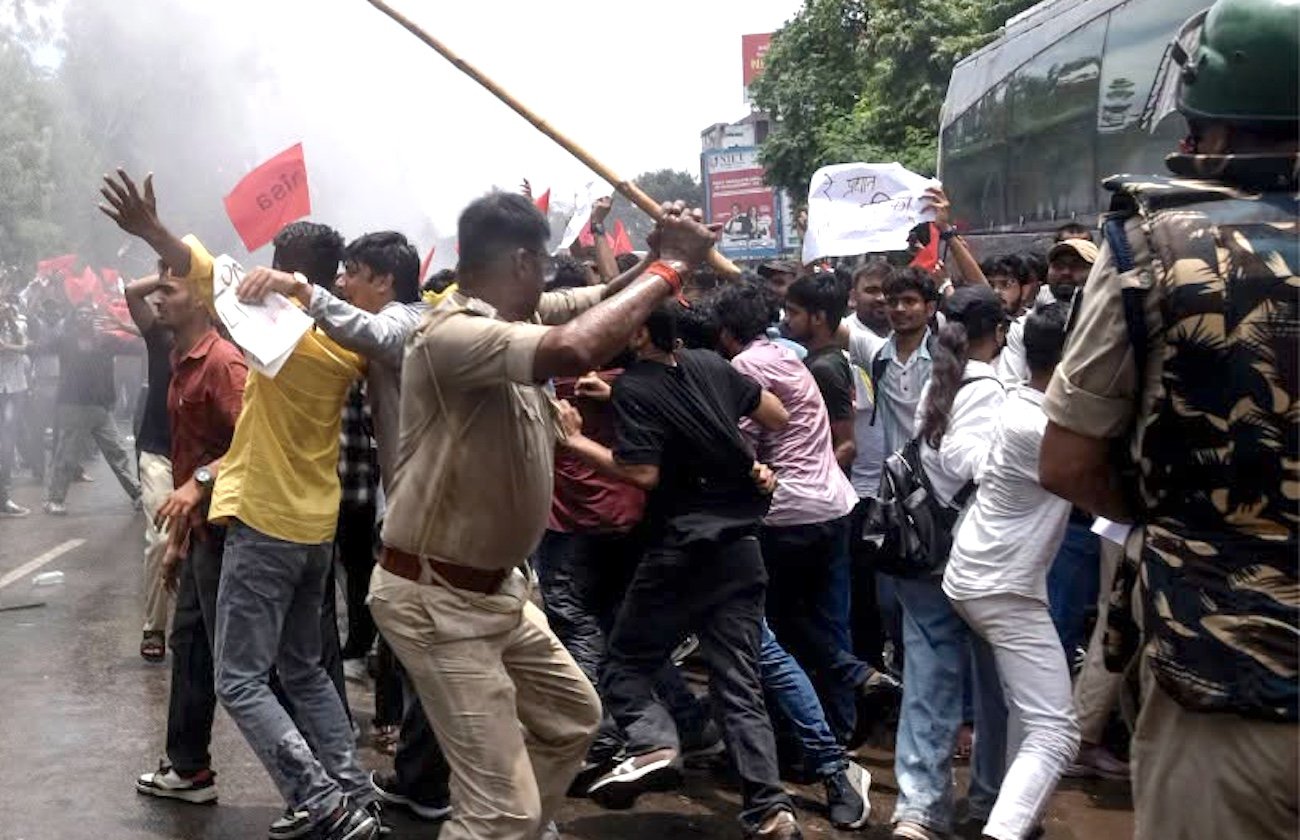

On the morning of Monday, July 20, 2026 — the opening day of India’s Parliament monsoon session — thousands of young people converged on Jantar Mantar, the 18th-century astronomical observatory in central New Delhi that has served for decades as India’s most politically charged protest ground. They had come to march to Parliament.
They did not get there.
What happened instead — captured on dozens of mobile phones, uploaded within minutes, and watched by millions within hours — produced images that have become the defining visual record of a protest movement that neither the Indian government nor the international community can any longer pretend is a fringe phenomenon.
Video of police beating protesters and dragging them away spread on social media, fueling public outrage, as PBS NewsHour documented in its account of the day. Amnesty International, in a statement published two days later, reported that social media users had shared videos and accounts alleging that Delhi Police threw stones at protesters, used excessive force by beating demonstrators with batons, and fired tear gas grenades at peaceful protesters.
France 24 and CNN both described the protests as the biggest demonstrations against the Indian government in several years. Sixteen metro stations across Delhi remained closed until further notice, as the Delhi Metro Rail Corporation announced in the aftermath of the clashes.
By nightfall, Abhijeet Dipke — the 30-year-old Dalit founder of the Cockroach Janta Party, who had flown from the United States to lead the protests — stood at a torn-down stage at the CJP’s protest site, addressing approximately 2,000 protesters who had stayed back after the crackdown.
“This barbaric Delhi police has beaten up our students and comrades. We are heartbroken,” he told them, as Al Jazeera reported. “We will continue to resist and demand accountability from the government. We will not back down until Dharmendra Pradhan resigns.” He told the crowd that the Delhi police “brutally cracked down to crush our hopes” that the education minister would step down. “It was only our first call to march,” he said.
How a Movement Was Born: From NEET to Jantar Mantar
The 2026 Delhi Jantar Mantar protests did not begin on July 20. They began, in a meaningful sense, with a cheating scandal.
The National Eligibility cum Entrance Test — universally known as NEET — is the gateway examination for admission to India’s medical colleges. Every year, millions of students spend years of their lives and their families’ savings preparing for it. In 2026, credible and subsequently confirmed reports of systematic paper leaks in NEET and in the Central Board of Secondary Education’s on-screen marking process exposed what the World Socialist Web Site described as “systematic fraud” in India’s examination infrastructure — a failure that affected not thousands but potentially millions of students whose years of preparation may have been rendered meaningless by the cheating of those with connections, money, or access to leaked materials.
The CJP, formally constituted on May 16, 2026, by Dipke — then based in Chicago — had channeled that anger from its first weeks of existence. Its primary demand has remained consistent throughout: the resignation of Union Education Minister Dharmendra Pradhan. But the movement’s resonance extended far beyond any single official’s tenure.
“Dipke says it is getting harder to afford a decent education and find well-paying jobs,” NPR reported in its July 20 account of the protests. “In India, if you’re rich, the system dances at your fingertips. If you’re poor, nobody will be there for you,” he told NPR. “We’re frustrated because the government has stopped listening.”
The CJP launched a continuous sit-in at Jantar Mantar on June 20. Eight days later, on June 28, Sonam Wangchuk — the prominent environmental and education activist from Ladakh, whose real-life story inspired the character in the Bollywood film “3 Idiots” — began an indefinite hunger strike at the protest site in solidarity with the students. His presence transformed the protest’s profile: where the CJP had been a Gen Z digital phenomenon, Wangchuk’s hunger strike gave it institutional credibility and a moral gravity that transcended party or generational lines.
On July 18 — his 21st day of fasting — Delhi police forcibly removed Wangchuk from the protest site and shifted him to a hospital against his wishes, as Amnesty International documented. The forced hospitalization of a hunger-striking activist generated immediate public outrage and became a direct catalyst for the march two days later.
The Videos: A Phone in Every Hand
The images from July 20 traveled faster than any official statement could contain them.
Videos shared by social media users showed police using baton charges against crowds of young people attempting to march toward Parliament, as multiple outlets documented. Amnesty International cited videos showing officers firing tear gas grenades at what the organization described as peaceful protesters. One widely circulated clip showed what was captioned as a Mumbai Police officer threatening protesting students and warning them of consequences. Another video showed protesters attempting to rebuild their tents at the designated protest site after police dismantled them — doing so, as Wikipedia’s account noted, amid rain and rubble.
A student at a protest site told a reporter from a regional outlet that she had walked hours to reach the demonstration and would not leave until she was heard. Other clips showed young women being dragged by police officers — footage that drew particular outrage given the BJP government’s consistent public messaging about women’s empowerment.
One image — a protester seated on the hood of a police car with the CJP cockroach insignia visible — became the movement’s most widely shared photograph, a visual that captured both the protesters’ defiance and their willingness to occupy, literally, the instruments of state power, as the World Socialist Web Site documented.
The BJP government has contested the characterization of the crackdown as brutal. Delhi Police stated their actions were necessary to maintain public order. The government noted that two assistant commissioners of police and four other police personnel were reported to have been injured in stone-pelting allegedly by protesters near Jantar Mantar during the evening of July 20. BJP chief Nitin Nabhi described the protesters as “people who want to make the country hollow,” NPR reported.
CJP spokesperson Sourav Das, the investigative journalist among the party’s three official representatives, said in a statement that the government had attempted to suppress what was a constitutional right of peaceful assembly. “The system has collected so much rot. The people have been very vocal,” he said.
The Specific Violence: An FIR and a UN Complaint
The CJP did not let the July 20 crackdown pass without specific accountability demands.
The Federal documented that Dipke filed a First Information Report — FIR — with the Parliament Street Police Station against Additional Deputy Commissioner of Police Sandeep Lamba, whom he accused of assaulting a woman protester at Jantar Mantar on July 20. “I have filed a complaint with the SHO, Parliament Street Police Station, for registration of an FIR against Additional DCP Sandeep Lamba who assaulted a woman protestor at Jantar Mantar on 20 July 2026,” Dipke wrote in a post on X. “Yesterday, in the Delhi High Court, the Government’s answer to the petitions on police brutality was that nobody had approached the police for an FIR. So today, I filed a police complaint. Every single police officer who illegally assaulted peaceful protestors must be brought to justice.”
He also filed a special procedures complaint with the United Nations against the alleged police brutality, as The Federal reported — an escalation to the international human rights architecture that underscored the movement’s determination not to be contained within the boundaries of Indian domestic politics.

The International Dimension: Amnesty, and a Government Rattled
Amnesty International’s July 22 statement was among the most significant pieces of international institutional attention the movement has received. “India: Crackdown on peaceful protesters in New Delhi raises serious human rights concerns,” the organization’s headline read. The statement documented Wangchuk’s forced hospitalization, described the July 20 events, and called for independent investigation into the allegations of police excess.
Amnesty’s intervention placed the Indian government’s response to the protests within the framework of international human rights law — a positioning that the BJP administration, which has historically resisted external criticism of its domestic security operations, has shown consistent discomfort with.
The protests have drawn comparisons, by international commentators, to the 2024 Bangladesh student uprising that toppled Sheikh Hasina’s government — a comparison that Indian authorities have explicitly rejected but that has circulated widely on social media and in international coverage. “People are messaging us saying they’ve lost hope in both the government and the Opposition,” Dipke told The Print.
On Tuesday, July 21, speaking with reporters at Jantar Mantar, Dipke issued a statement that captured the movement’s new posture after the crackdown. “If the government wants to have talks again, they have to come to Jantar Mantar. We won’t be going there,” he said.
Since the forced hospitalization of Wangchuk and the events of July 20, slogans targeting Prime Minister Modi personally have begun reverberating through the Jantar Mantar protest site — a significant escalation from the movement’s original, more specifically targeted demand for the resignation of the education minister. The movement, which began with a six-word joke about cockroaches on X, has arrived at the question that all serious protest movements in democratic societies eventually reach: who, ultimately, is responsible?
The Students Remain
On the night of July 20 and through July 21, hundreds of protesters remained camped at Jantar Mantar under heavy police presence, according to PBS NewsHour. They were sleeping on the ground, under plastic sheeting against the monsoon rain, in the shadow of dismantled tents that police had torn down — tents they were already beginning to rebuild.
Some have called for the decentralization of the protests — a dispersion beyond the CJP’s formal leadership into a broader, less structured movement that the government would find more difficult to negotiate with or suppress, as Al Jazeera documented from conversations with demonstrators. The debate reflects a maturity of strategic thinking unusual in a two-month-old protest movement.
What is not in debate, among those who have watched India’s protest landscape across the twelve years of BJP governance, is the scale of what has already happened. The Jantar Mantar protests of July 2026 are the largest street demonstrations against Modi’s government since he came to power in 2014.
They were built, the cockroaches would like you to know, by young people who the Chief Justice of India once called parasites. Who were told, by the most powerful judge in the land, that they were the problem — that their unemployment, their frustrated ambitions, their anger at a system that bent for the wealthy and broke for everyone else, were not the government’s failure but their own.
They took the name. They wore it. They refused to be swept away.
They are still there.