




What the Children Said: The Humbling Realities Beyond India’s ‘Gen Z Protests’

- Some students may yearn for reform, and others for revolution. What will be, we don’t know. But the good news is that propaganda is not in control like it used to be either.
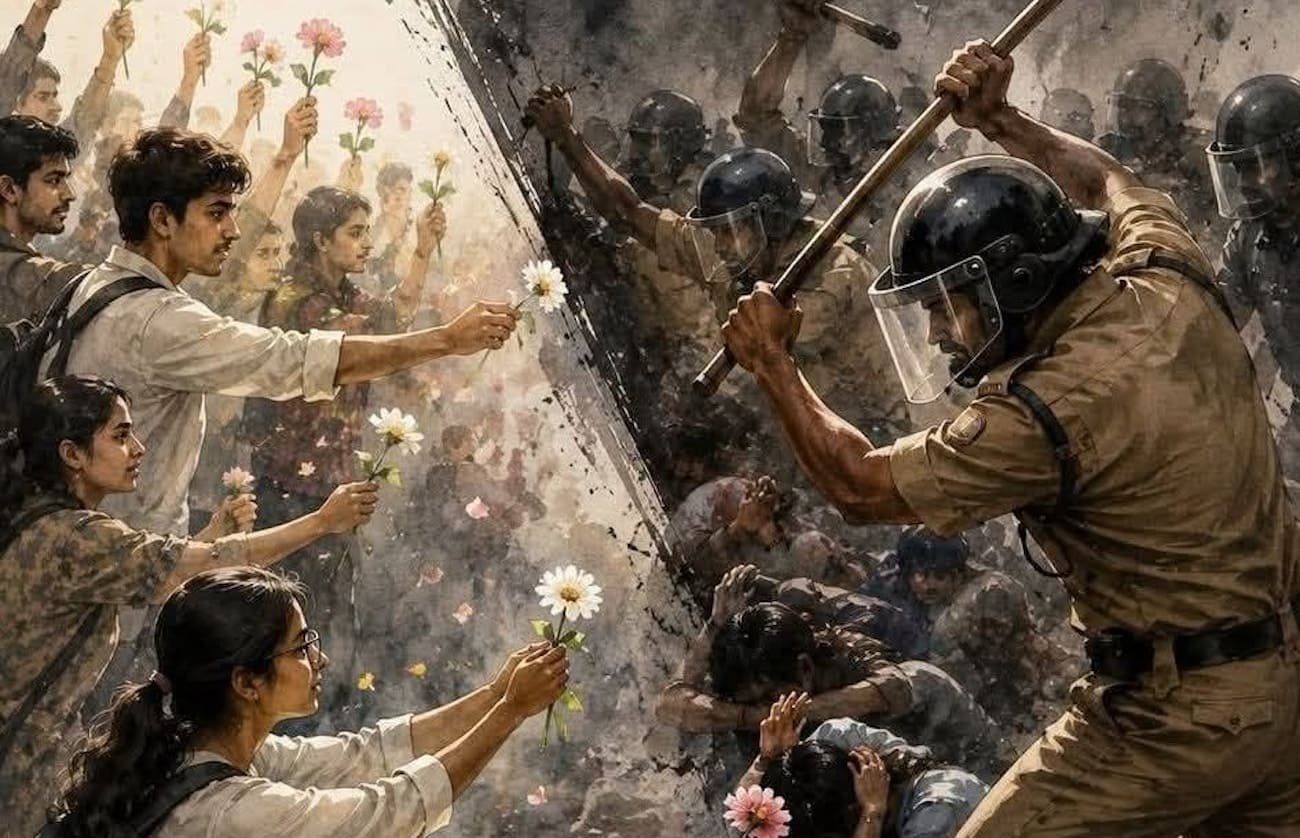

June felt like T.S. Eliot’s Wasteland. Mumbai was hot. Extremely humid, paralyzing, and hot. “It’s not just you NRIs,” friends said, “we who have been here all our lives haven’t seen anything like this either.” The rains showed no signs of coming at all. The mood was bleak. And in the background, the sounds and sights of another storm brewing. The NEET re-examination was held. Poignant images of parents crying and banging their heads in despair against closed exam-hall gates filled our screens and wrenched our hearts. And of course, the most wrenching, crushing, irrevocable scenes of all, the victims of exam-madness and re-exam insanity who took their own lives.
Datta. What have we given? What have we given them really? And why?
Dayadhvam. No kindness, no pity. It’s all rules and laws, you know. That’s what makes a country great. That’s what makes engineers engineer and doctors doctor and progress progress. You must be stopped and frisked and fingered about like a dangerous criminal before you are allowed to go in, think of Ganesha and Saraswati quickly and quietly, and write that exam you spent years slogging for and your parents spent years slogging for to earn the tuition and coaching fees for you. Why not a Hannibal Lecter restraint system now for India’s students? That should do the trick and keep them straight and narrow so only scientifically selected candidates become doctors and engineers and contribute to Vik-sit 2047 (or whatever the other party might call it if they come to rule again). You are not a human. You are not fit for science and progress if you are treated with dignity. The crueler you are, the fairer you are, somehow.
Damyata. The boat did not respond to the skilled controlling hand. It will not. There is no skill, no hand, all thumbs, all fingers, wriggling about in every sordid pie and piece of the pie. Stricter punishment for paper-leakers! Bigger surveillance tech everywhere! Big close-up intimate Instagram videos. Big talk. But no walk because only a free country can walk, isn’t it? Postcoloniality. Systemic oppression. Corruption. Call it what you will. We have no swaraj. Only a ventriloquist dummy kind of raj where everyone has to go through the motions. Examiners. Security guards. Politicians. Administrators. Professional propagandists and “All is great, you anti-nationals!” boasters. There is no swaraj. It did not come in 1947. It did not come in 1991. It did not come in 2014.
Of course, now many have hope that it will come. Post the summer of 2026. In 2029. Or some other date down the line. The “lowly” cockroach, an unlikely symbol for counter-communication. Others say it’s all already co-opted too. The polarization is now so obvious we are even beginning to see it clearly. Most of my friends who were mildly critical of the government’s education policies and failures even a few months ago decide to get behind protecting their frail, elderly, besieged Prime Minister. They weep on X for him. Others, who never liked him, are proud of this moment.
But as V.V.P. Sharma writes in American Kahani, how easily we have forgotten what is at the heart of this mess. It is not the politicians. Not our anger or fanboy love for politician x or y. It is the children who we have given something called life to. But what sort of a life? No air. No sidewalks to walk on. No trees to shelter. No nurturing in learning. Nothing but dystopia as a society, and some small cocoon of shelter as a family. A bit stronger for those with privilege, less for others. “Why the poor don’t kill us” wonders Manu Joseph. The weird thing about Indians and India is that maybe they just couldn’t be bothered. The amount of enlightened detachment is ridiculous. Getting by is its own reward. And getting by is what we all do.
As V.V.P. Sharma writes in American Kahani, how easily we have forgotten what is at the heart of this mess. It is not the politicians. Not our anger or fanboy love for politician x or y. It is the children who we have given something called life to.
But the question remains. If it is true that the one thing, the one supreme thing, which animates Indians with that indomitable will and calm is their children, and the realization dawns that so much of what has been done to them has been a hoax, how will they react? Will parents also rise? Or wise-up, at the least? A few years ago, a digital-tech mania swept the country. It wasn’t a natural thing but a highly deliberate and relentless marketing campaign. Authoritative-looking “testing experts” went around convincing parents, many of them working-class, that their kids were in dire need of buying some kind of a digital device to get ahead in their studies in life. That bubble burst. Some traps don’t feel like traps, still. Some rat-races seem inevitable, for now. But the time will come, it will come, with viral memes and street protests, or through something else, I do not know. The division of generations by the hell-dreams of corporations, colonizations, and states will end. Nothing in nature warrants the arrangements in vogue among us humans today. Nature is rising. But since it’s kali yuga, and the media age, it will wear the weirdest of masks and forms. But the writing is on the wall. The songs are in the air.


Who would have thought that a song about a baby being rocked to sleep would be the swan song for a man who could do no wrong? I do not say this in a partisan way. Maybe the man who could do no wrong will realize he was wrong about thinking of himself that way. Or at least his fans. One can hope. The whole problem was not just because of the incompetence, or the corruption, but the absolute cluelessness. A whole generation, indeed more than one generation, can see what is wrong. But to see how deep is the wrongness of it all is the task still ahead. For that to change, we have to see ourselves, and our children, and this whole institution of schooling, competing, rat-racing, everything, in perspective. None of it needs to be this way. Learning comes before anything else.
It is ironic but the confrontation in India now seems to have polarized not around religious lines or caste lines or any identitarian-electoral machination (though those who try will try) but on the question of being able to learn. The showdown has crystallized between one group which has shown itself most incredibly incapable of learning, the political class, and the group which has had more whiplashes on its back in the name of learning than anyone else, the students. Some students may yearn for reform, and others for revolution. What will be, we don’t know. None of us really are in control. Neither votes nor protests will change things in the end. That is the truth. But the good news is that propaganda is not in control like it used to be either. When the waters clear, there will be more than just a party or a personality swept away. Parents will think of children as children. And children will think of themselves and their worth in a whole new way, ancient as nature, young as the future.
Vamsee Juluri is Professor of Media Studies, University of San Francisco. He is the author of “Becoming a Global Audience: Longing and Belonging in Indian Music Television” (Peter Lang, 2003), “The Mythologist: A Novel” (Penguin India, 2010), and “Bollywood Nation: India through its Cinema (Penguin India,” 2013), “Rearming Hinduism: Nature, Hinduphobia and the Return of Indian Intelligence “ (BluOne Ink, 2024) and “The Guru Within” (in progress).