




‘We Are Watching You’: How Indians Across America Rallied for the Cockroaches — and What It Revealed About a Divided Diaspora

- The student protests that ended Dharmendra Pradhan's career and cracked open twelve years of BJP political dominance found an unexpectedly powerful echo among Indian Americans — a community that had long been assumed to be among Modi's most loyal foreign constituencies.
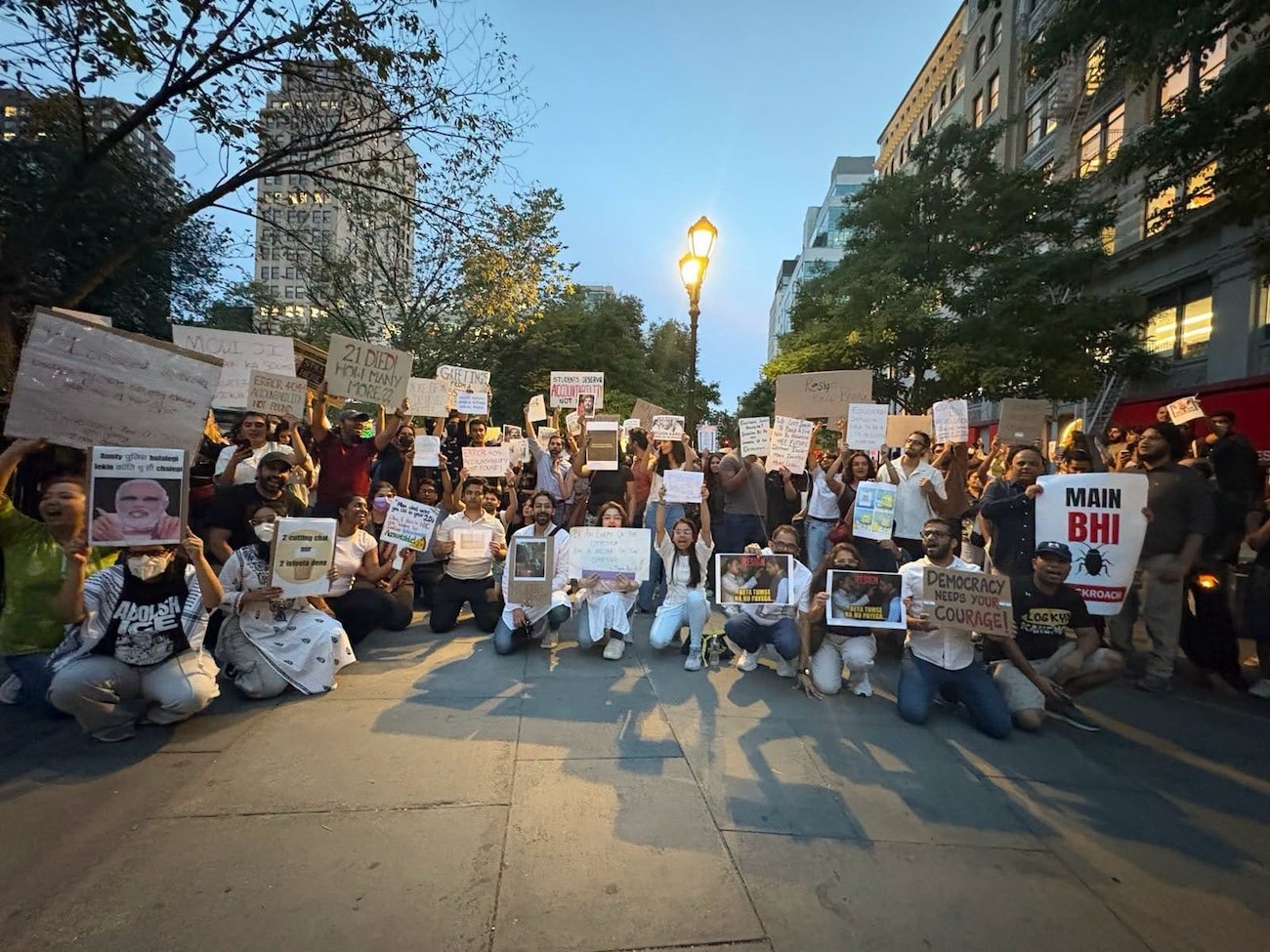

On the evening of Sunday, July 20, 2026 — the same day that Delhi Police used batons and tear gas against student protesters marching toward Parliament — a crowd gathered at the base of the Mahatma Gandhi statue in Union Square, New York City. They held placards reading “Stand with India’s Students for a Future They Can Trust” and “Main Bhi Cockroach” — I Am Also A Cockroach — (an allusion to supporters of the Cockroach Janata Party) and chanted in Hindi and English for the resignation of India’s Education Minister Dharmendra Pradhan.
The first rally was held on July 20 at Union Square, near the Mahatma Gandhi statue. The U.S.-based advocacy organization Hindus for Human Rights promoted the New York demonstration, calling on supporters to gather “to stand with India’s students.”
Writer and activist Yashica Dutt, who attended the rally, later announced that a second demonstration would be held at the same location on Friday, July 24, citing what she described as the “tremendous response” to the July 20 gathering. She invited participants to join a “peaceful solidarity protest” and encouraged them to bring handmade signs and water.
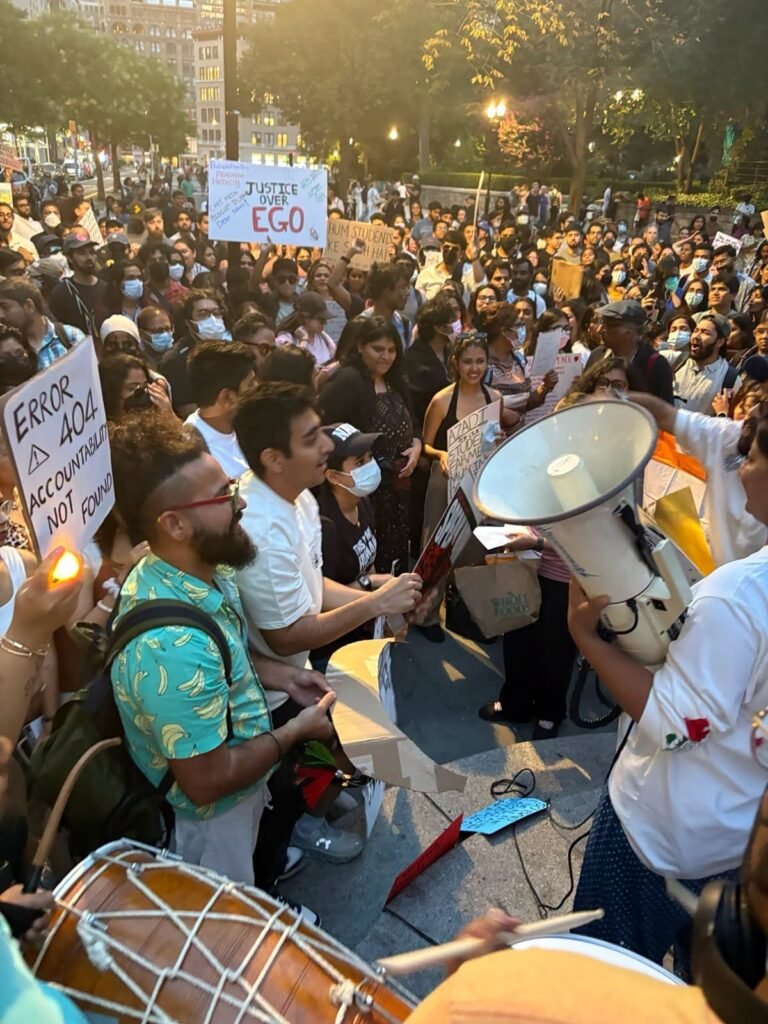
Four days later, the numbers had grown dramatically. Hindus for Human Rights said that more than 500 students and community members gathered at the Mahatma Gandhi statue in New York’s Union Square on Friday, July 24, according to organizers. And on July 25 — the day Pradhan resigned — a parallel rally in Fremont, California, gathered more than 100 Indian Americans at Central Park’s Unity Sculpture, as American Community Media documented.
The scale and geographic spread of the American response — from Union Square to Silicon Valley, from Chicago to Austin, from San Jose to Washington D.C. — was among the most significant indicators that something had fundamentally shifted in the Indian diaspora’s relationship with Indian politics. A community that had long been identified with Modi’s political project was, in significant numbers, standing in public against it.
A Diaspora Long Assumed to Be Modi’s Own
Understanding why the American diaspora response to the CJP protests matters requires understanding what the community’s political alignment had previously looked like.
The Overseas Friends of the BJP — the official diaspora arm of the ruling party — has organized events, fundraisers, and prayer ceremonies across American cities for over a decade. In 2024, hundreds of BJP supporters conducted havans — sacred fire ceremonies — in New Jersey, New York, Virginia, Maryland, and Chicago to pray for Modi’s re-election, as the Deccan Herald documented. The “Howdy, Modi!” rally at Houston’s NRG Stadium in 2019 drew 50,000 Indian Americans to cheer a joint appearance by Modi and then-President Trump. Indian American donors had contributed millions of dollars to Republican and Democratic candidates who took positions favorable to India’s ruling party.
The Carnegie Endowment’s 2026 Indian American Attitudes Survey — published just months before the protests — had found the BJP to be the most popular Indian political party among Indian Americans, with 28 percent identifying with it. The same survey found that 71 percent of Indian Americans disapproved of Trump, but contained no suggestion that their disapproval of the BJP was anywhere near comparable.
What the CJP protests revealed is that those numbers masked a more complicated reality — and that the community’s political allegiances were not as settled as either the BJP’s diaspora machinery or the liberal Indian American advocacy organizations had assumed.
New York, San Jose, Fremont: The Geography of Solidarity
The overseas rallies were organized by the advocacy group Hindus for Human Rights, which said supporters gathered at Mahatma Gandhi’s statue in New York City’s Union Square and at a separate demonstration in San Jose on July 20. The organization said similar protests took place outside the Indian High Commission in London and the Indian Embassy in Dublin. Participants carried placards backing Wangchuk, chanted slogans against the Indian government and called for the resignation of Education Minister Dharmendra Pradhan. In a statement issued after the rallies, the organization said the demonstrations were intended to highlight what it described as the need for fairness and accountability in India’s examination system.
“Our protests sent a clear message, whether in New York or London, San Jose or Dublin: India’s students deserve to be treated with fairness and dignity,” the organization said in its statement.
Demonstrations also took place or were announced in Los Angeles, San Francisco, Chicago, San José, Fremont, Austin, London, Dublin, Berlin, Manchester, Toronto, Vancouver and other cities, according to the organisers.
The Fremont rally — held on July 25, the day of Pradhan’s resignation — was particularly resonant given its location. Fremont, in California’s East Bay, is home to one of the largest concentrations of Indian Americans in the United States, with a significant population of software engineers and technology professionals. Many have relatives who navigated India’s brutal competitive examination system — including NEET, the medical entrance test at the center of the scandal. The personal stakes of the protest were immediate and biographical for many in the crowd.
“Today, the people of India won a small victory, but an opening for a fundamental change in the policies of the country,” said Sharat Lin, co-founder of South Asians for Collective Action, one of the groups that organized the rally in Fremont. “We are here showing our solidarity with the youth of India who understand the oppression caused by the ruling party, the BJP.”
Similar rallies organized by Hindus for Human Rights were held July 25 in Irving and Austin, Texas; Washington, DC; London, and Melbourne, Australia.
“Do Not Be Afraid to Take On Power”
Among the most widely circulated pieces of diaspora solidarity content was a video shared by AJ+, Al Jazeera’s social media channel, in which speakers at one of the overseas rallies addressed their counterparts in India directly.
“Do not be afraid to take on power, because when we take on power together, this is what happens. We are watching you as you courageously stand strong and reclaim our democracy back,” one speaker said.
Another speaker added: “It is our responsibility to amplify their voices. International solidarity reminds those struggling back home that they are not alone.”
The language of solidarity — “we are watching you,” “you are not alone” — carried particular weight given the role of overseas attention in constraining the options available to authoritarian governments. When the July 20 police crackdown generated footage that circled the globe within hours, the diaspora’s role in amplifying that footage — sharing it, condemning it, showing up in public to register their opposition — was not merely symbolic. It was part of the international accountability infrastructure that made ignoring the protests politically costly for the Modi government.
Organizers said the rallies were intended to reassure demonstrators back home that they were “not alone” and to draw greater international attention to their demands.
The Students With American ZIP Codes
The diaspora response was not only organizational. It was personal, immediate, and generational.
Abhijeet Dipke himself — the CJP’s founder — had been living in Chicago and studying at Boston University when the movement began. He had organized and led the initial campaign from American soil. His decision to fly to India and lead the protests in person, despite his stated fear of arrest at the airport, gave the American dimension of the story a human center.
The CJP’s social media architecture — Instagram, X, YouTube — was built and sustained, in significant part, by young Indians living in the United States and other Western countries. The 22 million Instagram followers and the viral memes that circumnavigated government suppression relied on a diaspora that was fluent in American internet culture and had the technical infrastructure, the time zones, and the platform relationships to keep content moving when Indian internet shutdowns slowed it within the country.
Many of the students who turned out at Union Square and Fremont were not Indian American citizens but Indian nationals on student visas or work visas — people whose own futures in the American immigration system were shaped in part by the examination system they were protesting against. The NEET scandal affected not only aspiring Indian medical students in India but a community whose entire pathway to professional life in the United States had depended on navigating competitive examinations with integrity.
The Fault Line: A Diaspora Divided

The solidarity was real — but so was the division it exposed.
The Indian American community has never been politically monolithic, and the CJP protests intensified a tension that the Carnegie survey had documented in statistical terms: between an older, often more affluent, often more BJP-aligned diaspora and a younger, more politically heterogeneous generation whose relationship with Indian nationalism is significantly more complicated.
Hindus for Human Rights has been a consistent target of criticism from BJP-aligned groups in the United States, including the Hindu American Foundation, for what the latter characterizes as anti-Hindu bias. The participation of HfHR as an organizer therefore made the protests, from the perspective of pro-BJP diaspora organizations, politically coded in ways that complicated any straightforward reading of them as nonpartisan student solidarity.
The BJP’s own language about the CJP protests — BJP spokesperson Nitin Nabhi’s description of protesters as “people who want to make the country hollow,” and a BJP minister’s NDTV characterization of the CJP as “the B-team of terror groups,” as CNN documented — was amplified through the same diaspora WhatsApp groups and social media channels that served as the BJP’s primary communication tools with overseas communities. For Indian Americans who received both the protest footage and the BJP’s framing of it through the same networks, the task of forming an independent judgment was not simple.
Yet the sheer scale of the American response — more than 500 people at Union Square alone, organized rapidly across at least a dozen American cities — suggested that the BJP’s diaspora communications machinery was not as effective at shaping perceptions of this particular crisis as it had been in previous confrontations.
“The First Resignation in Twelve Years of BJP Rule”
On the afternoon of July 25, 2026 — after 36 days of protests at Jantar Mantar, a 26-day hunger strike by Sonam Wangchuk, a police crackdown on July 20 whose images had circled the world, the brief detention of opposition leader Rahul Gandhi outside Modi’s residence, and sustained international attention — Dharmendra Pradhan resigned as India’s Education Minister.
Within hours, the crowd at Fremont’s Central Park heard the news delivered by Sharat Lin from the platform. The crowd at Union Square, which had been gathering for its second rally, learned of it from their phones. Across the diaspora cities where protests had been held or planned, the reaction was one of stunned relief.
The SFI-UK Leeds committee in England said on X that it organized a “victory gathering in celebrating the win of student solidarity in India and across borders that brought in the first resignation in the 12 years of BJP rule. Onwards and upwards comrades.”
The Federal, summarizing the moment, put the diaspora dimension plainly: the CJP’s protest at Jantar Mantar garnered global support with the Indian diaspora and students, who have always been believed to be backing Prime Minister Narendra Modi, supporting the “cockroaches.”
The CJP called off its protests later that day after the government agreed to its remaining demands — including compensation for families of students who died by suicide in connection with examination stress, and commitments on preventing future paper leaks. The Jantar Mantar site, which had been continuously occupied for more than a month, was quiet by nightfall.
In Fremont, New York, Chicago, and Austin, the Indian Americans who had spent the previous week holding placards and sharing videos folded their signs, checked their phones one more time, and went home.
The cockroaches, it turned out, had made it to America too.
Photos: Courtesy of Hindus for Human Rights. More than 400 students and supporters gathered at the Mahatma Gandhi statue in New York City’s Union Square standing in solidarity with India’s students and job seekers.