




National Handloom Day: When the Loom Turns Into a Symbol, a Photo-Op, a Hashtag, a Line in Someone’s Speech

- A day that actually wants to honor weavers would do a few things differently, such as naming specific communities instead of gesturing at “heritage,” adding income numbers next to the celebration, and spreading awareness about the people and work behind the craft.
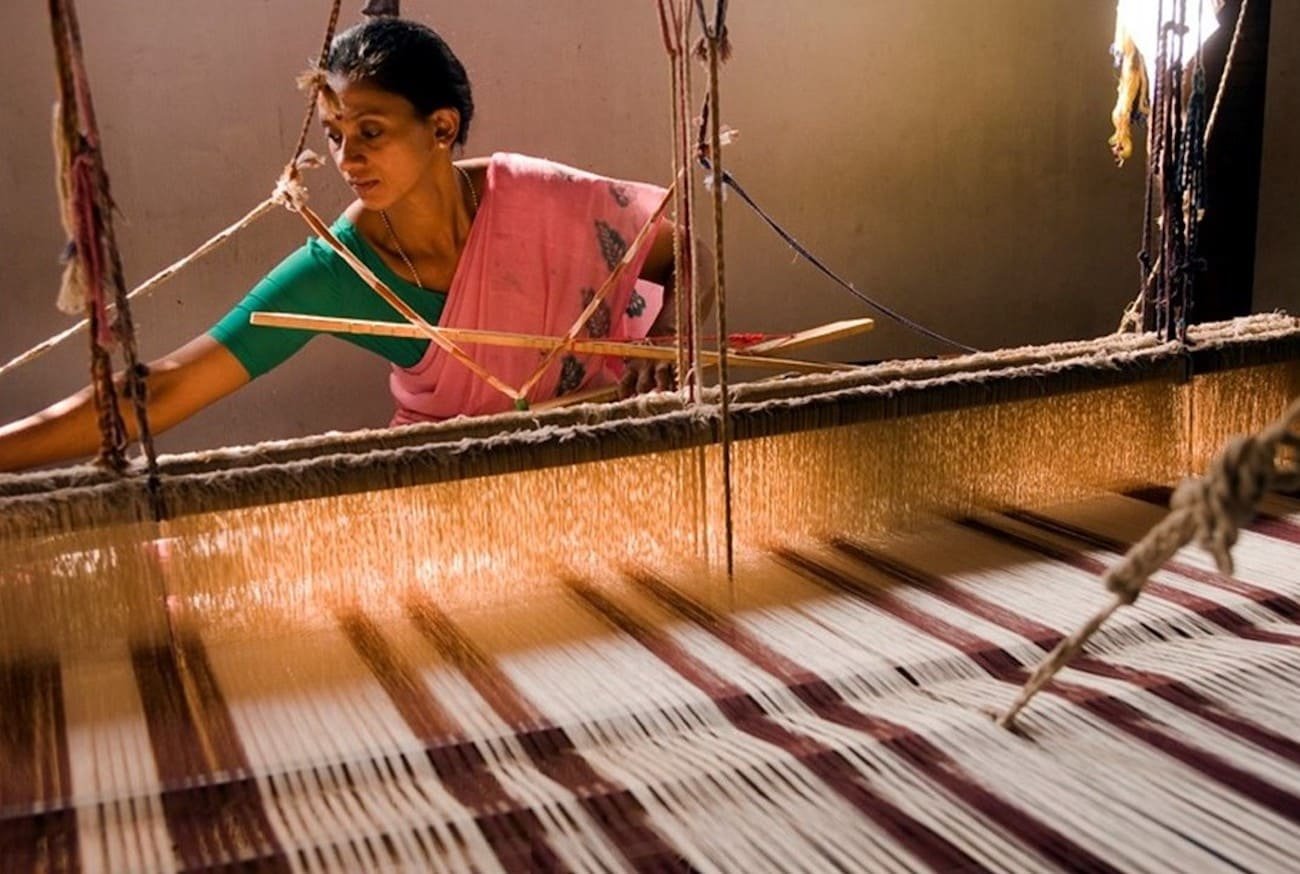

Last week, India marked another National Handloom Day. MPs wore handloom to Parliament, celebrities were mentioned across media as ambassadors of Indian weaves, and citizens flooded social media with handloom photos, hashtags trending for a couple of days. Prime Minister Narendra Modi marked the day with a video message urging citizens to commemorate August 7, 1905, the day the Swadeshi movement was launched. As he put it, people from all walks of life joined the shared struggle against British rule. He asked citizens to support weaving families directly: buy at least one handloom product, film it, share it, so that Indian craftsmanship gets seen by the world.
My family’s roots are close to Nuapatna, a weaving cluster in Odisha’s Cuttack district known for Khandua Ikat. This particular textile has its own history. It is tied not to nationalist politics, but to temple offerings, which go back to the twelfth century. The weavers there weren’t strangers to me, even if I only saw them a few weeks a year. I didn’t live around the sound of a loom, but I did visit it every school vacation. It continued to be there, unchanged, going on for the rest of the year, a rhythm my native place kept whether or not I was around to hear it.
Now, as I discuss it from the U.S., it’s a place I still return to, even if only for a few weeks a year or two. I think this is the kind of distance that makes it easier to see what National Handloom Day gets right, and what it doesn’t. The question is what are we actually remembering on this day, and who ends up benefiting from the remembering?
Two Different Kinds of Pride Wearing One Costume
There is a usual move nations make again and again: turning local things into national symbols that everyone can hold onto at once. The government chose this date for National Handloom Day back in 2015 for exactly this reason; so that honoring a craft would also mean honoring an older act of defiance. Weaving was never just about weaving. For more than a hundred years, it has also had to carry a nation’s idea of itself.
Sumit Sarkar, in his landmark 1973 study, “The Swadeshi Movement in Bengal, 1903-1908,” argues that the movement’s leadership was overwhelmingly urban, educated and upper-caste. The weavers whose labor the boycott depended on were rural and poor, and they show up in the movement’s own record mostly as a resource to be organized, not as people with a voice. That old pattern hasn’t fully gone away. National Handloom Day, even after over a century, is still a day about weavers, arranged mostly by non‑weavers, leaving the weavers in the background of someone else’s story. Hence, this celebration of “heritage” is worth a second look at who is celebrating, and on whose behalf.
The Number Nobody Sits With
The handloom sector is still one of India’s largest sources of rural income outside farming. As per the Ministry of Textiles’ figures, roughly 72% of India’s handloom workforce are women, most working from home, on piece rates with seasonal income swings. This statistic gets repeated constantly as something to be proud of.
The Ministry of Textiles’ Fourth Handloom Census, released in 2019-2020, counted around 31.45 lakh households engaged in handloom activity. It’s a rise from 27.83 lakh a decade earlier, a growth the government has credited to its own welfare schemes. But the number of actual weavers tells a different story: from 65.5 lakh people engaged in weaving in 1995-96, is down to 43 lakh by 2009-10, and down further to somewhere between 26 and 35 lakh by the time of the 2019-20 census. Also, two-thirds of weavers still earn less than five thousand rupees a month, and barely one percent earn more than twenty thousand rupees.
The narrative government presents about handloom weaving contrasts starkly with the realities faced by the artisans. National Handloom Day highlights perseverance and autonomy but ignores falling youth participation, the rise of power‑loom knockoffs and the unequal profit split between weavers and merchants. The exact numbers shift by region, by product and by whether a weaver sells through a cooperative or a private trader. But it’s a pattern that shows up again and again in India’s handicraft economy: the slowest, most skilled work in the chain is usually the worst paid.
While promoting handloom, it is easy to slide into treating any weaver who has shifted to a power loom as someone who has abandoned the tradition, a kind of betrayal of the craft. However, the weaver is merely making a rational choice about his own survival.
Also, while promoting handloom, it is easy to slide into treating any weaver who has shifted to a power loom as someone who has abandoned the tradition, a kind of betrayal of the craft. However, a weaver who shifts to a power loom, or sends his child into a city job instead of onto the loom, is making a rational choice about his own survival. National Handloom Day furthers the romanticization of labor on one day a year while doing very little to make that labor sustainable for the rest of the year.
Where the Diaspora Fits, and Where It Doesn’t
The diaspora sits somewhere odd in all this. It does put real demand back into the system. A saree bought for a wedding or a Khandua worn at an event thousands of miles from Odisha sends money back to the makers. However, diaspora buying is largely a performative way to assert your cultural background to others. Though none of that makes the sentiment fake. It just means a symbol behaves differently once it’s cut loose from where it came from. Worn far from Nuapatna or Kanchipuram or Pochampally, the saree starts doing a different kind of work. It is less about the labor behind it, more about the wearer’s own need to be seen a certain way. Both things are true at once. The feeling can be sincere, yet still sideline the significance of the labor behind it.
Walk through any diaspora wedding or Diwali gathering and count who is actually wearing the handloom. It is almost always the women: sarees, kurta sets, dupattas, the occasional shawl or stole. The men, more often than not, are in Western suits, or at most a handloom shirt or kurta. It says something about who has been quietly handed the job of carrying culture forward, and who has been let off the hook. Heritage, in practice, seems to be a woman’s assignment; something she wears, maintains, and passes down, while the men around her get to opt in or out of it as they please.
The diaspora does promote handloom genuinely. But there is a silent contradiction right underneath that support which is rarely spoken. We happily buy the saree, post the photo, repeat the hashtag. However, ask a diaspora parent how they would feel about their own child studying textile design, or fine arts, or crafts as a career. The enthusiasm tends to disappear fast. Handloom is fine as heritage to consume. It is much less fine as a subject actually to pursue, as that is considered an impractical choice. It is a strange kind of respect: admiring the object while silently steering their own kids away from ever becoming the people who make it. Underneath that is an old, uncomfortable assumption: pursuing art and craft as a profession entails many struggles, such as financial burden and lack of recognition.

The Fair Case for the Day
National Handloom Day didn’t invent India’s handloom policy, and it doesn’t operate alone. Geographical Indication(GI) tags have given clusters like Nuapatna’s ikat real legal standing against imitation. A Nuapatna Khandua now means something specific in law, not just in reputation. Government procurement schemes create guaranteed demand that many weaving households genuinely depend on. And cooperatives, where they function well, do let weavers keep a larger share of what their work is worth than they’d get selling to a private trader on their own. For a lot of families, these benefits are what keep them from quitting.
That said, it’s also not the whole picture. A GI tag may protect a name, but it doesn’t guarantee a wage. A procurement scheme creates demand, but doesn’t decide how much of that money actually reaches the person at the loom. And cooperatives, when they are poorly run or captured by the wrong interests, can end up looking a great deal like the intermediaries they were built to replace. So the honest position is that the record is genuinely mixed. National Handloom Day tends to be marketed as if it were perfect, even though that is far from the truth.
What Honoring Weavers Would Actually Look Like
The impulse behind National Handloom Day is not cynical. The Swadeshi history is real. The stakes for weaving families are real. Attention, whether it is imperfect or sentimental, can provide meaningful support. But a day that actually wants to honor weavers would do a few things differently, such as naming specific communities instead of gesturing at “heritage,” adding income numbers next to the celebration, and spreading awareness about the people and work behind the craft. Honoring weavers would mean direct market access, fair wages, and local training programs.
There is a loom I remember from childhood, while observing the weavers of Nuapatna. I can not tell the make or the year it was built. Yet, I remember the sound it made every afternoon, who sat at it, and how completely ordinary yet significant that sound was. Now, on the single day of August 7th, that same loom turns into a symbol, a photo op, a hashtag, a line in someone’s speech. Every other day, it is just another tool for a family to make a living from, mostly unseen and mostly uncelebrated. Handloom Day would mean more if it added focus to that unwatched, ordinary labor and process instead of asking us to look only at the final product.
Top image, courtesy of www.womenonwings.com.
Sarita Dash is an independent researcher working on culture, memory, and identity across South Asia and its diaspora. She is the author of Cultural Dimensions of India’s Look-Act East Policy: A Study of Southeast Asia (Palgrave Macmillan) and holds a PhD from the Centre for South Asian Studies, School of International Studies, Jawaharlal Nehru University, New Delhi. Her work explores how culture, memory, and identity shape and are shaped by foreign policy in South Asia, particularly through everyday practices, lived experience, and questions of belonging.