




India at the Top — and the Giant Who Was Left Out: South Asians on Forbes’ Most Successful Immigrants List

- The inaugural Forbes 250 is a remarkable tribute to Indian and South Asian contributions to American life. But its historical section's omission of Subrahmanyan Chandrasekhar — the Nobel laureate who gave NASA its most celebrated telescope its name — is a gap that demands attention.
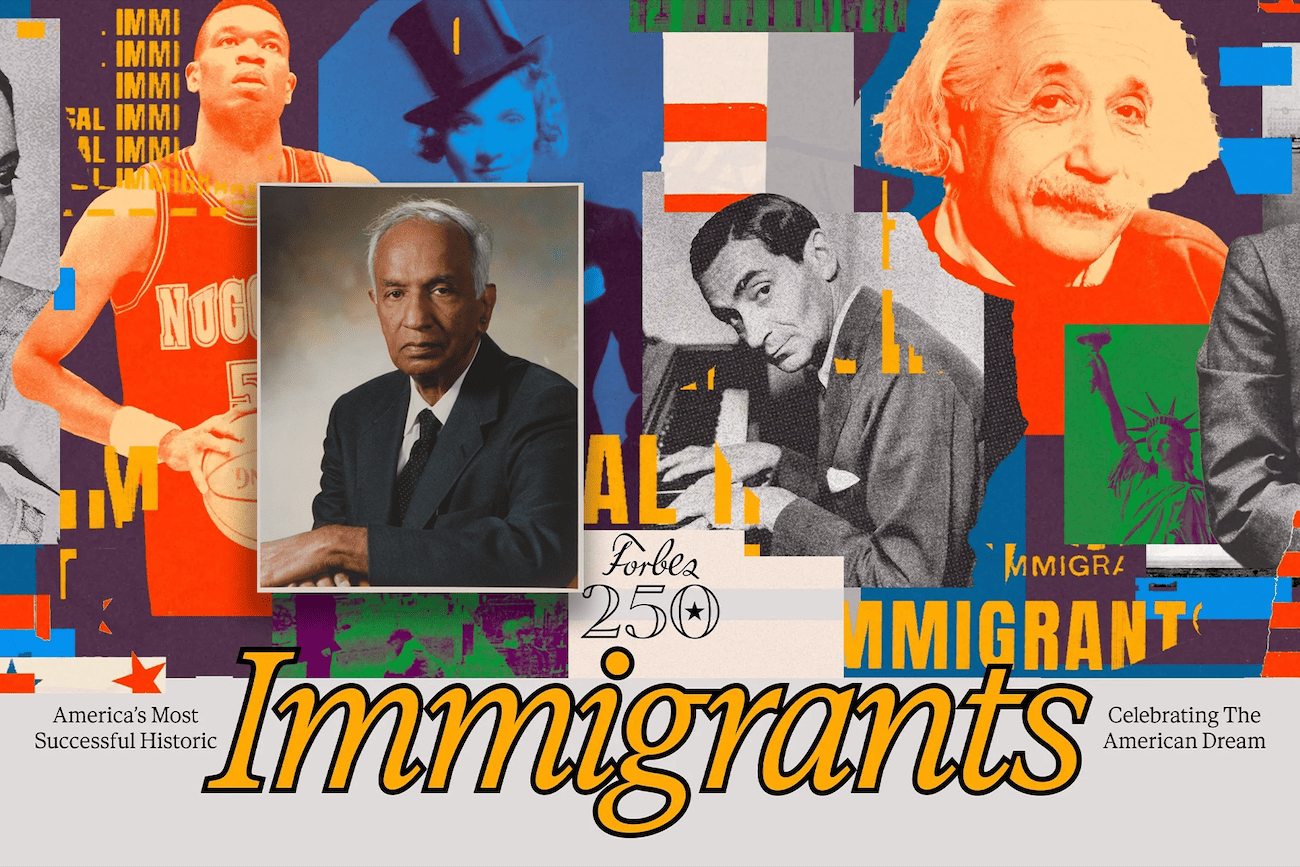

When Forbes published its inaugural “Forbes 250: America’s Most Successful Immigrants” list on June 10, 2026, timed to the nation’s 250th anniversary, it set out to capture the full sweep of immigrant contributions to American life — not just the living, but the historical. The list is divided into two sections: America’s Most Successful Living Immigrants and America’s Greatest Historic Immigrants.
The South Asian presence on both lists is substantial, distinctive, and, in one significant case, conspicuously incomplete.
The Living List: India as the Dominant Nation
India is the single most represented country of origin on the Forbes 250 overall, with NRI Pulse’s tabulation placing the total at 32 honorees across the full list — outpacing Canada at 18, Israel at 15, China at 14, and the United Kingdom at 14. Among the living immigrants, the Indian-origin honorees span venture capital, semiconductor engineering, cloud computing, molecular biology, poverty economics, television, clean energy, and nonprofit finance. Pakistan contributes several significant figures of its own to the South Asian tally.
Vinod Khosla, ranked 14th overall — the highest placement of any Indian-origin honoree — came to the United States in 1976 from New Delhi, co-founded Sun Microsystems in 1982, and subsequently built Khosla Ventures into one of Silicon Valley’s most influential early-stage investment firms. His portfolio includes DoorDash, Stripe, Affirm, Impossible Foods, QuantumScape, and OpenAI, for which his firm was the first institutional backer. Forbes estimates his net worth at approximately $14 billion.
Naval Ravikant, ranked 27th, was born in New Delhi and moved to New York as a child, later studying computer science and economics at Dartmouth. He co-founded the investment platform AngelList, which transformed early-stage startup fundraising, and made foundational bets on Uber, Twitter, and Postmates before they became global names.
Hemant Taneja, ranked 31st, is the founder of General Catalyst, whose investments include Stripe, Snap, and the defense technology firm Anduril.
The list’s most recognizable names to a general audience are the chief executives running the world’s largest technology companies. Sundar Pichai of Google and Alphabet, ranked 55th, was born in Madurai, Tamil Nadu. Satya Nadella of Microsoft, ranked 89th, was born in Hyderabad. Nikesh Arora of Palo Alto Networks, ranked 155th, Arvind Krishna of IBM at 219th, and Shantanu Narayen of Adobe at 221st round out a cohort of Indian-born chief executives whose companies collectively influence virtually every aspect of modern economic and digital life.
Sanjay Mehrotra, ranked 44th, founded SanDisk before becoming CEO of Micron Technology, whose recent rise to a trillion-dollar valuation tracks the global boom in artificial intelligence infrastructure. Jay Chaudhry, ranked 93rd, was born in a remote Himalayan village in India where electricity and running water did not arrive until his teenage years, moved to the United States in 1980 for graduate studies at the University of Cincinnati, and built Zscaler into the defining company in cloud security. Romesh T. Wadhwani, 98th, sold Aspect Development for $9.3 billion in 2000 and founded Symphony AI in 2018.
Among the investors and builders: Kavitark Ram Shriram, 103rd, was a founding investor in Google and has made early bets on Stripe and Notion. Jyoti Bansal, 127th, waited seven years for his green card before founding AppDynamics, which he sold to Cisco for $3.7 billion. He has since built Harness, last valued at $5 billion. Neha Narkhede, 142nd, co-founded data streaming platform Confluent, which IBM acquired in March 2026 for $11 billion. Jitendra Mohan, 147th, co-founded semiconductor company Astera Labs after a career at Texas Instruments. Shyam Sankar, 156th, serves as chief technology officer of Palantir — among the most influential companies in American defense and intelligence — and as chairman of Ginkgo Bioworks. Raj Sardana, 198th, founded IT services firm Innova Solutions after working at a missile engine company and owning gas stations. Aman Narang, 207th, co-founded Toast, which now serves as the digital cashier for nearly 100,000 restaurant locations.
Clean-energy pioneer K.R. Sridhar, 223rd, led a NASA team developing oxygen-generation technology before founding Bloom Energy in 2001. Premal Shah, 224th, co-founded Kiva, the nonprofit microloan platform that has helped facilitate more than $1 billion in small loans to entrepreneurs in emerging economies. Rakesh Gangwal, 230th, served as CEO of US Airways before co-founding IndiGo, which became India’s largest airline. Rajiv Jain, 231st, founded GQG Partners, which manages more than $162 billion in assets.
The two women of Indian origin on the list represent the community’s reach beyond technology and finance. Neerja Sethi, ranked 91st, co-founded the IT consulting firm Syntel in her apartment with her husband Bharat Desai in 1980, sold it to Atos for $3.4 billion in 2018, and in 2025 pledged to give away $1.3 billion of their combined fortune. Indra Nooyi, 248th, was born in Chennai, led PepsiCo as its chair and chief executive from 2006 to 2018 during which the company nearly doubled its sales, and now sits on the board of Amazon.
Abhijit Banerjee, 59th, occupies a different register entirely. Born in Mumbai and educated at Presidency College Calcutta, Jawaharlal Nehru University, and Harvard, he teaches economics at MIT and co-founded the Abdul Latif Jameel Poverty Action Lab — J-PAL — which uses randomized controlled trials to evaluate anti-poverty programs globally. He won the Nobel Prize in Economics in 2019. Padma Lakshmi, 64th, came to the United States as a child in 1974 and built a career across television, literature, and food culture as the long-running host of Bravo’s “Top Chef” and the creator of “Taste the Nation.”
The South Asian Presence Beyond India
Pakistan contributes several notable figures to the South Asian cohort. Shahid Khan, ranked 11th overall — the highest placement of any Pakistani-origin honoree — arrived in Illinois with $500 in his pocket to study engineering, won a lawsuit against his former employer Flex-N-Gate, bought the company, and built it into a cornerstone of an auto parts empire. He also owns the Jacksonville Jaguars and hosts naturalization ceremonies for new American citizens at the team’s stadium. Qasar Younis, 83rd, was the first chief operating officer of Y Combinator before co-founding Applied Intuition, which builds software for autonomous vehicles. Mamoon Hamid, 237th, is the managing partner of Kleiner Perkins and has been an early investor in Slack, Figma, Rippling, Glean, and Box. Tariq Farid, 220th, worked at a local McDonald’s after arriving in the United States before launching a flower shop and founding Edible Arrangements in 1999, now a chain of more than 1,000 franchised storefronts. Safi Qureshey, 222nd, co-founded AST Research, a pioneering personal computer company whose first machine shipped in 1986.
Bangladeshi-American engineer Fazlur Rahman Khan, ranked 186th on the historical list, is recognized for developing the structural engineering principles that underlie modern skyscrapers, and for personally designing Chicago’s Sears Tower and the U.S. Air Force Academy in Colorado Springs. Khan was born in British India in what is now Bangladesh in 1929 and died in 1982.
Raj Panjabi, 172nd, was born in Liberia and came to the United States as a refugee. He founded Last Mile Health, a nonprofit delivering healthcare in remote communities, and is now a partner at Flagship Pioneering.
New York City Mayor Zohran Mamdani, 188th, was born in Uganda and came to New York at the age of seven in 1998 — a figure of South Asian descent whose presence on a list of immigrant success stories carries particular resonance given the role his Ugandan Asian family background plays in his public identity.
The Forbes list’s “Greatest Innovators” sub-ranking includes several additional Indian-American figures not on the main list: Suma Krishnan, recognized for creating the first topical gene therapy for skin diseases; Sangeeta Bhatia, who brought microchip technology to biology for safer drug discovery; Shiv Rao, building AI tools to reduce physician paperwork; and Shivani Siroya, who disrupted lending by using smartphone data to assess creditworthiness.
The Historical List and Its Conspicuous Omission
Forbes’ historical section makes a serious attempt to acknowledge Indian and South Asian contributions to American science and civil life that predate the modern era of immigration. Har Gobind Khorana, ranked 49th among historical immigrants, is rightly honored. Born in a village of one hundred people in the Punjab — in present-day Pakistan — Khorana was the youngest of five children in a family so poor that his father, a patwari working for the British colonial government, established a one-room school in the village simply to educate his children, as the Nobel Prize website’s biographical account documented. He won scholarships to study at the University of the Punjab and the University of Liverpool, earned his doctorate in 1948, and moved progressively from Cambridge to Switzerland to Canada to the United States. At the University of Wisconsin-Madison, where he arrived in 1960, he cracked the genetic code — demonstrating that specific three-nucleotide sequences called codons dictate specific amino acids in protein synthesis — work that earned him the Nobel Prize for Physiology or Medicine in 1968, shared with Marshall Nirenberg and Robert Holley, according to Britannica and the Nobel Prize official biography. He became a naturalized American citizen in 1966. He joined MIT in 1970 and remained on faculty until his retirement in 2007, according to Britannica. “He revolutionized biotechnology with his pioneering work in DNA chemistry,” Aseem Ansari, a University of Wisconsin-Madison professor of biochemistry, said after Khorana’s death in 2011, as the university’s official news service reported.
Bhagat Singh Thind, 206th, the World War I veteran whose losing Supreme Court naturalization case paradoxically became a landmark that led to Congress enabling Indian-born Americans to become citizens in 1946, is recognized. Dalip Singh Saund, 209th, is recognized as the first Indian American elected to Congress, in 1956. Paramahansa Yogananda, 238th, who introduced millions of Americans to yoga and meditation through his Self-Realization Fellowship, is recognized.
But the historical list is missing one figure whose absence is the most glaring gap in the entire Forbes 250 enterprise.
Subrahmanyan Chandrasekhar — known universally as Chandra — is not on the list. He is not on it despite being, by virtually any measure, one of the most consequential immigrant scientists in the history of the United States. He is not on it despite the fact that NASA named its premier X-ray space observatory — the Chandra X-ray Observatory, launched in 1999 — in his honor. He is not on it despite the fact that his theoretical work on white dwarf stars, laid out in calculations he completed on a steamship voyage from India to England at the age of 19, established the Chandrasekhar limit — the maximum mass a white dwarf can sustain before collapsing into a neutron star or black hole — a discovery that underpins the modern theory of stellar evolution and the existence of black holes. He is not on it despite winning the Nobel Prize in Physics in 1983, more than half a century after the discovery that merited it.
Chandrasekhar was born on October 19, 1910, in Lahore, British India — now Pakistan — into a Tamil family, the nephew of C.V. Raman, who won the Nobel Prize in Physics in 1930, according to Britannica and the Nobel Prize official autobiography. He completed his undergraduate degree at Presidency College, Madras, and his doctorate at Trinity College, Cambridge. He immigrated to the United States in 1937 and joined the faculty of the University of Chicago, where he remained until his death in 1995, becoming a naturalized American citizen in 1953, according to the NASA Chandra X-ray Observatory’s official biographical page.
“Chandra probably thought longer and deeper about our universe than anyone since Einstein,” Martin Rees, Great Britain’s Astronomer Royal, said of him, as the NASA Chandra website recorded. Nobel laureate Hans Bethe described him as “a first-rate astrophysicist and a beautiful and warm human being,” according to the same source.
His omission from the Forbes historical list is difficult to explain on any principled basis. The list includes figures recognized for cultural influence, civil rights significance, and entrepreneurial achievement — but its scientific honorees are notably sparse, and Chandrasekhar represents the most significant gap among them. A man who spent 58 years at one American institution, whose theoretical work reshaped humanity’s understanding of the cosmos, and whose name has been attached to a NASA space observatory for more than a quarter century is, by any reasonable definition, among the most successful immigrants in American history.
That Forbes missed him is an oversight worth naming — particularly in a year when the country is celebrating its 250th birthday with a list that is, in so many other respects, a genuine tribute to what immigration has built.
I’m so happy this omission was noted. Thank you. My father, the late Kameshwar C. Wali, himself a noted physicist, wrote an official biography about him entitled “Chandra: A Biography of S. Chandrasekhar” published in 1991 by The University of Chicago Press illuminating the man behind the science. I hope Forbes will amend their list.
I’m so happy this omission was noted. Thank you. My father, the late Kameshwar C. Wali, himself a noted physicist, wrote an official biography about him entitled “Chandra: A Biography of S. Chandrasekhar” published in 1991 by The University of Chicago Press illuminating the man behind the science. I hope Forbes will amend their list.
Monona Wali