




The Kid From Carmel: How Nishesh Basavareddy, Son of Telugu Immigrants, Stunned the French Open on Day One

- A 21-year-old wildcard ranked 148th in the world, who learned the game following his older brother to Indiana courts, has just produced the biggest upset at Roland-Garros in a generation — and become the first American to beat a top-10 seed in Paris in 26 years.
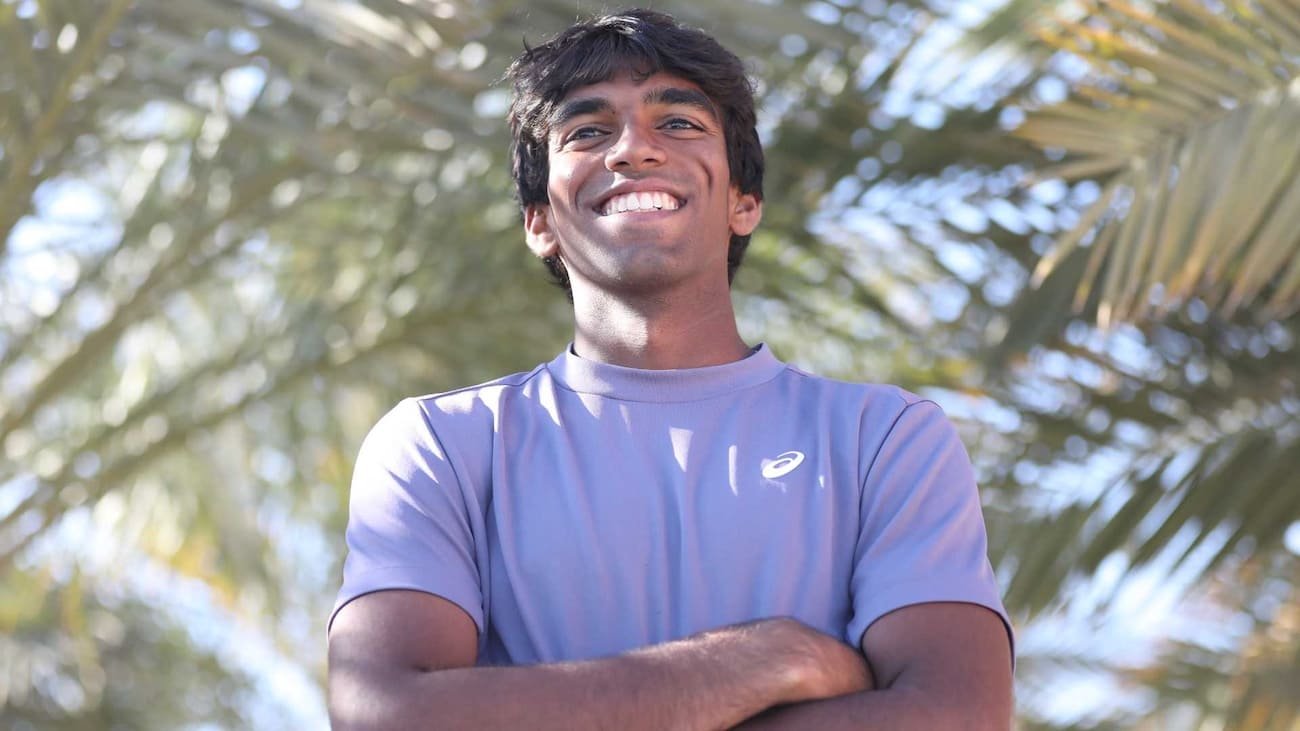

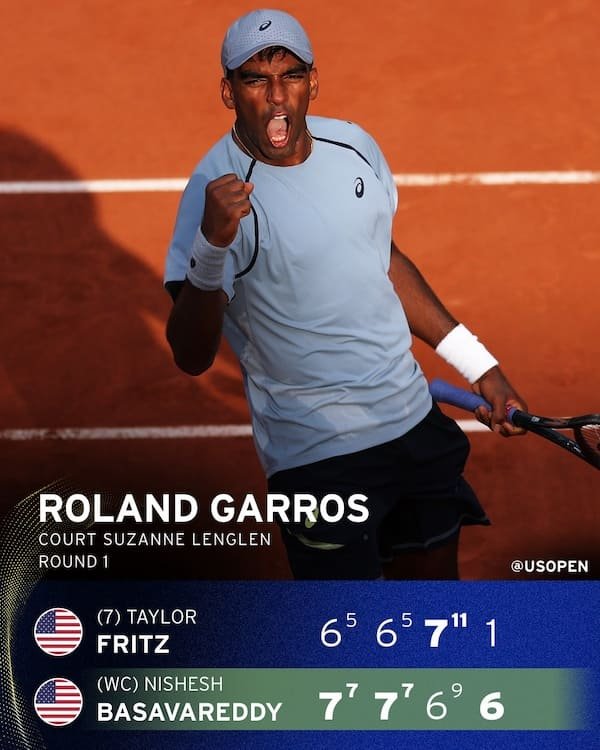
On the afternoon of Sunday, May 24, 2026, a young man from Carmel, Indiana walked onto Court Suzanne-Lenglen at Roland-Garros and proceeded to dismantle the seventh seed in world tennis. When it was over — 7-6(5), 7-6(5), 6-7(9), 6-1, three hours and twenty-five minutes of clay-court chess played on one of the sport’s most storied stages — Nishesh Basavareddy had produced the first major upset of the 2026 French Open, ended Taylor Fritz’s day before it had barely begun, and written his name into a piece of American tennis history that had gone unclaimed since the year 2000.
He was, as the official Roland-Garros website confirmed, ranked 148th in the world. He was playing his first-ever French Open main draw match. He got there on a wildcard. He is 21 years old.
“Definitely,” Basavareddy said, when asked by the on-court interviewer if this was the biggest win of his career, his voice barely concealing what sounded like equal parts relief and joy. “What a match. Taylor’s obviously a great player, so super happy to get through that — especially after losing the third set. First French Open main draw and all the support I had, it’s incredible.”
The Drop Shot That Decided Everything
The statistics of the match tell a story of controlled aggression and tactical intelligence. According to Yahoo Sports, drawing on data from the match, Basavareddy withstood 21 aces from Fritz — the kind of serving barrage that has historically made Fritz difficult to handle on any surface — and converted three of six break points while controlling net play at a remarkable 83.8 percent rate, winning 31 of 37 net approaches. The fourth set, after Fritz had clawed back the third in a tight tiebreak saving a match point along the way, was virtually one-sided: Basavareddy took it 6-1 as Fritz ran out of answers.
But the weapon that truly defined the afternoon was the drop shot. As the Roland-Garros official match report detailed, Basavareddy’s ability to produce dipping, precise drop shots off balls landing on the baseline proved unanswerable. Fritz, standing deep behind the baseline to absorb the pace he expected, found himself repeatedly sprinting forward in futile pursuit of shots that barely cleared the net and died in the red clay.
“He just played incredibly well. I mean, the biggest thing was just the dropshots were crazy,” Fritz said at his post-match press conference, as reported by Tennis Now. “He was hitting dropshots. Typically when someone is dropshotting me too much, I kind of just tell myself, okay, I need to hit the ball deeper. He was hitting insane dropshots, like, off balls that were landing on the baseline. He killed me with that, and there’s not really much I can do about it.”
For Basavareddy, the drop shot was tactical by design. “That was definitely a part of the game plan today,” he told the Roland-Garros on-court interviewer, as quoted by the tournament’s official website, “but with more and more confidence of hitting that shot well, it just kept coming. And it worked. I mean, he was so far back, especially on return. I wanted to move him up and back and make the match a little bit more linear, instead of side to side.”
He also charmed the Lenglen crowd with a few words of French, drawing applause and laughter. “I was working with a French coach earlier this year, so I was taking classes,” he told the interviewer, as the Roland-Garros site reported.
Historic Achievement: The Numbers Behind the Win
The scope of what Basavareddy accomplished on Sunday was underlined by the Roland-Garros official website’s own framing: he became the first American to notch a top-10 win at Roland-Garros since the year 2000 — a drought spanning 26 years. Fritz, the report noted, is the first top-10 seed to fall at the 2026 tournament.
Basavareddy’s professional debut at the Grand Slam level came at the 2025 Australian Open, where he received a wildcard and drew Novak Djokovic in the first round. The moment was surreal for a teenager who had spent years idolizing the sport’s all-time greats.
TennGrand, in its first-round wrap, noted the particular difficulty of Basavareddy’s path to this moment: Fritz had entered Paris having played just one clay-court match all season — a loss to Alexei Popyrin in Geneva the week before — due to knee tendinitis. But as TennGrand observed, the circumstances surrounding Fritz had always suggested the margins would be smaller than the rankings indicated. Basavareddy exploited those margins with the precision and calm of someone far more experienced than his record suggested.
For context on what that record looked like: according to Wikipedia, Basavareddy arrived at Roland-Garros with a career win-loss record of 12-19 at the ATP Tour, Grand Slam, and Davis Cup level combined. He had won only two tour-level matches before Sunday. He had lost in the qualifiers when he attempted to enter the French Open the year prior. On Sunday afternoon, he won his first main draw Grand Slam match — against a top-10 player, on the tournament’s second-largest show court, in front of thousands of spectators.
His next opponent in the second round, according to Deccan Herald, will be either Alexander Shevchenko or Alex Michelsen — a matchup that will determine whether Sunday was a singular moment or the first chapter of a deeper run at Roland-Garros.
The Family From Nellore: How a Telugu Household Built a Tennis Player
Nishesh Basavareddy was born on May 2, 2005 — making Sunday’s match, in a pleasing coincidence, a present to himself exactly 21 years and 22 days after his birth — in Newport Beach, California, to Muralikrishna Basavareddy and Sai Prasanna Basavareddy, according to Sportskeeda. His parents had emigrated from Nellore, a city in the Indian state of Andhra Pradesh, to the United States in 1999, settling first in San Francisco before moving south to Southern California.
His father, as Nishesh told Indian Tennis Daily in a 2024 interview, played tennis recreationally in Irvine. It was through following his older brother Nishanth — about three years his senior — to local courts that Nishesh first picked up a racquet. “I started going to the courts with him when I was like three years old, four years old and just picked up a racquet,” he told Indian Tennis Daily. “I played tennis and soccer growing up and then when I moved to Indiana at eight, I chose only tennis. I like the individuality of the sport and I just loved it.”
The family relocated to Carmel, Indiana — a well-resourced suburb north of Indianapolis with one of the strongest junior tennis programs in the Midwest — when Nishesh was eight, following his father’s employment at Toyota, according to Sportskeeda. The household they built in Indiana, as Global Indian documented in its profile, was deeply rooted in Telugu culture while its two sons grew increasingly American in their daily lives. “My favourite aspect of Indian culture is the food,” Nishesh told Global Indian. “When I’m home, my mom cooks every day. I eat Indian food most nights.” His brother Nishant was quoted in the same piece: “We grew more Americanized at school, but there’s still the food, the movies, the music. These are the things that keep us very Indian.”
Basavareddy comes, as Sportskeeda noted, from a non-sporting family in the professional sense — neither parent was an athlete. The tennis was entirely self-generated, driven by curiosity and then by passion, and developed at local clubs in California and Indiana before elite coaching took over.
Through Two Knee Surgeries to Stanford
The path from those Indiana courts to Court Suzanne-Lenglen was not smooth. As a teenager, Basavareddy underwent two knee surgeries that disrupted his junior development at a critical time, according to the Global Indian profile. The surgeries cost him ranking points and visibility at a stage when college coaches were making their recruiting decisions.
“I was injured for a lot of that period,” he told Global Indian. “Coaches had to take a bit of a gamble on me.”
Stanford took the gamble. He enrolled in 2022, telling Indian Tennis Daily he was studying data science and had always intended to take the college route. “The end goal was always to turn pro,” he admitted. “It was just a matter of when.”
The Stanford years were, by any measure, exceptional. In his freshman season, he won the ITA Fall National Championship and was named an ITA All-American, according to Stanford Athletics. In 2023-24, his final college season, he was named Pac-12 Singles Player of the Year — winning the award three times in a single season as Pac-12 Player of the Week along the way — and earned All-American honors for the second time, according to the Stanford Athletics roster page. His 16-2 singles record that season included 11-2 against ranked opposition and eight wins over top-50 college players.
He also won the U.S. Open boys doubles title in 2022 alongside Ozan Baris, as Sportskeeda noted, and had earlier represented the United States on the U14 World Junior Team at a tournament in the Czech Republic.
He turned professional in December 2024. What followed surpassed virtually every expectation.
From Djokovic to Fritz: A Rapid Education at the Highest Level
Basavareddy’s professional debut at the Grand Slam level came at the 2025 Australian Open, where he received a wildcard and drew Novak Djokovic in the first round. The moment was surreal for a teenager who had spent years idolizing the sport’s all-time greats. “Playing Djokovic is something I’ll never forget,” he told Global Indian. “That walkout, with everyone clapping and then seeing the 10-time champion across the net — it was unreal.”
He reached the second round of that tournament, according to Wikipedia’s career results table. He also reached the first round of Wimbledon and the U.S. Open in 2025, accumulating Grand Slam experience at a pace that suggested rapid adaptation to the tour’s demands. At the Challenger level, he collected two titles and finished 2024 with a 41-13 match record across the season, according to Global Indian, propelling him to a career-high ranking of No. 99 in June 2025.
He arrived at Roland-Garros 2026 ranked 148th — having slid from his 2025 peak — but with a wildcard earned through winning the USTA’s Roland-Garros Wild Card Challenge, as the official tournament website confirmed. He had lost in the qualifiers the year before. On Sunday, he won the main draw.
Outlook India, in its pre-match preview, had noted that Basavareddy had “surged more than 250 places in the rankings over the past two years” and was “comfortable on the dirt” — a detail that proved prescient given the clay-court fluency he displayed against Fritz.
What Comes Next
The win over Fritz places Basavareddy in the second round of a Grand Slam for the second time in his career — the first being his Australian Open appearance where he pushed Djokovic. He will face Alexander Shevchenko or Alex Michelsen in the next round. Michelsen, notably, is one of the American prospects with whom Basavareddy grew up training, according to Grokipedia’s biographical account — making the potential pairing a reunion of sorts between two players who came of age on the same junior circuit.
Whether he advances further or exits in the next round, Sunday’s result will be the defining public introduction of a player who has been quietly building toward this kind of stage for the better part of three years. The Indian American tennis community, which has long watched with interest as Basavareddy climbed the rankings, celebrated the result across social media as a moment of communal pride — the son of immigrants from Nellore, who grew up eating his mother’s cooking and watching Telugu movies in Indiana, standing on the red clay of Roland-Garros and producing the tournament’s first shock.
In his own telling, the experience of being on that court for the first time — the crowd, the occasion, the opponent — was itself a source of fuel. “First French Open main draw and all the support I had,” he told the interviewer as the Lenglen crowd roared behind him, “it’s incredible.”
Top image: courtesy of © Andrew Eichenholz/ATP Tour