




Jets Set: Amish Shah Wins Arizona Democratic Primary for the Second Straight Cycle, Setting Up a Historic November Battle

- The emergency physician and son of Indian immigrants who became the first Indian American elected to the Arizona Legislature has defied his own party's congressional committee twice — and now faces former New York Jets kicker Jay Feely, a Trump-endorsed Republican, in one of the most closely watched House races in the country.
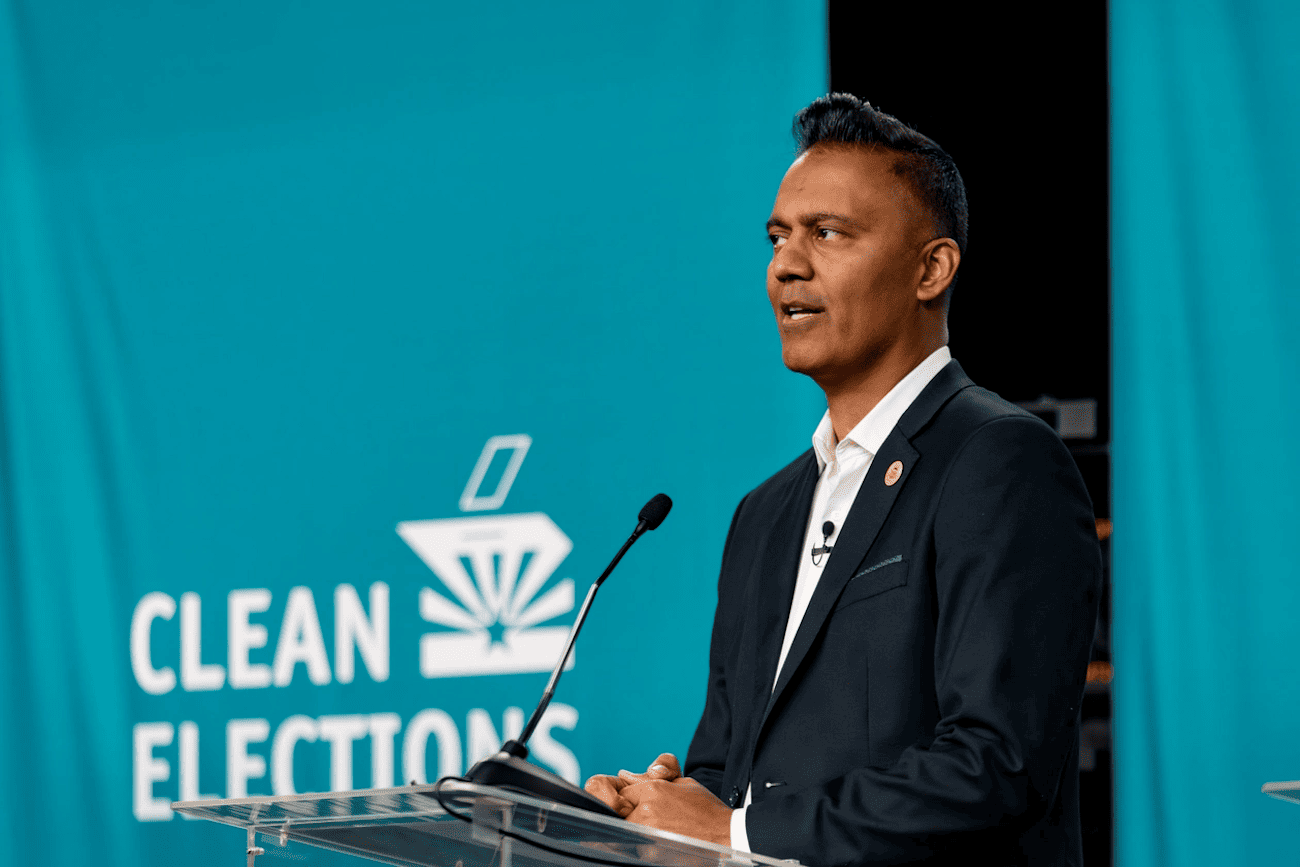

On the evening of Wednesday, July 22, 2026, Amish Shah stood before supporters at a friend’s home in Phoenix and delivered a victory statement that was careful not to dwell on what it had taken to get there. “Our victory in this primary was a grassroots victory where Arizona voters made their voices heard,” Shah said. “Now, it’s my job to earn the support of every voter in this district.”
The statement did not address the snub that had defined the preceding months — the Democratic Congressional Campaign Committee’s decision, for the second consecutive election cycle, to back his opponent over him. It did not need to. The result spoke for itself.
Shah, a former state legislator and emergency-room doctor, won the Democratic nomination in Arizona’s 1st Congressional District for the second consecutive election cycle, according to a race call by the Associated Press on Wednesday evening. Shah won the Democratic primary, delivering another defeat to the Democratic Congressional Campaign Committee, which backed a rival, as more voters reject the preferences of party leaders in Washington.
He will now face Republican Jay Feely — a former NFL kicker endorsed by President Donald Trump — in a November general election that Cook Political Report and Inside Elections have each identified as among the most competitive House races in the country, with control of the chamber potentially hanging in the balance.
A Chicago Boy, a Gujarati Household, and a Catholic School Education
Amish Shah was born in Chicago, Illinois, according to the Arizona State Library Archives. His mother and father were engineering students who immigrated from India in the 1960s. His father is Jain and his mother is Hindu. He attended Catholic school from grades K-12.
The household in which he grew up was therefore a layered one: Indian immigrant parents whose respective religious traditions — Jainism’s emphasis on non-violence and reverence for life, Hinduism’s diversity of practice — coexisted in a home that also sent its son to Catholic school for his entire pre-college education. Shah has said in interviews that he was influenced by Mahatma Gandhi, who was himself shaped by the Jain ethical tradition. He said he finds joy in his work and was inspired in a big way by a trip to Mahatma Gandhi’s Sabarmati Ashram in Gujarat. Gujarat is the home state of his father’s family — a connection that runs through his name, his vegetarianism, and his fluency in Gujarati, which he speaks alongside conversational Spanish, according to his campaign website and the Arizona Legislature’s official member page.
He attended Northwestern University in Evanston, Illinois, and graduated cum laude with a Bachelor of Arts in Economics. He graduated from Northwestern University Medical School as part of the Honors Program in Medical Education. He then completed a Master’s in Public Health with a full merit scholarship at the University of California, Berkeley, followed by residency training in Emergency Medicine at New York City’s busiest Level I trauma center, according to Indiaspora’s documented profile of his career. He won the American Academy of Emergency Medicine’s National Resident Research Competition for his work inventing a new method to provide care for critically ill patients. He completed a sports medicine fellowship at the University of Arizona.
From the New York Jets to the Mayo Clinic to the Arizona Legislature
Before he entered politics, Shah’s medical career had an unusual and distinctive dimension. During his time in New York, he served as a team physician for the New York Jets of the National Football League. He assisted the NFL in enhancing its emergency management protocols through research presented at the NFL Physicians’ Society. He also served as a faculty member and academic researcher at Mount Sinai Medical Center, and as chief medical officer of Urgent Consult.
Before becoming political opponents, Feely and Shah were part of the same team — the New York Jets. Shah was a doctor on the sidelines, while Feely was the kicker. The two men who will contest one of the most consequential House seats of the 2026 cycle first shared a professional relationship on an NFL sideline.
It is here that one of the race’s more striking biographical details emerges. Before becoming political opponents, Feely and Shah were part of the same team — the New York Jets. Shah was a doctor on the sidelines, while Feely was the kicker. The two men who will contest one of the most consequential House seats of the 2026 cycle first shared a professional relationship on an NFL sideline.
Shah eventually relocated to Arizona, where he joined the Mayo Clinic Arizona as an emergency physician in 2023, according to StarsUnfolded. He founded the Arizona Vegetarian Food Festival in 2014 as a philanthropic endeavor to promote healthy eating and eliminate preventable disease — now in its twelfth year and drawing thousands of attendees annually, according to the Arizona State Library’s documented member biography.
He is the first Indian American elected to the Arizona Legislature. He won election to the Arizona House of Representatives in 2018 and won three consecutive general elections in 2018, 2020, and 2022, representing first the 24th District — covering Central Phoenix, Sunnyslope, and South Scottsdale — and later the 5th District following redistricting, according to Wikipedia and his campaign website. During his five years in the state legislature, Grokipedia documented, he passed more bills than any Arizona Democrat in a decade, focusing particularly on healthcare access and teacher pay. He resigned from the legislature in February 2024 to run for Congress full-time.
The DCCC Problem: Twice Snubbed, Twice Victorious
The most revealing dimension of Shah’s primary victory is what it says about the current state of the Democratic Party’s relationship with its own voters.
The DCCC backed Marlene Galán-Woods, a former television journalist in Phoenix. The DCCC’s decision puzzled local Democrats because there was little ideological difference between her and Shah. Both are moderates, and the race was not a proxy fight in the party’s deepening feud between progressives and centrists.
Shah bested Galán-Woods, overcoming a wave of support for her from the Democratic Congressional Campaign Committee and prominent Arizonan Democrats, including U.S. Senator Mark Kelly, Secretary of State Adrian Fontes, and Attorney General Kris Mayes. The backing of Kelly — the sitting Democratic senator from Arizona and one of the most prominent statewide officials in the country — for Galán-Woods had been widely interpreted as an institutional signal that the party establishment preferred her. Arizona voters disagreed.
This was the second consecutive cycle in which Shah overcame DCCC opposition. In 2024, he had also won the Democratic primary in a crowded six-candidate field, as Grokipedia documented, before narrowly losing to 15-term Republican incumbent David Schweikert in November in what was one of the closest House races of that cycle. Schweikert’s decision to run for governor rather than seek reelection to Congress — leaving the seat open — gave Shah his second opportunity.
The DCCC’s choice to oppose him again, rather than unify behind the 2024 nominee who had come within striking distance of winning, was interpreted by local Arizona Democrats as a Washington-centric calculation about electability that the primary electorate has now twice rejected.

The November Battle: A Tossup Seat, a Trump Ally, and a Historic Opportunity
Arizona’s 1st Congressional District encompasses Scottsdale, north Phoenix, and Cave Creek. It’s one of the most competitive races in the country and could be key to determining control of Congress. The district includes some of the most affluent ZIP codes in Arizona — northeast Phoenix, Scottsdale, Fountain Hills, and Paradise Valley — communities whose college-educated professional voters have been trending Democratic in federal races even as they have voted Republican in state contests.
Schweikert held the seat for 15 years, but Democrats have come closer and closer to flipping the seat blue in recent elections. In 2024, CD1 residents voted for Schweikert and President Trump, but also favored Democrat Ruben Gallego in the race for U.S. Senate. That split-ticket pattern — supporting Trump and Schweikert while also backing Gallego for Senate — is precisely the kind of voter behavior that Democrats believe makes the district winnable in an open-seat cycle.
His Republican opponent, Jay Feely, won the GOP primary with Trump’s endorsement, according to KJZZ. The Republican nomination was won by former NFL kicker Jay Feely, who was backed by President Donald Trump. Feely’s victory gives Republicans a high-profile candidate as they seek to hold the seat.
The National Republican Congressional Committee moved immediately after Shah’s victory to define him on its preferred terms. The NRCC was out Wednesday with a digital ad attacking Shah, labeling him a socialist and tying him to progressives in Congress. The attack is almost certainly a preview of the general election message — an attempt to nationalize a race whose local conditions favor a candidate running on healthcare, cost of living, and a record of bipartisan legislative achievement.
Shah’s own positioning is built on precisely that record. His campaign website emphasizes that he has worked across party lines, protected abortion rights, stood up to Big Pharma on insulin pricing, and continues to practice medicine in the district he seeks to represent — a deliberate contrast with a political class that he argues has lost touch with the everyday realities of the people it governs. He flies his own small plane to treat patients in underserved communities across Arizona, according to his campaign website.
If he wins in November, Shah would become the seventh Indian American member of Congress — joining the “Samosa Caucus” of Ami Bera, Raja Krishnamoorthi, Ro Khanna, Pramila Jayapal, Shri Thanedar, and Suhas Subramanyam. The Times of India documented his aspiration precisely: he has said he hopes to be the sixth Indian American in Congress — a number that has since grown, making his potential membership in that caucus all the more resonant.
He speaks fluent Gujarati and conversational Spanish. He has three adopted cats named Hillary, Miss Meowerson, and Cousin Oliver. He plays basketball and flies small airplanes. He won the DCCC’s opposition twice and beat it twice.
Now comes the harder part.
Top imaage, courtesy of Arizona Media Association + Local News Foundation.