




Ro-ughed Up: How Armed Israeli Settlers Blockaded Congressman Ro Khanna and What He Plans to Do About It

- The Indian American lawmaker from California, already one of the most vocal congressional critics of Israel's war on Gaza, spent more than an hour detained by armed settlers near a village that had been ethnically cleansed — and came away more resolved than ever to seek the presidency.
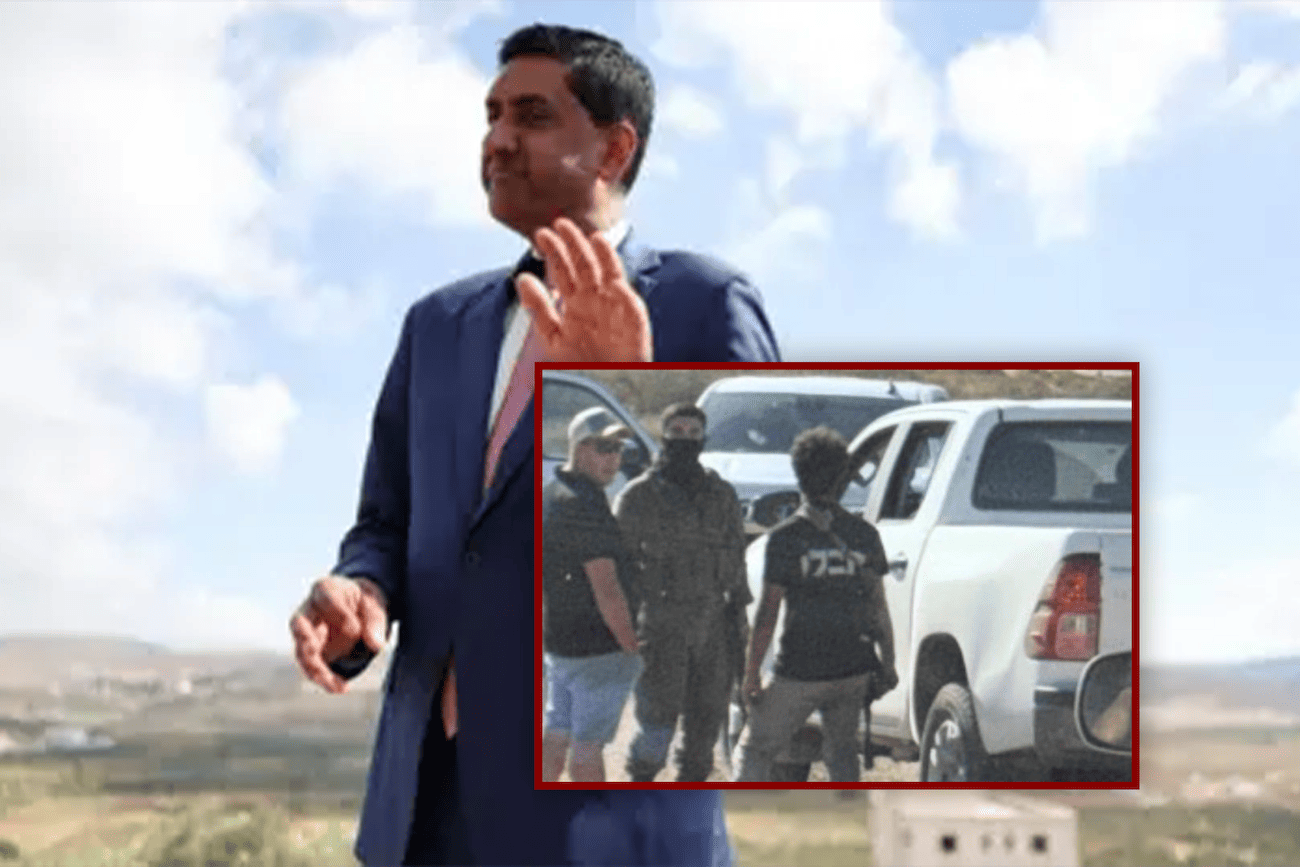

On the afternoon of Wednesday, July 8, 2026, Congressman Ro Khanna was standing near the ruins of Khirbet Zanuta — a small Palestinian hamlet in the southern West Bank whose residents had been forcibly displaced by violent settler raids following the Hamas attacks of October 7, 2023 — when the vans carrying his delegation were surrounded.
The men who surrounded them were Israeli settlers carrying American-made M4 rifles. They circled the vehicles, cursed in Hebrew and Arabic, wiped the windows, filmed the occupants, and laughed, Khanna told CNN in an interview on Saturday. They blocked the road. They were not going anywhere.
“And these hoodlums come in with machine guns — M4, an American-made machine gun — and they detain us,” Khanna told Reuters the following day, speaking from a Palestinian village near Ramallah. “They block off the road. And then they call the IDF and the IDF is on their side, not on the side of the Americans.”
The incident, first reported by The New York Times — whose photojournalist also witnessed the confrontation. It lasted more than an hour.
Cameron Kasky, an aide traveling with Khanna, said the group made repeated appeals to the U.S. Embassy in Jerusalem for help. The embassy was “very helpful,” Khanna told CNN. They were ultimately freed after communication between the U.S. Embassy and a high-level official in the Israeli government. A group of officers who appeared to be police eventually intervened and secured their release, Kasky said.
The Israeli Defense Forces issued a statement acknowledging the blockade but disputing Khanna’s account of its own soldiers’ conduct. “Upon receiving the report, IDF troops were dispatched to the scene, quickly dispersed the Israeli civilians, and reopened the blocked road. The IDF soldiers operating in the area did not take part in blocking the road,” the IDF said. Khanna did not accept that account. He told CNN that when four IDF soldiers arrived, they sided with the settlers. He said he plans to ask the White House and the State Department to seek a response from the Israeli government about what it intends to do with the four soldiers.
An Israeli security source told Haaretz that Khanna had not coordinated his visit in advance and therefore had not been provided with security — a claim Khanna’s office disputed. Both the U.S. Embassy and the Israeli government, Khanna told CNN, had been notified of the trip ahead of his visit.
The incident had begun, as Khanna explained to Reuters, with the visit to Khirbet Zanuta itself. “We were at a village that Israeli settlers had destroyed, they had destroyed the school, they had destroyed that village, and we were just looking at it,” he said. What followed was, from his perspective, a crystalline illustration of the reality he had traveled to the West Bank specifically to document.
“I see these young men brandishing M4s, circling, circling our vans, cursing us out in Hebrew and Arabic, which I didn’t understand, and filming us, laughing at us, wiping our windows while doing that, blockading us,” Khanna told CNN, his account consistent across multiple interviews. He called on the Israeli government to prosecute both the settlers and the IDF soldiers who, in his telling, had sided with them.
On X, he was direct: “Israeli settlers, brandishing American made M4s, detained me and other Americans on my trip to Palestine. When the IDF arrived, they sided with the settlers and continued our detention. They made a huge mistake. You will be hearing more soon.”
Why He Went — and What He Found
The West Bank visit was, by Khanna’s own account, entirely intentional in its design. He told CNN he wanted to travel to the West Bank because “it is important for an American politician to have an uncurated, extensive look at the occupation through the eyes of Palestinians.” He arranged his trip specifically to be led by Palestinians, not by Israeli government officials or American diplomatic staff — a deliberate choice to experience the territory on its own terms.
The village of Khirbet Zanuta, where the blockade occurred, is one of dozens of Palestinian communities in the southern West Bank that human rights organizations have documented as having been forcibly displaced by settler violence since October 7, 2023. The school settlers destroyed in the village — which Khanna said he visited before the confrontation — is a concrete, specific example of the kind of displacement that has accelerated dramatically since the Gaza war began.
More than 700,000 Israelis live in the occupied West Bank and east Jerusalem, territories captured by Israel in 1967 from Jordan and sought by the Palestinians for a future state. About 15 percent of the settlers are Americans. The United Nations calls Israeli settlements in the West Bank illegal, and Israel has been criticized for the actions of settlers in the territory. CBS News further noted that Israeli soldiers accused of harming Palestinians in the West Bank are rarely penalized and were indicted in fewer than 1 percent of cases based on 2,427 complaints alleging wrongdoing between 2016 and 2024, according to Israeli rights group Yesh Din.
Overlooking a valley dotted with settler outposts on the outskirts of Turmus Ayya, a village home to thousands of Palestinian-American dual nationals, Khanna told Reuters he believed his party’s establishment was “clueless about how much of a moral test Palestine, Gaza and Israel have become.” He said his own experience over two days in the West Bank had exceeded what he had expected to find. “I know in this country there’s a lot of understandable debate and emotion about the situation in the Middle East,” he told CNN. “But I believe any American, no matter how much they care and love Israel, if they go and spend a few days in the West Bank and see the reality, would be horrified.”
Khanna’s congressional district encompasses Sunnyvale, Fremont, and Cupertino — a constituency that includes one of the highest concentrations of Israeli American residents in the Bay Area. That constituent reality has not tempered his public positions on the conflict.
A Record of Escalating Engagement
The West Bank incident did not emerge from nowhere. It was the latest and most dramatic moment in a sustained, escalating engagement with the Israel-Palestine conflict that has defined Khanna’s congressional career since October 2023 — and that has increasingly positioned him as one of the most consequential progressive voices on the issue in American politics.
Khanna, a self-described “progressive capitalist” who represents California’s 17th Congressional District in the heart of Silicon Valley, was born in Philadelphia on September 13, 1976, into an Indian family. He graduated from the University of Chicago and Yale Law School, worked in the Department of Commerce under President Obama, and has represented his district since 2017 after defeating eight-term incumbent Mike Honda. He co-chaired Bernie Sanders’ 2020 presidential campaign. His district encompasses Sunnyvale, Fremont, and Cupertino — a constituency that includes, as J Weekly noted, one of the highest concentrations of Israeli American residents in the Bay Area.
That constituent reality has not tempered his public positions on the conflict. Since October 7, 2023, Khanna has called for a permanent ceasefire in Gaza and argued that Congress should more closely scrutinize U.S. arms transfers to Israel, according to Wikipedia. In June 2024, he was among more than 60 Democrats who boycotted Israeli Prime Minister Benjamin Netanyahu’s address to Congress, saying he did not want to sit through a “one-way lecture.” In November 2025, he was one of 20 Democratic members of Congress who co-sponsored a resolution introduced by Representative Rashida Tlaib to officially recognize Israel’s genocide against the Palestinian people. He agreed publicly with the United Nations commission’s finding that Israel’s conduct in Gaza constituted genocide — making him, as Reuters noted, one of only a handful of congressional members to endorse a charge that Israel strongly rejects. “I agree with the UN commission’s heartbreaking finding that there is a genocide in Gaza,” he wrote on X. “What matters is what we do about it — stop military sales that are being used to kill civilians and recognize a Palestinian state.”
In January 2026, Khanna and Senator Peter Welch led 74 lawmakers in urging the Trump administration to oppose Israeli annexation efforts in the West Bank and to preserve the possibility of a negotiated two-state solution, according to Wikipedia. In February 2026, as Middle East Eye reported, he introduced House Resolution 1092, condemning Israeli settlement expansion and settler violence, calling for accountability, and calling on President Trump to implement a verifiable freeze of development in the E1 corridor between East Jerusalem and the Maale Adumim settlement — construction that would undermine the territorial contiguity needed for a viable Palestinian state.
That resolution’s language was more specific than most congressional measures on the subject, and reflected what Khanna told an interviewer at Infinitejaz.com in April 2026 was a deliberate positioning of the Democratic Party’s debate on Israel: he said plainly that the United States should view Israel first and foremost as “an occupying nation violating human rights,” and that this lens should guide all policy decisions. He said he no longer supports renewing the existing Memorandum of Understanding on military aid when it comes up for renewal in 2028.
He has also been careful, however, to maintain that he supports Israel’s right to exist and describes himself as a Zionist in the specific sense of supporting Jewish self-determination, as The Times of Israel documented in an October 2025 interview. “My criticism has always been about Netanyahu, Ben-Gvir, Smotrich and those in power whose actions have undermined the peace and safety of Israelis and Palestinians,” he told J Weekly. He said he continues to support Iron Dome funding, which he has described as saving lives, while opposing U.S. military aid that, in his view, is being used to harm Palestinian civilians.
Two States, One Demand, No Sign of Progress
Khanna’s consistent position on the political resolution of the conflict is the two-state solution — a framework that conditions recognition of a Palestinian state on full recognition of Israel and the disarmament of Hamas. In September 2025, he led 47 House colleagues in a letter urging President Trump and Secretary of State Marco Rubio to have the United States formally recognize a Palestinian state. That effort was unsuccessful. The Trump administration did not move toward Palestinian statehood recognition.
He has not proposed cutting off Iron Dome funding but has called for ending offensive weapons transfers to Israel, stopping military aid that he argues is being used to harm civilians, and conditioning future American support on Israeli compliance with international humanitarian law — a set of positions that place him well to the left of the Democratic Party establishment but that increasingly reflect the sentiment of the party’s grassroots, as Reuters documented: Israel’s favorability rating among Democrats fell from 59 percent in 2018 to 22 percent in May 2026, according to Reuters/Ipsos polling.
The Presidential Dimension
The West Bank trip, the blockade, and Khanna’s response cannot be fully understood outside the context of his increasingly explicit presidential ambitions.
Reuters noted that Khanna had cast his West Bank visit as “an unfiltered look at the human toll of Israeli occupation as he weighs a 2028 presidential run.” When asked directly by Reuters whether he was running for president, he gave an answer that was as unambiguous as he has yet offered. “I’m strongly considering it and I’m more resolved to consider it after this trip,” he said.
His 2025 and 2026 activities have tracked a presidential positioning operation: town halls in Republican-held districts, appearances in early-voting presidential states, the Epstein Files Transparency Act passed alongside Republican Thomas Massie and signed into law by Trump in November 2025, and now a West Bank trip that has generated international headlines and placed him at the center of a political confrontation whose images — a U.S. congressman blockaded by armed settlers as IDF soldiers stood by — are exactly the kind of visual documentation that drives political narratives.
“If you’re unwilling to speak up for Palestinian human rights, if you’re unwilling to speak up against the genocide in Gaza, the apartheid in the West Bank, then you are morally compromised,” he told Reuters from the outskirts of Turmus Ayya, standing among a people whose treatment he had just experienced firsthand.
Rep Khanna was advised by the Israeli embassy to not visit the restricted areas. What gives the right to a US Congressman to disobey the nation’s instructions? Rep Khanna showed absolute disrespect to the country he chose to visit and show up as a hero. He should apologize to Israel. He should have gone to Gaza with Hamas entourage. He may have enjoyed being taken a hostage.