




Two Journeys, Two Wars, One Human Question: The Odyssey and the Mahabharata

- The greatest epic of ancient Greece and the longest poem in human literary history emerged from different civilizations separated by thousands of miles — and arrived at strikingly similar conclusions about fate, duty, suffering, and what it means to be human.
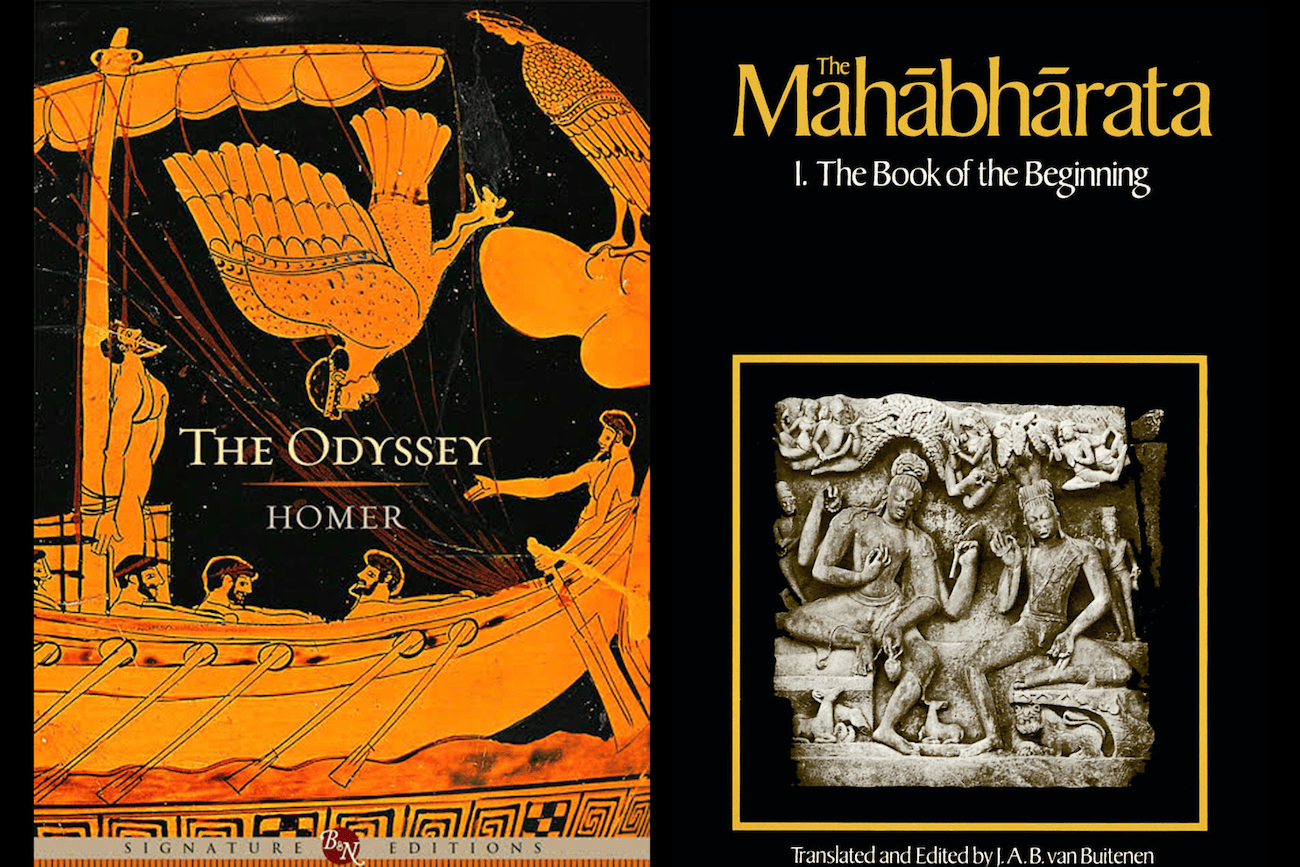

The two works come to us through vastly different compositional traditions, across comparable spans of time.
The Odyssey is attributed to Homer — a figure whose historical existence remains one of antiquity’s most productive debates. Whether Homer was a single blind poet from Ionia, a composite authorial tradition, or a convenient name attached to a body of oral verse accumulated over generations, the consensus of classical scholarship places the poem’s composition in the late 8th century BCE, though the events it describes are believed to reflect a much older world — the Mycenaean civilization of roughly 1200 BCE, when the siege of Troy is thought to have occurred, if it occurred at all as a historical event. The poem as we have it was likely standardized in Athens during the 6th century BCE under the tyrant Pisistratus, who commissioned a fixed written text of the Homeric corpus for public recitation at the Panathenaic festival. It comprises 24 books and approximately 12,000 lines in dactylic hexameter.
The Mahabharata’s compositional history is simultaneously more transparent and more complex. Tradition attributes the poem to the sage Vyasa — who is himself a character within it — and credits the god Ganesha with transcribing it as Vyasa dictated. Modern scholarship places the poem’s core in the period between roughly 400 BCE and 400 CE, with the probable kernel of the narrative — the great war between the Pandava and Kaurava clans — possibly reflecting historical conflicts in the Kuru kingdom of the upper Gangetic plain around 1000 to 800 BCE. It comprises 18 books — the parvas — plus a supplementary 19th, the Harivamsa, and contains approximately 100,000 shlokas or couplets, making it roughly ten times the length of the Iliad and Odyssey combined and the longest poem ever written in any language. It was composed in Sanskrit and preserved through a continuous tradition of oral performance, manuscript copying, and regional translation across South and Southeast Asia.
Both epics carry within them the residue of far older oral traditions. Both were almost certainly performed — sung, chanted, recited — long before they were written. And both have exercised a continuous and transformative influence on the literary, religious, philosophical, and artistic traditions of their respective civilizations down to the present day.
The Central Narratives
The surface difference between the two works is immediately apparent: the Odyssey is a journey home, the Mahabharata a war that destroys kingdoms and dynasties. But both are ultimately concerned with the consequences of a previous conflict — the Trojan War for the Odyssey, the dice game that exiled the Pandavas for the Mahabharata — and both build toward a reckoning whose weight the protagonists must carry long after the fighting ends.
The Odyssey follows Odysseus — king of the island of Ithaca, the Greek hero most distinguished by intelligence rather than brute strength — as he makes his ten-year journey home from Troy. He is delayed by the wrath of the god Poseidon, whose son Polyphemus the Cyclops he has blinded, and must navigate a series of trials — the island of the Cyclopes, the enchantress Circe, the land of the dead, the Sirens, Scylla and Charybdis, the island of the sun god Helios — before finally returning to Ithaca, where he slaughters the suitors who have been consuming his household and competing for his wife Penelope in the assumption that he is dead.
The Mahabharata’s narrative is exponentially more sprawling. Its central story concerns the conflict between two sets of cousins — the five Pandava brothers, sons of King Pandu, and the hundred Kaurava brothers, sons of the blind king Dhritarashtra — for control of the Kuru kingdom. When the eldest Pandava, Yudhishthira, loses everything including his brothers and their shared wife Draupadi in a rigged game of dice against the Kaurava prince Duryodhana, the Pandavas are sent into exile for thirteen years. At the end of that exile, the Kauravas refuse to return their kingdom, and the two sides meet in the cataclysmic eighteen-day battle of Kurukshetra. The Pandavas prevail, but at such cost — including the deaths of Arjuna’s son Abhimanyu, the entire Kaurava line, and virtually every warrior in India — that victory itself is experienced as devastation. The poem’s aftermath tracks the Pandavas’ own renunciation of the world they have won.
Embedded within this central narrative is the Bhagavad Gita — the dialogue between the warrior Arjuna and his charioteer, revealed to be the god Krishna, on the eve of battle. Arjuna, paralyzed by the prospect of killing his kinsmen, asks Krishna whether the battle should be fought at all. Krishna’s answer — encompassing the nature of duty, the immortality of the soul, the varieties of spiritual path, the relationship between action and its fruits — is among the most philosophically dense and influential texts in any literary tradition. It occupies 18 chapters and has been read, translated, and commented on continuously for more than two millennia.
Structural Parallels
The two works share several architectural similarities that reflect common features of oral heroic epic rather than any direct influence.
Both open in medias res — in the middle of things — with the main narrative already underway. The Odyssey begins not with Odysseus but with his son Telemachus, and with the Olympian gods debating his fate, establishing both the human and divine dimensions of the story simultaneously. The Mahabharata’s frame narrative begins with a sage recounting the story to an audience gathered at a snake sacrifice — a narrative embedding that is characteristic of Sanskrit literary convention and that places the poem’s events at a deliberate remove from the reader’s present.
Both poems employ the frame narrative as a structural device. The Odyssey’s hero himself becomes a narrator — in Books 9 through 12, Odysseus recounts his wanderings to the Phaeacian court of King Alcinous, making himself simultaneously protagonist and storyteller. The Mahabharata is a story told within a story told within a story: Vyasa composes it, Vaisampayana recites it at the snake sacrifice, Sauti later recounts Vaisampayana’s recitation to a forest assembly of sages.
Both poems contain what scholars call interpolations — material added over time that is only loosely connected to the central narrative. The Mahabharata is far more expansive in this respect: its digressions include the Nala and Damayanti story, the tale of Savitri and Satyavan, lengthy philosophical treatises, genealogical accounts, and the entirety of the Bhagavad Gita. The Odyssey is more tightly structured by comparison, though even it contains passages — the catalog of heroic women in the underworld, the extensive account of Odysseus’s scar — that scholars have identified as interpolated.
Both poems are organized around a hero’s return — a nostos in Greek literary terminology. In the Odyssey the return is literal and geographical: Odysseus is trying to get home to Ithaca. In the Mahabharata the return is moral and cosmic: the Pandavas are trying to reclaim what is rightfully theirs, and the poem’s long arc bends toward a restoration of cosmic order — rita in Vedic terms, dharma in the Mahabharata’s own — after a period of its catastrophic disruption.
They are separated by language, religion, geography, and cultural context. They are united by the conviction that the deepest human questions — about duty and survival, suffering and meaning, homecoming and loss.
The Heroes: Odysseus and Yudhishthira
The most illuminating comparison between the two epics lies in the contrast between their central heroic figures.
Odysseus is defined above all by cunning — metis in Greek, a word that means practical intelligence, craft, and the ability to think through a problem rather than simply overpower it. He is not the strongest of the Greek heroes — that is Achilles in the Iliad, Ajax in terms of physical brawn, Diomedes in terms of battle fury. He is the cleverest. His identity as the man of many devices — polytropos, many-turning, is the Odyssey’s first word of description for him — is inseparable from his moral complexity. He lies. He disguises himself. He manipulates. He uses language as a weapon with the same facility he uses a bow. The Odyssey presents these qualities as survival skills rather than moral failings, though it does not entirely exempt him from their consequences.
Yudhishthira, the eldest Pandava, is in some respects the Odysseus figure’s moral inverse. Where Odysseus is defined by cunning, Yudhishthira is defined by dharma — righteous conduct, duty, truth. He is known as Dharmaraja, the king of dharma, and his chariot is said to float several inches above the ground because of his moral purity. And yet the Mahabharata’s most devastating irony is that Yudhishthira’s greatest failing — the weakness that brings catastrophe upon his family — is his inability to refuse a dice game he knows is rigged, because refusing would violate the Kshatriya code of honor that obliges a warrior to accept a challenge. His virtue, rigidly applied, becomes the instrument of his family’s destruction. The Mahabharata treats moral rigidity as no less dangerous than moral corruption.
Where Odysseus’s journey tests his resourcefulness — can he find a way home despite divine opposition and monstrous obstacles? — Yudhishthira’s journey tests his judgment: does following the rules always lead to the right outcome? The poem’s answer is genuinely tragic in its complexity. The Pandavas follow dharma and win the war. They also lose virtually everything they loved in the process.
The Divine: Gods, Fate, and the Question of Cosmic Justice
Both epics populate their worlds with active, interventionist gods — but the theological implications of that divine presence differ significantly.
In the Odyssey, the Olympian gods are anthropomorphic, capricious, and frequently at odds with each other. Athena champions Odysseus; Poseidon persecutes him. Zeus presides over the quarrel but is not omnipotent in any absolute sense. The gods have favorites and enemies. They intervene in human affairs for personal reasons — Poseidon’s rage over Polyphemus, Athena’s affection for Odysseus’s cleverness — rather than in service of a cosmic moral order. The Homeric divine world is, in this sense, profoundly political: the gods model human political dynamics, including rivalry, favoritism, and the negotiation of power, writ large onto an eternal canvas.
The Mahabharata’s divine framework is both more complex and more philosophically coherent. Krishna, who serves as Arjuna’s charioteer and closest ally throughout the poem, is not merely a god playing favorites — he is, as the Bhagavad Gita reveals, an avatar of Vishnu, the preserver of cosmic order, who has taken human form specifically to restore dharma at a moment of its most acute crisis. His intervention in the war is not capricious but purposive. The war itself, in the poem’s theological framework, is not simply a political conflict over a kingdom but a cosmic event — the destruction of an adharmic order to make way for the renewal of the moral universe.
This theological difference produces a different relationship between the human characters and divine will. In the Odyssey, the gods’ interventions are obstacles or aids to a journey that is fundamentally about one man’s perseverance. In the Mahabharata, the war and its participants are instruments of a cosmic purpose so vast that individual human suffering — the death of Abhimanyu, Draupadi’s humiliation, the extinction of dynasties — is simultaneously real and, in the poem’s final accounting, purposive in ways that the characters themselves cannot fully comprehend.
Women: Penelope and Draupadi
The two epics’ most significant female characters reward sustained comparison.


Penelope, awaiting Odysseus’s return in Ithaca for twenty years while raising their son Telemachus alone and fending off over a hundred suitors who are consuming her household, is one of ancient literature’s most remarkable female figures. Her famous ruse — weaving a shroud for Odysseus’s father Laertes during the day and unraveling it at night, thereby indefinitely deferring her promised choice of a new husband — demonstrates a capacity for strategic deception that mirrors her husband’s own defining quality. She is, in a meaningful sense, her husband’s match: a woman of metis in a world that does not offer her the same scope for its exercise. Her loyalty to Odysseus is the moral anchor of the poem — without it, his journey home would have no destination worth the suffering.
Draupadi — the shared wife of all five Pandava brothers, born from a sacrificial fire, and arguably the Mahabharata’s most morally complex figure — occupies a different register entirely. Where Penelope’s suffering is private and domestic, Draupadi’s is public, political, and catalytic. When Yudhishthira stakes and loses her in the dice game, the Kaurava prince Dushasana attempts to disrobe her in the Kaurava court while her five husbands sit bound by the rules of the game they have lost. Draupadi calls on Krishna, who miraculously extends her sari so that it cannot be fully removed. Her subsequent oath — that she will not braid her hair again until it is washed in Dushasana’s blood — is the moral engine that drives the entire war. Without her humiliation, and without her refusal to accept it in silence, there is no Kurukshetra.
Both women are, in different ways, the moral center of their respective epics — but where Penelope’s fidelity is fundamentally private and sustaining, Draupadi’s defiance is public and destabilizing. One holds a world together while her husband is absent; the other, in her refusal to accept injustice, breaks a world apart so that it can be rebuilt on more just foundations.
Themes: Homecoming, Duty, Loss, and the Cost of Winning
The deepest thematic convergence between the two epics lies in their shared interrogation of what victory actually costs and whether return is ever truly possible.
Odysseus comes home. He slaughters the suitors, reunites with Penelope and Telemachus, and reclaims his kingdom. The Odyssey ends in restoration. But the poem is careful to show that the man who returns is not quite the man who left. He has seen the dead. He has spent time with Circe and Calypso — semi-divine women who offered him an easier existence — and chosen Ithaca. He has endured suffering that cannot be entirely undone by homecoming. The Odyssey’s final book, in which Odysseus must go on yet another journey carrying an oar until he reaches a land where no one knows what an oar is, suggests that even restoration is not a final stopping point.
The Mahabharata is darker in its accounting. The Pandavas win the war. They sit on their throne for many years. And then, near the poem’s end, they renounce everything they have won, leave Hastinapura, and walk into the Himalayas — accompanied only by a dog who turns out to be the god Dharma himself — toward their deaths. Yudhishthira alone reaches the gate of heaven. He is asked to abandon the dog to enter. He refuses. The refusal turns out to be his final test. The poem ends not with victory but with renunciation — the suggestion that the world of power and conflict, however righteously navigated, is ultimately something to be left behind rather than celebrated.
Both epics, in other words, are skeptical of triumphalism. Both suggest that the cost of survival in a world of war and conflict is a kind of permanent diminishment — that the heroes who endure are not entirely the same people who began, and that what they return to, or build, is shadowed by what they lost along the way.
Legacy
The Odyssey has been translated, imitated, adapted, and reinterpreted continuously since antiquity. Virgil’s Aeneid is in large part a Latin response to both Homeric epics. Dante places Odysseus — as Ulisse — in hell for the sin of false counsel. James Joyce’s Ulysses maps the poem’s structure onto a single day in Dublin in 1904. Derek Walcott’s Omeros resets it in the Caribbean. Margaret Atwood’s The Penelopiad retells it from Penelope’s perspective. Every generation rewrites it to ask the questions its own moment requires.
The Mahabharata’s afterlife is, if anything, more pervasive — because it is not merely a literary text but a religious one. The Bhagavad Gita has been translated into every major language on earth and has served as a source of spiritual and philosophical guidance for figures as different as Mahatma Gandhi, who called it his mother, and J. Robert Oppenheimer, who quoted it at the first nuclear detonation. The poem’s stories — the birth of the Pandavas, Draupadi’s swayamvara, Abhimanyu in the chakravyuha — are known to virtually every Hindu in South and Southeast Asia, and have been continuously performed in Sanskrit recitation, regional language retelling, dance drama, television serial, and film for more than two thousand years. Peter Brook’s nine-hour theatrical adaptation in 1985 brought it to Western audiences for the first time at scale. Its contemporary Indian television adaptation in 1988 drew the largest audience of any broadcast in Indian history.
Together, the Odyssey and the Mahabharata represent the two most consequential narrative traditions in human civilization — one from the ancient Mediterranean world, one from the ancient South Asian world — whose influence on everything that came after them, in literature, philosophy, religion, and art, is simply impossible to overstate.
They are separated by language, religion, geography, and cultural context. They are united by the conviction that the deepest human questions — about duty and survival, suffering and meaning, homecoming and loss — are worth telling stories about, at whatever length the telling requires, for as long as human beings remain human.