




‘Heartbreak and Loss Threw Me Into Politics’: Sonia Gandhi Breaks a Lifetime of Silence With a 544-Page Memoir

- The Congress party's longest-serving president, who has guarded her private life with ferocious discipline for six decades, will publish "Belonging: A Journey of Love" on November 10 — a book whose announcement has already divided India's political class along entirely predictable lines.
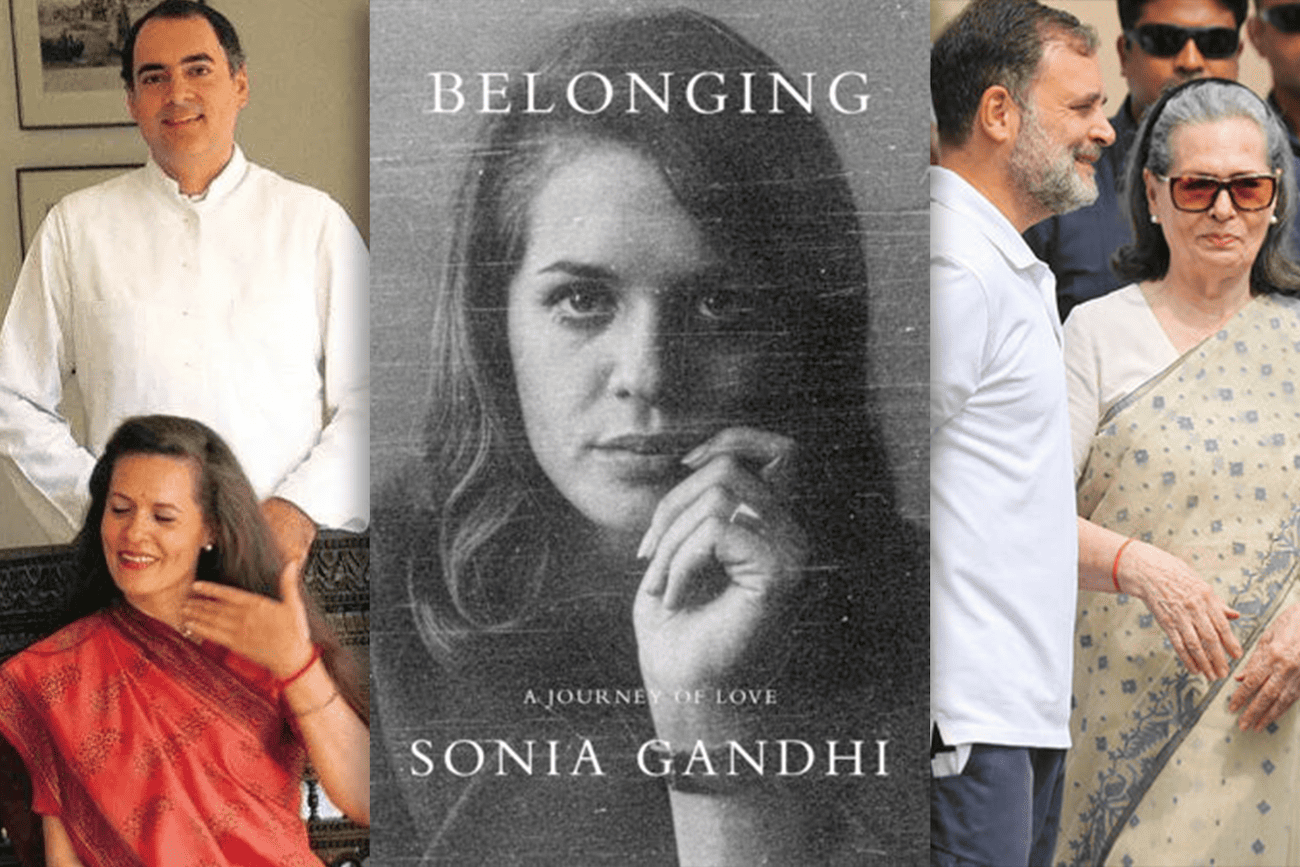

On Tuesday, August 18, 2026, Alfred A. Knopf — one of the most prestigious literary imprints in American publishing, an arm of Penguin Random House — made an announcement that sent an immediate ripple through Indian political and literary circles simultaneously.
Publisher Alfred A. Knopf announced that Congress leader Sonia Gandhi’s memoir, “Belonging: A Journey of Love,” will be published on November 10. Gandhi is set to open up about her personal life, family tragedies and political journey in a 544-page memoir.
The cover — a graceful black-and-white photograph of Sonia Gandhi from her youth — was revealed simultaneously on Knopf’s Instagram in what the publisher described as a “Cover Reveal.” The Knopf description called it “a riveting memoir by one of the world’s most prominent women leaders that tells a richly” personal story. The memoir will be released in hardcover and ebook editions by Knopf on November 10, while an audiobook edition will be published by Penguin Random House. The publisher has announced a first printing of 100,000 copies.
The publisher’s framing describes the memoir as “an intimate account of Sonia Gandhi’s life and a story of love, family and India, offering a perspective on the country’s tumultuous post-independence history and its present political struggles” — language that signals a book reaching well beyond personal memoir into political testimony.
In Her Own Words: What Sonia Said
The announcement came with a statement from Gandhi herself — carefully worded, personal in register, and notable for what it revealed about the emotional difficulty of the undertaking. For a woman who has spent six decades deploying silence as both personal preference and political strategy, the statement was itself a departure.
“Much has been written about my family, but few narratives were able to reach into the truth of their motivations, their actions and even their very human failings,” Gandhi said in a statement issued through Knopf. “In many ways, this book is a homage to their humanness. My story also offers readers a unique perspective of the social and political changes I have witnessed for six decades in the beautiful country of my belonging.”
“Writing about my life did not come easily to me. It meant opening myself up, sharing moments and experiences I had always held deep inside,” she said. “Yet as I gradually removed myself from the political sphere and looked back at all I had seen, the thread of love and loyalty that wove through my story began to define itself, from the simplicity of my childhood in small-town Italy, to the complexity of my years in India as the wife of Rajiv Gandhi and the daughter-in-law of Prime Minister Indira Gandhi.”
“It was heartbreak and loss that threw me into the public world of politics. Up till then I had guarded my privacy fiercely,” she said in a statement issued through Knopf.
Gandhi said writing about her life required her to revisit deeply personal experiences and emotions that she had long kept private. She described the book as a reflection of the “tender joys and dark despair” that shaped her life.
The memoir chronicles Sonia Gandhi’s journey, from her childhood in post-war Italy and her romance that brought her to India to the devastating personal losses that profoundly shaped her life and her relationship with her adopted country.
What the Book Will Cover: A Life of Extraordinary Drama
As per Penguin Random House, the memoir begins in Cambridge, England in 1965, when 19-year-old student Sonia Maino falls in love with the grandson of India’s first prime minister Jawaharlal Nehru, Rajiv Gandhi.
The narrative arc is among the most dramatic in modern political biography. The memoir chronicles Sonia Gandhi’s journey, from her childhood in post-war Italy and her romance that brought her to India to the devastating personal losses that profoundly shaped her life and her relationship with her adopted country.
The description says Gandhi resisted the pressure to join politics before accepting the challenge to become the longest-serving president of the Indian National Congress.
The book will also, inevitably, address the moment that defined her public reputation in a specific and singular way: her decision in 2004 to decline the prime ministership despite leading the Congress-led United Progressive Alliance to a general election victory, a decision so unexpected that it drew comparisons to acts of political sacrifice from across Indian and global history. The memoir will offer, for the first time in her own voice, her account of that renunciation — and of the years that followed.
Knopf Executive Vice President, Publisher and Editor-in-Chief Jordan Pavlin said the publishing house was honored to bring out the memoir, describing it as an account of Gandhi’s life, resilience, family and history. Penguin Random House describes the book as an intimate account of love, family and India, with Gandhi offering readers an unusually personal look at her private world and her reflections on identity, duty and the meaning of home.
Who She Is: A Life That Required a Book
Sonia Gandhi was born Sonia Antonia Edvige Albina Maino in 1946 near Turin, Italy, to a working-class family, according to Wikipedia. She spent her childhood in the Veneto region before traveling to Cambridge, England, to study English at a language school — the Lennox Cook School — where, in 1965, she encountered Rajiv Gandhi across a restaurant table. He was studying engineering at Trinity College. She was nineteen. They married in New Delhi on February 25, 1968.
The two settled in India while Rajiv worked as a pilot for Indian Airlines. The assassination of his younger brother Sanjay Gandhi in a plane crash in 1980 changed the family’s trajectory: Rajiv entered politics, over Sonia’s fierce objections. She is on record — in a rare public statement recalled in multiple published accounts — as having said: “For the first time, there was tension between Rajiv and me. I fought like a tigress — for him, for us and our children, above all, for our freedom.”
The catastrophic events of October 31, 1984, when Indira Gandhi was shot dead by her own bodyguards in the garden of her Safdarjung Road residence — with Sonia among those who rushed her to hospital — made Rajiv’s entry into the prime ministership unavoidable. He served until 1989. On May 21, 1991, he was assassinated by a suicide bomber at an election rally in Sriperumbudur, Tamil Nadu, leaving Sonia a widow at 44 with two young children.
She resisted enormous pressure to enter Congress politics for seven years before agreeing, in 1998, to become the party’s president. She led it to the 2004 general election victory — and then, in a move that stunned the Indian political establishment, renounced the prime ministership. She served as Congress president, the party’s longest-serving holder of that office, until 2017. She is currently a member of the Rajya Sabha, India’s upper house.

Both of Sonia Gandhi’s children, opposition leader Rahul Gandhi and Priyanka Gandhi Vadra, are members of India’s lower house parliament from the Congress party.
The Reactions: Supporters, Critics, and the Lines Between Them
The announcement of the memoir produced an immediate and entirely predictable division in Indian political response — one that mapped almost exactly onto the country’s existing political fault lines.
Congress supporters and opposition politicians greeted the news with enthusiasm. Senior party figures circulated the cover on social media within hours of the Knopf announcement. Rahul Gandhi, whose own political fortunes have been shaped at every turn by his mother’s decisions, did not immediately make a public statement — but Congress party social media accounts prominently shared the announcement.
The book’s arrival is timed, perhaps not coincidentally, to a moment of genuine political uncertainty in India. The Modi government has faced its most sustained protests in twelve years — the Jantar Mantar student demonstrations led by the Cockroach Janta Party, which produced Dharmendra Pradhan’s resignation in July — and the Congress party, while still a secondary force in Parliament, has found renewed energy through the leadership of Rahul Gandhi and Priyanka Gandhi Vadra. A memoir by the matriarch of the dynasty, published in November, lands into a political environment that is more favorable to the opposition than at any point since the BJP’s 2014 victory.
BJP supporters and the nationalist media ecosystem reacted with considerably less warmth. Social media commentary from the BJP’s digital wing questioned the timing of the publication and suggested the memoir was a political intervention disguised as autobiography. Some commentators questioned whether a book written at 79, looking back on decisions taken decades earlier, could offer a genuinely honest accounting of events that had involved significant political controversy — including the Emergency of 1975 declared by Indira Gandhi, the anti-Sikh riots of 1984, and the Bofors corruption scandal that dogged the Rajiv Gandhi years.
The question of foreign origin — which has followed Sonia Gandhi throughout her Indian political career, used most aggressively by the BJP and its predecessor the Jana Sangh to question her legitimacy as a national leader — is itself addressed, implicitly, in the book’s title. “Belonging” is a word chosen with awareness of that history. Its double meaning — the memoir of belonging to India, and an argument that she does belong — is unlikely to escape readers on either side of the political divide.
That framing — the personal rather than the political as the memoir’s organizing principle — is precisely what will satisfy her supporters and frustrate her critics, who have long sought from her a more direct reckoning with the controversies of the dynasty she married into and ultimately led.
The Publisher’s Confidence: 100,000 Copies and Counting
The announcement’s details speak to the commercial ambitions of both Knopf and Penguin Random House. A first printing of 100,000 copies for a political memoir by a figure who is not primarily known to the American reading public is a significant commitment — one that reflects the publisher’s assessment that the book’s international appeal, particularly in India, the Indian diaspora, and among readers interested in global political history, justifies the investment.
The simultaneous announcement of a William Collins UK edition, an audiobook from Penguin Random House, and ebook availability alongside the hardcover suggests a coordinated global launch strategy designed to maximize both media attention and sales across markets. India, where Sonia Gandhi’s name requires no introduction, will likely be the book’s most important single market — though the terms of the Indian rights arrangement have not been publicly disclosed.