




The Hinge State: Pakistan’s Diplomatic Balancing Act and the Unmaking of the Old Middle East

- In a world where power is increasingly fragmented, Islamabad’s ability to move between roles—to be, at once, participant and intermediary—has become a form of power in itself.

History rarely announces its turning points in advance. The years 2025 and 2026 will not be remembered for any single event—not the Israeli missiles that tore through a residential neighborhood in Doha on a September afternoon, not the four-day air war between two nuclear-armed states in South Asia, not even the reported killing of Iran’s supreme leader in a joint American-Israeli strike that shook the architecture of the post-Cold War order.
They will be remembered, instead, for what these events revealed together: that the rules underwriting international security for three decades had already expired—and that the world was only beginning to notice.
At the centre of this reckoning stood a country long filed under “problem state”—too poor to be a great power, too nuclear to be ignored, too unstable to be trusted.
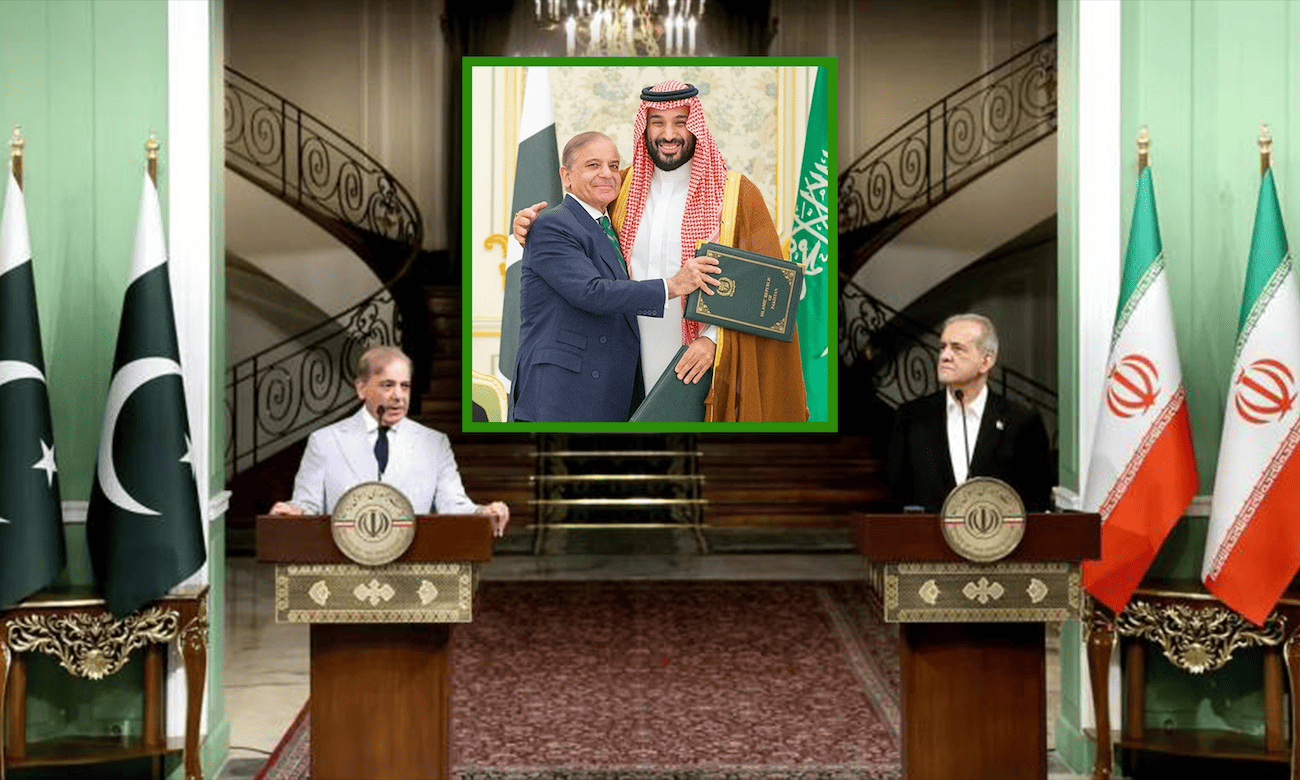
Pakistan confounded that assessment in ways that will take years to fully interpret. It fought a brief but consequential war with India in May 2025—the most intense exchange of fire between the two countries in half a century—then absorbed the outcome and pivoted, within months, toward a new strategic architecture in the Gulf. It signed a mutual defense treaty with Saudi Arabia in September, deployed fighter jets and ground forces to the Arabian Peninsula the following spring, and, at the same time, hosted negotiations that helped produce a ceasefire between the United States and Iran. It condemned American and Israeli strikes on Tehran even as its own military reinforced the kingdom those strikes were designed to protect.
To call this contradictory is to miss the point. Pakistan was not confused. It was doing, with unusual clarity and urgency, what it has always done: surviving.
I. The Education of a Pivot State
Pivot states are not born; they are made. They emerge when geography, history, and necessity converge to place a country at the intersection of competing interests—and when that country develops the institutional capacity and strategic culture to exploit that position.
Pakistan’s education in this art was long and often brutal. The Saudi-Pakistani relationship, often caricatured as a simple exchange of petrodollars for loyalty, is better understood as a decades-long co-investment in mutual survival. From the late 1960s onward, Pakistan provided what Saudi Arabia lacked: trained manpower, institutional expertise, and a military culture grounded in state discipline rather than tribal allegiance. Pakistani officers helped build elements of the Saudi armed forces from the ground up.
By some estimates, Pakistan trained thousands of Saudi military personnel and stationed tens of thousands of its own troops in the kingdom during the first Gulf War. A formal agreement institutionalizing aspects of this cooperation dates back to 1982. The relationship deepened during the upheavals of the 1970s and 1980s, when the Iranian Revolution, the Soviet invasion of Afghanistan, and Cold War competition reshaped the region’s security landscape.
Pakistan became, simultaneously, a frontline state against Soviet expansion, a conduit for the Afghan jihad, and an informal security partner to a Gulf monarchy that was growing rich but remained militarily exposed. The United States underwrote parts of this system, but the Saudi-Pakistani bond developed on its own terms—below the surface, and beyond formal alliances.
It was during this period that ambiguity itself became a strategic instrument. The precise extent of Saudi financial support to Pakistan’s nuclear program has never been publicly established. The text of the 2025 defense agreement has not been fully released. The meaning of its reference to “all military means” remains deliberately undefined.
This is not accidental. In deterrence, ambiguity is not a flaw. It is a feature.
II. A Season of Shocks
The year preceding the defense pact was marked by cascading shocks. In April 2025, militants killed twenty-six Hindu tourists near Pahalgam in Indian-administered Kashmir. India attributed the attack to Pakistan-based elements. Within weeks, it moved to suspend the Indus Waters Treaty, the 1960 agreement governing river flows critical to Pakistan’s agriculture.
On May 7, India carried out strikes not only in Pakistan-administered Kashmir but also in parts of Pakistan’s Punjab. Pakistan responded with air and drone operations. Both sides placed their nuclear forces on heightened alert.
The conflict lasted four days. It ended under international pressure, with neither side claiming decisive victory. India demonstrated reach. Pakistan demonstrated resilience—and, notably, the operational effectiveness of Chinese-origin systems against Western platforms, though claims on both sides remain contested.
The significance of the war lay not in who won, but in what it revealed. Pakistan emerged with its military credibility intact, but its economic fragility exposed. Energy costs rose. External financing tightened. Remittances from Gulf workers became even more critical. The lesson for Pakistan’s leadership was clear: military competence needed to be translated into strategic and economic insurance.
III. September 9
The Israeli strike in Doha in September 2025—reportedly targeting Hamas-linked figures—proved to be a strategic shock for Gulf states. Qatar, a close U.S. partner hosting a major American air base, was struck in broad daylight. Whether justified or not, the signal was unmistakable: alignment with Washington did not guarantee immunity.
Saudi Arabia had sought a formal U.S. security guarantee earlier that year. It received, instead, a massive arms deal. The distinction became stark.
The difference between an arms deal and a security guarantee is the difference between a weapon and a promise.
Within days, Saudi Arabia moved to formalize its relationship with Pakistan. The Strategic Mutual Defense Agreement committed both sides to treat aggression against one as aggression against both. Its wording echoed NATO’s Article 5—but without its legal precision or institutional constraints.
Hinge states are not comfortable. They are pressured from all sides. They must speak in multiple registers at once. They are trusted fully by no one—and needed by everyone.
When asked whether the pact extended to nuclear protection, officials on both sides chose their words carefully. Some suggested broad coverage; others walked those statements back. The ambiguity remained intact—and that was the point.
IV. The Test
The arrangement was tested sooner than expected. In early 2026, following U.S. and Israeli strikes on Iranian targets—reported to have killed senior leadership figures—the region moved toward open confrontation. Iran retaliated with missile and drone strikes across the Gulf, targeting energy infrastructure.
Saudi Arabia absorbed significant damage. Oil facilities were hit. Export capacity was disrupted. The vulnerability that decades of defense spending had failed to eliminate was exposed again.
Pakistan moved.
Military assets were deployed to Saudi Arabia. Air defense systems were integrated. Troops were positioned in sensitive zones. At the same time, Islamabad hosted diplomatic engagement aimed at de-escalation. Pakistani officials maintained communication with Tehran while reinforcing Riyadh.
This was not contradiction. It was calibration.
Pakistan signaled commitment to Saudi Arabia through deployment. It signaled restraint to Iran through diplomacy. It signaled relevance to the United States by facilitating talks.
The roles were distinct, but mutually reinforcing.
V. The Economy of Ambiguity
Shortly after the deployment, Saudi Arabia extended and expanded its financial support to Pakistan—amounting to roughly $8 billion in deposits and facilities.
This was not aid in the conventional sense. It was structural support.
Pakistan’s external position at the time was precarious. Foreign exchange reserves were under pressure. Debt repayments loomed. Without Gulf support, macroeconomic stability would have been difficult to sustain.
Dependency, however, did not produce passivity. Pakistan converted necessity into leverage by becoming indispensable to the very partner it depended upon.
Saudi Arabia was not merely funding Pakistan. It was securing a strategic relationship—one that combined military capability, geographic proximity, and nuclear ambiguity.
The arrangement was not a classical alliance. Nor was it purely transactional. It was something more complex: a system of mutual reliance in which each side compensated for the other’s vulnerabilities.
VI. The India Question
Pakistan’s repositioning cannot be understood without reference to India. The rivalry remains the central fact of South Asian geopolitics.
India possesses far greater structural power: a larger economy, a diversified industrial base, and expanding global partnerships. Its alignment with the United States and its Indo-Pacific strategy reflect this trajectory.

But power brings constraint.
India’s engagement with multiple partners—Russia, the United States, the Gulf—requires careful calibration. Its insistence on strategic autonomy sits alongside deepening alignments that are increasingly visible. The result is not incoherence, but complexity.
Pakistan operates under different expectations. Its contradictions are assumed. This gives it a degree of flexibility that more powerful states often lack.
This is not a judgment of superiority. It is a difference in strategic position.
VII. What Endures
What emerges from these events is not the rise of a new alliance, but the erosion of an old order.
For decades, Gulf security rested on a single premise: that the United States could and would guarantee stability. That premise has weakened. Not disappeared—but weakened enough to force adaptation.
Security is now being diversified. Distributed. Partly outsourced.
Pakistan has inserted itself into this space—not as a dominant power, but as a necessary one.
It is not an ally in the classical sense. It is not neutral. It is not a proxy.
It is something else.
A hinge state.
A state whose value lies in connecting systems that cannot otherwise connect. In mediating between actors who cannot speak directly. In holding open, at considerable cost to itself, the possibility of outcomes that no single power can impose.
Hinge states are not comfortable. They are pressured from all sides. They must speak in multiple registers at once. They are trusted fully by no one—and needed by everyone.
Pakistan, for all its internal fragilities, has learned to operate in this space with a certain discipline. Whether it can sustain that position is uncertain.
But for now, something important has shifted.
In a world where power is increasingly fragmented, the ability to move between roles—to be, at once, participant and intermediary—has become a form of power in itself.
Pakistan has understood this earlier than most.
That does not make it stable.
But it does make it indispensable.
Satish Jha, former Editor, Indian Express Group and The Times of India Group writes on geopolitics, international affairs, and development.