




A Touch of India at the Met Gala: Karan Johar’s Raja Ravi Varma Cape was a Cinematic Tribute to Indian Heritage

- Johar wore a literal art museum. He moved beyond the Western silhouette to prove that Indian attire is a living archive of emotion and fine art.

When we think of the Met Gala, the dresses that flash across the mind’s eye are more than mere garments; they are indelible markers of cultural history and couture. They range from Rihanna’s legendary 2015 “omelet” dress to Princess Diana’s defiant 1996 navy Dior slip. The 2026 theme, “Costume Art,” pushed this legacy further by celebrating fashion as a high-art form that turns the human body into a curated canvas.
This year’s exhibition paired nearly 400 objects: including clothes, paintings, and sculptures from prehistory to the present. The idea was to explore varied body types, from the classical and anatomical to the aging and pregnant form.
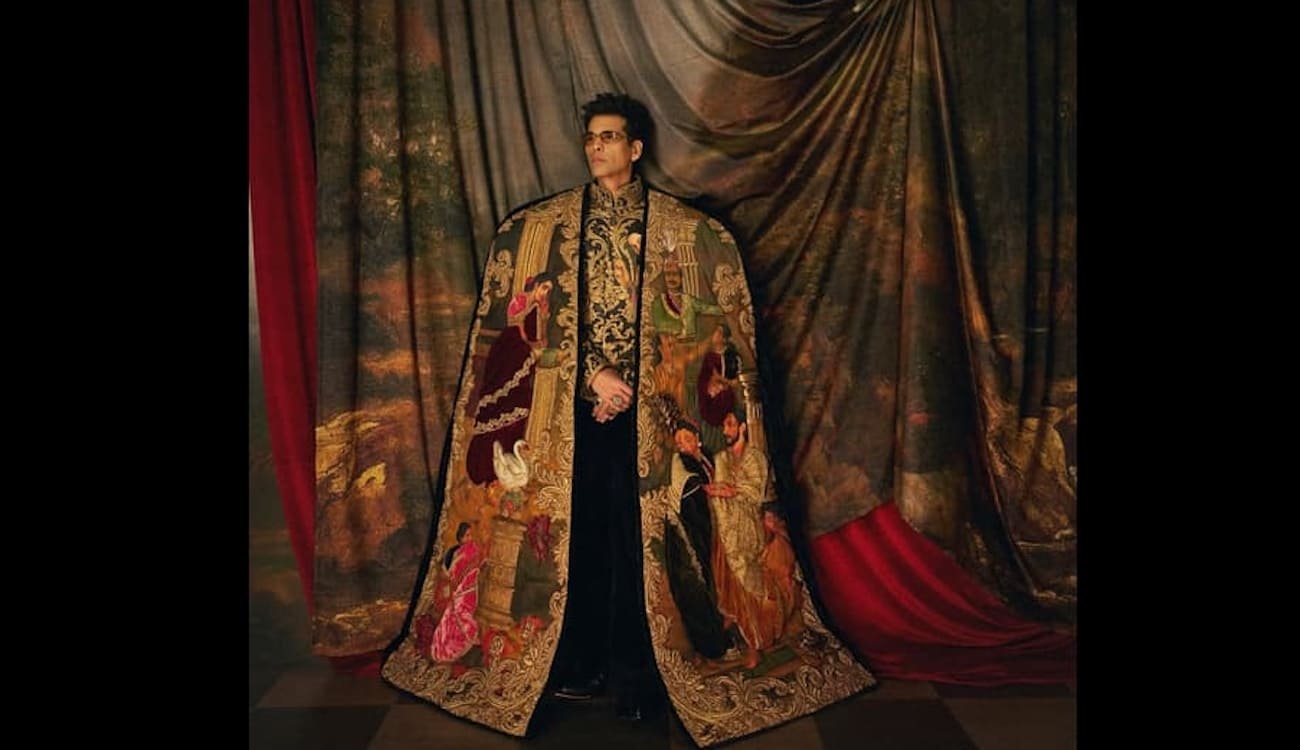
My daughter and I found ourselves captivated by the storytelling on display. While she was mesmerized by the ethereal “Airo” gown worn by the lovely Eileen Gu, a surreal crystal and bubble masterpiece by Iris van Herpen, I was enthused by the sheer drama of Karan Johar’s Raja Ravi Varma cape. Designed by Manish Malhotra, the ensemble titled “Framed in Eternity” was a cinematic tribute to Indian heritage. As a filmmaker who excels in larger-than-life visuals, Johar’s choice of Varma, the artist who first visualized Indian mythology for the masses, resonated with me on a personal level.
Raja Ravi Varma (1848–1906) was a pioneering painter who revolutionized Indian art by blending European academic realism with Indian mythological themes. Known as the “Father of Modern Indian Art,” he mastered oil painting to create realistic, humanized depictions of Hindu deities and scenes from the Mahabharata and Ramayana. By establishing an industrial-scale printing press in 1894, he mass-produced his works as affordable oleographs, bringing the images of goddesses like Lakshmi and stories like Nala-Damayanti into common households for the first time.
The craftsmanship showcased on Johar’s cape was staggering: 5,600 hours of labor by 80 artisans to hand-paint Varma’s masterpieces like the beautiful Hamsa Damayanti, Kadambari, and the legendary Arjuna and Subhadra onto fabric.
The craftsmanship showcased on Johar’s cape was staggering: 5,600 hours of labor by 80 artisans to hand-paint Varma’s masterpieces like the beautiful Hamsa Damayanti, Kadambari, and the legendary Arjuna and Subhadra onto fabric. The tapestry-like cape featured sculptural lotus and swan motifs, transforming the filmmaker into a walking art gallery. This intersection of fine art and couture echoed into my artistic soul, urging me to pen a piece. I have long shared a love for wearing painted art, having hand-rendered the works of Matisse, Van Gogh, Gauguin, and Picasso, as well as whirling dervishes and traditional Kalamkari art with peacocks, and temples, onto my own shirts, skirts, scarves, shoes, umbrellas, and sarees.
Seeing Johar’s six-foot hand-painted cape, I couldn’t help but think of my mother. She would have enjoyed the sheer audacity of this piece. I can almost see her promptly bringing out her own plain tussar silk sarees for me to paint, demanding her own wearable versions of realistic Shakuntala, Nala Damayanti, Ahilya, and the most beloved of all Ravi Varma’s deities, the goddess Lakshmi. I can see her now setting up my fabric paints, and brushes, covering the table with an oil cloth, lest I make a mess.
Johar’s debut marked a significant shift in how Indian artists grace the Met Gala. In 2025, Shah Rukh Khan made his debut in a bespoke, all-black Sabyasachi creation that focused on a powerful, minimalist “King energy,” highlighted by an 18-karat gold Bengal Tiger cane. That same year, Diljit Dosanjh embraced his Punjabi heritage in an ivory Prabal Gurung sherwani paired with a reimagined Cartier Patiala Necklace. Earlier, in 2024, Alia Bhatt stunned in a 23-foot floral Sabyasachi saree-gown for “The Garden of Time.”
While these previous appearances leaned into royal silhouettes and cultural identity, Johar’s 2026 look went a step further. Johar wore a literal art museum. He moved beyond the Western silhouette to prove that Indian attire is a living archive of emotion and fine art.


The evening was filled with such artistic collisions. Beyoncé made an epic return after a decade, wearing a glittering skeleton-embellished Olivier Rousteing creation with a voluminous feather cape. Her look perfectly embodied the Gala’s focus on the anatomical and sculptural body, highlighting fashion as performance.
By pairing contemporary couture with 5,000 years of artistic history, the 2026 Met Gala held on the first Monday of May, successfully moved beyond fashion’s functional roots. It proved that whether through a skeletal masterpiece or a hand-painted Indian cape, fashion is not ephemeral. It is an embodied art form.
This new wave of representation has brought Indian designers like Sabyasachi Mukherjee, Manish Malhotra, Rahul Mishra, and Prabal Gurung to the forefront of global fashion, proving that Indian craftsmanship is unparalleled in its ability to turn “The Dressed Body” into a masterpiece.
With one foot in Huntsville, Alabama, the other in her birth home, India, and a heart steeped in humanity, Monita Soni writes as a contemplative practice. She has published hundreds of poems, movie reviews, book critiques, and essays, and contributed to combined literary works. Her two books are “My Light Reflections” and “Flow Through My Heart.” You can hear her commentaries on Sundial Writers Corner, WLRH 89.3 FM.