




A Lamp for the Ancestors: Odisha’s Deepavali and a Ritual That is Shared Across the World

- The Odia in me has always found the connection, from Halloween in Dallas to Día de los Muertos in Mexico, from Obon in Japan to Vu Lan in Vietnam.
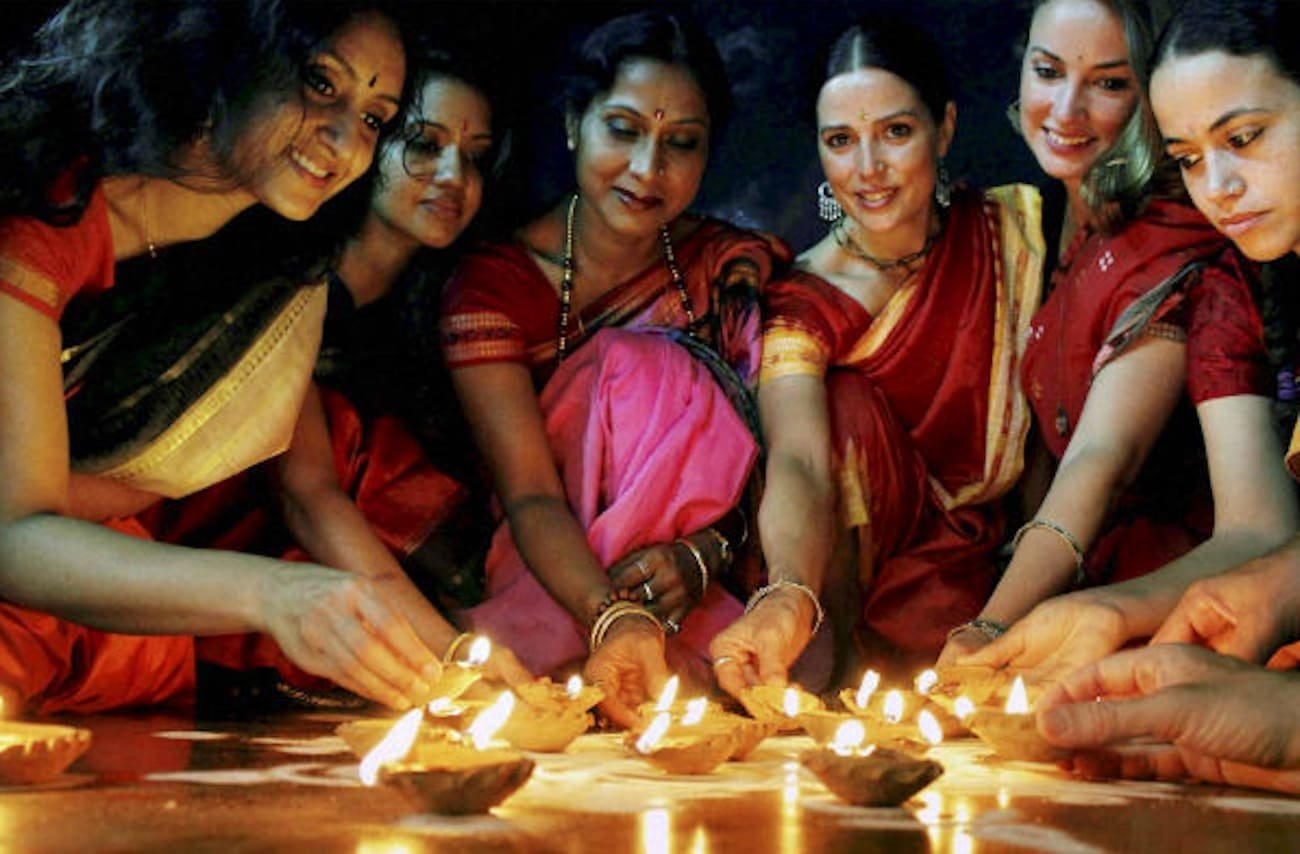

First it was Halloween, then Día de los Muertos, with its marigold altars and photographs of grandparents propped between candles and sweet bread. Both traditions were observed in Dallas, and this past weekend the diyas came out for Deepavali. At first glance, the three festivals seem worlds apart. However, the Odia in me has always found the connection.
Diwali, as most people here know it, is about Lord Rama coming home to Ayodhya. It’s also about worshiping Goddess Lakshmi, sweets, new clothes, and fireworks. But back in my home state, Odisha, the evening has always meant something else, too. Something probably older than any of these stories. It is the night we send our ancestors back.
Calling the Ancestors
On Deepavali evening, Odia families gather in the courtyard, often around the tulasi chaura (holy basil plant). Everyone holds a bundle of kaunria kathi(dried jute stalks) and lights it from the earthen lamp of the evening puja. The bundles go up towards the sky and the family calls out together:
Bada badua ho, andhaara re aasa, alua re jaa.
(Oh ancestors, you came in the dark. Go back now in the light.)
This chant includes a line about the Baisi Pahacha, the twenty-two steps of the Jagannath temple at Puri. The whole ritual is called Bada Badua Daka, the calling of the elders.
In our house, my mother had one firm rule about Deepavali evening. Not a single deepa could be lit to decorate the house until the puja for the ancestors was over. Afterward, she would sit with us and explain why the ancestors are no less than the gods, and how they visit the earth during these days to see us and look in on our well-being. She would say, “we are here because of them, and if they are happy, we will have a good life.”
In Puri, on Deepavali evening, the Bada Danda (the Grand Road) in front of the temple fills with people holding burning stalks, and many offer paya shraddha to their forefathers that same day. By night, the smoke hangs over the whole length of the road. I can think of very few other occasions when an entire town remembers its dead together, in public, at the same time.
It Begins at Mahalaya
According to tradition, ancestors (pitru) are invited to the mortal world during the dark fortnight that ends on Mahalaya amavasya, when tarpana and shraddha are offered. Then they remain guests of the house until Kartika Amavasya. On Deepavali, the darkest night of Kartika, they are shown the path of light and bid farewell to the ancestral world. For almost a month, between two new moons, the ancestors live with us. Mahalaya brings them in, Deepavali sends them back, and the jute torch lights their road.
Every evening in Kartika, many Odia homes raise the akasa deepa, or sky lamp. They place a ghee lamp in an earthen pot with small holes in its sides. They pull the pot up a tall bamboo pole beside the tulasi chaura, where it burns through the night. It is generally offered to Damodar (Krishna). However, in many homes, it is also understood as a light for the ancestors, set high enough for them to see from far away, like a lighthouse that guides ships. So for the whole month a lamp stands over the house, and on Deepavali night the family holds up its own flames beneath it.
Not Only Odisha Tradition
Bengal has something close to it. On Bhut Chaturdashi, the night before Kali Puja, people light fourteen lamps and eat a dish of fourteen greens. It is said to be for fourteen generations of ancestors. It is also believed to keep restless spirits away. In Bihar’s Mithila region, families do hukka-paati on Deepavali evening, lighting bundles of sticks as prakash tarpan, an offering of light to the dead. In Assam, families raise a similar akash banti, a sky lamp on a bamboo pole, through the month of Kati(Kartik), to guide the ancestors’ souls towards heaven.
The custom reaches the far south too. Many Tamil households, from Jaffna, Sri Lanka to Malaysia and Singapore, cook a padaiyal on the eve of Deepavali, a spread of their late parents’ and grandparents’ favorite dishes, offered to them before the festival begins.
So the idea that the darkest night of the year belongs to the dead runs from Bengal and Odisha down to the Tamil south. None of these customs depends on a priest. They belong to what Odias call lokachara, the way of the people, and they feel much closer to the household religion of farming families than to temple ritual. Even Jagannath, in Odia tradition, was first worshipped in the forest by Biswabasu, a Sabara chief, long before kings and Brahmins brought him to Puri. Odia religion has always carried that older, local layer inside it.
The Same Light, Elsewhere
I only noticed how far this tradition goes after I left India, and even more once my research took me to Southeast Asia.
In October 2018, I was in Siem Reap. Our tour guide told us about Pchum Ben, the Cambodian festival for the dead that falls at that time of year. It lasts fifteen days and ends on the same new moon as Mahalaya, usually on the same day or within a day of it. Families take food to the pagodas for their dead and toss rice balls for the hungry spirits.
Laos feeds its dead a few weeks before Pchum Ben. Southern Thailand releases and sends back its ancestral spirits in the tenth month. Vietnam observes Vu Lan. Korea sets food for its ancestors at Chuseok. Filipino families keep candlelit vigils at the graves on Undas. Bali, Indonesia, keeps the same tradition on a different clock. Balinese Hindus believe their ancestors come down to visit during Galungan and return ten days later at Kuningan. Because Galungan follows a 210-day ritual calendar rather than the moon, it can fall in any season, sometimes twice in a year. In Bali, the month between Mahalaya and Deepavali has become ten days.
In Japan, during Obon, families light a small fire at the gate, mukaebi, to bring the ancestors home, and another, okuribi, to see them off. The fire is often made of ogara, dried hemp stalks. Hemp stalks at a Japanese door, jute stalks at an Odia one, lit for the same people and for the same reason. In Kyoto, the send-off is done on a grand scale, with huge bonfires on the hills around the city.
Taiwan has something even closer to Odisha’s akasa deepa. During Ghost Month, temples put up tall bamboo poles with a lantern at the top to guide spirits up from the underworld. Those lanterns are mostly for wandering spirits with no family to feed them, rather than for one’s own ancestors. But the idea is familiar: the higher the pole, people say, the more souls can find their way.
I found similar rituals in Sweden for myself in 2004, when my husband and I were living on Brahegatan in Stockholm. That autumn, just a week before Deepavali, I saw a few of our Swedish neighbors gather in the central garden of our apartment complex, holding candles beside photographs of their ancestors and the loved ones they had lost. When I spoke with them later, they told me about Alla helgons dag, All Saints’ Day, when families in Sweden light candles on the graves of their parents and grandparents. I was utterly surprised. In Stockholm, the biggest gathering is at Skogskyrkogården, the woodland cemetery south of the city, where thousands of small flames burn among the trees in the early November dark. Sweden is one of the most secular countries in the world, and lighting candles on graves only became common there after the Second World War. Yet there we were in that garden, an Odia woman and her Swedish neighbors, each remembering our dead at the same turn of the year. Later, when I lived in Dublin, I heard about Samhain, Ireland’s old festival for the night the dead were believed to walk among the living. It still survives in the Halloween I began with.
Then there is Mexico. For Día de los Muertos, families set up altars with photographs, food, and candles, and scatter marigold petals from the street to the altar so the dead can find their way. The interesting part is that the marigold in every garland back home is native to Mexico and Central America and most likely reached India with the Portuguese. The same flower ends up laid out for the same guests on opposite sides of the world.
Some of the Asian rites are cousins of ours by descent. Obon and Vu Lan go back to an Indian Buddhist story, Maudgalyayana’s rescue of his mother from the realm of hungry ghosts, and Pchum Ben grew from the same Indic soil. But borrowing cannot explain the rest. Mexico learned nothing from Puri, and nobody in Stockholm was reading Odia almanacs. What these rites share is older and simpler than any trade route or faith. It is reverence for those who came before us. The belief that our dead come back to us for a while, and that we have to show them the road home. Our jute stalks belong to that very old human family, not just to a regional calendar.
How Many Deepavalis Became One Diwali


So why does the Diwali most of the world now sees leave all of this out? The Diwali of Times Square, office parties and our children’s classrooms is about Lakshmi and Rama, sweets and fireworks. Nobody mentions the ancestors. In India, Bada Badua Daka gets a short travel feature once a year, usually as an old-world Odia custom, forgotten until the next Deepavali.
The ancestors have not vanished from the north either. On Dhanteras or Choti Diwali, many families still set a lamp outside facing south, the direction of Yama and the dead. In Varanasi, people hang sky lamps through Kartik to light the ancestors’ way. The truth is the ancestors have simply been moved to the edge of the festival, while Lakshmi and Rama took the center.
Part of the reason is the calendar. In Odisha, Lakshmi already has her own days. She is worshipped as Gaja Lakshmi on Kumar Purnima, and again on the Thursdays of Margasira, Manabasa Gurubara, when women draw jhoti at the doorstep to invite her in. The Kartika new moon never became her night, so it stayed with the ancestors. In Gujarat and among Marwari traders, Diwali, by contrast, marks the start of the business year, when they open new books. It makes sense that a festival so tied to trade would turn to the goddess of wealth.
Part of it is also the stories. The northern Diwali is built on the Ramayana, the southern one on Krishna killing Narakasura, and both are about a hero beating evil. The eastern versions do not have a hero. They have a family and its ancestors.
The rest comes down to who gets to define a festival. The Diwali that became national is the one carried by Sanskrit learning, temple priests and merchant patrons, and later by printed panjikas, films, television and the festive market. Brahmanical tradition did not ignore the dead. It gave them the shraddha: performed in Sanskrit, by a priest, for three generations in the male line, on fixed days. It left little room for a whole family standing in the courtyard with burning jute, calling out to the ancestors in Odia.
Oddly, the Sanskrit texts once knew this custom too. A verse in the Skanda Purana, in its praise of the month of Kartika, tells people to hold up torches on the evenings of Chaturdashi and Amavasya to show the ancestors their path. The festival that went national kept the lamps and quietly let the ancestors go. Over time, the priestly, Lakshmi-centered Diwali became the norm, and everything else was relabelled a “regional variation”. The former civil servant and cultural historian Jawhar Sircar has argued that there was never one central Diwali for the others to vary from, and that each region’s festival is a tradition in its own right. I agree, and I would go a step further. The so-called variations are often the older layer, and the standardized version is the newcomer.
Even in Odisha, more city families now do Lakshmi puja on Deepavali, and a fourth-floor flat in Bhubaneswar has no courtyard to stand in. The jute stalks themselves are getting rare as fewer farmers in Odisha grow jute. A child in Odisha may still see them burning somewhere on her street. However, a child in Texas mostly sees a standard Diwali, at least outside the house. Whatever she learns about the ancestors, she will learn from her parents.
Carrying the Light
Here in Dallas, I keep the night in my own way. I cook Odia dishes and offer them, with tropical fruits on banana leaves, to my late parents, grandparents, and in-laws, who are now my ancestors. Marigolds always went into the ancestor puja of my childhood, and they still do; mine now come from my backyard garden. There is no jute stalk here, so the family lights a deepa instead. We sit quietly in front of it for a few minutes, remembering each of them. Then we say the words together: Bada badua ho, andhaara re aasa, alua re jaa.
Only then do the other lamps go up around the house. My mother’s rule has traveled to Texas with me: not a single diya for decoration until the ancestors have had theirs.
Perhaps that is why the ritual travels so easily. It doesn’t need a temple or a priest, or even to be present at Puri. A backyard is enough, with a flame and a few words said together. Many of us here lost parents an ocean away, sometimes without getting home in time. A night that brings them back once a year, and then sees them off with light, means more at this distance.
And somewhere in another American backyard, an Odia family may still lift a flame to the sky and call out to the ones who came before. O Ancestors, come in the dark. Go back in the light.
Sarita Dash is an independent researcher working on culture, memory, and identity across South Asia and its diaspora. She is the author of Cultural Dimensions of India’s Look-Act East Policy: A Study of Southeast Asia (Palgrave Macmillan) and holds a PhD from the Centre for South Asian Studies, School of International Studies, Jawaharlal Nehru University, New Delhi. Her work explores how culture, memory, and identity shape and are shaped by foreign policy in South Asia, particularly through everyday practices, lived experience, and questions of belonging.