




Unbearable Gratitude and Joy: Vishal Chaturvedi’s Film ‘Hanuman Ansh’ is Here, There, and Life Itself

- Everything was new to me around this movie because I knew very little of Neem Karoli Baba's life story before. The crushing habit of familiarity and expectation simply weren't there, and that was good.
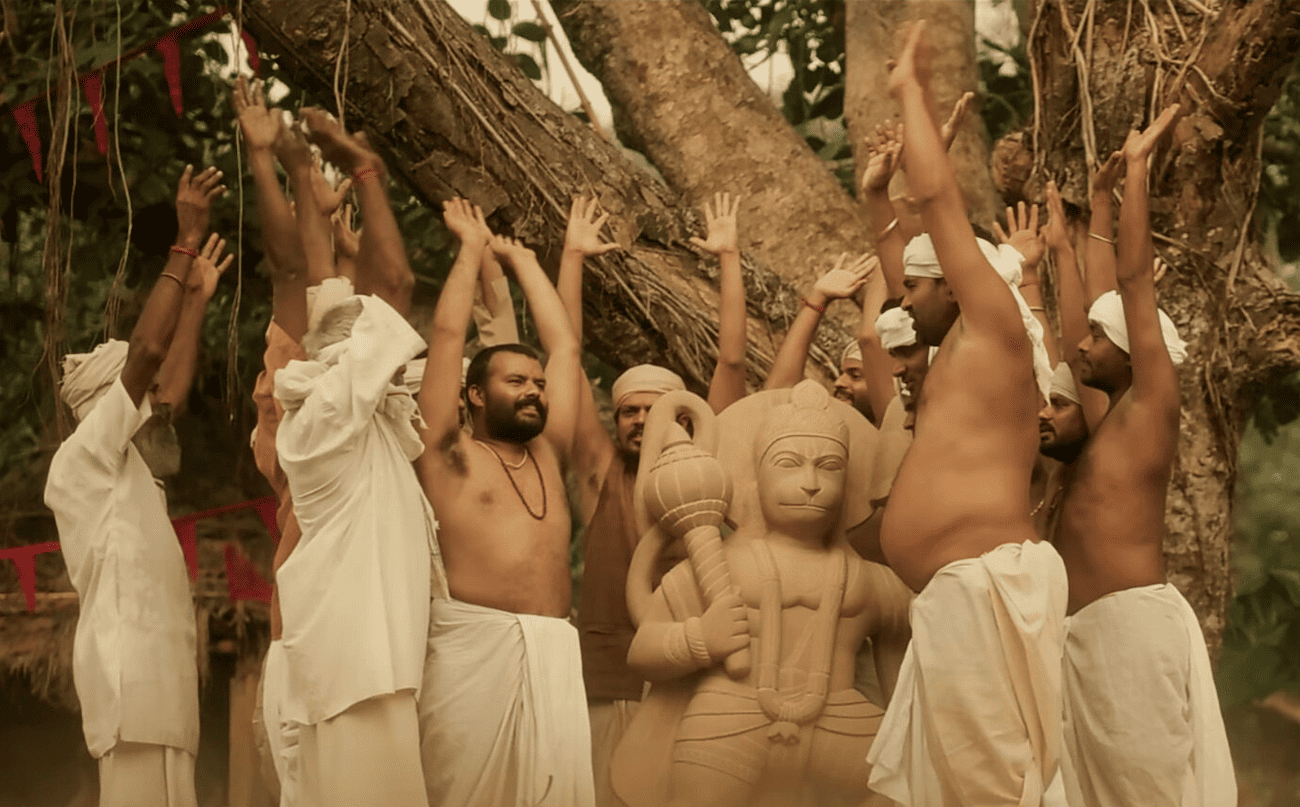

It has taken me two or three days to settle on what to start with about how “Hanuman Ansh” made me feel. Like my father in his later years often did when watching movies, I too shed copious tears in the cinema hall. Mostly of unbearable gratitude and joy. So much love. So much truth, all at once, all around us.
I was expecting a good movie. But what I didn’t expect is how fast and how deep “Hanuman Ansh” hits.
What exactly has left me feeling that way about the movie? At one level, it was the subject, and the themes associated with that subject, admittedly. “Hanuman Ansh” is about gods, devotion, miracles, gurus, and all those are here. On the face of it, it is a biopic about Neem Karoli Baba. As someone not too familiar with his life story beyond occasional anecdotes told mostly by his Western devotees, I went in with affectionate respect but not too many expectations by way of incidents and details. (My familiarity is perhaps confined to Krishna Das’s music and some of Ram Dass’s writings, including his essay in Be Here Now in which he recounts Babaji’s nonchalant humoring of a brash and even dangerous psychedelic dare; and of course, the beautiful Hanuman temple in Taos, New Mexico).
I suppose what I had hoped for was a pleasant, stimulating, bhakti-laden journey through a life-story. But what happened, or at least how I now seem to think of what happened to me when I watched the movie, is more complex.
So-Ham, So-Ham, a Duality-Dance
I would describe it as a pure dance between two opposite states which flowed back and forth, tossing me along this way and that way, in the process. Like so-ham, so-ham, inhalation and exhalation, but then it wasn’t just that, there was something specific to these two poles. I would describe them as the new, and the familiar. Or, to be more faithful to my mood in the theater, the strikingly, soaringly, refreshingly, alive-ingly, new, and the grounding-ly, comfortingly, profoundly secure-ingly, familiar.
And this intense swaying and swinging wasn’t just in terms of the moods or forms of the movie itself. I felt like this is a dance that is actually happening in existence. All the time. It’s just that we don’t notice it, except perhaps, to quote an Orson Welles (vide Edgar Alan Poe via the Alan Parsons Project) monologue, “when the bodily and mental health are in perfection.”
Usually, in real life, we notice newness and familiarity in their noticeably negative forms. As boredom, perhaps. As uncertainty and anxiety, of course. We fear the new sometimes, and yet we abhor the familiar.
A Little Help with Consciousness
But then, the trouble, as our gurus might say, is not with the world, but with how we see it. And that’s what gurus should say. Cooler gurus of course don’t just say it, but show it, mean it, and even force it. The bottom-line in terms of a specific learning from all this, this culture of seeking, this movie, this life, or guru-trip: our consciousness needs help.
And that’s where culture comes in. Art. Ceremony. Beauty. Creativity. Cinema.
The strange thing about our consciousness needing help though is that “Hanuman Ansh” has come at a time when our consciousness is under historically unprecedented, some might say, unbearable, conditions. We are now habituated into an endless dance of newness/familiarity, surprise/comfort, through the simple task of scrolling and swiping, isn’t it?
I was going to write “on our phones,” at the end of that last sentence but it’s redundant. We know what it means. Ten or fifteen years ago, this phrase, and this constant preoccupation of humanity in the early twentieth century, the scrolling and swiping, simply wasn’t there. Sure, we had other ways of swaying, trancing, “vegetating.” I remember Edward Norton’s gaping couch-face in a scene early on in “Fight Club.” We were “couch potatoes” before we became phone-zombies. I don’t know what we were, or the generations before, were before that. But this is the whole point of where, how, when in time, this phenomenon called Hanuman Ansh is landing.
In a time when digital delusion is amok, and we are so hooked on the twin rushes of newness and comfort, the same two elements have come to life in a cinematic experience worthy of every tear of joy and word of praise it has earned.
Yes. Bravo! Utthamam! Adbhutham! Jai Hanuman! May Neem Karoli Baba’s pat fall on all your backs, dear artists…
Such is how this review has to unfold. Praise first and last, and other observations if any only in passing.
Ekam Hanuman, Bahurupam Sampradayas
Newness. Everything was new to me around this movie because I knew very little of Neem Karoli Baba’s life story before. The crushing habit of familiarity and expectation simply weren’t there, and that was good. All I knew is that he was Hanuman, and the title indicated that too.
Now, I might have had some expectations, of let’s say a disciplinary-scholarly kind on that point because I was born into a Dvaita family and some of my best friends and guides on Hindu thought are Dvaita scholars and teachers. So, we, I mean our sampradaya has some thoughts I’m sure on who’s Hanuman and who can’t be (or maybe not). But then, we are all also bhakthi-blissed. We are also ekam/bahurupam balanced. Neem Karoli Baba felt like Hanuman to me.
If Hanuman lived in human form in colonial early 20th century India, that would be the vibe. For sure.
I’m getting into the familiar end of the pendulum already, but that is how it is with the gods, isn’t it? One moment, you are swung without asking or knowing or expecting into an abyss of unknown depths, and the next you are back in the deepest lap of comfort and trust you could imagine. Primordial cradle dreams? I don’t know. But Hanuman is who I felt I was with in this movie. And, of course, Neem Karoli Baba too… hardly know him, yes, but then he seems to know me, isn’t it?
Just the privilege of having been brought into this opportunity, this moment, this cinematic experience of knowing his life and deeds and his followers’ bhakti.
The Forest
The first gasp of joyous love came for me in the river scene. Rock steady and mountain-silent, the boy-guru stands in the water. You know he’s Hanuman. You know he can “hold his breath.” I mean, he holds all our breaths, our lives, in his hands and in his compassionate plans (purists may say this is a projection but that is how bhakti flows and shapes itself in modern times I suppose)
“Breath” isn’t a problem here. The Hanuman theme of breath and life is in the zone of the familiar. But then the appearance of the mithais changed everything.
The “miracle” is, I suppose, the ultimate example of newness, the surprise, which goes beyond not just behavioral expectation but the normal borders of “reality” itself. Like a page-turner, the movie kept us going from one miracle to another. But the funny thing is that at no point was there a gimmick or a hook, a “cliffhanger” to make us crave one more “hit.” Unlike our social media feeds, or even pulp fiction/serial writers, there really wasn’t any need to pander to our attention. Maybe it’s the nature of the form of cinema as opposed to say a novel. But still, I wonder what it was that kept me so “engaged” as they say. Each moment, each scene, just felt really full.
One thing that made such a content viewing experience is perhaps the depiction of nature in the movie, I kept wondering where in today’s India they found forest and rural landscapes so undisturbed (or un-viksit-ed as they say these days). The last time I got astounded by such an in-cinema realization about location was in Dhurandhar. The urban-concrete-wire apocalypse being served to us as “Pakistan” was like well, shot in India and like quite a lot of unplanned “developments” wasn’t it? A jungle out there.
But in Neem Karoli Baba’s world, the jungle was the jungle (except the night scene at the end which was like from another movie, or average TV serial and didn’t fit well at all).
The Bundeli-Hindi song Parvathi, which I have been binge-watching and loop-listening, is bringing the movie home to me again and again.
The Mundane (Sometimes) is the Miracle
Every moment in “Hanuman Ansh” had presence, intensity, and very frequently, surprise. The appearance of the sweets was one. The snakes, another (keeping it vague here to avoid spoilers). But most of the surprises were, frankly, not of the miraculous or supernatural sort. They were so everyday, so mundane, so reality-based, it made the story, well, to use a mega-compliment in the contemporary idiom, “based”!
It wasn’t, for example, a shock when Babaji’s father finds him years after he has left home and family. But then, what he reveals, and the scenes that follow… they moved so fast and so sweetly I can only evoke them again now with the Telugu phrase “aadi dampatulu” (primordial couple). The symbolism was also full of what the Telugu industry calls “nativity” here (again, keeping it vague for the benefit of readers who haven’t watched yet).


The triumph of the familiar in the new, and the new of out of the familiar, maybe nothing matched this creative-esthetic play as intensely as this part of the movie. The Bundeli-Hindi song Parvathi, which I have been binge-watching and loop-listening, is bringing the movie home to me again and again.
Vaag-Artha, or, The Marriage of Shiva and Parvathi
Parvathi is a perfect example of the new and the old, the curiosity of childhood and the confidence of experience. Most of the words of course do not make instant sense to me (the YouTube video only flashed key words in Devanagari but not the whole literal translation which is fine). In fact, even singing along is a challenge because I realize your ears, mind, mouth all operate slightly asynchronously in the sonic terrain of an unfamiliar language (or dialect). Each time I hear the song I am excited; by the strength of familiarity in the story and the wildness of how new the words are in terms of how it’s being retold here. The Bundeli words still sound different to me, while some words have started to grow into familiar friendship. For now, though, I yell, merely yell, what I think they sound like, to the amusement and annoyance of family and friends.
But as I yell, I am not mocking, but only releasing; my ignorance, my hesitation, my presumption that I must know something before putting my foot forward (or “in it”). There is joy in my yelling something “kai gara katta” (or something else) because broadly, vaguely, I know what the elegantly turbaned singers have been describing. O.M.G! and O.M.G! It’s Mighty, Mighty, Mahadev! See, that’s the reason we leap, swing, sing, delight in the new and unfamiliar here. We already know. It’s our Shiva. And our Amma-vaaru, and their tale in this song. The thought of the venerable saptarishis playing along with her parents and trying to discourage her marriage-choice is so funny, it is endearing. I do not know the language, and much of the words’ meanings, or even the sounds. Yet, I explode with ecstatic recognition for each of the details that I do know. Saamp around his neck. Bull on which he roams around. Dreadlocks on his head.
What a wild, wild, man… my dad, our dad, our beloved Ganesha and Muruga’s dad!
And what a sweet, sweet, “simpleton” too. “Itne seedhe-saadhe”… this… Bholenath!
A million mothers’ love. A million fathers’ love. A million forms of love exploding in this dance of consciousness in a four-minute song. A million gods seem to be smiling. and I feel the mood from another song about Shiva I once heard and felt very, very deeply. Tandava Keli Salpene, sung by Sri Sathya Sai Baba, fully in his younger days, and partially, gaspingly, the last time I saw him, on Shivarathri day, 2008.
Baba. Neem Karoli. Sathya Sai. Father. Mother. Guru. God.
God not abstract. God by Name. God by such intimate, indestructible, form and name.
Hanuman. Shiva. Parvathi, Parvathi…
We are happiest when we are with them. We are happiest when we are home- with them. We are happiest when we roam – with them.
In space and in time. In this lifetime and many lifetimes. In this cosmos and others.
In our gods, and our gods, in us.
But mostly, the first one, us-in-gods. Presumption, anthropocentrism, speciesism, inevitably follows with the other way isn’t it.
I remember what my filmmaker friend said way back in the early 90s in our first semester. “Cinema works because we go into the cinema, while with TV it’s the other way.” Big and small. God and humans. There is an order. Actually, maybe there are multiple orders. But in this particular moment of intersection called Hanuman Ansh, in this moment when ears and tongues and eyes and the devas that rule them all came together in this sabha, something beautiful, indeed divinely celestial, has happened. It’s happening. I can go on, maybe, in search of more data points and examples and stories I don’t know yet that might come. But I pause. I conclude. Watch Hanuman Ansh. Sing your joys and loves from it as best as you see fit. Or, just forget the part about what fits, or fitting-in, and let go. In the medium of bhakti, somehow the oldest of memories seem to become the newest of delights. Infinite gravity, infinite light. Hanuman.
Vamsee Juluri is Professor of Media Studies, University of San Francisco. He is the author of “Becoming a Global Audience: Longing and Belonging in Indian Music Television” (Peter Lang, 2003), “The Mythologist: A Novel” (Penguin India, 2010), and “Bollywood Nation: India through its Cinema (Penguin India,” 2013), “Rearming Hinduism: Nature, Hinduphobia and the Return of Indian Intelligence “ (BluOne Ink, 2024) and “The Guru Within” (in progress).