




Trump on a Rickshaw: How America’s Publicity Blitz in India Meets the Complex Politics of MAGA and Hindu Nationalism

- Whether the Freedom250 campaign softens those grievances or merely decorates them is a question the decorated three-wheelers cannot themselves answer.
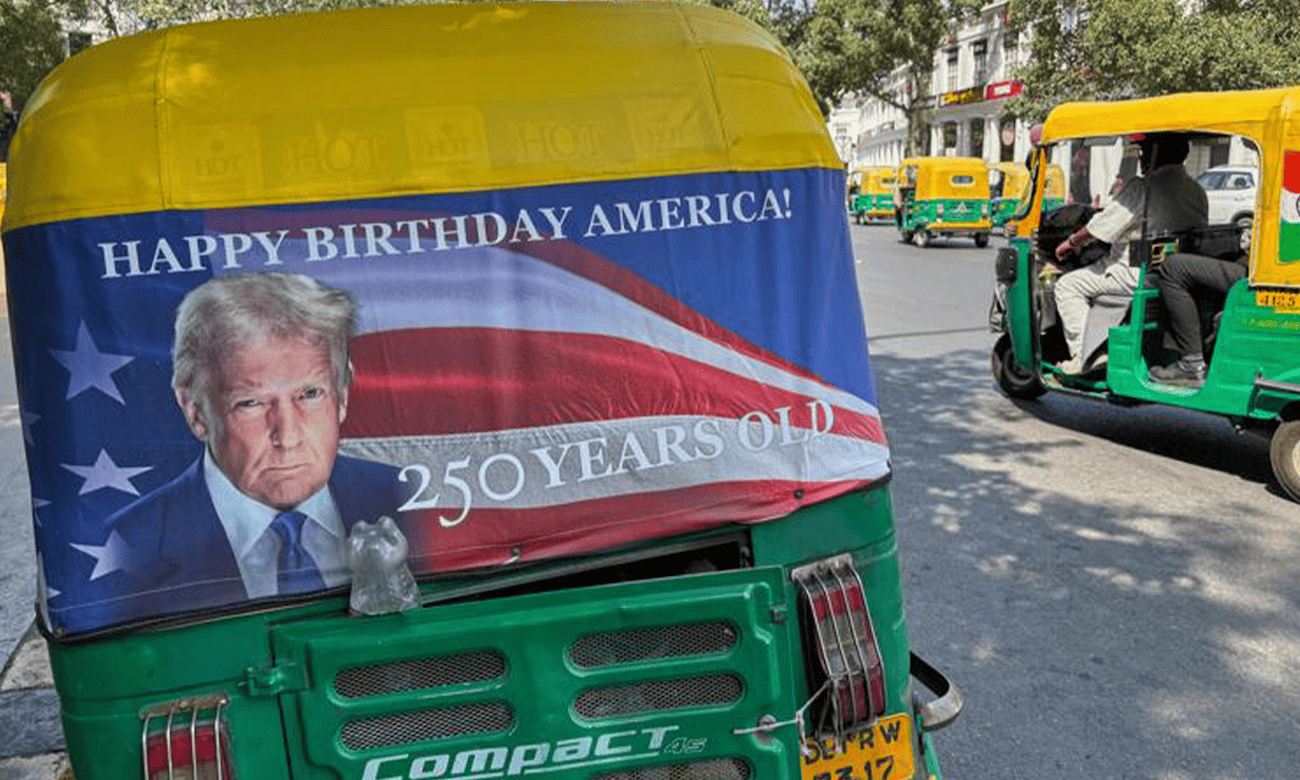

The U.S. Embassy’s splashy Freedom250 campaign — decorating New Delhi’s iconic three-wheelers with the president’s face — lands in a country where Trump’s popularity is real but complicated, his policies have strained bilateral ties, and Hindu nationalists on two continents have discovered that their alliance with MAGA has limits they did not anticipate
The Rickshaws Roll Out
In mid-April 2026, something unusual began appearing on the congested streets of New Delhi. Auto-rickshaws — the ubiquitous yellow-and-green three-wheelers that weave through the capital’s traffic like aquatic creatures navigating a reef — were spotted in Central Delhi wrapped in bright American imagery: the Stars and Stripes, the Statue of Liberty, the words “Happy Birthday America” and “250 Years Old,” and, prominently, the face of President Donald Trump.
The fleet was unveiled by U.S. Ambassador to India Sergio Gor, who posted photographs on his official X account and announced the launch of the “Freedom250” campaign — a yearlong series of celebrations tied to July 4, 2026, the 250th anniversary of the signing of the Declaration of Independence. “Thrilled to kick-off the #Freedom250 celebrations from New Delhi, previewing vibrant autos featuring @POTUS and iconic American images that will be rolled out across the city to mark the start of this special journey,” Gor wrote in his post. “As we celebrate America’s 250th, we also honor the strength and dynamism of the U.S.-India partnership. Stay tuned as #Freedom250 travels across India.”
The decorated vehicles are intended to serve as moving billboards for American history and values through India’s densest urban environments — a deliberately localized approach that uses one of the most recognizable symbols of Indian street life to carry American symbolism. The embassy confirmed that the decorated “freedom vehicles” would travel to other major Indian cities through 2026, accompanied by educational programs, technology events, and cultural programming.
Gor, who is 39 years old and was born Sergey Gorokhovsky in Tashkent in what was then the Soviet Union, served as Director of the White House Presidential Personnel Office before being sworn in as the 26th U.S. Ambassador to India in January 2026. He has emphasized the U.S.-India relationship as one of the most consequential partnerships of the 21st century, with bilateral cooperation spanning defense, trade, artificial intelligence, critical minerals, and regional security.
The visual of Trump’s face riding across the capital of the world’s most populous democracy — beaming from a vehicle that costs roughly 10 rupees per kilometer — is striking on multiple levels. It is a piece of soft-power theater deliberately calibrated for a country where the president’s image already resonates in certain quarters. It is also a campaign being rolled out at a moment of genuine tension in U.S.-India relations, and at a moment when the political calculus connecting Trump, Hindu nationalism in India, and the Indian diaspora in the United States has grown significantly more complicated than it appeared in the early days of the administration.
Modi, Trump, and the Personal Chemistry — and Strained — the Relationship
To understand the context of the Freedom250 rickshaw campaign, it helps to understand the unusual personal bond that has defined the U.S.-India relationship at the highest political level for the better part of a decade.
The visual high-water mark came in September 2019, when Trump and Prime Minister Narendra Modi shared a stage at NRG Stadium in Houston, Texas, before a crowd of roughly 50,000 Indian Americans. The “Howdy, Modi!” rally — organized by diaspora groups aligned with the BJP — was an unprecedented spectacle: a sitting U.S. president and a foreign head of government jointly addressing a diaspora community in a format that blurred the line between diplomatic event and political rally. Trump called Modi “one of America’s greatest, most devoted and most loyal friends,” according to Reuters. Modi, whose party the BJP had lost its parliamentary majority in the 2024 Indian general election before recovering through coalition-building and subsequent state victories, used imagery deliberately: the chant “ab ki baar, Trump sarkar” — roughly translating as “this time, Trump’s government” — audible in the crowd, as The Wire noted in its analysis of the Hindu nationalist-MAGA convergence.
When Trump returned to power in January 2025, Modi was among the first foreign leaders to Washington. At their February 2025 White House meeting, Modi invoked Trump’s “Make America Great Again” formulation with his own “Make India Great Again,” according to Al Jazeera. A pre-meeting India Today magazine “Mood of the Nation” survey, cited by Reuters, found that more than 40 percent of Indians believed Trump’s second term would be favorable to their country, and that Trump enjoyed a positive image among a majority of BJP supporters. Only 16 percent felt he would be bad or disastrous for India.
The personal rapport has held. As MSN/WION noted in its coverage of the Freedom250 rickshaw launch, the campaign coincided with a cordial telephone call between Trump and Modi, reaffirming their personal chemistry despite ongoing geopolitical frictions.
Those frictions are real and documented. The Trump administration’s imposition of a 50 percent tariff on Indian imports triggered alarm in New Delhi. Technology transfer restrictions have strained Quad alliance dynamics. The Carnegie Endowment for International Peace’s 2026 Indian American Attitudes Survey, cited by The Tribune India, found that only 20 percent of Indian Americans approved of Trump’s handling of bilateral relations with India — a sharp drop from 35 percent during his first term and a stark contrast to the 48 percent who backed Joe Biden’s approach in late 2024. Fifty-five percent now disapprove, with the survey’s authors describing the relationship as having been thrown “into crisis,” according to India Weekly.
The anti-Indian racism within the MAGA movement has created a specific crisis of political identity for those who invested most heavily in the alliance.
At the same time, a Morning Consult global leader approval tracker survey conducted between March 2 and 8, 2026, as reported by News on Air — India’s public broadcaster — ranked Modi as the world’s most popular leader with a 68 percent approval rating. Trump, at 39 percent approval in the same survey, did not feature in the top ten. The contrast underscores a dynamic the Freedom250 rickshaw campaign must navigate: in India, the American president is admired by specific segments of the population, but the country’s own leader commands far more domestic confidence.
The Hindutva-MAGA Alliance: Ideology, Opportunity, and Its Limits
The political overlap between Hindu nationalism and the MAGA movement is real, documented, and — as the Trump second term has demonstrated — significantly more fragile than its architects anticipated.
The ideological overlap was never difficult to identify. Writing for Al Jazeera in February 2025, analysts noted that Trump’s disdain for diversity, equity, and inclusion policies aligned neatly with Hindu nationalist opposition to any framework protecting marginalized communities — whether in India or the diaspora. Trump’s brand of Islamophobia, the same analysis noted, offered ideological resonance with a Hindu nationalist movement whose governance under Modi has been characterized by critics as systematically discriminatory toward India’s Muslim minority. Trump’s skepticism of affirmative action aligned with upper-caste Hindu resistance to caste-based reservation policies in India. The anti-Muslim thread, the anti-Left thread, and the majoritarian thread all ran parallel.
In the United States, these currents produced organized political action. Jacobin magazine’s detailed March 2025 account of the Hindutva-MAGA alliance documented an inaugural ball held the evening of January 19, 2025 — the night before Trump was inaugurated — organized by the American Hindu Coalition alongside right-wing Latino organizations at Washington’s Mayflower Hotel, attended by, among others, Rajiv Pandit, a board member of the Hindu American Foundation. Following Trump’s election, Jacobin reported, pro-Trump megadonor Shalabh Kumar launched a $1 million advertising buy targeting Hindu voters in swing states. A viral post composed by Utsav Sanduja — identified by Jacobin as the former chief operating officer of the alt-right social media platform Gab and founding chairman of Hindus for America First PAC — framed Hindu American political priorities as a “Hindu American Project 2025.” After Trump won, Jacobin reported, Hindu supremacist groups were quick to congratulate the president-elect with messages of effusive support for his MAGA agenda.
The Transnational Institute, in its analysis of Hindutva as a global far-right project, described the diaspora advocacy infrastructure as serving as “diplomatic, financial, and ideological intermediaries” helping normalize Modi and Hindu nationalist politics in Western capitals — pointing to groups including the Hindu American Foundation, the Vishwa Hindu Parishad of America, and the Overseas Friends of the BJP as key nodes in a transnational network that has cultivated relationships with conservative Western think tanks, Christian Zionist networks, and Islamophobic advocacy organizations.
But the alliance has run into contradictions that were, perhaps, always structural.
Writing in The Wire in January 2025, analysts observed that Hindu nationalists had assumed a shared dislike of Muslims would permanently tie them to the Trump coalition. That assumption failed to account for the fact that MAGA’s nativist wing is not selectively xenophobic — it is comprehensively so. The same movement that Hindu nationalists hoped would target only Muslim immigrants has turned its hostility on Indian Hindus as well, as the documented surge of anti-Indian rhetoric on X through 2025 — analyzed at length in previous reporting — makes clear. The Wire’s analysis put the BJP’s dilemma plainly: “Recalibrating towards Western progressives is not a straightforward matter for Hindu nationalists who have been vilifying Muslims, Christians and the Left in India in recent years — a fact that is well-known to progressives abroad. They cannot make common cause with other minorities in the West while attacking minorities at home.”
The Diplomat’s July 2025 analysis of whether Hindutva had peaked offered a somewhat different angle: RSS chief Mohan Bhagwat had given a speech advocating reconciliation and restraint on disputes over historical mosques, and during the May 2025 India-Pakistan military confrontation, the Indian government had deliberately promoted a multifaith national identity by featuring Muslim Army spokeswoman Colonel Sofia Qureshi. The Diplomat concluded that nationalism in India remains extremely popular, but its expression has changed — suggesting that the most aggressive forms of Hindutva messaging may be softening at the institutional level even as grassroots sentiment remains firm.
The Diaspora Caught Between: The MAGA Desi Dilemma


For Indian Americans who aligned themselves with Trump, the second term has produced what The Print described in April 2026 as a “bitter irony”: they had become both symbols of the Trump coalition and targets of its most hostile elements simultaneously.
Siddhartha Deb, author of “Twilight Prisoners: The Rise of the Hindu Right and the Fall of India,” offered The Print a sharp assessment of the dynamic. Indians in the Trump administration, he argued, represented a “comprador class” — a term, he noted, first used in 18th and 19th century China to describe local elites who enriched themselves by acting as intermediaries for Western interests. “A significant number of Indians wish to identify with the winners, in terms of material wealth, power, and violence,” Deb told The Print.
The Carnegie Endowment’s 2026 survey, documented the breadth of the disillusionment. Seventy-one percent of Indian Americans disapprove of Trump’s performance, according to India Weekly. The community has grown more politically independent — with nearly one-third now identifying as independents rather than Democrats — but disaffection with Trump has not produced a Democratic resurgence. The BJP, notably, remains the most popular Indian political party among Indian Americans, with 28 percent identifying with it in 2025 Carnegie survey data, as reported by the Carnegie Endowment’s own published summary — a number that reflects diaspora political ties to India’s governing party even as approval of Trump himself falls.
The Carnegie survey also found that among Indian American Hindus — the largest religious group in the community — Democratic identification remains predominant, according to The Tribune India. It is Indian American Christians, the survey found, who have most sharply moved toward Republicans, a detail that complicates the straightforward narrative of Hindu nationalism driving Indian American Republican affiliation.
The anti-Indian racism within the MAGA movement has created a specific crisis of political identity for those who invested most heavily in the alliance. As The Print reported, citing Vivek Ramaswamy’s December 2025 New York Times op-ed, some Indian-origin conservatives have tried to locate the hostility within the “Groyper” movement — the white nationalist wing of online conservatism — rather than acknowledging it as a broader feature of MAGA culture. Others have warned that the right’s growing reliance on racial and religious “purity tests” is becoming difficult to ignore.
Al Jazeera, in its February 2025 analysis of the H-1B visa controversy, described the resulting fault line with precision: “On one side are those clinging to the notion of the ‘good immigrant,’ selectively embraced for their utility within America’s tech economy; on the other are MAGA’s ethnonationalist purists, for whom all immigration represents a threat.”
Rickshaws, Realpolitik, and the Semiquincentennial
Against this complex backdrop, the Freedom250 auto-rickshaw campaign represents something more layered than a standard public diplomacy initiative.
At the most basic level, it is a semiquincentennial celebration — part of the America250 yearlong commemoration of the nation’s 250th birthday, which includes events across the United States and at diplomatic posts worldwide. The use of the auto-rickshaw is a savvy localization: the vehicle is not merely a transportation choice but a cultural touchstone in Indian cities, immediately recognizable and emotionally resonant in a way that a billboard or a bus would not be. Earlier U.S. diplomatic ventures into auto-rickshaw publicity — including Secretary of State Antony Blinken’s 2023 ride to the U.S. Embassy during the G20 Foreign Ministers’ Meet, documented by Gulf News — established a playbook that Gor’s team has now deployed at much larger scale.
But the decision to feature Trump’s face prominently — rather than more generic American imagery — is a diplomatic choice with political content. It signals that the current administration views its presidential brand as an asset in India, not a liability. That assessment may be partially correct: among BJP-aligned voters and Hindu nationalist audiences in India, Trump’s image carries positive associations rooted in years of Modi-Trump personal rapport, shared anti-Muslim political framing, and the “Howdy, Modi!” mythology. In those communities, Trump’s face on a Delhi auto-rickshaw may read as a statement of allied strength.
In a broader India — one where only 20 percent of Indian Americans approve of Trump’s bilateral approach, where tariffs have strained trade relations, and where Morning Consult’s own surveys show Trump at 39 percent global approval while Modi stands at 68 percent — the signal is more complicated. The rickshaws are rolling into a city that, for all its affection for the U.S.-India partnership in the abstract, is navigating a concrete set of economic and strategic grievances with Washington’s current posture.
Whether the Freedom250 campaign softens those grievances or merely decorates them is a question the decorated three-wheelers cannot themselves answer. They will, for the time being, continue their journey across the capital — bright, cheerful, unavoidable — carrying the president’s image through neighborhoods that have watched the arc of U.S.-India relations with hope, frustration, and the particular attentiveness of a country that knows the world’s most powerful democracy is also, at this moment, a deeply uncertain one.
Hindus for America First was not contacted for comment prior to the publication of this article. We are a pro-America First organization comprising Hindus, Sikhs, Jains, and Buddhists who support the Republican Party. We are not a supremacist organization, nor are we affiliated with any of the people or entities listed. Our membership also includes Christians and Jews who support our voter-coalition efforts. We oppose all forms of hate and condemn anti-Christian, anti-Jewish, and anti-Muslim bigotry as well.
My work with Gab was focused on defending free speech and supporting people facing censorship during a period when technology companies were increasingly deplatforming and demonetizing users. I am not associated with the alt-right, and I condemn political extremism of all forms.