




The Fraying Dream: One in Three Indian Americans Has Thought About Leaving the United States

- A landmark Carnegie–YouGov study finds a community navigating discrimination, immigration limbo, political disillusionment, and economic anxiety — yet still, for most, holding on.

For generations of Indians who made the journey to America, the destination was more than a geography. It was a compact — the promise that talent and work ethic would be rewarded with opportunity, stability, and a place in the world’s most powerful democracy. That compact, a new and sweeping survey suggests, is under significant stress.
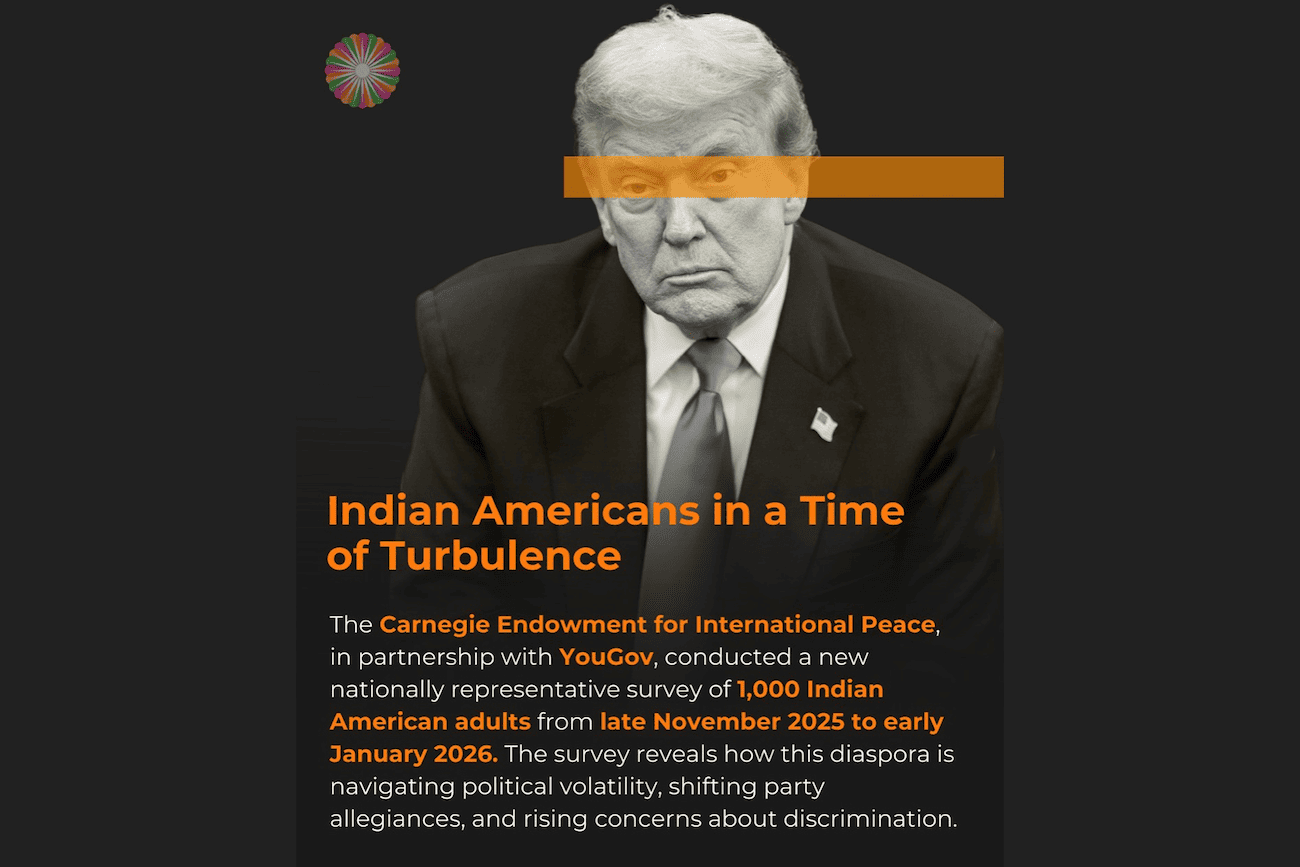
The 2026 Indian American Attitudes Survey, conducted by the Carnegie Endowment for International Peace in partnership with the polling firm YouGov and published on February 19, 2026, found that nearly 40 percent of Indian Americans have at some point thought about emigrating from the United States. The finding, drawn from a nationally representative sample of 1,000 Indian American adults surveyed between November 25, 2025, and January 6, 2026, sits at the center of a portrait the survey’s authors describe as a community in “turbulence” — buffeted by political alienation, rising discrimination, unresolved immigration limbo, and a deepening sense that the country’s national narrative no longer fully includes them.
The Numbers Behind the Restlessness
The survey’s emigration finding breaks down in ways that reveal both the depth and the limits of the disillusionment. According to the findings, 14 percent of respondents said they had frequently thought about leaving the United States, while 26 percent had occasionally considered it. Together, those figures produce the roughly 40 percent.
Yet the survey is careful not to overstate what that number means in practice. As Carnegie’s published report notes, discrimination is reshaping behavior but is not prompting widespread exit. Most respondents do not plan to leave the country, and a majority still recommend the United States for employment, particularly for career prospects. The community is unsettled, the researchers found — but not yet in departure mode.
Among those who have contemplated leaving, the Carnegie survey identified a cluster of converging grievances rather than a single dominant cause. Frustration with the direction of American politics ranked prominently, as did the rising cost of living. The survey noted that “discomfort with the tone of domestic politics and what they perceive as a more exclusionary national narrative” ranked high among the concerns expressed. Immigration policy uncertainty — specifically the grinding, multi-decade wait for permanent residency — emerged as another structural driver of the emigration calculus.
Trump, Tariffs, and the Strained Bilateral Relationship
The survey’s authors — Milan Vaishnav, director of Carnegie’s South Asia Program; Sumitra Badrinathan, an assistant professor of political science at American University; Devesh Kapur, the Starr Foundation Professor of South Asian studies at Johns Hopkins SAIS; and Andy Robaina, a junior fellow at Carnegie — framed the moment starkly in the report’s introduction.
“There are more than 5.2 million people of Indian origin residing in the United States today,” they wrote. “Over the past few decades, much has been written about their elevated socioeconomic status, growing political profile, and engagement in everyday civic and political life. One year into President Donald Trump’s second term, however, Indian Americans are confronting a convergence of cross-pressures that has recast their position in America’s social and political landscape.”
The survey’s headline political finding is unambiguous: 71 percent of Indian Americans disapprove of the way Trump is handling his job as president, with more than half saying they “strongly disapprove.” Only 29 percent approve. As the Carnegie report noted, Indian Americans are substantially more critical of Trump than the general U.S. public, regardless of gender.
The disapproval is not limited to domestic affairs. Some 64 percent of respondents disapprove of Trump’s immigration policy, 68 percent disapprove of his handling of the domestic economy, and 70 percent disapprove of his international economic policy — including his use of tariffs and sanctions. On U.S.-India bilateral relations specifically, only 20 percent of Indian Americans approve of Trump’s approach, while 55 percent disapprove — a figure that marks a sharp deterioration from the 35 percent approval his handling of India received during his first term. The survey authors described Trump’s second-term actions as having thrown U.S.-India relations “into crisis, roiling what was once hailed as the ‘defining partnership of the twenty-first century.’”
Yet the report is equally clear that widespread disapproval of Trump has not translated into a Democratic resurgence. Democratic identification among Indian Americans has slipped from 52 percent in 2020 to 46 percent in 2026. Republican identification has risen modestly, from 15 to 19 percent. The share identifying as independents has climbed to nearly one-third of the community — a striking development for a group long considered a reliably Democratic constituency. On Milan Vaishnav’s Substack, where he published a summary of the findings, the authors described what is happening not as a realignment but as “a recalibration.”
The Discrimination Landscape: Widespread but Not Sharply Worse
The survey’s findings on discrimination reveal a community that is persistently and frequently targeted, even if the raw rate of personal encounters has not dramatically worsened since 2020.
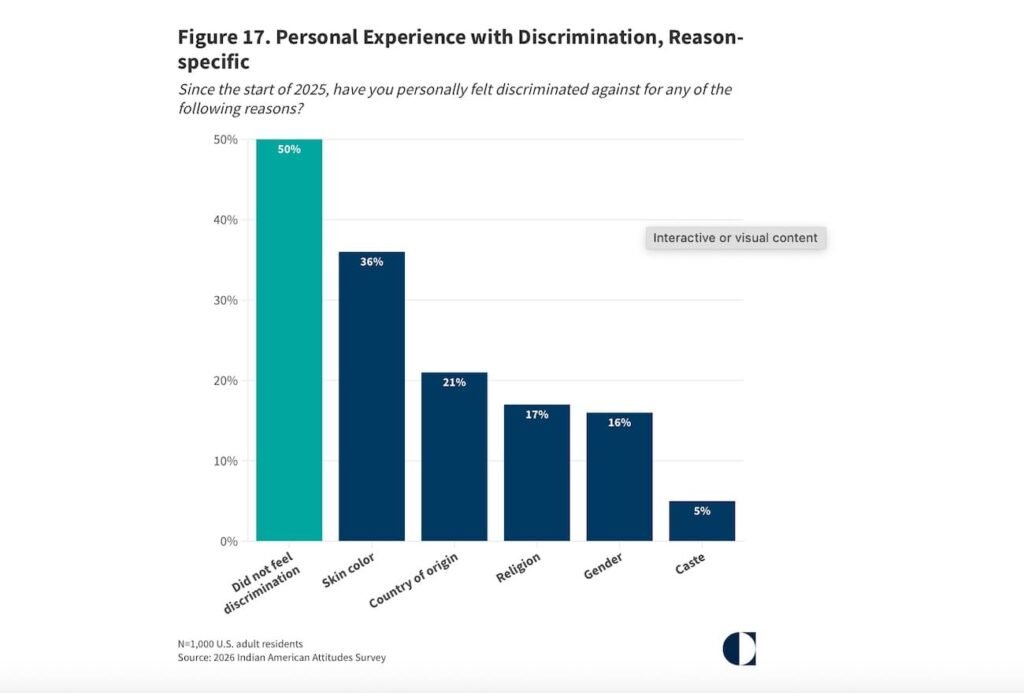
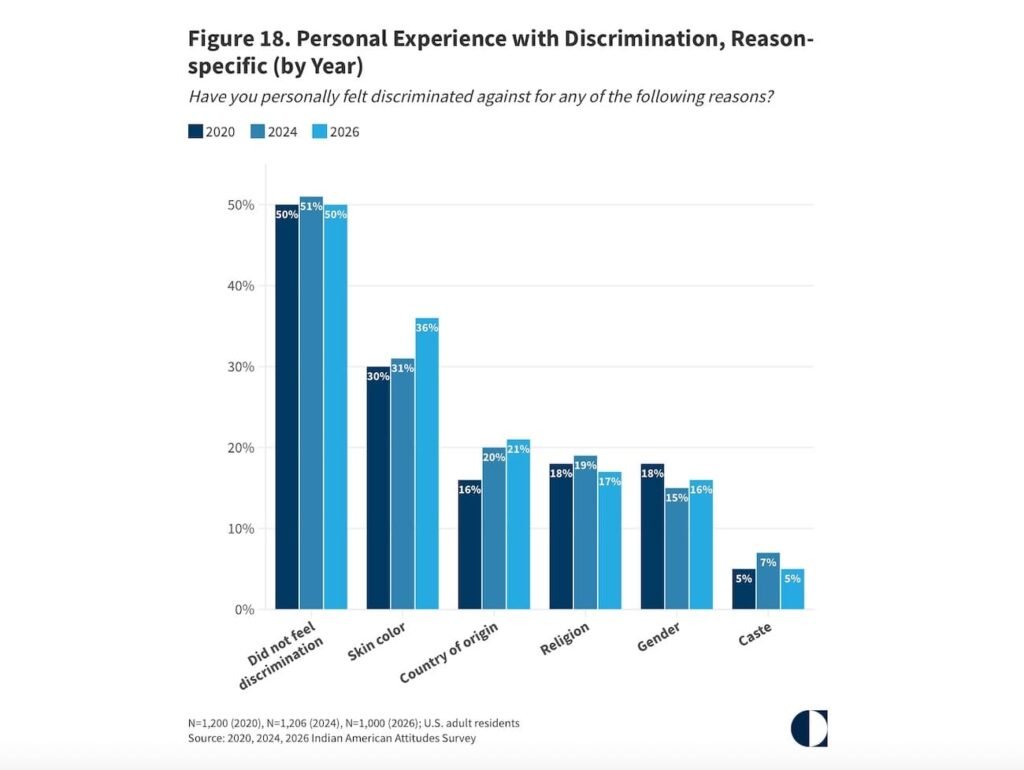
Half of all respondents — 50 percent — reported experiencing some form of personal discrimination since the start of 2025. Among those who reported discrimination, skin color was the most commonly cited basis, named by 36 percent of those affected. Country of origin was cited by 21 percent, and religion by 17 percent. Caste-based discrimination was reported far less frequently, at 5 percent. Discriminatory incidents were most commonly reported in stores or malls (42 percent of those who experienced discrimination) and while applying for jobs (38 percent), followed by cultural or religious settings (31 percent).
One in four Indian Americans reported being called a slur since the start of 2025. Smaller but notable shares reported being physically threatened (9 percent), receiving hate mail (8 percent), experiencing property damage (6 percent), or being physically assaulted (4 percent), according to the Carnegie data.
The online environment has become a particular source of hostility. Nearly half of respondents — 48 percent — said they had seen racist content targeting Indians or Indian Americans on social media very or somewhat often since the start of 2025, the survey found. The emotional responses were sharp: 50 percent said such content made them angry, 33 percent reported feeling anxious, and 31 percent felt fearful.
Crucially, the Carnegie report is explicit that since 2020 there has been no significant change in the share of respondents reporting direct, personal experience with discrimination — meaning the community’s acute sensitivity to the current climate reflects a broader environmental shift rather than a statistical spike in personal victimization.
Behavior Change: The Silent Adjustment
What the discrimination data documents most powerfully is the way hostility has caused Indian Americans to quietly restructure their daily lives — a form of informal self-censorship and social withdrawal that the survey’s authors describe as a behavioral reshaping driven by the threat of discrimination.
What the Carnegie-YouGov survey captures is not a community poised to leave, but one in the midst of a difficult reckoning with a country that has not always lived up to its promises — while still, for the most part, choosing to stay.
Nearly one-third of respondents said they now avoid discussing politics on social media due to fear of harassment. About one-fifth said concerns about discrimination had affected their travel choices, public expression, or civic participation. Others reported avoiding wearing traditional Indian attire in public, staying away from political rallies, and scaling back their engagement in cultural or religious settings.
The Green Card Backlog: Structural Despair
Alongside the political and social dimensions of Indian American unease, the survey points to a structural grievance that predates the Trump administration and shows no sign of resolution: the catastrophic backlog in employment-based green card applications.
The State Department’s Visa Bulletin for May 2026, released on April 15, 2026, showed that the priority date cutoff for the EB-2 category — for skilled workers with advanced degrees — remained stalled at July 15, 2014. For EB-3 other workers, the cutoff date stands at November 15, 2013. That means individuals who applied for permanent residency more than a decade ago are still waiting. According to estimates, wait times in certain green card categories could extend up to 70 years.
The Carnegie survey highlighted green card wait times stretching to 30 to 40 years for many Indian applicants — a figure that captures in human terms the scale of what is effectively a generational injustice built into a per-country cap system that treats India, with its enormous population of skilled workers, identically to smaller nations with far fewer applicants.
For hundreds of thousands of Indian professionals living in the United States on temporary H-1B and related work visas, this backlog means years of legal and financial vulnerability: an inability to change jobs freely, an inability to obtain mortgages or plan long-term, and the constant awareness that a policy shift or an employer decision could unravel lives built over decades.
Politics Through a Pocketbook Lens

For all the complexity of the survey’s findings on discrimination, immigration, and geopolitics, the Carnegie report’s authors are consistent in emphasizing where Indian American political consciousness actually centers: on economic concerns.
Inflation and jobs ranked as the top policy issues for 37 percent and 33 percent of respondents respectively. The authors of the survey point out: “Foreign policy, including U.S.-India relations, remains of secondary concern for most respondents, even as dissatisfaction with Washington’s handling of India has grown. This pattern reinforces a consistent finding of the IAAS: Indian Americans, like most Americans, evaluate politics primarily through the lens of pocketbook concerns rather than diasporic or foreign policy considerations.”
The cost of living in the United States — housing, healthcare, childcare, education — is a real and pressing burden for Indian Americans across income levels, and it interacts with the immigration backlog in uncomfortable ways. Skilled workers waiting decades for a green card cannot easily relocate to lower-cost cities or change careers in response to economic pressures. They are, in a meaningful sense, trapped.
The Community’s Relationship With Both Parties
One of the survey’s more striking conclusions is the symmetry of its political skepticism. Indian Americans are disillusioned with Trump, but they are also cooling toward the Democratic Party that has long claimed their loyalty.
As Vaishnav and his co-authors wrote in their Substack summary, widespread disapproval of Trump’s policies has “not translated into expanded support for Democrats, signaling rising dissatisfaction with both parties.” Democrats rated their own party lower in 2026 than in 2020 — 69 on a thermometer scale compared to 75 six years earlier — while Republicans maintained a higher level of enthusiasm for their party, according to the Carnegie commentary published on the Emissary blog.
The sharpest shift in the survey is among younger Indian American men. Trump’s support in that cohort had risen to around 40 percent in the 2024 election, representing his breakthrough with the community. By early 2026, that support had collapsed to 24 percent — a drop of roughly 16 percentage points in about a year according to the Carnegie data. But as the authors note, Democratic support among this group has not returned to its 2020 peak, and among older voters, lower-income households, and those without college degrees, Democratic support has also softened.
Nearly half of Indian Americans fault the Republican Party for discrimination against their community, and at least one-third view the GOP as intolerant of minorities, suggesting — as the Carnegie Emissary commentary put it — that “there may be a ceiling on GOP growth” within the community.
Still Here, Still Hoping
In the end, what the Carnegie-YouGov survey captures is not a community poised to leave, but one in the midst of a difficult reckoning with a country that has not always lived up to its promises — while still, for the most part, choosing to stay.
The survey’s own summary language is precise on this: “Discrimination is reshaping behavior but not prompting widespread exit from the United States,” the Carnegie report states. A majority still recommend the country for employment, citing strong economic opportunities.
The 40 percent who have thought about emigrating have, by definition, thought about it — and not yet acted. Their frustration with U.S. politics, the cost of living, the grinding backlog in the immigration system, the rise of online hostility, and the discomfort with an increasingly exclusionary political discourse are real and documented. But so is the recognition, held by most of the community, that the United States remains a place where ambitious people from India can build something extraordinary — if the country will let them.
Whether that faith persists through a second term of policies that the survey says Indian Americans view with broad and deep disapproval is, as the survey’s authors conclude, “an open question.”