




Lakshman Rekha: Harvard Faculty Draws a Line Against Ram Katha Event Deeming it ‘Religious Rather Than Academic’ Program

- Several faculty members reportedly questioned whether an academic center should associate itself with a large religious program aimed primarily at an outside audience.
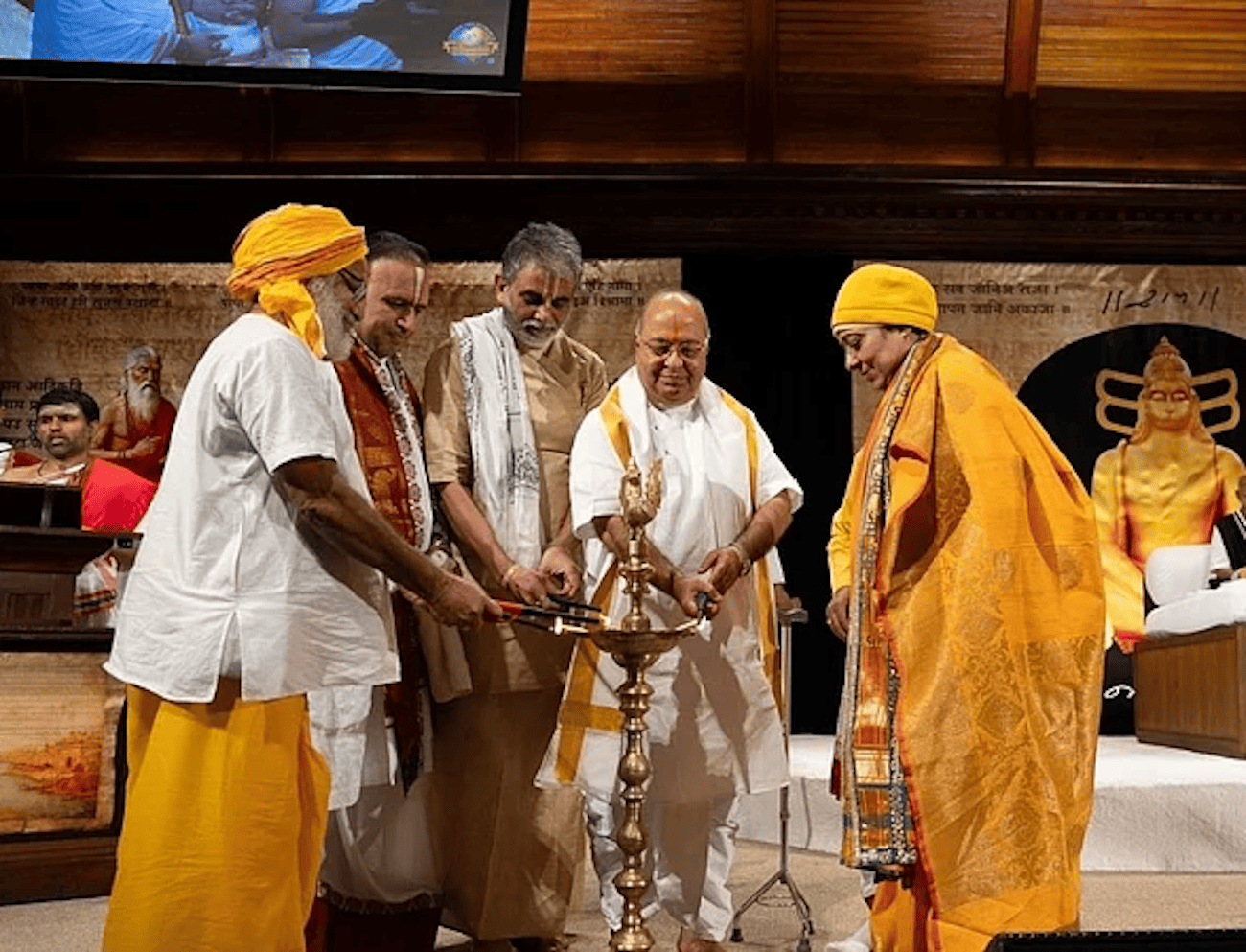

Harvard University’s prestigious South Asia Institute withdrew its formal association with a nine-day Ram Katha (recitation of Hindu sacred texts) held at Sanders Theatre in August 2026 after faculty members objected to the university lending its academic credibility to what they characterized as a primarily devotional religious event aimed at a non-Harvard audience, according to The Harvard Crimson.
The controversy surrounding Morari Bapu’s Ram Katha, which ran from August 15-23 and attracted roughly 1,000 attendees daily, highlights tensions between academic freedom and institutional boundaries, between honoring spiritual traditions and maintaining scholarly neutrality, and between liberal secular scholars and those who view Hindu knowledge systems as legitimate subjects of academic inquiry.
The event demonstrated “how deeply divided academia can be over questions of religion, tradition, and the proper role of universities in facilitating or endorsing particular worldviews,” according to observers quoted in media reports.
The Event and Initial Planning
The nine-day Ram Katha by Indian spiritual leader Morari Bapu was accompanied by a companion academic conference titled “The Living Ramayana” that ran from August 16-18, with more than 50 international scholars from the United States, Europe, India, and Japan examining the Ramayana across different languages and cultural traditions.
The event was funded by TRUDANA, a British charity run by Pavan Popat (son of Conservative House of Lords member Dolar Popat), working with the U.S.-based nonprofit Truth Love and Compassion, according to The Harvard Crimson.
Harvard’s Lakshmi Mittal and Family South Asia Institute, named after a $25 million gift from steel magnate Lakshmi N. Mittal in 2017, initially helped organize the academic conference, assemble the speaker list, publicize the event, and secure Sanders Theatre as the venue, according to The Harvard Crimson.
On June 18, faculty members with involvement in South Asian Studies received an email invitation to the event. The invitation immediately sparked concerns among scholars, according to The Wire.
“The email raised concerns about the use of Harvard and its Mittal South Asia Institute to facilitate what the faculty viewed as a religious rather than academic activity,” according to The Wire. “The timing of the event, scheduled before the start of the fall semester, also raised questions about its intended audience — ‘primarily a non Harvard audience and a non-academic ambition’ a statement by the faculty said.”
Faculty who served on the Institute’s own steering committee were among those expressing reservations. “Faculty argued that the Institute could not be involved in a devotional event aimed at a non-Harvard audience,” according to The Harvard Crimson.
The core objection centered on institutional boundaries. “Several Harvard faculty members questioned whether an academic center should associate itself with a large religious program aimed primarily at an outside audience.”
The dispute “wound its way to Harvard’s top lawyers and its public affairs office,” according to The Harvard Crimson, as the university grappled with how to handle the institutional entanglement with a religious devotional practice.
Harvard’s withdrawal from formal association was significant. “The dispute wound its way to Harvard’s top lawyers and its public affairs office” and ultimately “the university was forced to scrub its name off the event,” according to The Wire.
Organizers maintained that an accompanying three-day academic conference was the centerpiece from the Institute’s perspective. According to The Harvard Crimson, “The Institute, though, was interested in an academic conference.”
“Institute affiliates warned Paavan Popat that the scholars’ perspectives on the Ramayana might not be welcomed by all katha attendees. He said he told them that any scholar engaging in good faith would be welcome, whatever their views,” according to The Harvard Crimson.
The academic program, “The Living Ramayana,” featured distinguished scholars examining the text’s history, aesthetics, and cultural influence across diverse traditions including Tamil, Persian, Thai, and Javanese versions, according to organizers.
The incident demonstrates the divide between faculty members who view the university’s role as maintaining secular, scholarly distance from devotional practices, and those who believe that Hindu knowledge systems and textual traditions deserve serious academic attention.
Supporters Perspective
Supporters of the event emphasized its value as a bridge between spiritual and academic traditions. According to India Weekly, Paavan Popat OBE described the gathering as bringing together “the world’s oldest recital traditions and one of its greatest centres of learning.”
Dolar Popat, the British House of Lords member who funded the event, “connected those values with Harvard’s motto, ‘Veritas,’ saying the shared emphasis on truth made the gathering meaningful,” according to India Weekly.


The event organizers presented the Ram Katha as addressing a legitimate gap in American higher education. “For the Indian spiritual tradition, the Harvard recital represents more than a religious gathering. It places an ancient form of storytelling in conversation with a global academic audience, showing how the stories of Ram, Sita and Lakshmana continue to travel far beyond the places where they originated,” according to India Weekly.
Morari Bapu’s Stature
Morari Bapu is a globally renowned spiritual leader who has conducted more than 960 Ram Kathas at over 900 locations worldwide, according to his official biography. His previous venues have included the Vatican, the United Nations headquarters in New York, and Cambridge University in 2023, according to India Weekly.
At the conclusion of the nine-day event, “I dedicate this whole Ram Katha to Harvard University,” Morari Bapu stated, according to The Wire. This dedication, made after Harvard had distanced itself from the event, underscored the complexity and tension that had characterized the gathering.
In his concluding remarks, Bapu made a significant request: “In his concluding remarks, Bapu made a special request to Harvard University to preserve and house copies of all four Vedas, the Ramcharitmanas and the Valmiki Ramayan, making these foundational Indian texts accessible to students and scholars for generations to come.”
The controversy reflects fundamental questions about the role of universities in engaging with religious and spiritual traditions. The incident demonstrates the divide between faculty members who view the university’s role as maintaining secular, scholarly distance from devotional practices, and those who believe that Hindu knowledge systems and textual traditions deserve serious academic attention.
“The dispute that unfolded over the summer raises questions about how American universities should engage with non-Western spiritual and intellectual traditions,” according to analysis in The Wire.
Whether the university should facilitate events that blend religious devotion with academic scholarship, and whether doing so represents institutional endorsement of particular religious worldviews, remains contested among faculty and administrators.
The Ram Katha at Harvard ultimately proceeded, with nearly 1,000 people attending each day and over 50 scholars participating in academic sessions. But the controversy surrounding Harvard’s institutional involvement highlighted the complexity of navigating the intersection of spiritual practice, academic inquiry, and institutional neutrality in contemporary American higher education.
It is very interesting; your source of the information is WIRE, which is a anti Hindu propoganda machine.
How do you get a fair assessment?
The History which happened more than 9000 years ago is beyond the scope of the imagination of most people in the world.
For Harvard and America in particular, which is a new country, this would be eye-opening for the History staff.
I am a History student and have purchased Books published by Yale professors, and the book shows a horizon of 4000 years
The forces that oppose the Hindu Philosophy are living in the darkness and are not true academicians. They are just obstacle creators.