




The Model Minority Mirror Cracks: Vivek Ramaswamy’s Ohio Flameout is More Than a Political Metaphor

- Indian Americans are entering a new era — one where success no longer shields, wealth no longer flatters, and culture no longer charms by default. Visibility demands responsibility. Power demands humility. Public space demands awareness.
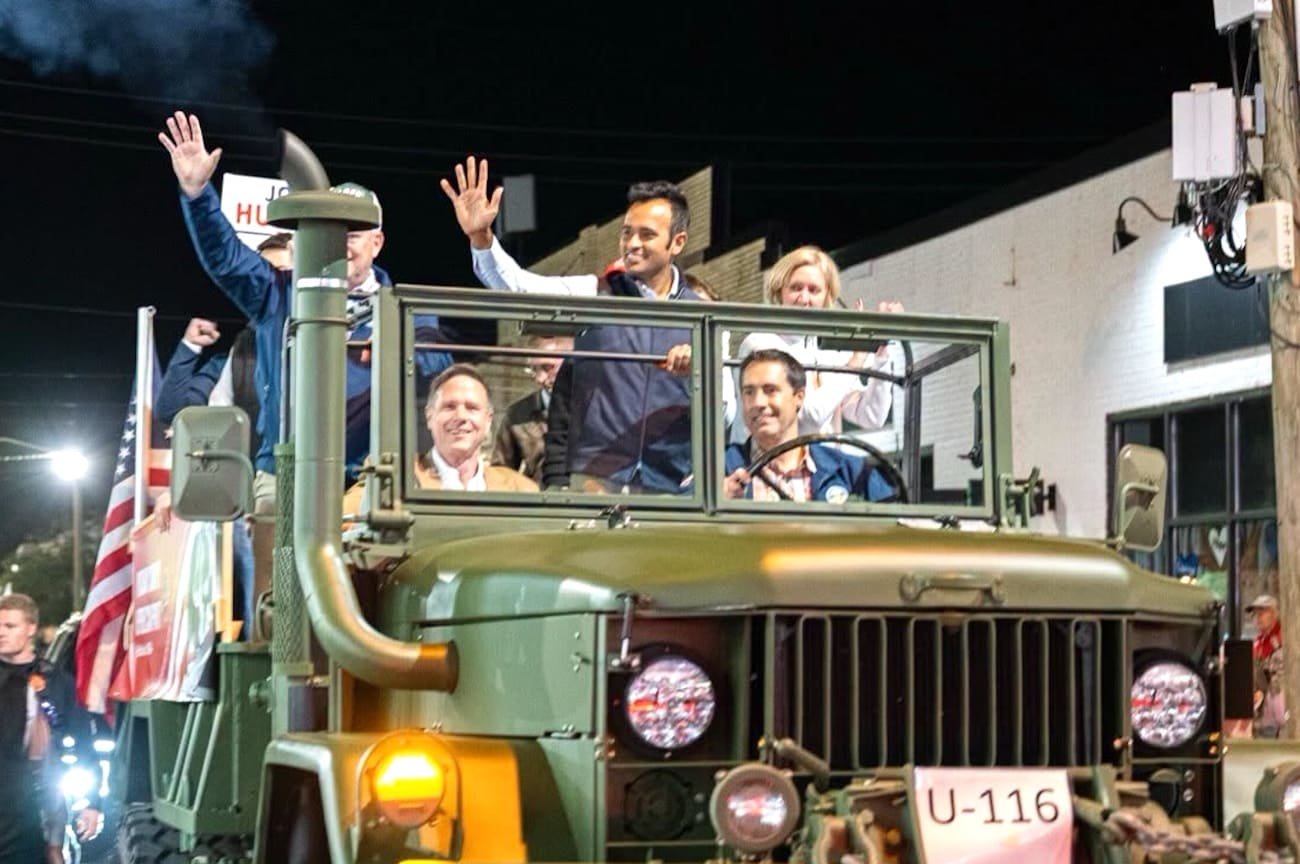
There is something almost Shakespearean about watching Vivek Ramaswamy’s Ohio gubernatorial campaign come apart — it will not be over till it is, of course. Not tragic — he is no Hamlet — but revealing. A man who built his public persona on provocation now finds himself trapped inside the very spectacle he engineered. And in that spectacle, you can see the outlines of a larger story: the Indian American community’s uneasy transition from “model minority” to something far more complicated, far less flattering, and increasingly impossible to ignore.
If Ramaswamy’s Ohio flameout is the political metaphor, the everyday behavior of Indian Americans in the U.S. is the lived reality — a community that has become visible in ways it never anticipated, and resented in ways it refuses to understand. The model minority myth didn’t just crack; it collapsed under the weight of wealth, spectacle, and denial.
According to multiple media sources, Ramaswamy entered the race with Donald Trump’s full-throated endorsement, clearing the GOP field and giving him nearly two years to prepare. But instead of consolidating a broad coalition, he leaned into the same pugilistic instincts that defined his 2024 presidential run — instincts that have now backfired spectacularly. The turning point came with the now-infamous attack ad featuring the estranged mother of his Democratic opponent, Amy Acton, calling her daughter a liar and disputing Acton’s account of childhood sexual abuse. The ad lacked disclosure, circulated anonymously at first, and was later confirmed by Ramaswamy as his own campaign’s work.
The backlash was swift and bipartisan. Acton’s brother called the ad “desperate” and “disgusting.” Ohio’s Republican governor, Mike DeWine, publicly urged Ramaswamy to take it down, calling it “deeply troubling.” Trump, however, encouraged Ramaswamy to keep running it. The result: a race once seen as a GOP lock is now slipping away, with polls showing Ramaswamy trailing Acton.
Ramaswamy’s personal narrative is familiar: son of Indian immigrants, raised in Cincinnati, It is the quintessential model minority arc — the story America loves to tell about Indian Americans because it flatters both sides: the immigrant who “made it,” and the country that supposedly rewards merit without prejudice.
But the model minority myth is brittle. It demands perfection, silence, and gratitude. It leaves no room for political ambition that is messy, polarizing, or morally compromised. And Ramaswamy’s campaign — with its Trumpian bravado, its hard-right immigration rhetoric, its “anti-woke” crusades — has collided head-on with the limits of that myth.
He is no longer the unthreatening overachiever. He is a partisan combatant. And America is responding accordingly. Ramaswamy’s troubles are not just his own. They mirror a broader shift in how Indian Americans are perceived — especially in cities like Dallas, Austin, and Houston, where rapid demographic growth has collided with political visibility.
For decades, Indian Americans were treated as a civic asset: high-achieving, apolitical, quietly successful. But that perception is changing. The community’s growing alignment with Hindutva politics — visible in temple networks, diaspora organizations, and fundraising circuits — has drawn scrutiny. Many Indian Americans loudly champion Narendra Modi abroad while remaining silent about human rights violations in India. They warn of “Hinduphobia” in the U.S. without evidence, even as civil rights groups note that Indian Americans already benefit from broad legal protections.
This contradiction — claiming victimhood while supporting majoritarian politics elsewhere — is beginning to grate on American civic spaces. It is not that Indian Americans are suddenly “a nuisance,” as some whisper; it is that the political behavior of a vocal subset is forcing a reassessment of a community once seen as benign.
The community’s growing alignment with Hindutva politics — visible in temple networks, diaspora organizations, and fundraising circuits — has drawn scrutiny.
Ramaswamy is not alone. Kash Patel, another Indian American figure elevated by Trumpism, has become emblematic of the diaspora’s new political archetype: the loyalist who thrives on grievance, conspiracy, and ideological zeal rather than competence or integrity.
These figures are not representative of all Indian Americans — far from it. But they are highly visible. And visibility shapes perception.
The Wealth Display: Prosperity Turned Performance Art
Indian Americans didn’t just become wealthy — they became performatively wealthy.
You see it everywhere:
- $500,000 weddings with drone fleets, imported horses, and traffic-stopping baraats.
- Temple parking lots that look like luxury car dealerships every festival weekend.
- Lakefront Diwali parties with pyrotechnics that shake entire neighborhoods.
- McMansions with gold-trimmed mandaps erected on front lawns like temporary monuments to excess.
This isn’t celebration. It’s broadcasting.
And in a country where most families are drowning in medical debt and rent hikes, ostentatious wealth reads as contempt — even if that’s not the intent.
The diaspora’s prosperity used to be quiet. Now it’s loud, curated, and Instagrammed.
And Americans notice. Indian Americans have also taken their cultural expression public — not organically, but theatrically.
- Garba nights in strip-mall parking lots that run past noise ordinances.
- Holi color throws that leave public parks stained for days.
- Temple floats on lakes, complete with DJs and drone videographers.
- Bollywood flash mobs at city festivals, blocking pedestrian traffic.
- Weekend-long Navratri events in residential neighborhoods with no regard for local norms.
The diaspora often behaves as if public space is theirs to occupy, reshape, and amplify — and when neighbors complain, the reflex is to cry racism rather than consider context. Yet, when news from India about Muslims offering namaz on streets and getting basked up and forced to move comes across, they shrug and ask “Well! why can’t they pray inside a mosque!”


The News Blindness: The World Burns, But Only When It Burns Them
Perhaps the sharpest contradiction is the diaspora’s relationship to crisis.
When India bulldozes Muslim homes, diaspora WhatsApp groups stay silent.
When journalists are jailed, silence.
When Christians are attacked, silence.
When Dalits are assaulted, silence.
When dissenters disappear, silence.
But when:
- a temple wall in New Jersey is vandalized,
- a school board debates caste discrimination,
- a city council questions Hindutva-linked nonprofits,
the diaspora erupts — petitions, press conferences, claims of “Hinduphobia,” demands for federal intervention.
The pattern is unmistakable: Global injustice is irrelevant until it touches diaspora comfort. Then suddenly, they are victims. This is not oppression. This is selective outrage. This is why Vevek Ramaswamy’s political collapse feels so symbolic. He is not an aberration. He is the diaspora’s most public mirror.
Indian America is entering a new era — one where success no longer shields, wealth no longer flatters, and culture no longer charms by default. Visibility demands responsibility. Power demands humility. Public space demands awareness. Ramaswamy’s unraveling is not just his own doing. It is the diaspora’s reckoning. And the reflection is uncomfortable because it is accurate.
The question now is whether Indian Americans will confront that reflection — or retreat further into denial, spectacle, and grievance.
Kuhu Singh is a writer with interest in social justice, cultural and political matters, in the U.S., India, and beyond. The opinions expressed in this article are my own. Biographical and Constitutional statements have been sourced via Wikipedia and other online sources.