




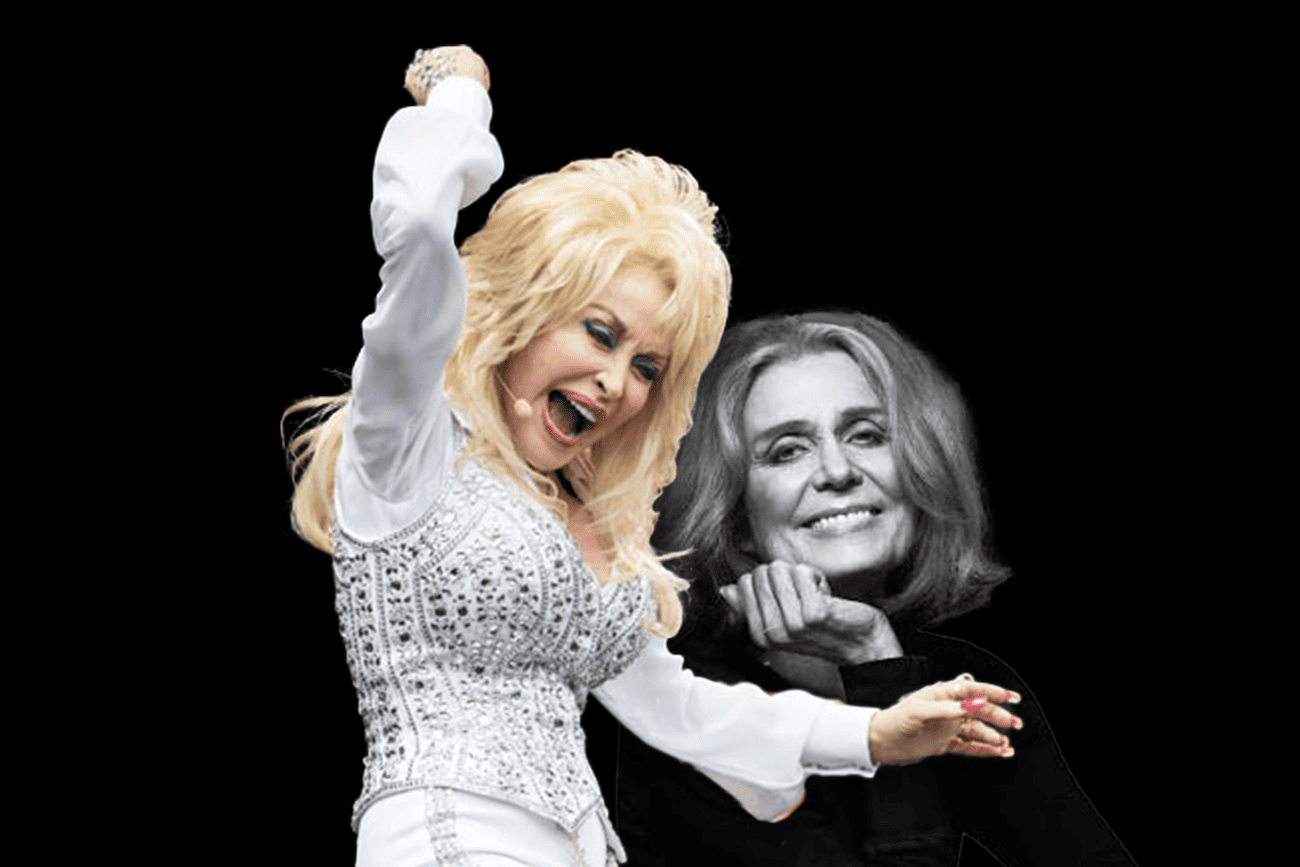
Dolly and Gloria: They Felt Permanent. But Permanence is Not the Same as Staying. It is What They Left Behind in Us

- Both believed in women: in our ability to decide who we are, make our own choices, take care of one another, and shape the world around us.

I feel palpably sad.
I learned Gloria Steinem died today. And Dolly Parton died last week. They were both at ages where death should not have been a surprise. But yet, it is. They had each become so much more than the work they did or the careers they built. They felt permanent.
For many people, these losses may seem unrelated. Dolly Parton and Gloria Steinem occupied very different places in American culture. One gave us rhinestones, country music, quick humor, and a public generosity that seemed almost limitless. The other gave us language for inequality, a model of feminist organizing, and a lifelong refusal to accept injustice simply because it was familiar. But to me, they belonged together. Both believed in women: in our ability to decide who we are, make our own choices, take care of one another, and shape the world around us.
I was born in Texas in the late 1960s, and both names were part of the headlines of my childhood. Gloria Steinem was always in the news in the 1970s. I knew she had come to Houston for the National Women’s Conference. Dolly Parton was everywhere, too — on television, in music, on posters, larger than life in every sense. Growing up in a culture that could be deeply patriarchal and, at times, openly misogynistic, I took keen notice of women like them. Even before I fully understood what they represented, I understood that people had strong feelings about them. They were not women you could ignore.
Dolly intrigued me from the get go. I think I first saw her on “Hee Haw,” a syndicated country-music television show. I remember the jewelry, the big hair, the makeup. She spoke to my Texas roots and my fascination with 70s Bollywood “heroines” — glamorous in a way that felt familiar but also completely her own. At first glance, Dolly could look like a femme fatale, all sparkle and perfectly delivered jokes. But the glamour was never the whole story. She never seemed especially concerned with correcting anyone. She just kept being smart, funny, wildly talented, and generous, and those were her superpowers.
Gloria was different. She was serious, direct, and always seemed to be asking people to look more closely at the world they had accepted. Her name floated around when I was a child, well before I read “If Men Could Menstruate” as a teenager. By then, I had grown up in a community where periods were not openly discussed and certainly not with humor or political analysis. The essay was startling and funny and infuriating all at once. It took something women were expected to endure quietly — the pain, inconvenience, embarrassment, and secrecy of it — and turned the logic of that silence upside down. If men menstruated, Gloria argued, periods would be treated differently. They would be celebrated, accommodated, and talked about as a sign of strength instead of something women should hide or simply endure.
A few years ago, I had the chance to be in a room with Gloria. She was in her eighties, vibrant and inspiring, with stories that made you feel the scale of the life she had lived. Being in her presence, especially with close friends, made me think about what it means to keep showing up for each other.
The essay was spot-on in its critique of how stigma and power shape whose experiences are taken seriously. It also made me think about how often women’s bodies are treated as something other people get to weigh in on or make decisions about. For most of my life, reproductive choice was the law of the land. I never even questioned it, or imagined a world in which that would not be the case. Women (and a few good men) had fought hard for the right to make decisions about our own bodies and our own lives. I am still in disbelief that it has all been taken away.
That is part of what makes Gloria’s death feel especially sad. She had spent a lifetime helping people see that rights we think of as permanent are only as secure as our willingness to protect them. Gloria spent meaningful time in India and often spoke about how it shaped her understanding of movement-building: people gathering, listening to one another, recognizing their shared power, and creating change from the ground up. She knew women were already powerful, even when the world was organized to deny or diminish that power.
A few years ago, I had the chance to be in a room with Gloria. She was in her eighties, vibrant and inspiring, with stories that made you feel the scale of the life she had lived. Being in her presence, especially with close friends, made me think about what it means to keep showing up for each other.

That is what I think about when I think about philanthropy and community, too. Not charitable (I take issue with that word) giving, but materially changing the conditions that make people struggle in the first place. Making it possible for families and communities to live with dignity, safety, and room to grow. Dolly understood that in the way she chose to use her influence and resources. Her Imagination Library has provided books to young children and families through local partnerships, investing in literacy and possibility from the earliest years.
I do not know what I believe about the afterlife. I do not know whether there is somewhere we go, whether we return in another form, or whether we become part of something beyond our understanding. I only know that Gloria Steinem and Dolly Parton left a tremendous mark on this life. I feel lucky to have lived in a world with them in it. They felt permanent. Maybe that is why their absence feels so hard to fathom. But permanence is not the same as staying. Sometimes it is what people leave behind in us — a different way of seeing the world or giving us words we couldn’t find.
And now, without them, I find myself thinking about what remains. What they gave us is not gone: the humor, the anger, the courage, the insistence on dignity, and the belief that people can build something better together. Maybe the best way to honor them is to keep showing up for one another and to keep trying to make a more just and generous world.
Swati Narayan was born in Houston, Texas to immigrant Indian parents. Her childhood experiences informed her views on justice and the right for all to have access to quality education and life opportunities. She attended public schools, and then the University of Texas and University of Houston. She has worked in the nonprofit sector both in India and in her home city of Houston focusing her efforts on underserved women, children, and underrepresented communities and is currently a nonprofit director in southeast Texas. Swati serves on the Board of Directors for Planned Parenthood Gulf Coast, Planned Parenthood Texas Votes, and on the Advisory Board of University of Houston’s Friends of Women’s Gender and Sexuality Studies and is an active volunteer in gun violence prevention efforts.Her activism is inspired by the strength of the human spirit. She looks forward to a day where people and organizations thrive by embracing and valuing differences in order to foster belonging. Swati is the mother of three sons and resides with her husband and their rescue dog, Aspen.