




Science, Memory and Finding Your Voice: Three Conversations at The South Asian Literature and Art Festival 2026

- Perspectives of Nobel Prize laureate Dr. Venki Ramakrishnan, mathematician and novelist Manil Suri, and journalist, columnist, and author Shobhaa De.
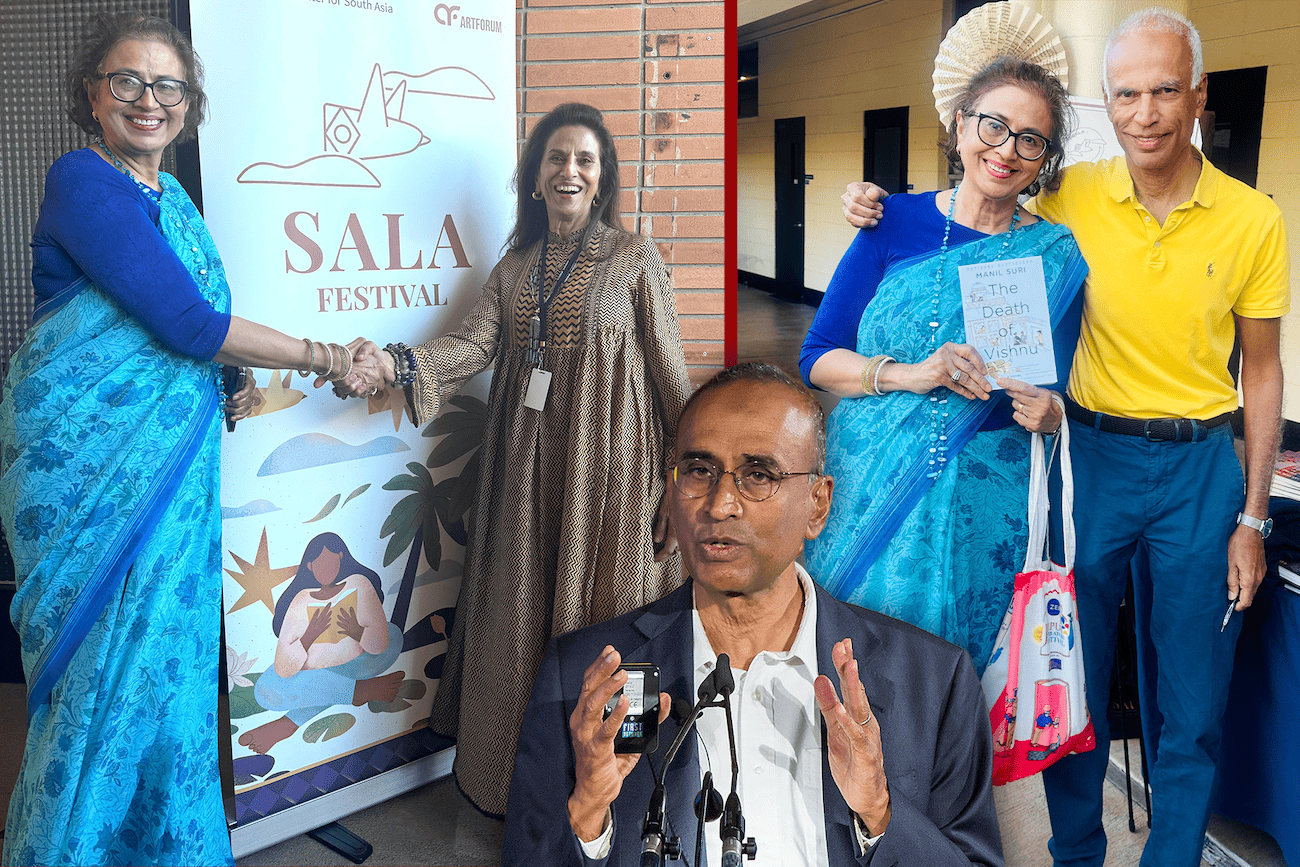

The South Asian Literature and Art (SALA) Festival 2026 opened on September 26 at Menlo College in Atherton, California. This year’s theme is “The Global Gaze, The South Asian Soul.” Day 1 brought together voices from science, literature, mathematics, art, and journalism. I want to showcase the conversations with Nobel Prize laureate Dr. Venki Ramakrishnan, mathematician and novelist Manil Suri, and journalist, columnist, and author Shobhaa De.
Their disciplines are radically different, but their conversations touched on several universal questions: How do we make the most of a finite life? Where do our creative impulses come from? How does childhood shape the adult voice? And what does it mean to remain authentic?
Dr. Venki Ramakrishnan: The Science of Mortality
Dr. Venki Ramakrishnan brought a Nobel-level perspective with a gripping lecture on the science of death, aging, and mortality.
As a Nobel Prize laureate in Chemistry for his work on the structure and function of the ribosome, he made complex scientific ideas understandable to a lay audience. His core message challenged the current enthusiasm surrounding biohacking, cryopreservation of human brains, peptide treatments, and other promises of extending youth. Rather than approaching mortality through commercial hype, he encouraged the audience to understand aging through the lens of molecular biology. He discussed senescence and the shortening of telomeres, the prevalence of “skinny fat” among Indians and obesity in African Americans in the United States, and the relationship to stress.
An audience question sparked an important debate on lifespan and healthspan. The goal, he suggested, should not simply be to increase the number of years we live. What matters is the quality of those years. A longer life accompanied by frailty and cognitive decline is not necessarily the outcome we should be pursuing.
He also talked about the prime of life and creativity, particularly the period between ages 20 and 30. He cited examples such as Tolstoy writing War and Peace and the extraordinary creative output of Schubert, Mozart, Stravinsky, and other greats.
In a world increasingly obsessed with quantified health, Dr. Ramakrishnan offered surprisingly simple advice. Rather than relying on the data churned out of Oura rings and other devices, he recommended three timeless principles: Eat in moderation. Get good, restful sleep. Exercise in moderation. The idea that “what does not kill you makes you stronger” became part of a broader reflection on resilience and the value of living with purpose.
He used that the value of life lies in the pursuit of our ideals, even though our physical efforts eventually disintegrate.
Manil Suri: Mathematics, Memory and the Urgency to Write
Manil Suri is a rare talent who bridges higher mathematics and literature. A distinguished professor of mathematics at the University of Maryland, Baltimore County, he is also the acclaimed author of The Death of Vishnu, The Age of Shiva, and The City of Devi, as well as the memoir A Room in Bombay. He has also explored the relationship between mathematics and the universe in The Big Bang of Numbers.
Suri spoke about his desire to be surrounded by writers and poets. Although mathematics was his professional discipline, he felt that he was missing a dimension and wanted the companionship of the humanities.
He returned to a childhood habit of writing and initially committed himself to completing one story each year. “I got lucky and got published,” he said. When asked about the word “luck,” he explained that luck is about being in the right place at the right time.
Despite Suri’s modesty, his literary success is the product of discipline. Suri’s writing is deeply rooted in his childhood memories of Mumbai. He wrote regularly to his mother, who saved 2,711 of his letters. “One autumn, I just read all those old letters,” he recalled. “I picked up pieces of dialogue and memories hidden somewhere. They just need a trigger to come rushing back.”
Those letters became an unexpected archive of memory. His relationship with his mother and his experiences growing up in Mumbai formed the foundation of A Room in Bombay.
As someone who also grew up in Mumbai’s apartment complexes, I found his reflections deeply resonant. Many of us who grew up in those spaces will recognize the shared experiences, the proximity of neighbors, the sounds, the conversations, the sense of living among an interwoven tapestry of people’s lives.
When he signed my copy of The Death of Vishnu, it felt like a beautiful connection to those Mumbai roots.
We also discussed the urgency of writing what is clamoring to be written. That urgency is something many creative people understand: the feeling that an idea has become so insistent that it must find its way onto the page.
Suri has developed a disciplined routine around this impulse. He writes a sentence at night before going to bed and expands on it in the morning. He has also said that he can write before breakfast. Even one line. He has told his mind, “Today you will be writing.”
He believes the original thought is often the best. Language can be polished later.
His editing process is equally disciplined. For his memoir, he cut approximately 50 percent of a 140,000-word draft to find the story’s core.
He has become more adept at what he calls “self-editing.”
“When you are starting out, you tend to be self-indulgent,” he says. “You have to ask yourself: what is it that is driving the narrative forward?”
Shobhaa De: Finding the Courage to Use Your Voice
Shobhaa De stands as a pioneering Indian columnist, former supermodel, and bestselling novelist, often dubbed “India’s Jackie Collins.” In the 1970s and 1980s, she co-founded and edited legendary pop-culture magazines such as Stardust. Her novels, including Socialite Evenings and Starry Nights, boldly exposed both the glamorous and darker sides of urban India and Bollywood. Her voice has always been her defining characteristic: sharp, provocative, and unapologetic.
Her lecture on her latest book, The Sensual Self, moderated by Dr. Anjal Arondekari, had the audience in stitches. But beneath the humor, in an interview with me, was a thoughtful reflection on childhood, independence, family responsibility, gender, and the courage to take risks.


De’s fierce independence was forged early. As the youngest child in her family, she had greater freedom of self-expression than her older siblings. Yet she also felt intensely duty-bound to her parents. That tension between freedom and responsibility influenced the choices she made.
“Looking back, I could have taken many more chances,” she reflected. “But in a way, I was inhibited by not upsetting my parents more than they were already upset.
Her message to younger people is therefore deeply personal: “Just be reckless. Don’t play it safe. No safe bets.”
She remembered herself at five years old as “quite adorable,” but also “pampered, entitled, and a bit too obedient,” and wondered what she would tell that little girl today. “Enjoy being five years old, ” Shobhaa said, imagining herself.
Shobhaa said she did not have one “mentor” but the many people she admired in college and during her early journalism career, those who gave her “fantastic” breaks.
My friends and I grew up curled up on sofas reading her scandalous Stardust columns.
My father appreciated her tongue-in-cheek outspoken spirit. During our conversation, De revealed a magnetic aura that naturally encouraged people to open up to her.
We spoke about the troubling tendency among women in the West to muffle their own voices and shrink themselves to fit into a man’s world.
De rejected that premise.
“There is no such thing as a man’s world. Don’t give it importance.”
She also spoke about ageism and the ways societies can impose limitations on women. Her message was that women must learn to rely on their own resources and continue to seek inspiration within themselves. Do not give up on yourself. Accept genuine care with grace but do not allow society to put you in a cage. On gender and identity, De made another characteristically memorable declaration. “I want to be reborn as a woman in the next seven lives.”
The three conversations explore different aspects of life: its limits, the power of memory, and the courage to express oneself. Together, they suggest that creativity grows from curiosity, personal history, and self-expression, connecting the global perspective with the South Asian experience.
With roots in Georgia and the Bay Area, and her heart still tethered to a childhood mango tree in Mumbai, India, Monita Soni approaches writing as a contemplative practice. A path to honor humanity. She has published hundreds of movie reviews, book critiques, poems, and essays, and contributed to combined literary works. Her two books are “My Light Reflections” and “Flow Through My Heart.” You can hear her commentaries on Sundial Writers Corner, WLRH 89.3 FM.