




Insurgent Academic: How Indian American Dartmouth Scholar Roopika Risam Made President Obama’s 2026 Summer Reading List

- A digital humanities professor whose career has moved from postcolonial literary theory to a sweeping 11,000-year history of data and power has produced what critics are calling the essential book for understanding the AI age — and Barack Obama noticed.
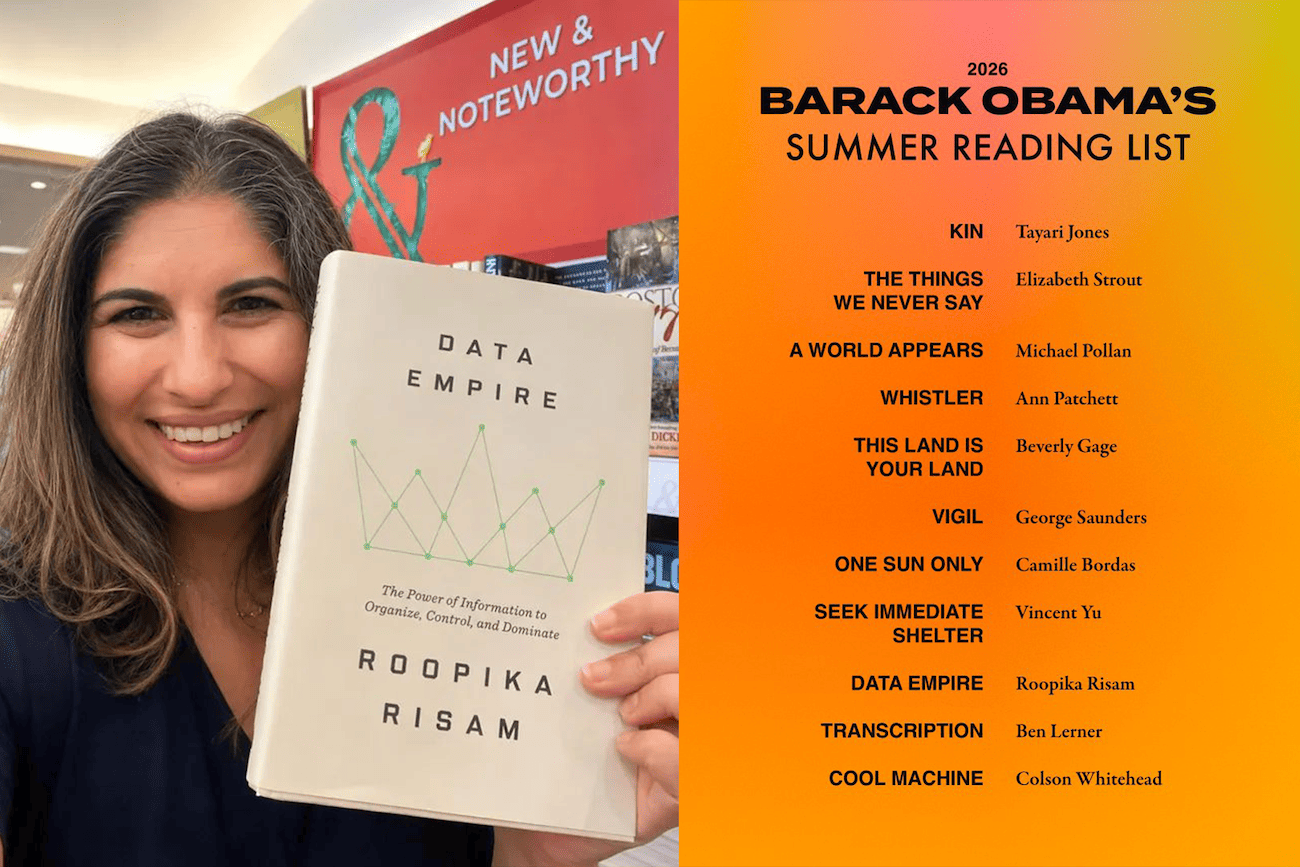

On Wednesday, July 29, former President Barack Obama did what he has done almost every summer since taking office in 2009: he posted his seasonal reading list on social media. “It’s that time of year again: here are some of the books I’ve enjoyed this summer,” he wrote on X.
Obama established the summer reading list tradition in his first year as president. He himself acknowledged the origin: “While we were still in the White House, I began sharing my summer favorites — and now, it’s become a little tradition that I look forward to sharing with you all,” he wrote in an earlier social media post. Neither Donald Trump nor Joe Biden opted to continue the tradition, making Obama’s list a singular cultural institution, according to the Washington Post.
The 2026 list — which Book Riot described as continuing to “celebrate some under-the-radar reads” alongside big literary names including Colson Whitehead, George Saunders, and Ann Patchett — included eleven books spanning fiction and nonfiction. Among the eleven was one that stood apart in its historical sweep and intellectual ambition: “Data Empire: The Power of Information to Organize, Control, and Dominate,” by Roopika Risam, described in Obama’s list as “a groundbreaking new lens on human history arguing that information has always been the seed of power.”
For Risam — an Indian American scholar known primarily within academic digital humanities circles — the inclusion was both a validation and an introduction to an entirely new readership.
The Scholar: Penn, Georgetown, Emory, and Dartmouth
Roopika Risam is a professor of Digital Humanities and Social Engagement at Dartmouth College, where she holds appointments in the Film and Media Studies Department and the Comparative Literature Program, and serves as Chair of Film and Media Studies and Director of Graduate Studies in Comparative Literature.
Her educational path is among the most distinguished in her field. She earned her Bachelor of Arts in Creative Writing and South Asian Studies from the University of Pennsylvania in 2003, her Master of Arts with distinction from Georgetown University in 2007, and her Ph.D. in English from Emory University in 2013. The double major at Penn — creative writing combined with South Asian studies — captures an intellectual sensibility that has defined her career: the literary and the postcolonial, the aesthetic and the political, in permanent conversation.
After completing her doctorate, she joined the faculty of Salem State University as assistant professor of English in 2013. Over nine years she became a tenured professor, department chair, and program director in both the English and Secondary and Higher Education Departments.
In 2022, she joined Dartmouth College. Her research portfolio there is substantial. Her work has been supported by more than $4.3 million in grants from the National Endowment for the Humanities, the Andrew W. Mellon Foundation, the Institute for Museum and Library Services, Mass Humanities, and the Massachusetts Department of Higher Education. She is past president of the Association for Computers and the Humanities — the primary U.S. scholarly organization for digital research in the humanities — and co-editor of the Text Technologies series at Stanford University Press with Elaine Treharne and Ruth Ahnert.
Among her recognitions: the Massachusetts Library Association Civil Liberties Champion Award in 2018 for her work promoting equity and justice in the digital cultural record, and the 2023 International Association for Research in Service Learning and Community Engagement Diversity, Equity, and Inclusion Award for her work on anti-racist community engagement.
Data Empire: From Cave Markings to the Algorithmic State
“Data Empire: The Power of Information to Organize, Control, and Dominate” was published by HarperCollins. Its central argument is both historically sweeping and immediately contemporary. As the London Review Bookshop’s description documented: “Long before writing existed, at the dawn of civilization in Mesopotamia, rulers pressed marks into clay to keep track of land, people and grain. To rule, they had to keep count. It is no accident, then, that the first written name in human history was neither a god nor a king, but an accountant.”
As the BookBrowse summary documented, Risam argues that what historians identify as the engines of human history — guns, germs, steel, religion, agriculture — share a common foundation: “Every human approach to power and domination has involved collecting data — from tracking where and how long animals live to sharpen the hunt, to classifying our fellow humans by sex, race and religion to stratify, isolate, and subjugate them.” Recording and mastering data, she argues, has always been the foundation of rule — and we are living through the latest iteration of that process now.
Jer Thorp, author of “Living in Data,” wrote: “Roopika Risam has let data’s story unfurl over centuries and across continents. The result is something profound, a chance to see how our current moment of LLMs and data brokers and ubiquitous surveillance sits in the bigger story of human history. This is an essential book.”
The book traces that history from ancient cave markings and knotted strings through European colonial expansion — which used censuses, maps, and ledgers to control more than 80 percent of the world’s surface and determine “who belonged, who owed, and who could be sacrificed,” as the London Review Bookshop documented — through the emergence of cybernetics, and on to the algorithmic state and the private data brokers of the present.
“Data isn’t a byproduct of modern technology,” Risam explained in her five key insights for the Next Big Idea Club. “It’s one of humanity’s oldest tools for governing ourselves. Every system we build reflects choices about who is seen, who is ignored, and who holds power.”
The critical reception has been exceptional. Publishers Weekly awarded it a starred review, calling it “a brilliant history” that “elegantly weaves scholarly research with trenchant political analysis” and “a must-read for those seeking to understand the deep history of the AI boom,” as documented by Amazon. New Scientist named it among the best new popular science books of July 2026. NPR named it an “easy must-read.” It was also selected as a Next Big Idea Club pick and a Nautilus best book of the month.
Frank Pasquale, author of “The Black Box Society,” offered a precise scholarly assessment: “Roopika Risam’s Data Empire offers fascinating new perspectives on data’s role in classifying persons, controlling resources, and hardening hierarchies. Her captivating longue duree history — from King Sargon to cybernetics — puts record-keeping at center stage, arguing that data is not merely the residue of events, but one of its main drivers.”
Jer Thorp, author of “Living in Data,” wrote: “Roopika Risam has let data’s story unfurl over centuries and across continents. The result is something profound, a chance to see how our current moment of LLMs and data brokers and ubiquitous surveillance sits in the bigger story of human history. This is an essential book.”
Jonathan Kennedy, author of “Pathogenesis,” called it “a powerful and thought-provoking deep history of data and power, essential reading for understanding the opportunities and dangers of the technological revolution now transforming our world.” One reviewer at McNally Robinson placed it in comparison to Daniel Yergin’s “The Prize” — the definitive history of oil — saying: “If data is the new oil, then Roopika Risam’s Data Empire can stand next to Yergin’s epic as a fascinating tale of how data slowly became the most consequential commodity in our world.”

The Work Before the Book
“Data Empire” is not Risam’s first significant publication — it is the culmination of a scholarly trajectory that began with questions about who gets to participate in the production of digital knowledge.
Her first book, “New Digital Worlds: Postcolonial Digital Humanities in Theory, Praxis, and Pedagogy,” was published by Northwestern University Press in 2019. The book has been taught in more than 150 universities worldwide and is a fixture on digital humanities syllabi. Its central argument — that digital humanities’ celebrated commitment to democratizing knowledge conceals significant omissions with respect to race, gender, sexuality, disability, and nation — was a provocation at the time of publication that has since become something closer to consensus in the field.
She has co-edited four collections: “Intersectionality in Digital Humanities” with Barbara Bordalejo, published by ARC Humanities Press in 2019; “South Asian Digital Humanities” with Rahul K. Gairola, published by Routledge in 2020; “The Digital Black Atlantic” with Kelly Baker Josephs, published by the University of Minnesota Press in 2021; and “Anti-Racist Community Engagement” in 2023.
Her second scholarly book, “Insurgent Academics: A Radical Account of Public Humanities,” is in progress for Johns Hopkins University Press, tracing a new history of university-community engagement through the unsung work of Black, Brown, and Indigenous scholars.
Among her digital projects, “Torn Apart/Separados” — a data visualization that mapped the U.S. government’s family separation policy at the Southern border — has been among her most publicly visible contributions, demonstrating what digital humanities tools could accomplish in real-time public advocacy.
The Obama Effect
For a book published by a major commercial house — HarperCollins — an Obama summer reading list inclusion means a sustained spike in sales, blanket media coverage, and introduction to audiences who would never encounter the book through academic channels. The Washington Post documented in 2024 that Obama’s endorsement boosts a book’s profile roughly as much as winning a National Book Award.
“Data Empire” was already performing well before the list. It had earned starred reviews, been named an NPR best book of the month, a New Scientist best science book of July, and a Next Big Idea Club selection. Obama’s description of it — “a groundbreaking new lens on human history arguing that information has always been the seed of power” — placed it in the company of works that use a single analytical lens to reread all of human history: Jared Diamond’s “Guns, Germs, and Steel,” Yuval Noah Harari’s “Sapiens.”
That is an unusual position for a book by a digital humanities professor from Dartmouth whose previous work was published by Northwestern University Press and assigned in graduate seminars. It is also, on reflection, exactly where it belongs. Roopika Risam has spent more than two decades arguing that the questions of who is counted, who is classified, who is seen, and who is erased by the systems through which we organize knowledge are not merely academic questions. They are the questions through which power has always operated — from the clay tablets of ancient Mesopotamia to the surveillance platforms of Silicon Valley.